
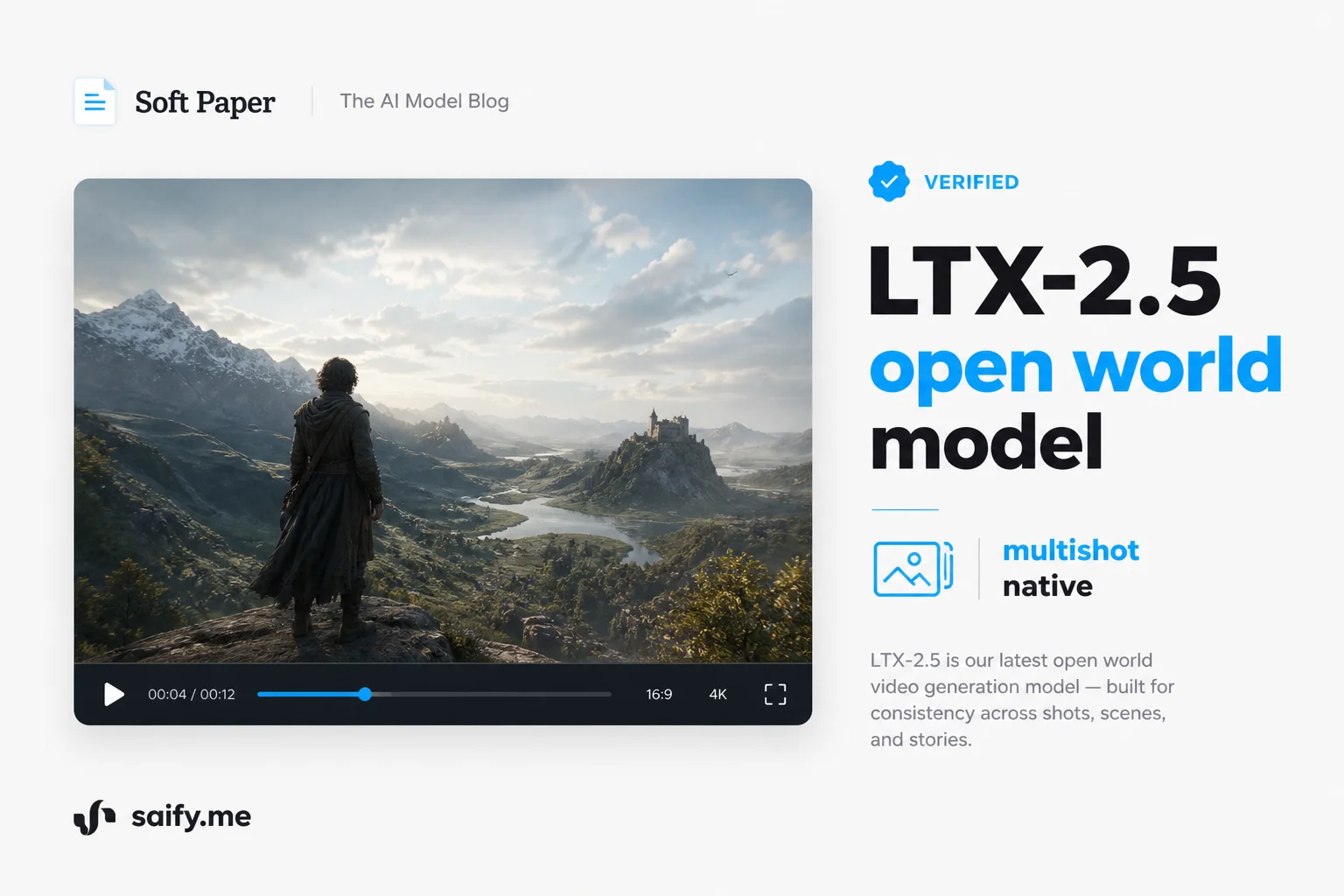
Open video weights are having a week. While closed labs race on latency leaderboards, Lightricks dropped LTX-2.5 as an open world model with day-one ComfyUI nodes and a rebuilt generation pipeline.
The headline from LTX: better prompt understanding, sharper visuals, native multishot, and support for real-time avatars plus physical AI workflows. If you build video products, avatar pipelines, or robotics simulators, this is the kind of release you actually download instead of bookmark.
What changed in LTX-2.5
LTX says it rebuilt nearly every stage of the generation pipeline instead of bolting features onto an older core. That matters because video models usually fail in boring ways: drift between shots, mushy motion, and prompts that work for frame one then fall apart by frame thirty.
| Capability | Builder impact |
|---|---|
| Native multishot | Storyboards and ad variants without stitching single clips by hand |
| Sharper visuals | Less post-upscale cleanup in production pipelines |
| Better prompt adherence | Fewer reshoots when client briefs are specific |
| ComfyUI day one | Node-based workflows without waiting for community ports |
| Open weights | Self-host, fine-tune, and audit instead of black-box API only |
LTX positions the model across three lanes on the same site: LTX Model (open source), LTX Model API (hosted generation), and LTX Studio (creative production UI). Same weights, different packaging.
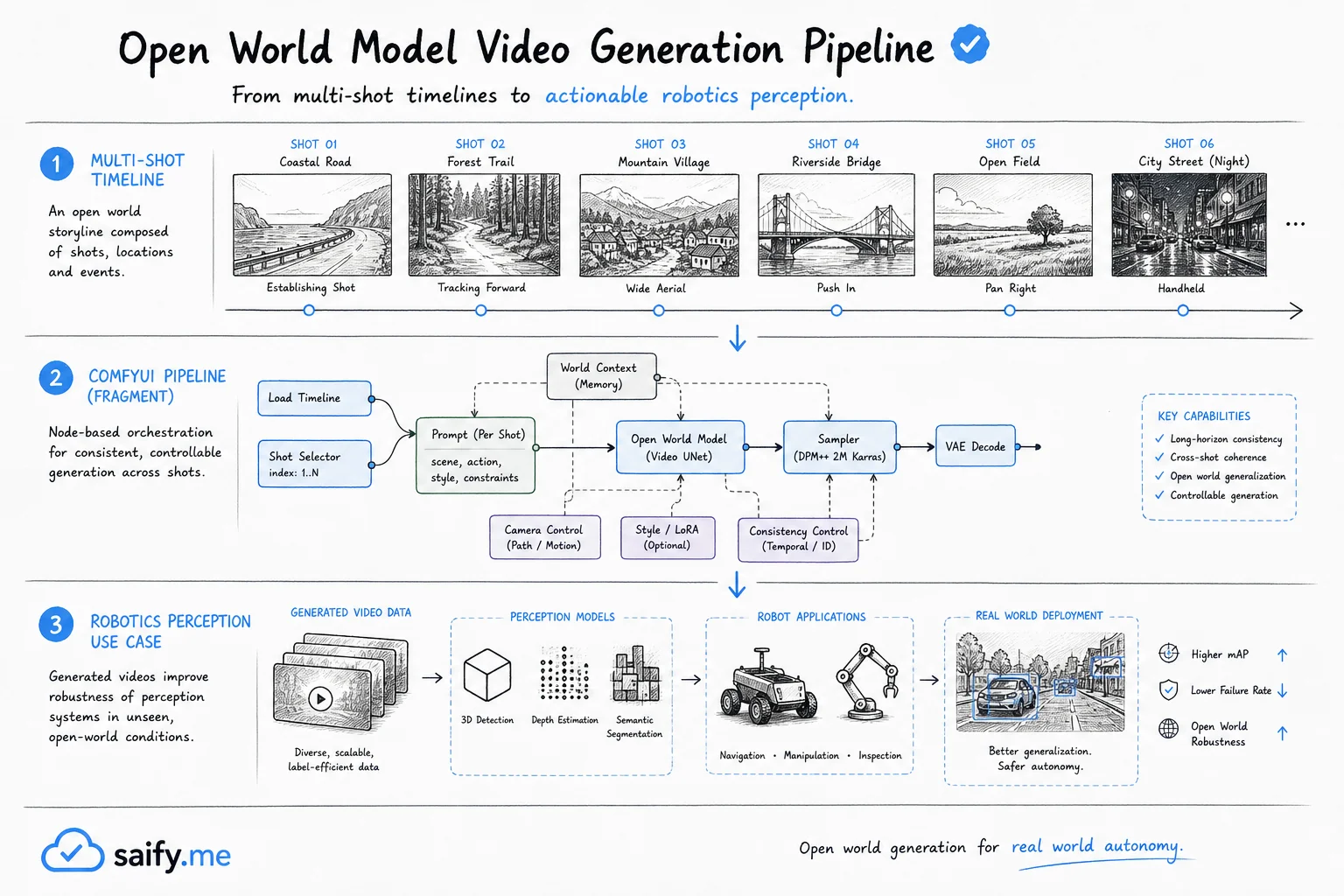
World models beyond social clips
The "world model" label is not marketing fluff here. LTX cites robotics partners like Markov Robotics using LTX to help physical systems perceive and move through environments, tackling generalization problems that break sim-to-real handoffs.
That is a different buyer than TikTok editors:
- Creative studios want multishot consistency and ComfyUI control.
- Avatar products want real-time generation with stable identity.
- Robotics teams want synthetic data and scene dynamics that transfer.
If you only need a one-off marketing clip, a hosted API might be enough. If you need repeatable pipelines with custom nodes and weight access, open LTX-2.5 is the interesting lane.
How LTX-2.5 fits the open video stack
The Rundown compared LTX-2.5 favorably to Gemini Omni Flash on internal speed and quality tests. I have not rerun those benchmarks on my own hardware. Treat vendor numbers as directional.
What I can compare from public positioning:
| Model line | Open weights | Sweet spot |
|---|---|---|
| LTX-2.5 | Yes | World model video, multishot, ComfyUI, robotics |
| Alibaba Wan3 | Yes (recent coverage) | Document-to-video workflows |
| ByteDance Bernini | Open source editing angle | Video editing, not full world sim |
| Closed APIs (Gemini, Runway, etc.) | No | Fastest time-to-demo, least control |
For teams already running ComfyUI for stills, LTX-2.5 is the lowest-friction path to motion without standing up a second proprietary stack.
Practical integration checklist
If you are evaluating LTX-2.5 this week:
- Pull weights from ltx.io/model/ltx-2-5 and read docs.ltx.video.
- Import the ComfyUI nodes and run one multishot prompt with locked seed behavior.
- Measure VRAM, seconds per second of video, and failure modes on your target GPU tier.
- If you need hosted inference, price the LTX Model API against self-host break-even.
- For robotics or sim data, test whether scene continuity survives your domain shift before betting a data flywheel on it.
Video is still the most expensive generative modality in production. Open weights do not make GPUs free. They make iteration cheaper because you control the graph.
Risks and limitations
- Quality variance by prompt class. World models can look great on cinematic prompts and fail on UI screen recordings or dense text.
- Ops overhead. Self-hosting beats API cost only above a usage threshold you should model upfront.
- License and commercial terms. Read the open-source license before shipping customer-facing products.
- Safety and provenance. Open video weights raise the same misuse questions as open image models. Plan detection and policy if you run a platform.
Bottom line
LTX-2.5 is not "another text-to-video toy." It is an open world model aimed at multishot creative work, real-time avatars, and physical AI perception, with ComfyUI support on day one.
For applied AI builders, the interesting bet is composability: same weights in Studio, API, or your own graph. That is the pattern open stacks keep winning on, even when closed models lead single-shot demos.
Building a video or avatar pipeline and want a second opinion on self-host vs API economics? Book a free discovery call.