
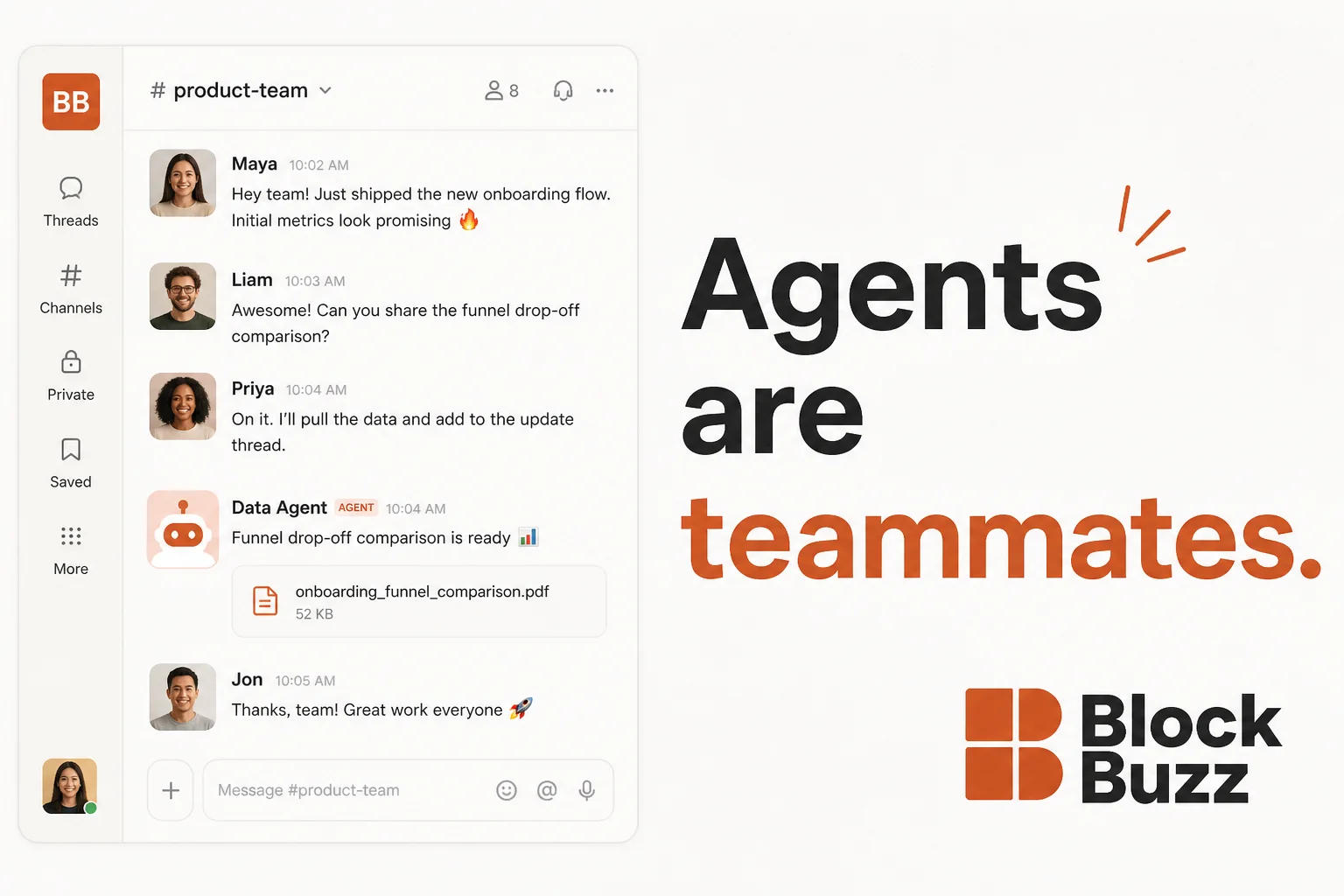
Jack Dorsey's Block shipped something unusual in July 2026: Buzz, a free, Apache 2.0 workspace where your team and your agents share the same channels, repos, and audit trail. Not a Slack bot bolted on the side. Agents get identities, permissions, and mention queues like everyone else.
I deploy voice and ops agents for clients who are allergic to "send all our data to another SaaS." Buzz is the first team chat story in a while that treats agents as members instead of decorations.
What Buzz actually is
github.com/block/buzz describes Buzz as a Rust monorepo built on the Nostr protocol (NIP-01 wire format). Every action (messages, reactions, workflow steps, canvas updates, huddle events) is a cryptographically signed event with a kind integer.
Shipped surface area includes:
| Capability | Notes |
|---|---|
| Channels, threads, DMs | Slack-familiar UX |
| Voice huddles | Real-time audio rooms |
| Git hosting | Patches and repo events as Nostr kinds |
| Full-text search | Postgres-backed |
| YAML workflows | Automation defined in config |
| Audit log | Who (human or agent) did what |
Desktop builds ship for macOS, Windows, and Linux (Tauri + React). Mobile clients were still unfinished at early releases. The repo had crossed 22k+ GitHub stars within days of the AlphaSignal digest.
Dorsey framed it as model-agnostic, self-sovereign, and open source, aimed at reducing Block's dependence on Slack and GitHub for internal collaboration.
Agents are members, not webhooks
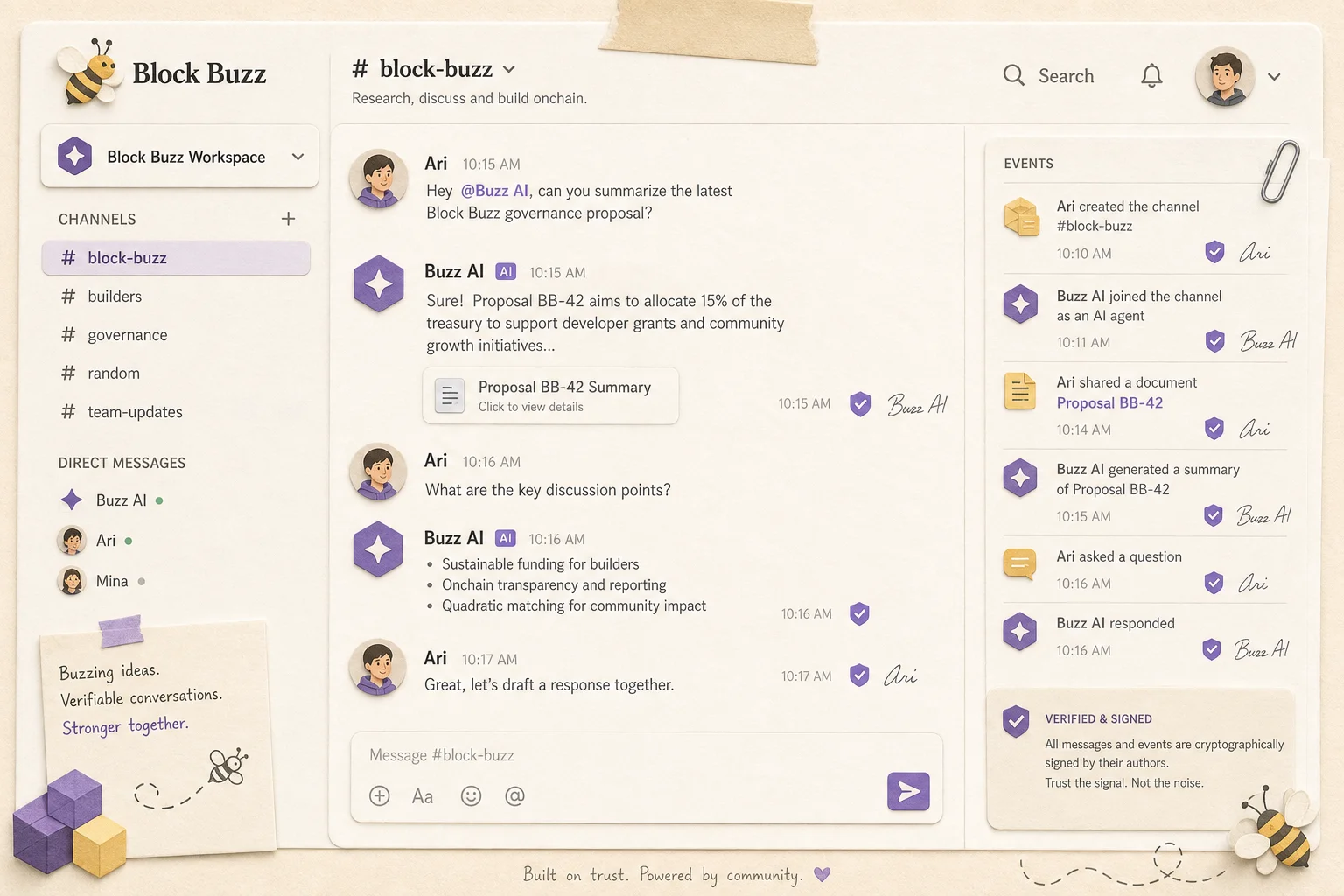
Most "AI in Slack" integrations are outbound webhooks with a bot badge. Buzz goes further:
- Agents hold their own cryptographic identities
- They join channels with explicit permissions
- They respond to @mentions through the
buzz-acpharness - Their actions land in the same audit trail as humans
The architecture doc spells out the relay-centric design. buzz-relay orchestrates subsystems (db, auth, pubsub, search, audit, workflow). Cross-subsystem calls go through the relay; crates stay isolated.
For agents, buzz-acp spawns subprocesses (1 to 32, default 1), connects over WebSocket with NIP-42 auth, discovers channels via REST, and queues mention events. At most one prompt is in-flight per channel, with batching for queued mentions.
Supported harnesses at launch included Claude Code, Codex, Block's goose, Grok, and a built-in buzz-agent.
That is the right abstraction if you believe agents are long-running workers, not one-shot chat completions.
Self-hosting: what you are signing up for
Buzz targets teams that want data and relay control. Block also offers hosted infrastructure at buzz.xyz for teams that do not want to run Docker.
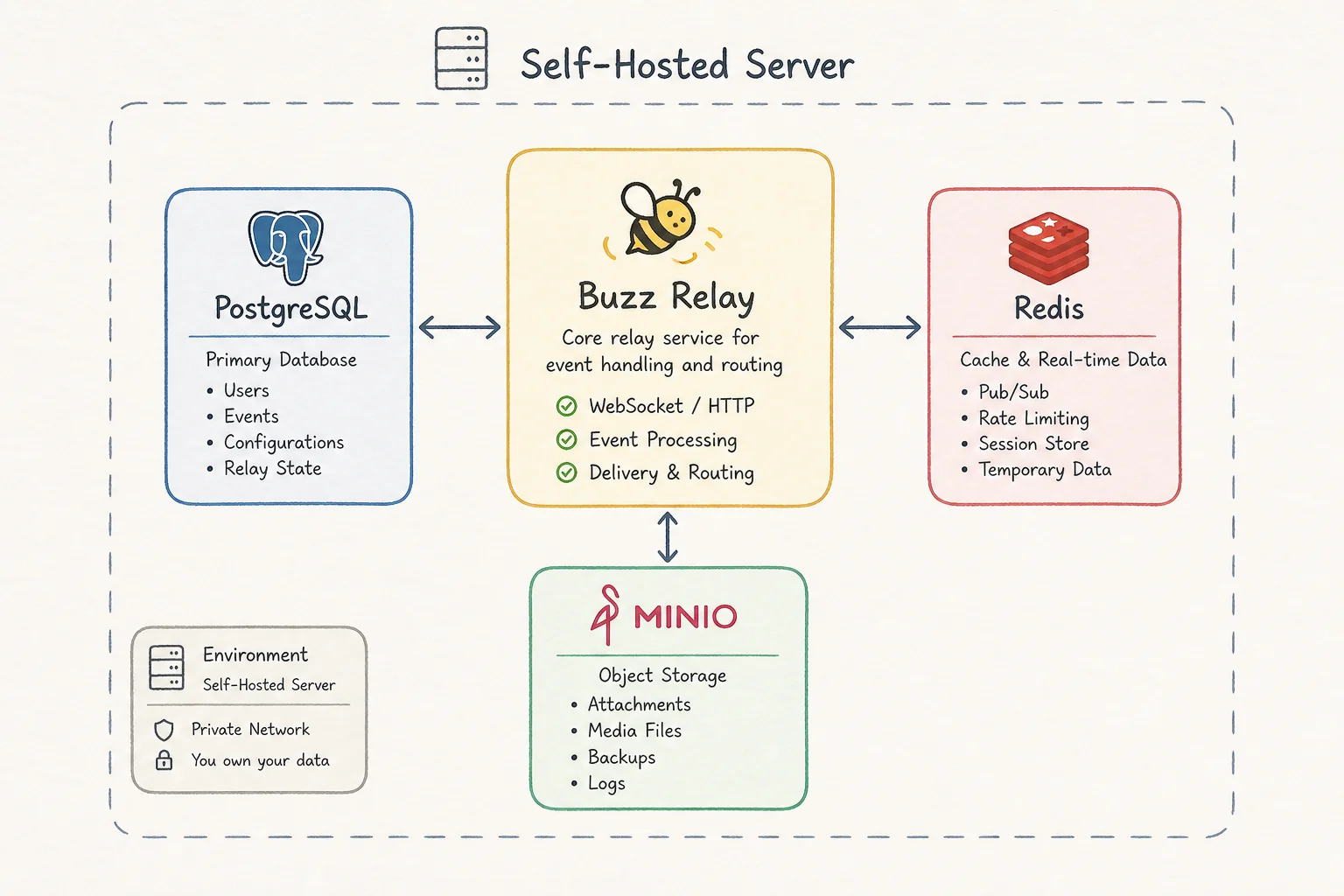
A typical self-hosted stack (from community guides and the repo's compose bundle):
| Service | Role |
|---|---|
buzz-relay | Core server, single source of truth |
| PostgreSQL | Event store + FTS |
| Redis | Pub/sub and caching |
| MinIO (or S3-compatible) | Media via Blossom |
Quick local dev path from the digest and docs: clone the repo, run just dev, relay at localhost:3000. Production deploys use Docker Compose under deploy/compose.
You control membership with add-member / remove-member commands on the relay. No external approval queue. That is attractive for regulated teams and annoying if you wanted a public open relay with zero ops.
Honest caveat: Buzz is early (0.4.x at launch). "Decentralized" marketing meets a single relay per workspace reality. Sovereignty here means you run the relay, not that every message federates across the open Nostr graph.
Use cases I would actually try
Feature branch as a room. Spin a channel per branch where patches, CI results, and agent review comments live together. Git events are first-class Nostr kinds, so the conversation and the diff share one timeline.
Ops war rooms with agent backup. On-call channel with a Codex or goose harness scoped to runbooks and read-only infra tools. Audit log answers "what did the agent run at 2am?"
Client workspaces on their metal. For buyers who will not put internal chat on US SaaS, Buzz is a credible "Slack plus light forge" alternative with agent hooks built in.
I would not rip out Slack on day one. I would pilot Buzz on one internal agent-heavy project and measure whether the unified event log beats juggling Slack, GitHub, and a separate agent dashboard.
How Buzz compares to agent-in-Slack patterns
| Approach | Pros | Cons |
|---|---|---|
| Slack + MCP bot | Familiar UX, huge ecosystem | Agent is a guest; weak audit; SaaS data path |
| Custom portal + agents | Full control | You build everything |
| Buzz self-hosted | Agents as members; git + chat + workflows; Apache 2.0 | Young project; ops burden; single-relay model |
Buzz wins when agent identity, permissions, and audit matter as much as chat. It loses on maturity and integrations versus decade-old incumbents.
Getting started without overcommitting
- Clone block/buzz and run
just devlocally - Add one harness via ACP with tight tool scopes
- Create a test channel with one human and one agent
- Run a YAML workflow on a trivial task (lint, doc update, ticket triage)
- Read the audit log before you trust it with write access to prod
If self-hosting is not your job, try Block's hosted relay first, then migrate when you have a compliance trigger.
Buzz is the most interesting "agents in the workplace" repo Block has shipped since goose. Whether it becomes infrastructure or a fascinating experiment depends on how fast they harden multi-tenant ops and mobile clients. The architectural bet (signed events, agents as peers) is the part worth watching.
Evaluating self-hosted agent workspaces for your team? Book a free discovery call.