
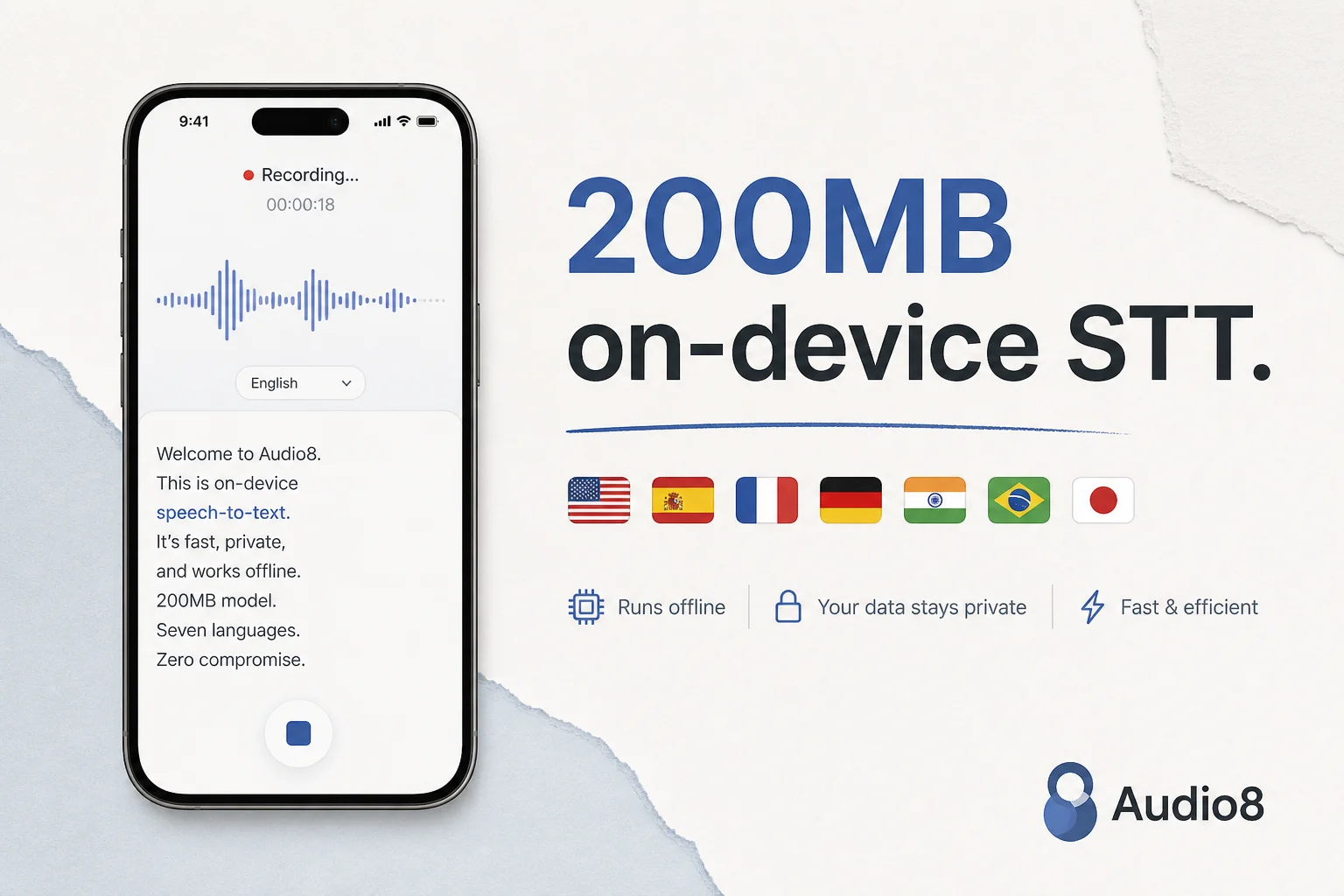
Cloud speech APIs are easy until you need offline intake, HIPAA-adjacent privacy, or sub-second latency on a bad hospital Wi-Fi network. That is where sub-billion-parameter ASR stacks are having a moment.
Audio8-ASR-0.1B showed up in the August 2026 digest as an open 0.1B speech-to-text model that runs fully on-device across seven languages. The iPhone ANE package on Hugging Face is the clearest public artifact: Core ML on Apple Neural Engine for the audio tower, ONNX Runtime for an int4 decoder, and a demo designed around ~200MB runtime memory on physical hardware.
I build voice agents for clinics and service businesses. This is the class of model I watch when a client says "we cannot send audio to OpenAI."
Why 0.1B ASR is a product decision, not a benchmark flex
Bigger is not always better for voice products. A front-desk agent that transcribes appointment requests on an iPad cares about:
| Requirement | On-device 0.1B | Cloud STT |
|---|---|---|
| Privacy | Audio never leaves device | Audio hits vendor infra |
| Offline / flaky network | Works air-gapped | Fails or queues |
| Latency | ANE path can be very low | Network RTT added |
| Cost at scale | CapEx / device GPU | Per-minute OpEx |
| Language breadth | Narrow (7 here) | Often 100+ |
| Accent robustness | Model-dependent | Often stronger at frontier |
Audio8 targets the left column deliberately. Seven languages cover a large share of multilingual intake in North America and East Asia without shipping a 1B+ decoder to every phone.
What the iOS ANE package includes
From the Hugging Face model card:
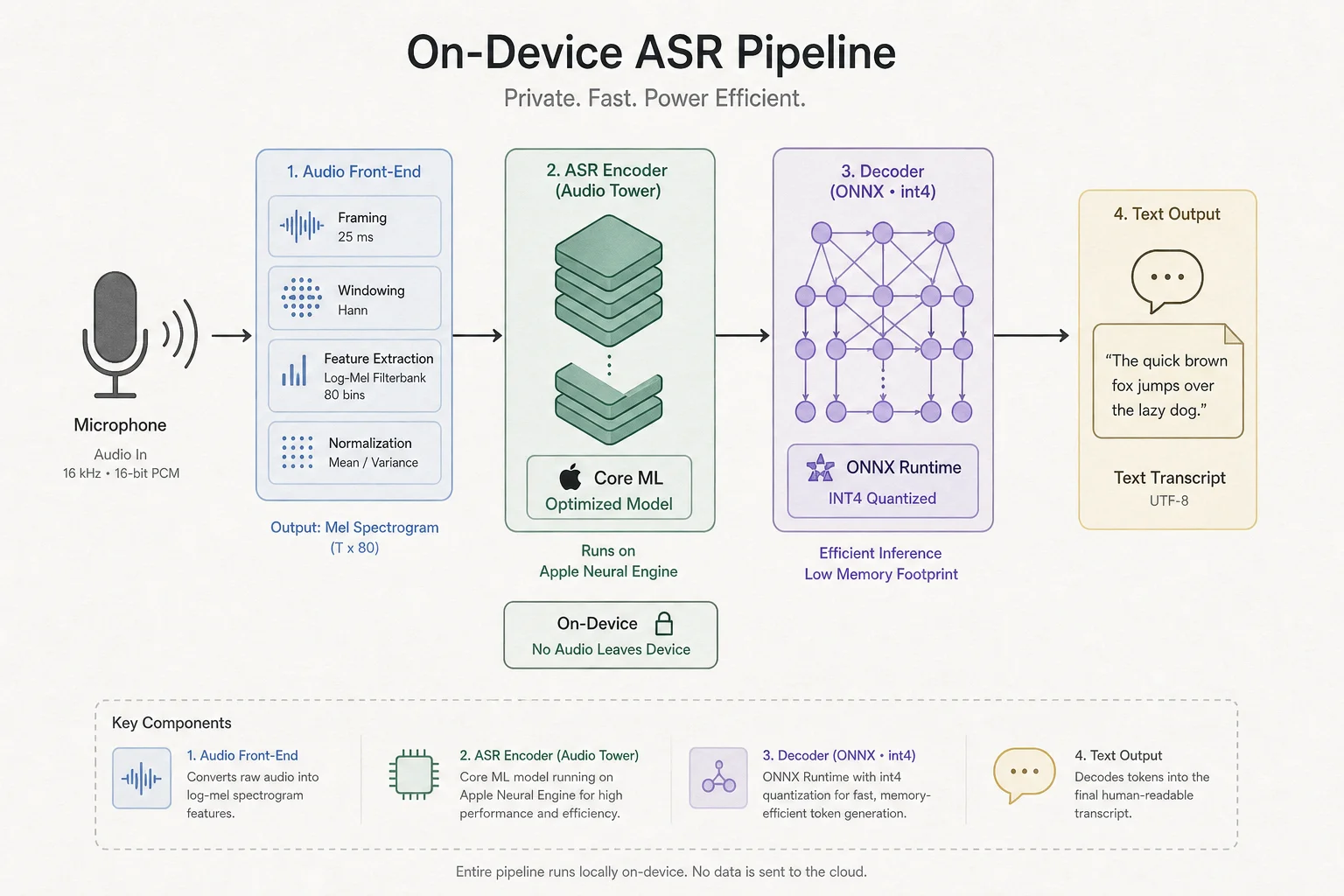
- Audio tower / head: compiled Core ML
mlmodelc, mixed Float16/Int8 storage, ANE execution - Decoder: ONNX Runtime CPU decoder with int4 shared LM weights
- Token embeddings: Float16 table on disk
- Swift SDK + demo app for microphone transcription without network calls
- Languages: English, Chinese, Cantonese, French, German, Japanese, Korean
Requirements skew Apple-native: macOS on Apple Silicon for builds, full Xcode, iOS 18+, physical device for realistic ANE numbers. The card shows example footprints around 183MB during live mic transcription, with peaks varying by device and cold start.
That memory budget matters. Many clinic iPads are not latest-gen pros. A 200MB-class stack leaves headroom for your UI, local RAG, and a small TTS model in the same process.
How this fits next to other local STT options
The ecosystem is crowded in a good way. Rough positioning:
| Project | Size class | Strength |
|---|---|---|
| Audio8-ASR-0.1B (ANE) | ~0.1B | iPhone ANE packaging, tiny RAM |
| IBM Granite 4.0 1B Speech | ~1B | Enterprise multilingual ASR/AST |
| phonex (Sherpa-ONNX) | 30-600MB models | Rust CLI, streaming, 10+ languages |
| OpenASR | Many families | Desktop OpenAI-compatible local API |
Audio8 is not trying to be Whisper-large for 99 languages. It is trying to be the smallest usable iPhone transcription stack with a credible multilingual set.
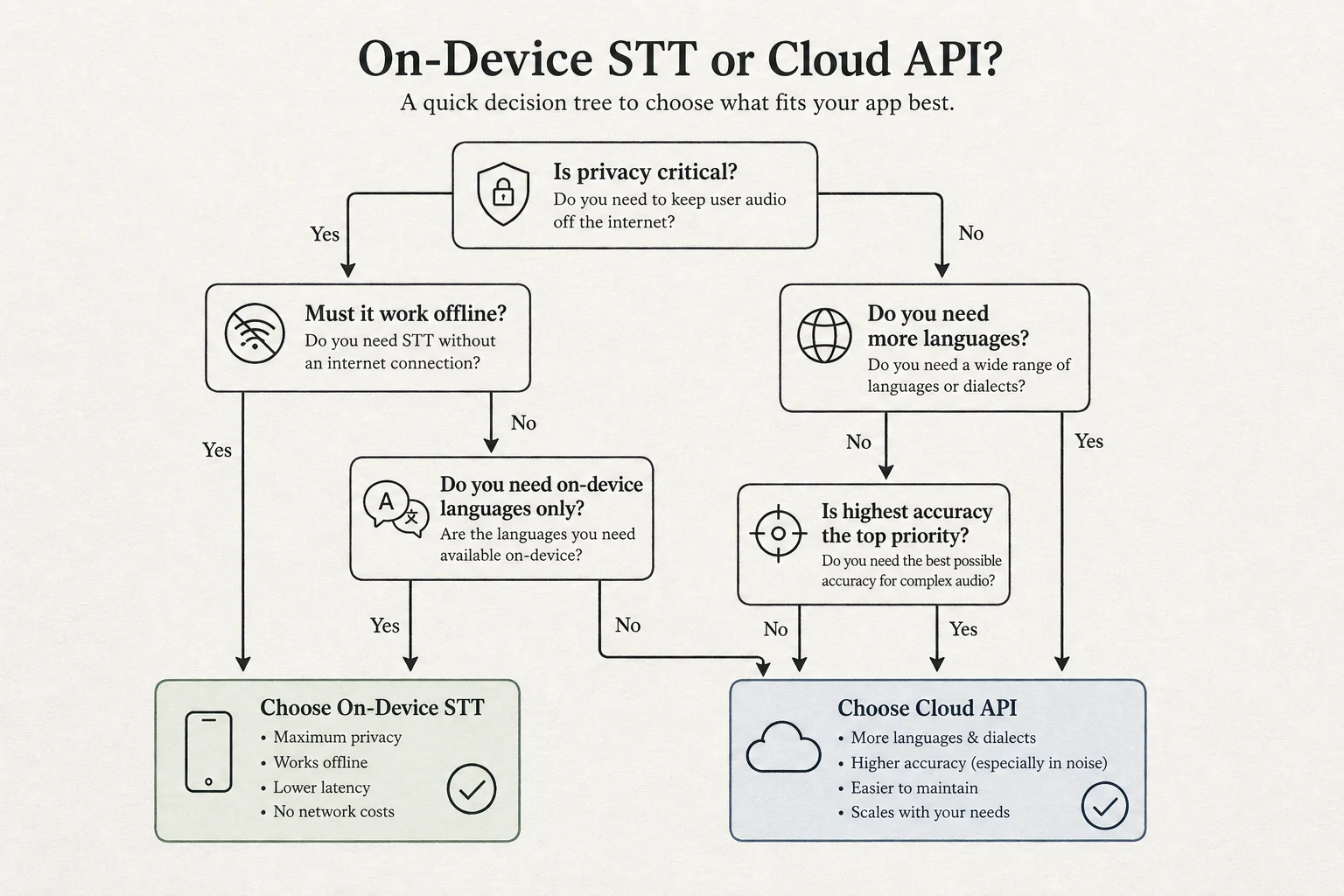
For my voice ops work, the decision tree looks like:
- Need 100+ languages or best accuracy? Cloud or Granite-class local.
- Need streaming on server/Linux? phonex or vLLM-served models.
- Need private on-iPhone capture? Audio8-class ANE packages.
Integration pattern for voice agents
A practical on-device voice loop for appointment booking:
- VAD (voice activity detection) on device
- Audio8 ASR for transcript
- Small local LLM or rules engine for slot filling
- Cloud escalation only when confidence is low or tools need CRM access
Keep PII-heavy audio local. Push structured fields (name, time window, service type) to your backend. That split satisfies a lot of clinic security reviews without giving up cloud CRM integrations.
Watch these failure modes:
- Accent and domain vocabulary. Fine-tune or keyword-bias if drug names or trade terms matter.
- Background noise. Front-desk environments are harsh; test with real HVAC and hold music bleed.
- Language mixing. Cantonese/English code-switching is common; validate on real calls, not clean studio clips.
When I would not use Audio8
Skip on-device 0.1B ASR if:
- You need real-time translation across many language pairs (look at AST models like Granite Speech)
- Your users are mostly on Android or desktop browsers without an equivalent ANE package
- Compliance requires vendor BAA and your cloud STT provider already offers one
- Accuracy on rare dialects is the top metric and you have budget for cloud frontier models
Audio8 is a building block for privacy-first mobile capture, not a universal STT replacement.
Bottom line
Audio8-ASR-0.1B is part of a broader shift: speech stacks small enough to live beside your app, not behind a API key. For seven-language on-iPhone transcription at ~200MB, it is one of the most concrete open packages in the August digest.
If you are designing a voice product and debating cloud versus on-device, start with where audio is allowed to go, not which leaderboard model is biggest.
Building voice intake or on-device transcription into your ops stack? Book a free discovery call.