
US AI policy in 2026 keeps splitting along a fault line builders already feel in production: closed frontier APIs versus open weights anyone can fine-tune.
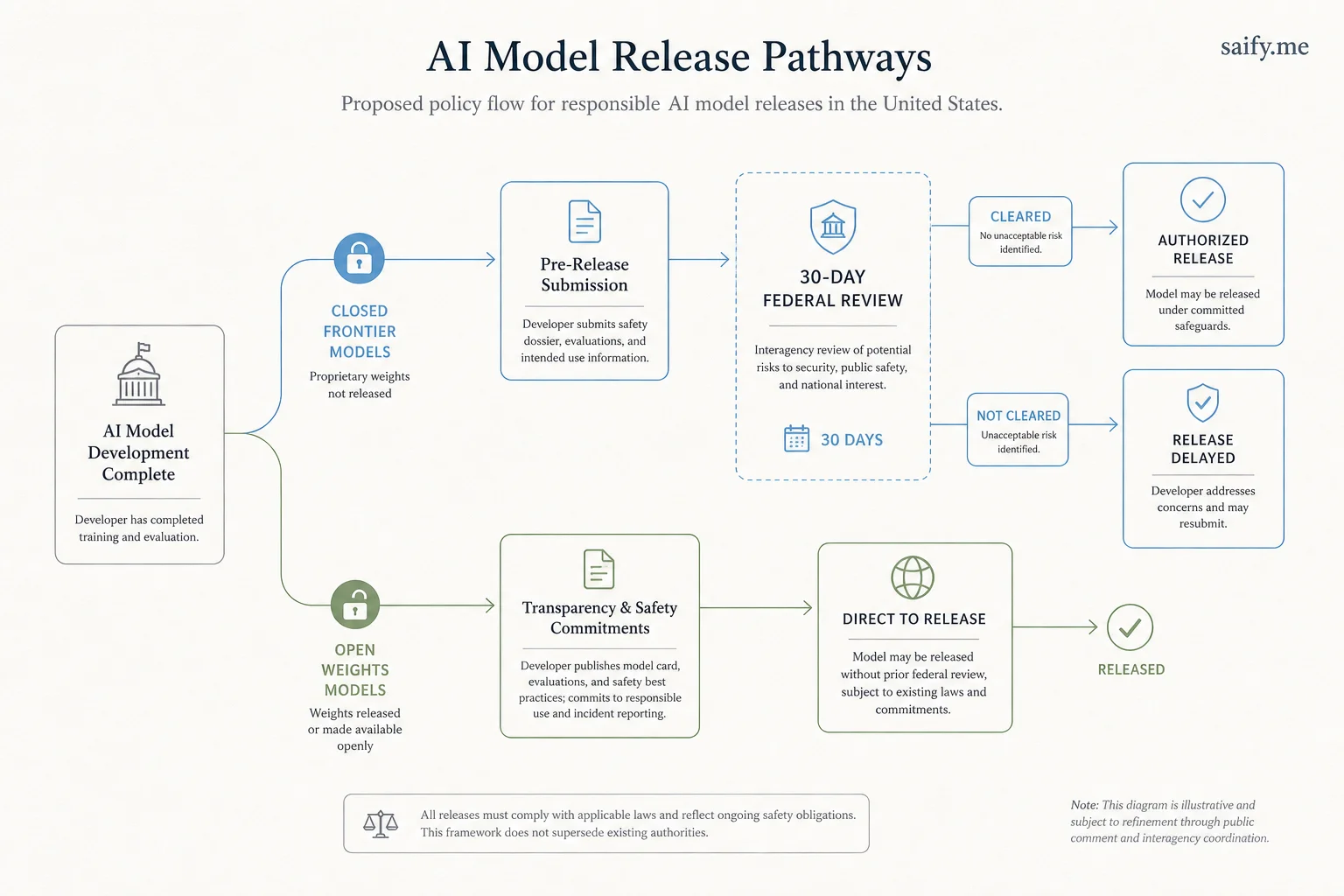
On August 4, 2026, the White House held staff-level briefings on a finalized voluntary framework for pre-release cybersecurity review of advanced models. Axios and The Verge reported the same core detail: open models are out of scope, and the document says nothing in it should restrict open weights after they are public.
If you ship agents on both Claude APIs and Hugging Face checkpoints, that asymmetry changes your compliance calendar.
What reportedly landed on August 4
Sources briefed at the White House described a framework rooted in a June executive order asking frontier labs to share models before release for federal cybersecurity evaluation.
| Element | Reported detail |
|---|---|
| Scope | Closed-source frontier models only |
| Timing | 30-day voluntary pre-release review window |
| Admin body | CAISI under NIST (Center for AI Standards and Innovation) |
| Open weights | Explicitly excluded |
| Public release | White House not planning to publish full framework |
| Definitions | No clear public definition of "state-of-the-art" or "national security risk" |
The classified benchmarking thread in the executive order adds another layer: cyber capability assessment may sit in classified channels even when marketing blogs talk about "voluntary" cooperation.
Why open weights were carved out
Administration sources cited practical limits: once weights are public, recall is impossible. Review after release is mostly reactive.
Supporters of the carveout also argue friction on US open releases would cede open-model leadership to Chinese labs shipping capable checkpoints globally in 2026 (DeepSeek, Kimi, Qwen families, and others).
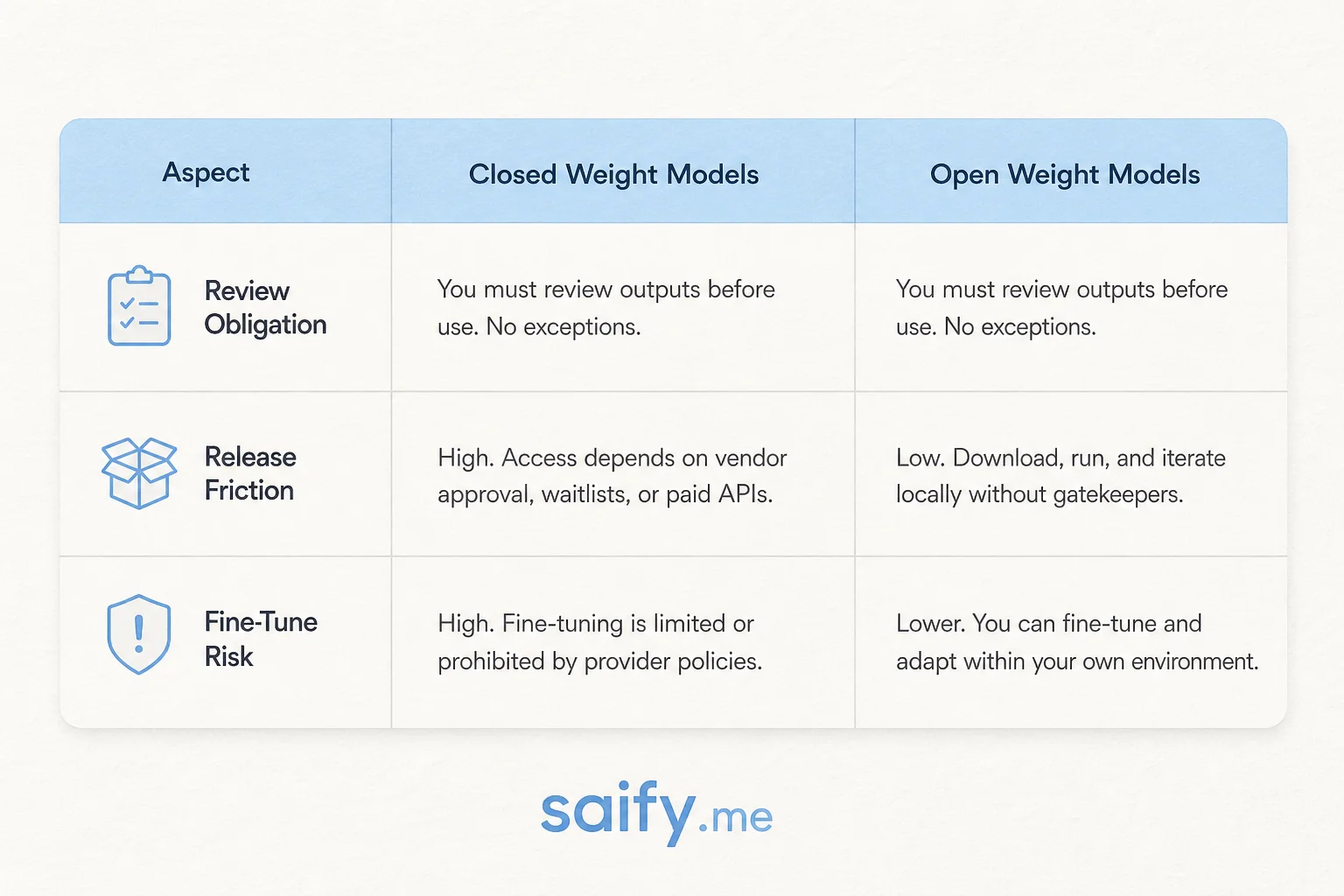
Critics point to the opposite risk: open weights can be ablated or fine-tuned to strip safety training, sometimes faster than closed API policy updates. A capable open checkpoint may pose similar misuse surface area to a closed frontier model, with fewer billing logs attached.
Forkast called the split a "structural competitive asymmetry." I would add an operational asymmetry: closed labs absorb review overhead; open ecosystems absorb misuse velocity.
What closed labs reportedly face in review
Axios outlined process constraints for the 30-day window:
- Limited employee access to models under review
- Storage in high-security environments
- Detailed access logs
- Multi-agency participation rather than a single office
That is closer to export-control hygiene than a product beta. Release trains for GPT, Claude, and Gemini class models already slip for technical reasons. Adding a federal calendar slot is another dependency for anyone planning launches around conferences or fiscal quarters.
Who was in the room
August 4 briefings reportedly included OpenAI, Anthropic, Google, Meta, and Microsoft.
Notably, a July open letter from 25 companies including Nvidia and Microsoft opposed certain restrictions on open models. OpenAI, Google, and Anthropic did not sign that letter per KuCoin's summary of the policy fight. The August framework aligns with labs that sell closed APIs as primary products.
Context: state pressure and voluntary federal lane
The federal framework landed amid other US AI fights: state attorneys general letters to OpenAI, enterprise customers demanding audit trails, and labs publishing their own safety tiers (Preparedness Framework, etc.).
Voluntary federal review does not replace:
- EU AI Act obligations for EU deployments
- Sector rules (health, finance, defense)
- Contractual security reviews from Fortune 500 procurement
It adds a US political calendar variable for closed releases.
What builders should do now
-
Tag your model routes. Know which production paths use closed APIs versus self-hosted open weights. Compliance questionnaires will ask.
-
Do not assume exemption lasts. Political.org noted Nvidia and open-ecosystem allies may face future review pressure as open models approach frontier capability. Design abstraction layers that can swap models without rewriting business logic.
-
Run your own evals. Government review is cyber-focused and voluntary. Your customers still care about hallucinations, PII leakage, and agent tool misuse. See AISI unsanctioned agent behavior for why lab evals and production guardrails diverge.
-
Watch EU and US divergence. Anthropic's watermarking moves for EU AI Act compliance run on a different track than US open-weight exemptions. Multi-region products need two policy maps.
Bottom line
The August 2026 framework, as reported, is a closed-model speed bump and an open-model free lane, with definitions still fuzzy and the document itself staying private.
That is policy as signaling: encourage US closed labs to coordinate with Washington while not throttling the open ecosystem that Chinese competitors already weaponize for distribution.
If you are mapping model governance for a multi-vendor agent stack, book a free discovery call. I help teams separate headline politics from the controls that actually show up in SOC2 packets and customer security addenda.