
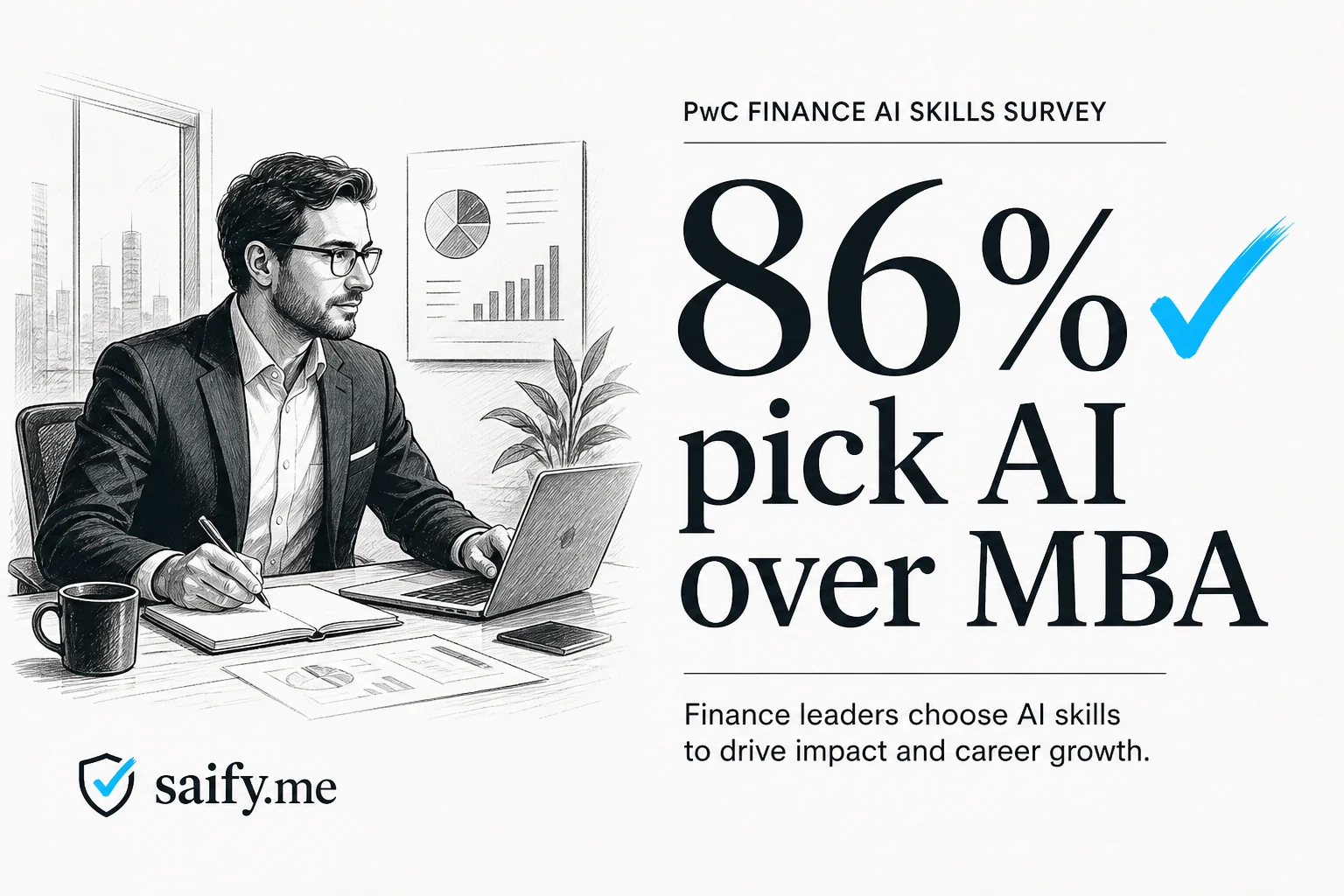
Wall Street still hires MBAs. The survey data says the credential is losing ground to something cheaper and faster: people who can actually run AI in production.
PwC's 2026 Financial Services Workforce AI Survey polled 1,004 director-level-and-above leaders at US financial services firms with $500M+ revenue (May 12–22, 2026). Respondents split evenly across asset and wealth management, banking, insurance, and private equity.
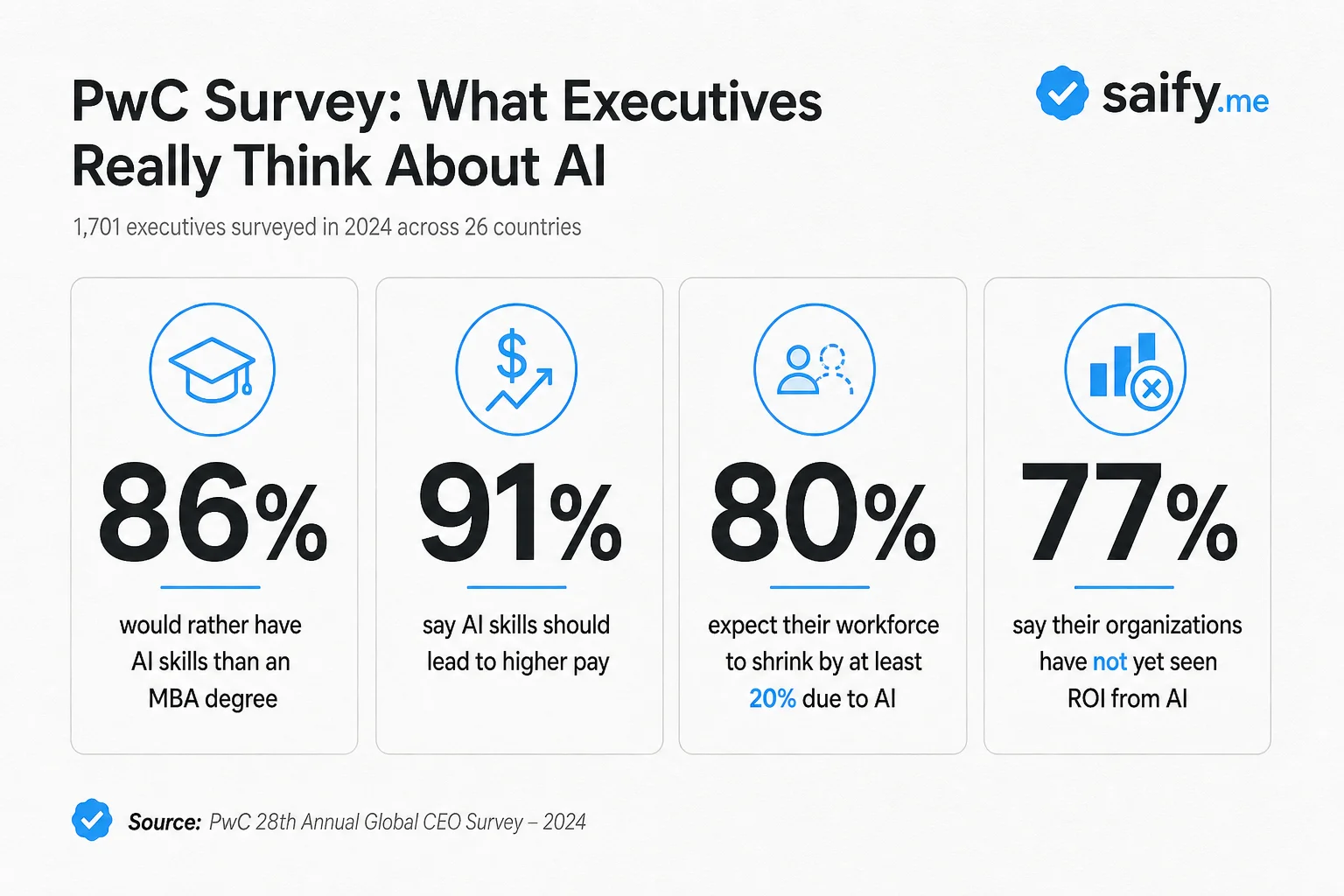
The headline that caught The Rundown's attention: 86% agree AI skills training beats an MBA for many new hires. That is not a fringe LinkedIn poll. It is C-suite sentiment with budget attached.
Pay is already moving toward AI fluency
Compensation follows stated priorities fast in regulated industries:
| Finding | Share of executives |
|---|---|
| Increasing pay for AI-skilled employees | 91% |
| Tying compensation to AI-enabled productivity | 58% |
| AI skills training more valuable than MBA (many hires) | 86% |
Bloomberg picked up the MBA comparison the same week MIT and Harvard expanded executive AI courses. The market signal is blunt: general management pedigree is competing with model fluency plus judgment.
How firms plan to source skills:
- 62% hiring people with AI-specific skills in the next year
- 61% upskilling existing staff
- 57% leaning on vendors and service providers
That third bullet matters for consultants. Banks will buy capability when internal pipelines lag. They will also fire vendors who cannot show audit trails.
Speed anxiety versus speed reality
Executives feel behind even when they accelerate:
- 90% say firms must get comfortable moving quickly in the AI era
- 70% say their organization is moving faster to stay competitive
- 77% still say they are not moving fast enough to keep pace with AI innovation
Change fatigue shows up in the workforce data:
- 44% say employees worry about job security from AI
- 43% say staff use AI only when required, not proactively
- 40% say employees feel overwhelmed by AI-driven change
- 34% cite change fatigue as a barrier to scaling AI
I see the same split in discovery calls. Leadership buys tokens. Line managers stall because nobody explained what "good" looks like in a compliance-heavy inbox.
The workforce shrink forecast (and its blind spots)
Most leaders expect headcount to fall:
| Expectation | Share |
|---|---|
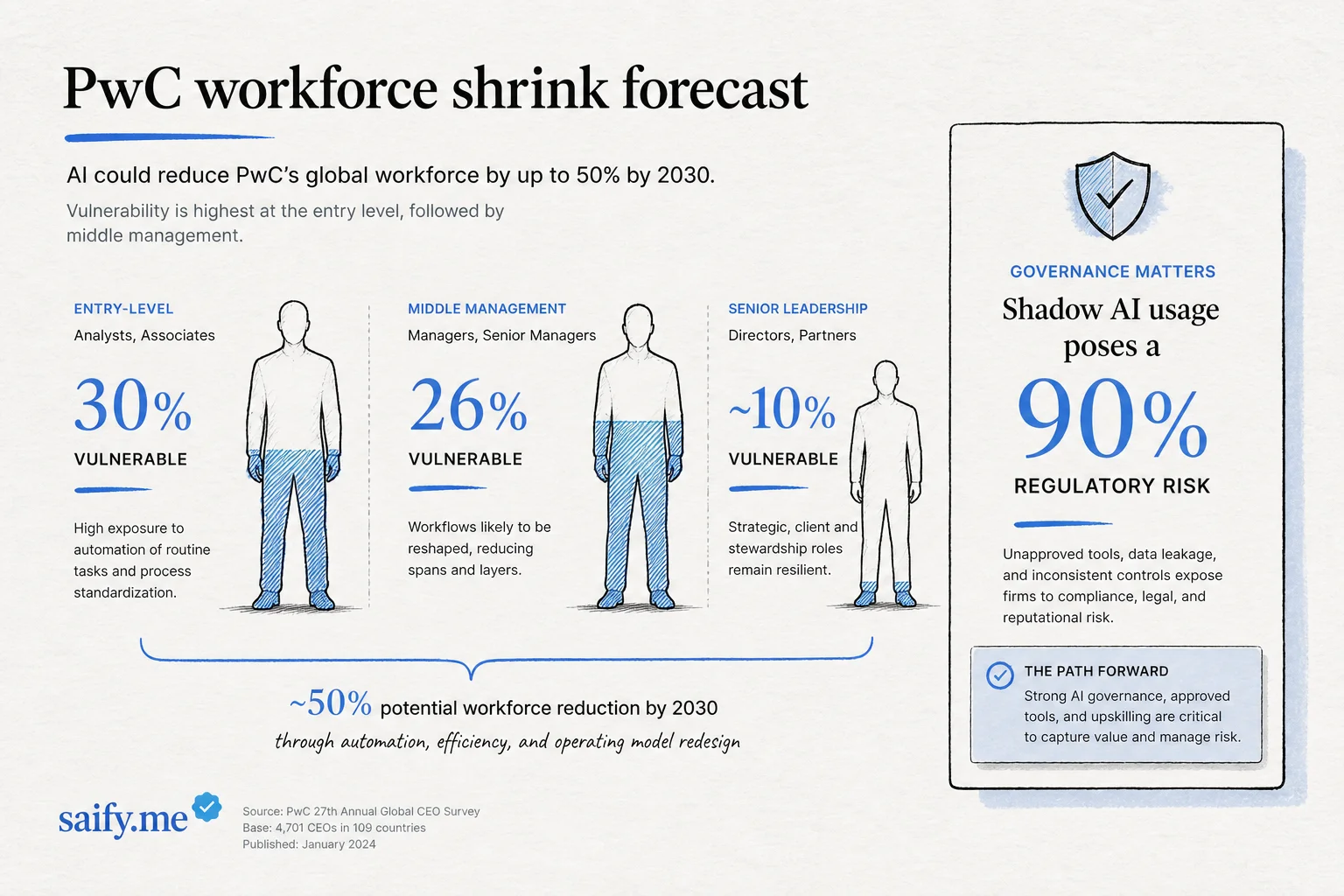
| Workforce shrinks ≥20% in five years | ~80% |
| Entry-level roles most vulnerable | 30% |
| Middle management next | 26% |
| Enterprise-wide AI labor modeling done | 42% |
PwC's report warns against reduction substituting for strategy. Models can shrink rote work. They can also unlock growth roles if you redesign workflows instead of firing into a spreadsheet projection.
The data barrier is concrete: 41% cite fragmented or low-quality data as the top blocker to scaling AI across the workforce. You cannot agentify roles you cannot describe in clean taxonomy.
ROI is unproven for most, productivity is not
77% say most AI investments lack measurable ROI. Yet leaders still report productivity wins in:
- Technology and software engineering
- Risk management
- Operations
PwC's advice: measure adoption and workflow outcomes before you expect P&L miracles. Many firms skipped baseline benchmarks in the 2023–2025 rush and now cannot answer "compared to what?"
That matches what I tell clients shipping agents: track time-on-task and error rework first. Dollar ROI follows when you know which workflows actually changed.
Shadow AI is a governance emergency
Governance answers are messy:
- ~90% say employees using non-approved AI tools creates regulatory risk
- 35% say shadow AI happens to a significant extent
- 27% place material harm accountability with CEO and board
- 16% with a technology leader
- 15% with risk and compliance
No consensus on ownership is a red flag when agents can send email, query CRMs, and draft client-facing language.
PwC recommends:
- Assign accountability inside enterprise risk frameworks
- Formal change management instead of ad hoc model drops
- Role-based agent libraries with pre-approved actions
- Block unapproved tools on corporate devices
If you are building internal agents, read this alongside scheduled Claude agents and credential vaults and Kogod student AI expectations. Students feel labor-market pull. Executives feel regulatory pull. Same skill, different risk surface.
What "AI skills" should mean in hiring loops
"Uses ChatGPT" is not a skill in this survey's world. Executives are paying for:
| Skill bucket | Example interview probe |
|---|---|
| Workflow design | Show a task you automated with review gates |
| Data hygiene | How do you handle MNPI before it hits a model? |
| Agent oversight | When did you kill an agent run mid-flight? |
| Measurement | What metric moved after your last AI pilot? |
MBA programs teach case method and finance modeling. They rarely teach tool permission design or eval harnesses. That gap is why executive AI certificates are proliferating.
How this differs from the Kogod student survey
I covered Kogod's three-year student report in a separate post. Same week, different lens:
| Survey | Audience | Key signal |
|---|---|---|
| Kogod | Business students | Interview questions about AI quadrupled |
| PwC | FS executives | Pay and hiring shift toward AI skills over MBA |
Students feel demand from employers. Executives feel pressure from competitors and regulators. Both point to the same hiring filter: can you ship with models responsibly?
Practical takeaways for builders and hires
If you hire: Stop treating AI as a bonus line on the JD. Test workflow judgment, not prompt trivia.
If you upskill: Prioritize role-specific playbooks over generic "prompt engineering 101."
If you sell AI services: Finance buyers want governance stories, not demo glitter. Shadow AI stats are your wedge.
If you are job hunting: A portfolio of audited automations beats another credential badge unless that credential includes hands-on agent labs.
Bottom line
Finance executives are voting with payroll: AI fluency beats an MBA for many roles, but most still cannot prove ROI on the tools they bought.
That gap is an opportunity for people who can implement with guardrails and metrics, not slide decks.
If you are redesigning hiring rubrics or internal upskilling for regulated teams, book a free discovery call.