
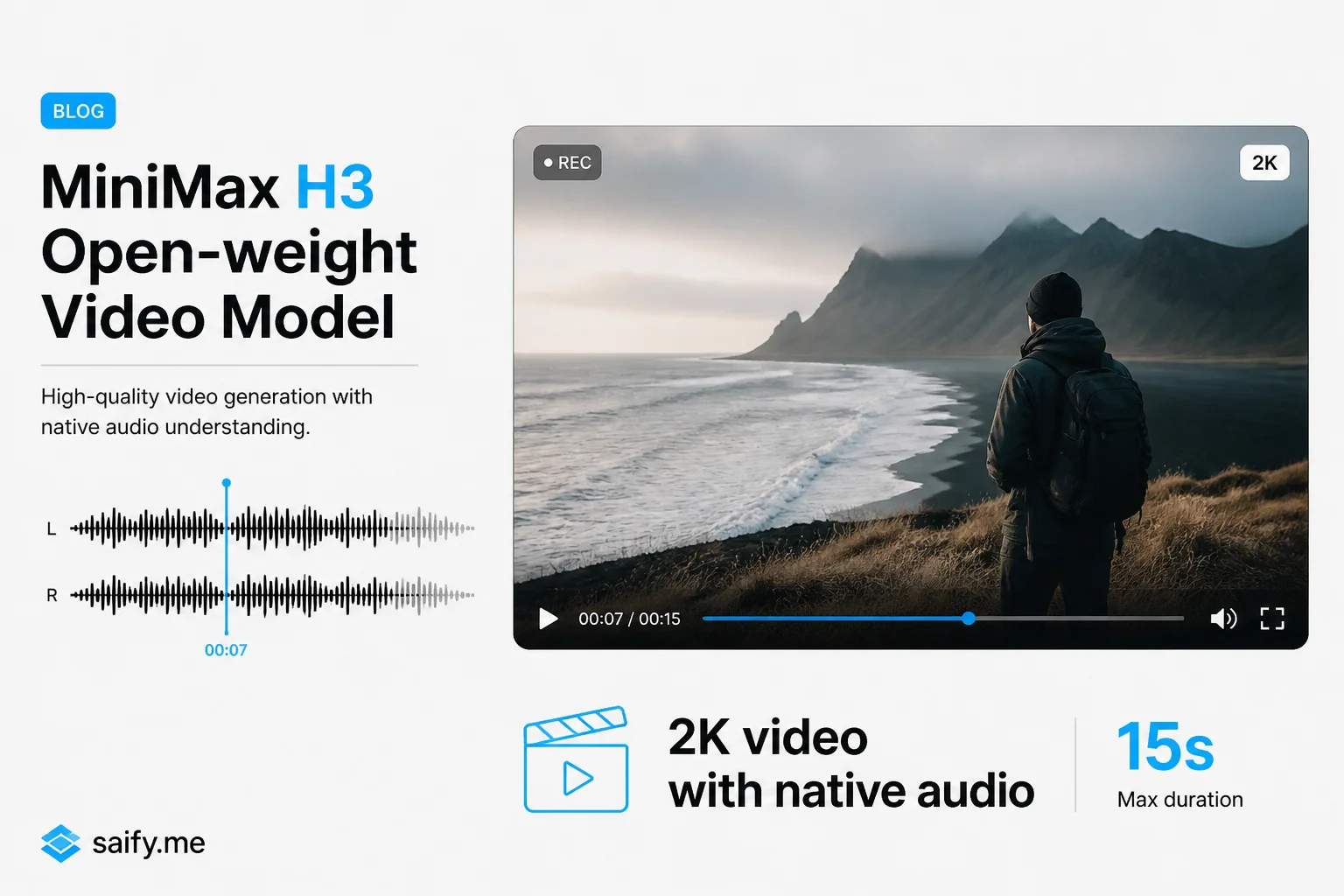
Closed video APIs still win on polish reels. Open weights win on auditability, fine-tuning, and price per second when you need volume.
MiniMax announced H3 on July 31, 2026 as a general-purpose multimodal generator: one model that reads text, images, video, and audio in shared context, then outputs 2K video up to 15 seconds with native stereo audio.
MiniMax said open weights are coming to Hugging Face within days, subject to export rules. That matters if you build ad pipelines, product demos, or localized creative tools and do not want a single vendor gate on every render.
The prompt pattern that shows what changed
Old video stacks wanted separate modes: text-to-video, image-to-video, motion reference, voice reference, each with its own UI tab.
H3's demo prompt is closer to how editors actually think:
Reference the Hitchcock camera movement from Video 1, have the character in Image 2 sing, with the vocals matching Audio 3.
One sentence. Four modalities. The model resolves relationships instead of forcing you to pick a task type first.
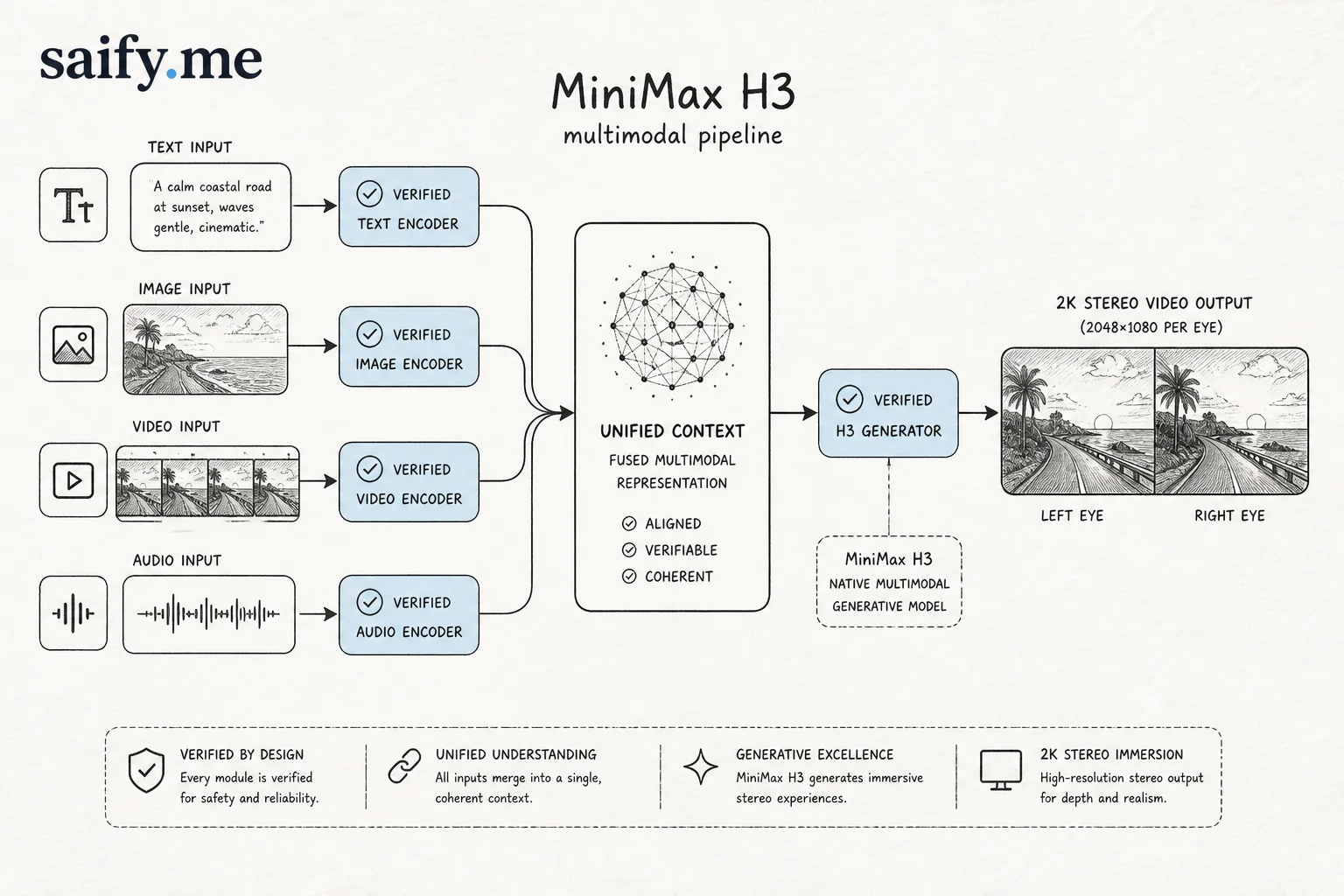
That is not a marketing gimmick. It reflects a training philosophy MiniMax calls task unification: stop fragmenting creative work into expert silos.
From siloed experts to one general model
MiniMax's blog walks through what they are trying to leave behind:
| Old pattern | H3 approach |
|---|---|
| Separate T2I, editing, motion, style models | Single pretraining mix |
| Voice, SFX, music as different audio stacks | Joint audio modeling, native stereo |
| Fixed task menus in product UI | Natural language as the bridge |
They group capabilities under generalized reference and editing, trained on real natural data with relationships expressed in language rather than a closed task enum.
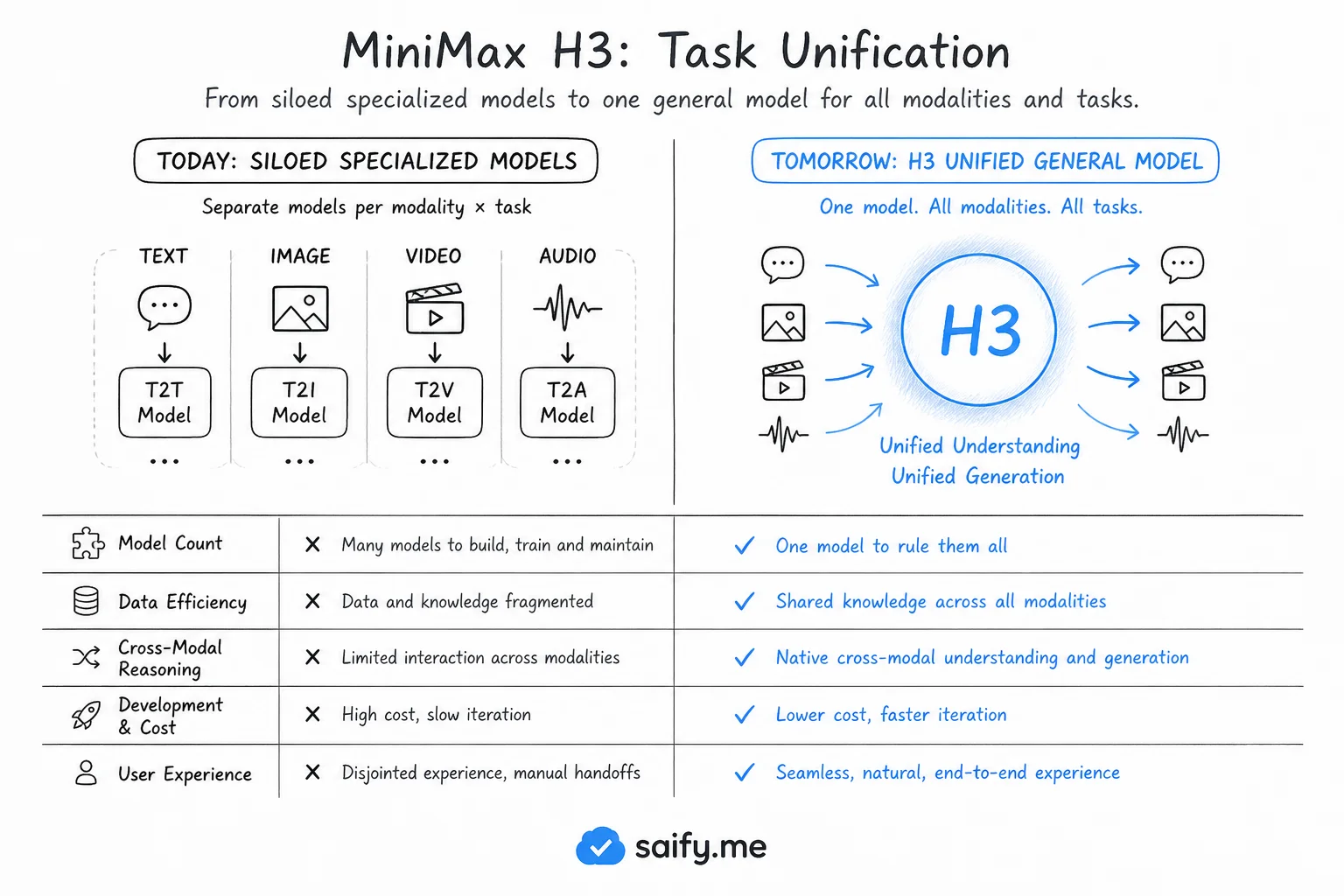
For builders, the product implication is simpler APIs and fewer brittle routing layers in your backend. For researchers, it is a bet that language is the scalable interface between modalities, the same thesis behind strong captioning pipelines in vision-language work.
Technical pieces worth watching
MiniMax highlighted four engineering bets:
Contextual Omni Representation
Captioning is not "describe this clip" anymore. It is describe relationships between context elements and the target shot, including cross-shot audio-visual ties. Their pipeline runs heavy inference on source material (around 100K tokens cited) distilled to roughly 4K tokens for training efficiency.
H3-VAE
A rebuilt tokenizer with higher compression and reconstruction quality. MiniMax claims 4x effective sequence length gains, which is how they justify native 2K without a separate super-resolution stage for every clip.
H3-Omni Transformer
Architectural refresh focused on task generalization over tricks. Multimodal context reportedly tripled sequence length variance, so they split understanding vs generation workloads in training to lift throughput about 30%.
In-context regeneration for 2K
Instead of a classic super-res module, the base model regenerates its own low-res output in-context at higher resolution, reusing original multimodal context to recover fine text and detail super-res would guess at.
If the technical report lands as promised, compare this to BFL Flux 3 native audio video and Alibaba Wan3 document-to-video. The race is unified context, not longer sliders in a UI.
Commercial specs that affect your stack
| Spec | H3 claim |
|---|---|
| Max length | 15 seconds |
| Resolution | 2K default |
| Audio | Native stereo |
| Open weights | Planned on Hugging Face |
| 2K price vs mainstream | < 1/3 per second |
| 768p price vs mainstream 720p | < 1/2 per second |
Try the hosted demo at Hailuo H3 tools before you commit GPU hours. Hardware compatibility was an explicit design constraint for the open release.
Where I would use H3 (and where I would not)
Good fits:
- Performance marketing variants (many short clips, brand-safe text in frame)
- E-commerce product spins with synchronized voiceover
- Internal storyboards where 2K is enough for stakeholder review
- Research teams that need weights to audit failure modes
Weak fits:
- Long-form narrative (15s cap)
- Broadcast QC pipelines that require frame-accurate legal clearance on every asset
- Workflows that must run fully air-gapped today (wait for weights plus your compliance review)
MiniMax also flagged known gaps: multimodal understanding still has headroom, model scale can grow, and visual fidelity in edge cases needs work. Open weights do not mean production-ready on day one for every brand.
Open video vs closed video in 2026
Closed models still dominate launch reels. Open models dominate iteration velocity:
| Dimension | Closed API | Open weights (H3 trajectory) |
|---|---|---|
| Fine-tune on brand actors | Restricted | Possible with governance |
| Inspect failures | Black box | Weights + logs |
| Cost at scale | List price | GPU + engineering |
| Safety filters | Vendor-managed | Your responsibility |
If you ship UGC platforms or agency tooling, that trade is familiar from the LLM wave. Video is just later.
Integration notes for applied AI teams
- Treat prompts like edit decisions, not tags. Reference IDs for clips beat keyword soup.
- Separate preview from final render. 2K in-context regen is clever; still budget compute per variant.
- Audio is part of the spec. Stereo native output changes loudness QA on social crops.
- Plan export review if you fine-tune on talent likeness. Open weights shift liability to deployers.
Pair this with Workers AI image patterns if you are building multi-modal pipelines on edge infrastructure. Video is heavier, but the routing logic rhymes.
Related models in the same digest cycle
The Rundown also flagged MiniMax H3 on Hugging Face alongside closed launches. If you are benchmarking:
- Latency to first frame on your GPU class
- Text rendering accuracy in 2K (MiniMax emphasizes brand and ad use cases)
- Lip sync and vocal alignment when referencing external audio
Publish your numbers. "Better reel" is not a benchmark.
Bottom line
H3 is MiniMax's bet that creative AI stops being a menu of task types and becomes one language-conditioned generator across modalities, at 2K with stereo sound, at open-weight prices.
That is the same direction Western labs are chasing with closed APIs. The difference is you may soon run it on your own hardware.
If you are choosing video model stacks for marketing automation or product-led creative tools, book a free discovery call. I spend a lot of time mapping open vs closed video paths for teams that cannot send every asset to a black-box API.