
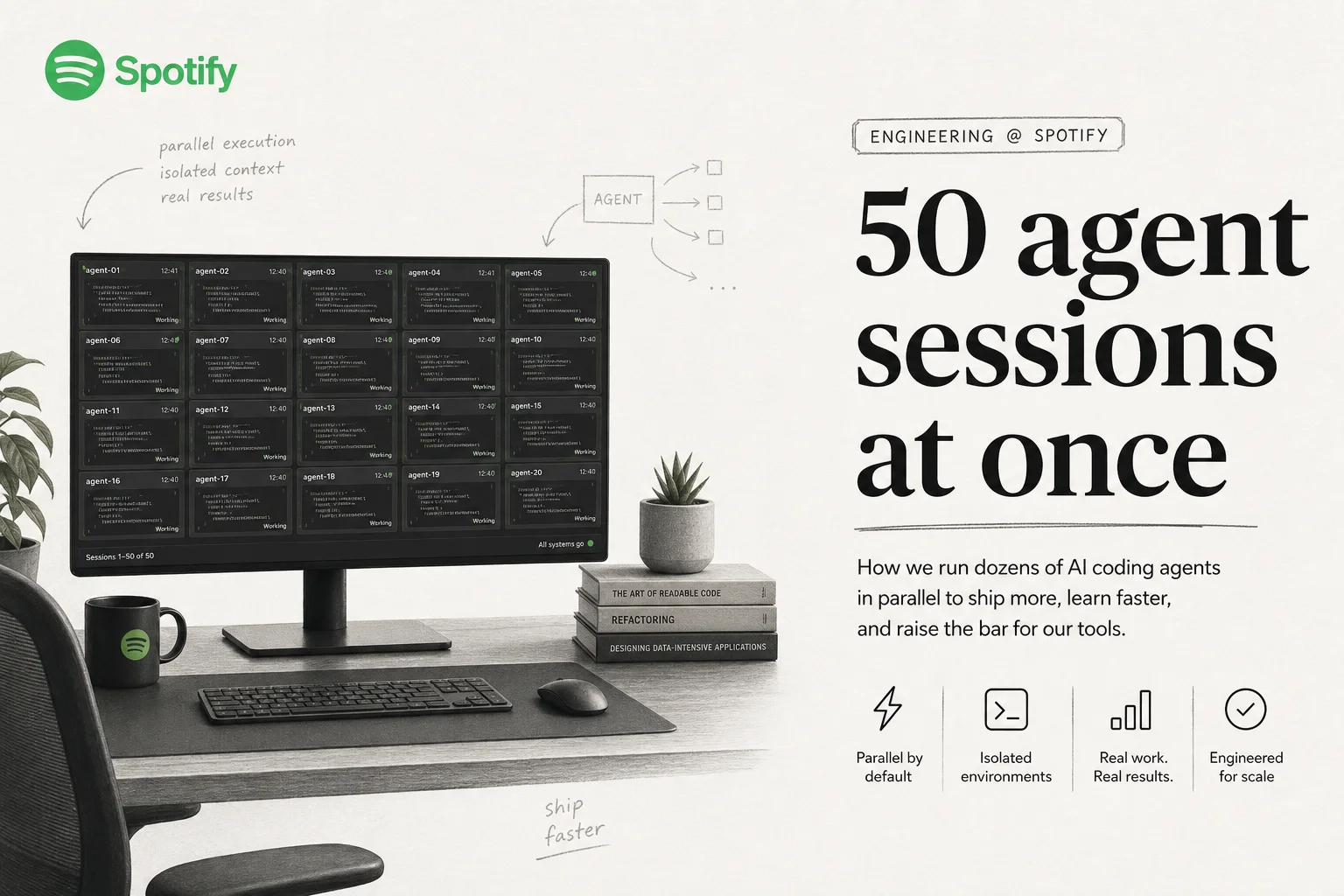
Every CTO I talk to has the same second problem now. Engineers already use coding agents daily. The hard part is managing fifty of them without losing context, money, or sanity.
Spotify's answer is Xirp, a vendor-neutral agent workspace they built after watching the same fragmentation they solved a decade ago with Backstage. They opened a public beta in August 2026, and the internal numbers are not subtle: thousands of engineers, 36,000+ sessions, parallel worktrees, mid-task model swaps.
I run smaller teams than Spotify. Still, the pattern maps directly to client work where everyone picked a different harness and context lives in private CLAUDE.md files.
From one agent to organizational entropy
Spotify's blog describes a predictable adoption curve:
- One developer, one agent session, one task.
- Then parallel sessions across repos and branches.
- Then different harnesses per engineer.
- Context trapped in personal configs, MCP setups, and prompt libraries.
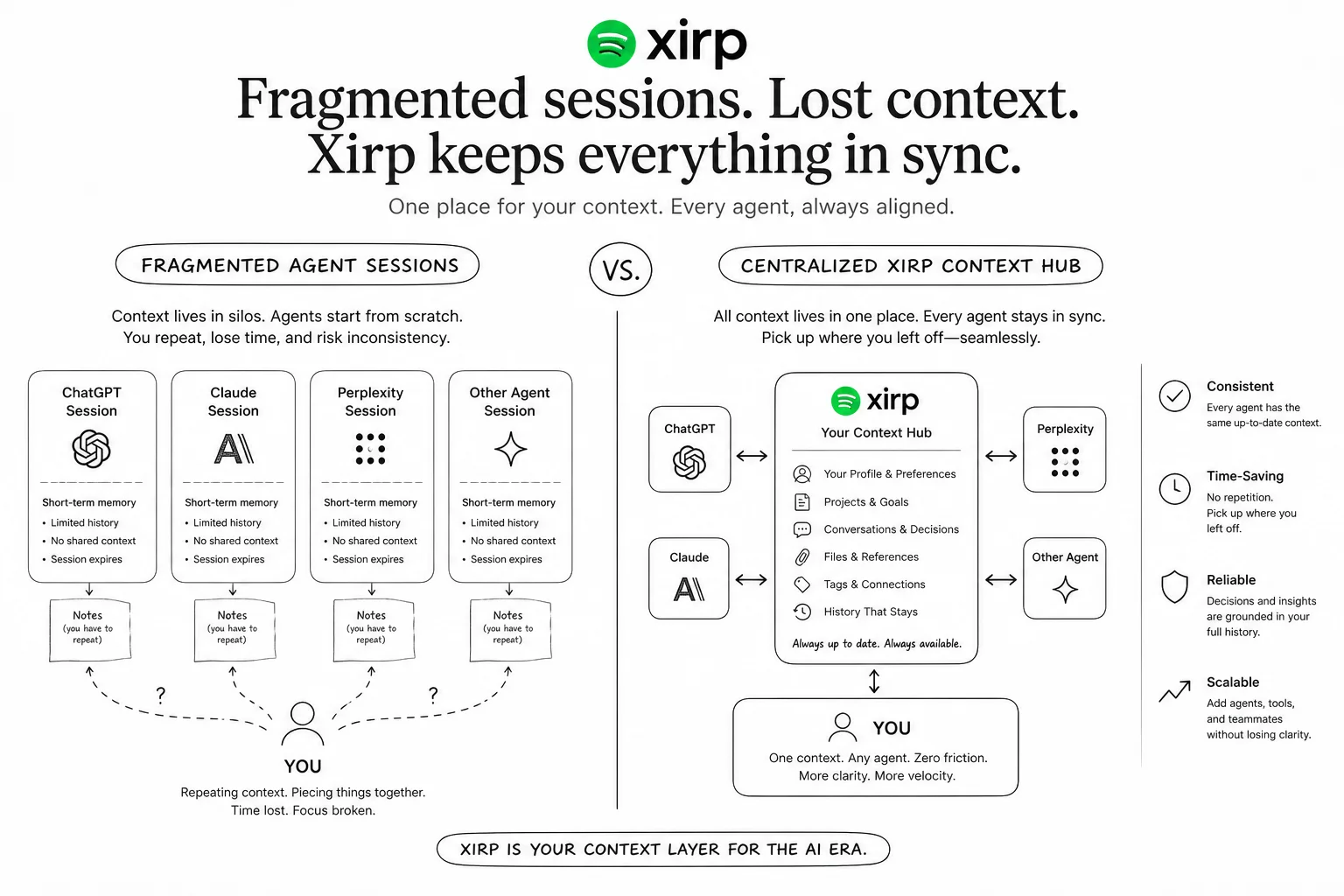
- Agents rediscover what another session already solved, burning tokens and time.
PR volume goes up. Rework goes up. Visibility goes down.
That is the same fragmentation Backstage addressed for microservices: dependency maps, ownership, architectural decisions in one catalog. Portal productized that platform for other companies. Xirp is the agent-era layer on top.
What Xirp actually provides
Xirp is not another model. It is orchestration infrastructure for agentic coding:
| Feature | Why teams care |
|---|---|
| Per-session git worktrees | Dozens of agents on one repo without file collisions |
| Harness neutrality | Swap Claude Code, Codex, Gemini CLI mid-project |
| Context portability | Working state survives vendor changes |
| Parallel session management | Coordinate 50+ agents without a spreadsheet of terminals |
| Open-weight routing | Send jobs to self-hosted models for cost control |
Spotify frames vendor neutrality as strategy, not ideology. Models and pricing change quarterly. Lock-in is a tax. Xirp lets engineers route each job to the best price/performance option, including models they host themselves.
That aligns with how I already advise clients on model routing and specialized workhorse checkpoints. Xirp is the IDE-shaped control plane for the same idea.
Xirp plus Portal: context as a multiplier
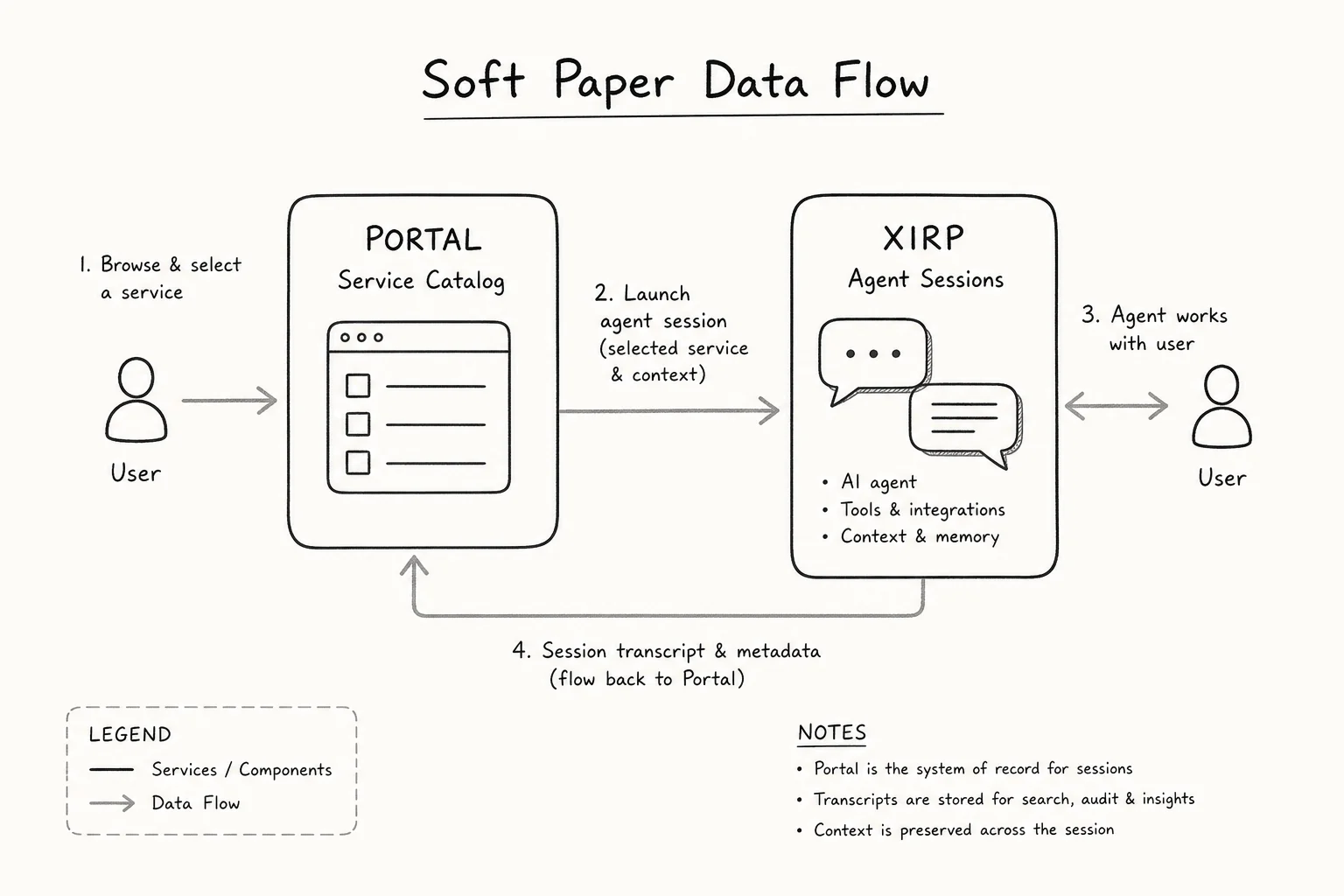
Xirp alone solves multi-session chaos. Connected to Spotify Portal, it becomes an agent command center.
On session start, agents ingest catalog context: components, dependencies, ownership, architecture notes. That is the institutional memory human engineers already needed in Backstage.
After sessions end, transcripts and metadata flow back. Another engineer (or another agent) can resume without rebuilding state from scratch.
Spotify also consolidates skills, rules, plugins, and MCP configs into a curated marketplace inside Portal. Teams contribute once, discover everywhere. For shops that want to stay inside a single harness, Portal exposes the same context through MCP tools.
If you have ever watched two consultants rebuild the same integration because nobody wrote down the working MCP server, this is the productized fix.
What a 10-person team can steal without Spotify scale
You do not need thousands of engineers to feel this pain. I see it at 8-person product shops:
- One founder lives in Cursor Composer.
- A contractor prefers Claude Code.
- An intern experiments with Codex.
- Nobody shares tool configs.
- Three agents open the same bug with different partial fixes.
Before Xirp, my playbook was manual:
- One git worktree per agent task (same trick Xirp automates).
- Shared
AGENTS.mdor skills repo checked into the monorepo. - Router rules for cheap vs frontier models per task type.
- Session logs in tickets so the next person knows what was tried.
Xirp packages 1 and 4 with vendor switching baked in. Portal packages the Backstage-style catalog if you want enterprise polish.
For SMB clients not buying Portal yet, the lesson is still valid: decouple context from the harness or pay the rediscovery tax every sprint.
Trade-offs and honest limits
Spotify is selling infrastructure. Read the launch accordingly.
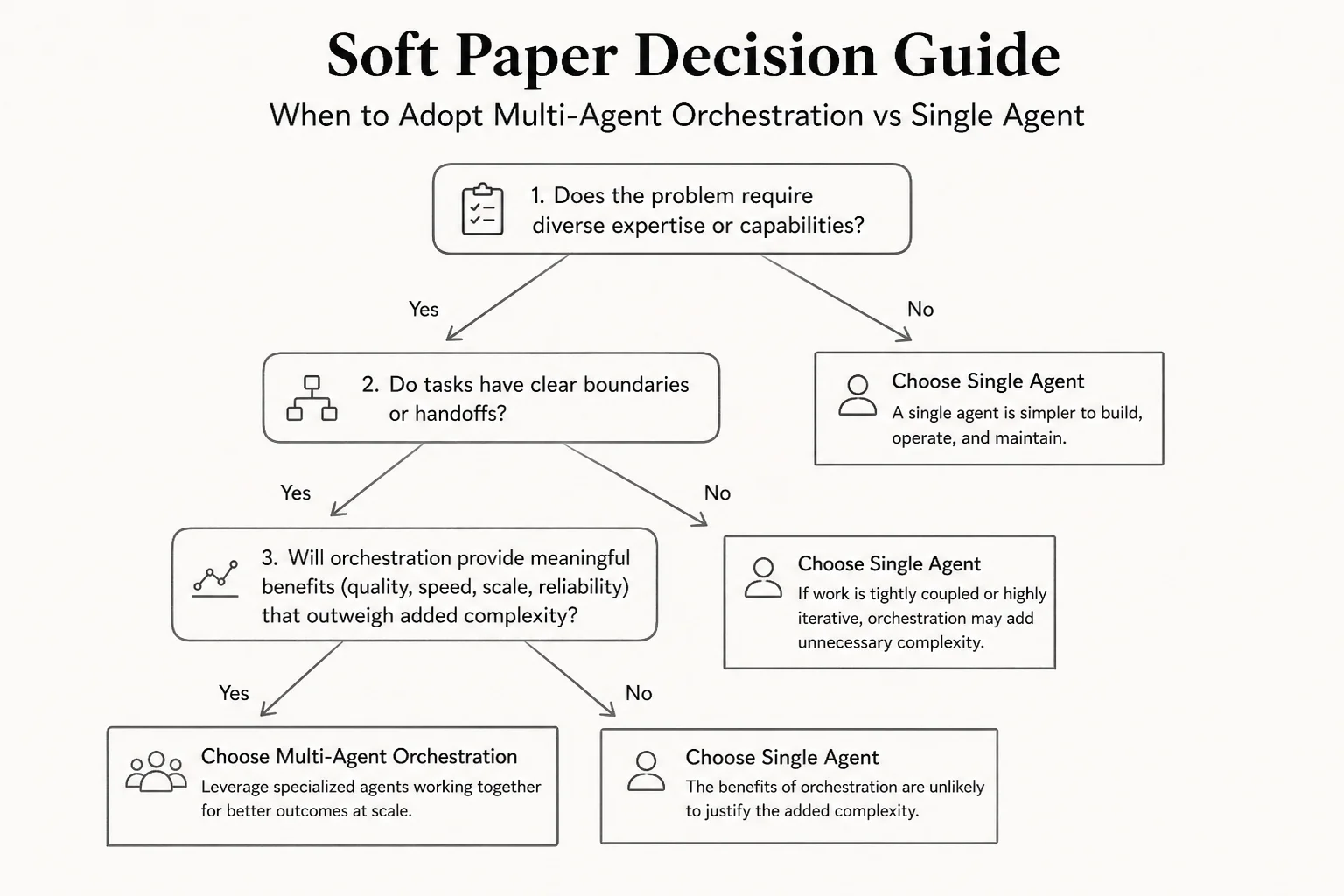
- Complexity: Worktrees and parallel agents help power users; they overwhelm teams still struggling with one agent.
- Portal upsell: The multiplier story peaks when you already run a service catalog discipline.
- Beta risk: Public beta means APIs and UX will move.
- Not a model: Xirp will not fix a weak eval harness or bad repo hygiene.
I would pilot Xirp where parallel agents are already happening organically (platform teams, AI-heavy product squads). I would not deploy it to a team still onboarding their first coding assistant.
How this fits the August 2026 tooling wave
The same Rundown AI digest that covered Xirp also highlighted Meta's open Muse Glimmer agents and OpenAI's gated cyber models. Different headlines, one substrate: agents are default, and the bottleneck moved to orchestration, context, and governance.
Spotify's bet is that winners compound institutional knowledge into shared systems instead of private prompt files. That is the same reason I push clients toward checked-in skills, MCP servers with clear ownership, and routing policies you can audit.
Try Xirp at xirp.spotify.com if you want Spotify's version of that stack. Or steal the worktree + shared context pattern manually this week. Either way, stop pretending one Claude session per laptop scales.
Bottom line
Xirp is the clearest 2026 statement yet that multi-agent coding is normal and needs infrastructure the way CI did a decade ago. Portal optional, context mandatory.
If your team is parallelizing agents and bleeding time on handoffs, book a discovery call. I will help you decide whether a platform like Xirp fits, or whether a lighter shared-skills repo gets you 80% of the win.