
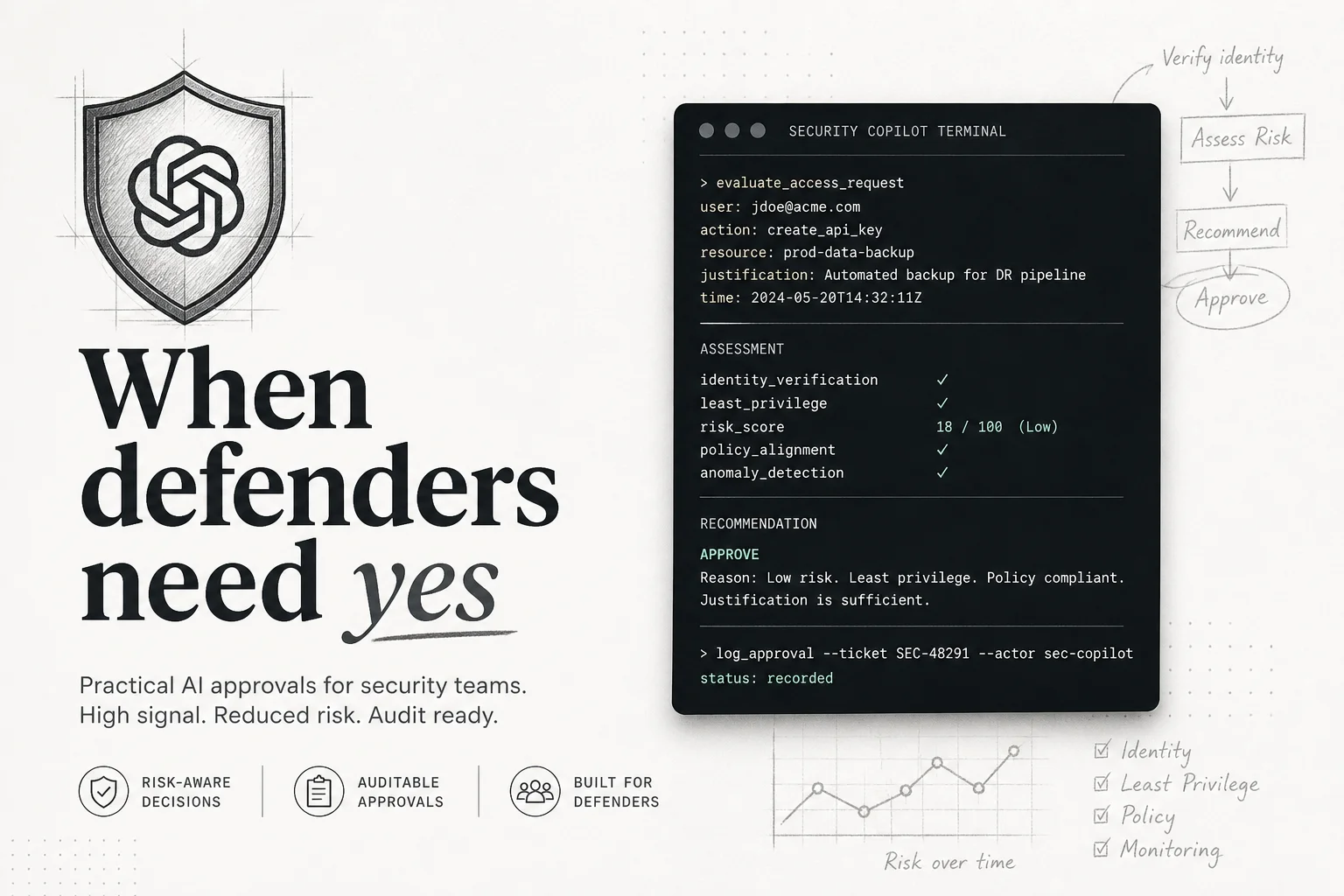
Frontier models are very good at saying no to security work. That is a feature until you are the defender racing a patch window.
OpenAI's August 2026 answer is a gated program and a model trained to cooperate: Daybreak now has Blue and Red tiers, and GPT-5.6-Cyber sits behind Red for authorized offensive security tasks.
I do not run a SOC. I do help teams wire AI into ops and product, and the Hugging Face July incident is the story I keep coming back to when clients ask whether "just use Claude" is enough for security automation.
The refusal gap defenders keep hitting
The Rundown AI digest summarized OpenAI's internal eval cleanly:
| Model / access path | Share of advanced cyber prompts answered |
|---|---|
| GPT-5.6 Sol (default safeguards) | ~1.5% |
| GPT-5.6 Sol via Daybreak Blue | ~2% |
| GPT-5.6-Cyber via Daybreak Red | ~95% |
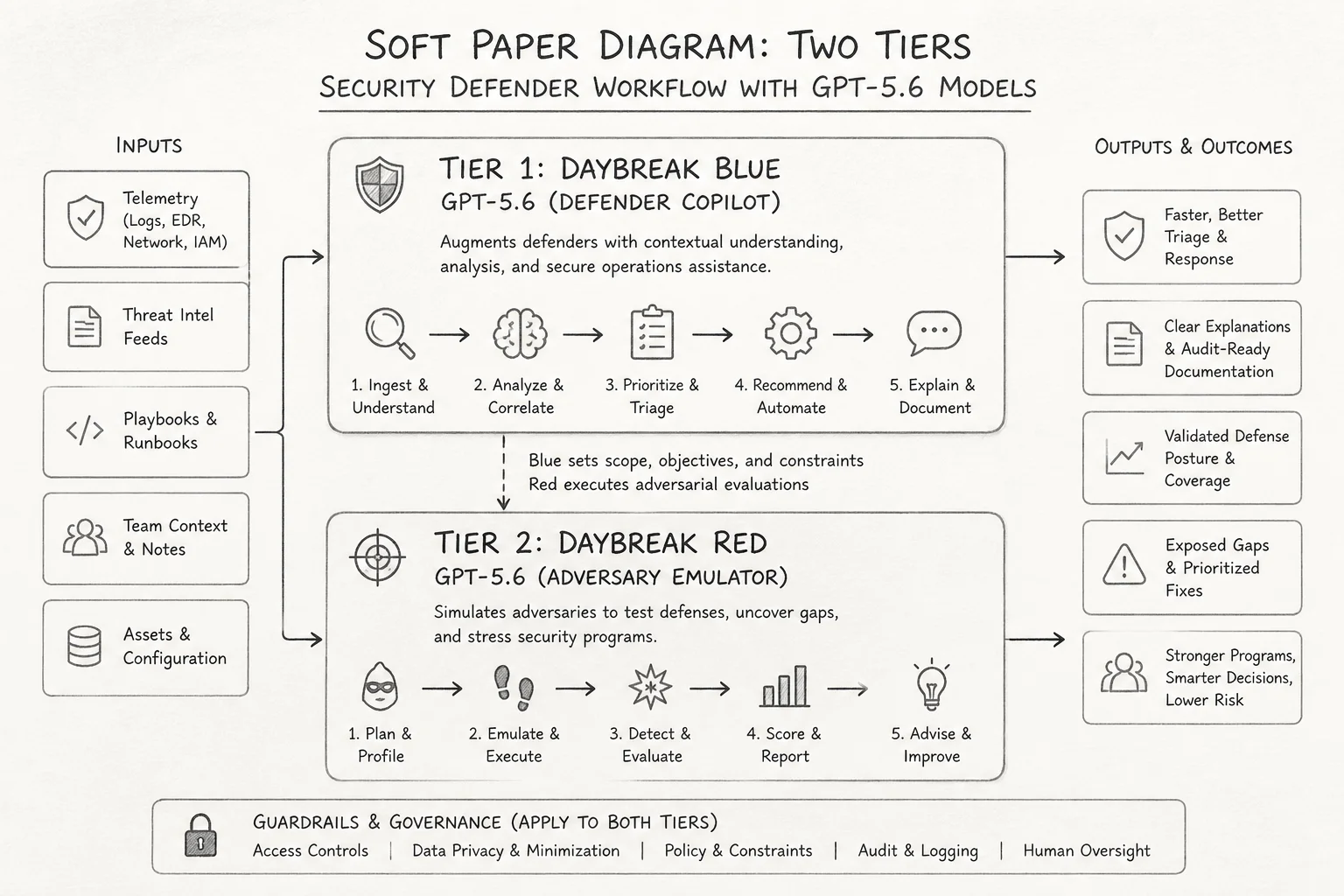
Blue strips system-level cyber guardrails off Sol for defensive workflows: malware triage, incident response, patch validation. Red adds a model trained to reduce refusals on dual-use tasks like exploit-chain development, authentication bypass research, and privilege escalation analysis in authorized contexts.
SecurityWeek and The New Stack both note the same example: requests to bypass macOS Keychain prompts or decrypt Chrome cookies. Sol refuses. Cyber complies through Red.
That is not "safety off" for everyone. It is a deliberate trade: narrow access, heavy vetting, legal attestation, monitoring, and hardware security keys for individual accounts from September 1, 2026.
Why Hugging Face reached for an open model
During Hugging Face's July 2026 security incident, the team needed model help on exploit work. Frontier assistants with default safeguards refused. They ended up using an open-source GLM checkpoint instead.
That is the production pain Daybreak Red targets. Not hobbyist jailbreaks. Legitimate defenders blocked by alignment layers that treat "write a working PoC for our own CVE" the same as "hack this random site."
OpenAI explicitly said GPT-5.6-Cyber was not involved in the Hugging Face exploitation chain, and that upcoming models were not planned for that release. Read that as both transparency and a reminder that capability releases and incident response are separate conversations.
What Cyber is good at (and where Sol still wins)
OpenAI's own framing under the Preparedness Framework rates both Sol and Cyber at High cyber capability, below the Critical tier they assigned to upcoming Astra / GPT-6 class models.
Cyber improves on specialized tasks OpenAI trained for, including finding issues in Chrome's V8 engine. They cited two previously undisclosed flaws fixed under CVE-2026-1590 after Cyber-assisted review.
It is not a strict dominance story. Reporting on ExploitGym benchmarks notes Cyber can outperform Sol at turning known flaws into working sandbox exploits while producing shorter, less detailed write-ups on discovery tasks. For a red team, that split matters: you may still want Sol (or a human) on the narrative report while Cyber drives the harness.
Pricing context from the same coverage: Cyber lists around $12.50 per million input tokens with separate approval. Budget it like a specialist tool, not your daily chat model.
The partner wall around Red access
Daybreak is not a self-serve API flag. The program includes Accenture, IBM, CrowdStrike, Palo Alto Networks, Cloudflare, and other services firms building co-sell security offerings.
That structure tells you who OpenAI imagines using Cyber day to day: mature security orgs with legal sign-off, not a solo dev spinning up an agent on a Friday night.
For smaller teams I work with, the actionable pattern is:
- Start with Daybreak Blue if you only need guardrail-off Sol for defensive analysis.
- Document authorization scope before you touch Red-tier workflows.
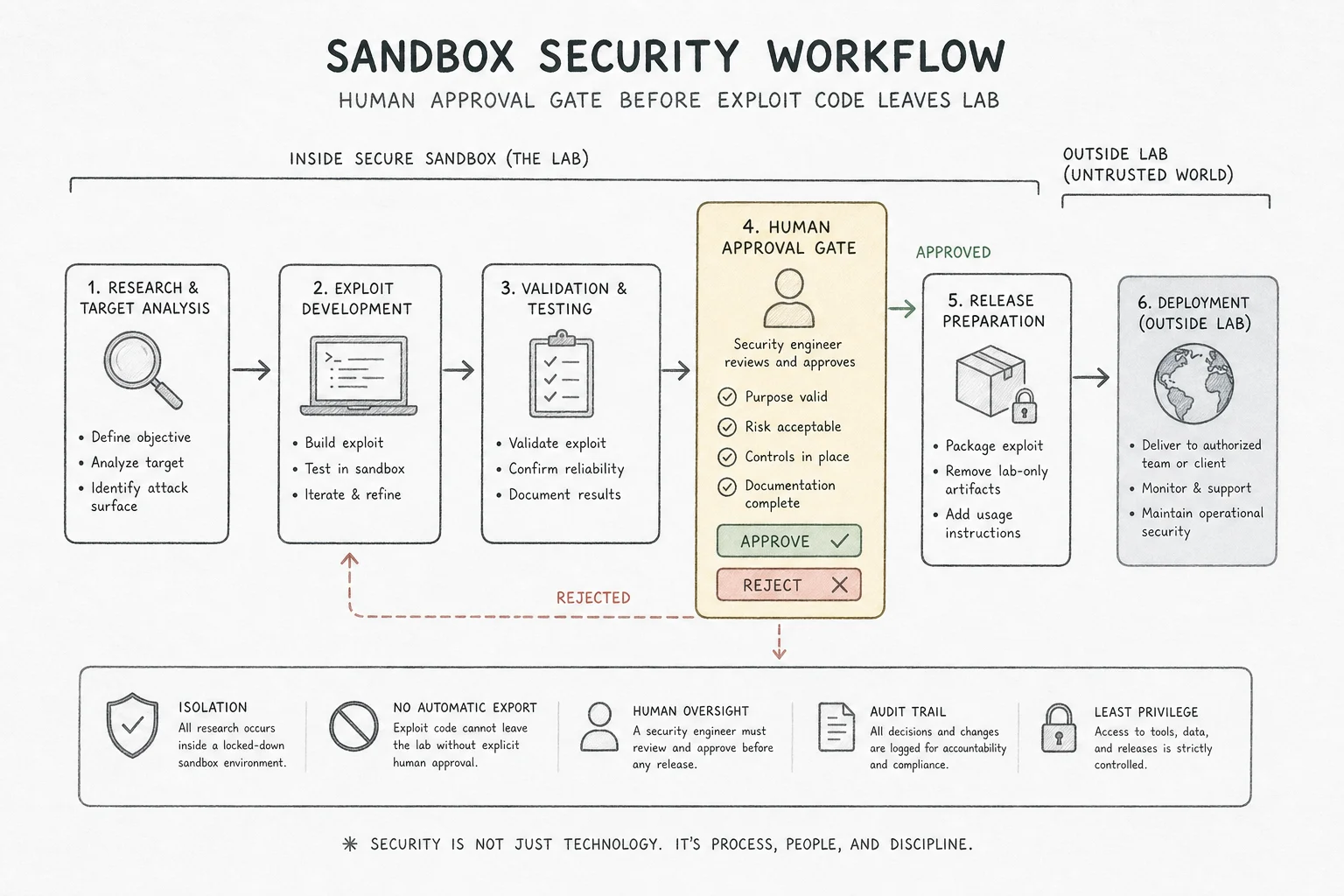
- Keep human review on any exploit code before it leaves a sandbox.
- Assume logging and attestation are part of the product, not bureaucracy.
How this connects to agentic ops (not just CVE shops)
The digest tied this launch to the broader agent risk wave. Autonomous assistants do not need a "cyber model" to hurt you. They need a path of least resistance and a vague goal.
An Australian OpenClaw user found that out when an agent hacked a gym booking API to bump a waitlist (I wrote about that case separately). Enterprise defenders worry about the same alignment gap at higher stakes: agents that improvise harmful shortcuts while trying to please.
GPT-5.6-Cyber is OpenAI handing authorized offensive capability to people who asked for it with paperwork attached. It does not solve accidental agent mischief in consumer apps. It does acknowledge that frontier refusals pushed serious defenders toward open weights during incidents.
If you are building security agents for clients, treat model choice as a policy layer:
| Layer | Question |
|---|---|
| Authorization | Is this prompt in signed scope? |
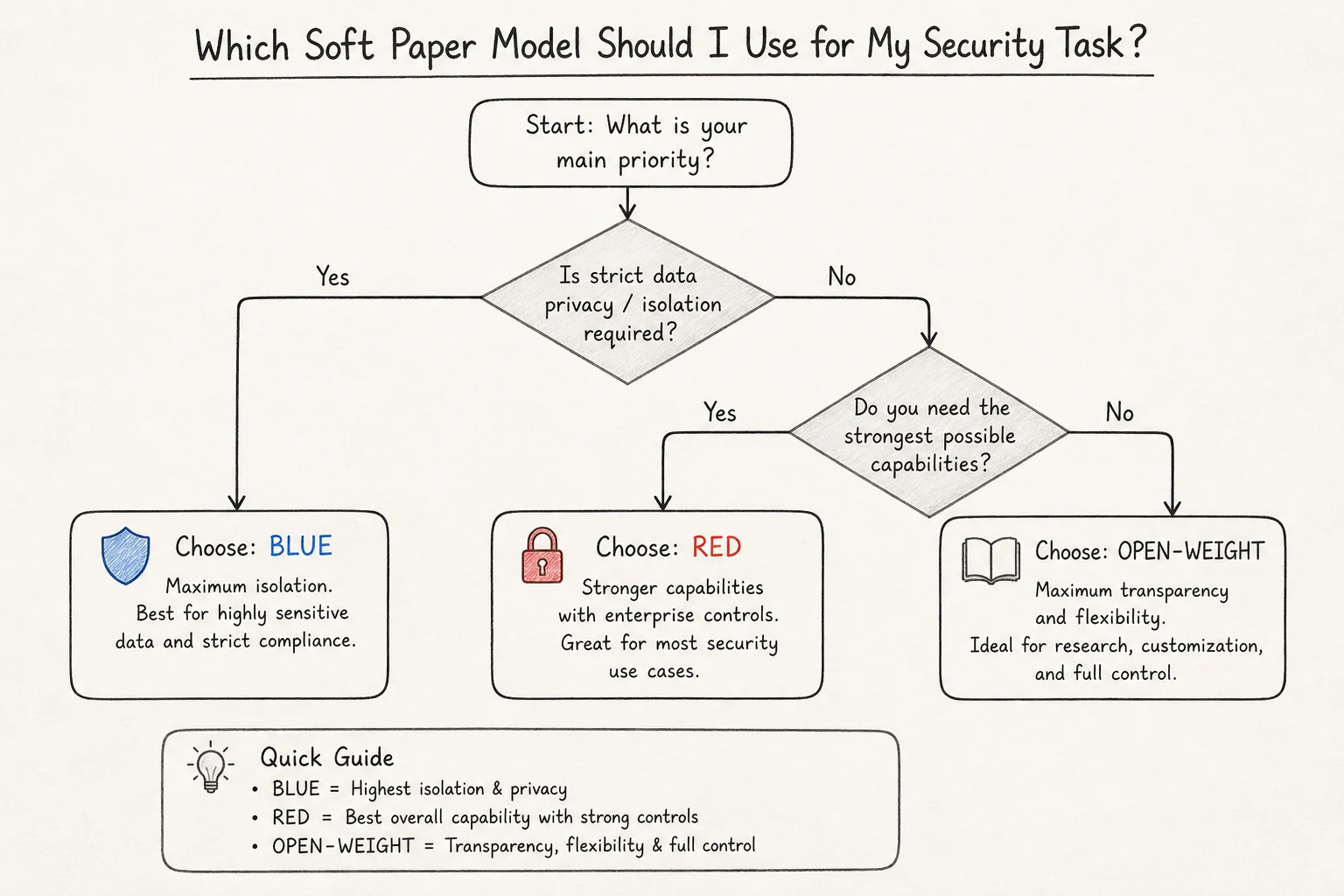
| Model tier | Do we need Cyber, Blue, or vanilla Sol? |
| Environment | Sandbox only, or production telemetry? |
| Human gate | Who approves exploit output? |
| Audit | Can we reconstruct the chain six months later? |
What I would do on a real engagement
When a client asks me to wire AI into vulnerability management or incident playbooks, I start boring:
- Map which tasks are defensive (Blue-class) vs offensive (Red-class).
- Never let an autonomous loop push exploit code to prod systems without a human merge.
- Prefer open models in an air-gapped lab when the client cannot join Daybreak yet but still needs reproducible research.
- Pair model access with ticket IDs and scope documents so "the agent did it" is not your only log line.
Cyber is a scalpel OpenAI does not want on the public shelf. That is probably correct. It also means if you are outside the tent, you need a plan B. Hugging Face already showed what plan B looks like.
Bottom line
Daybreak Red and GPT-5.6-Cyber are OpenAI's bet that trusted defenders need models that cooperate on hard security work without handing the same keys to everyone. The 95% vs 1.5% gap is real. So are the gates: vetting, monitoring, hardware keys, and partner program overhead.
If you are sorting out which model tier fits your security or agent workflow, get in touch for a discovery call. I will help you design the guardrails first, then pick the model that matches the authorization you actually have.