
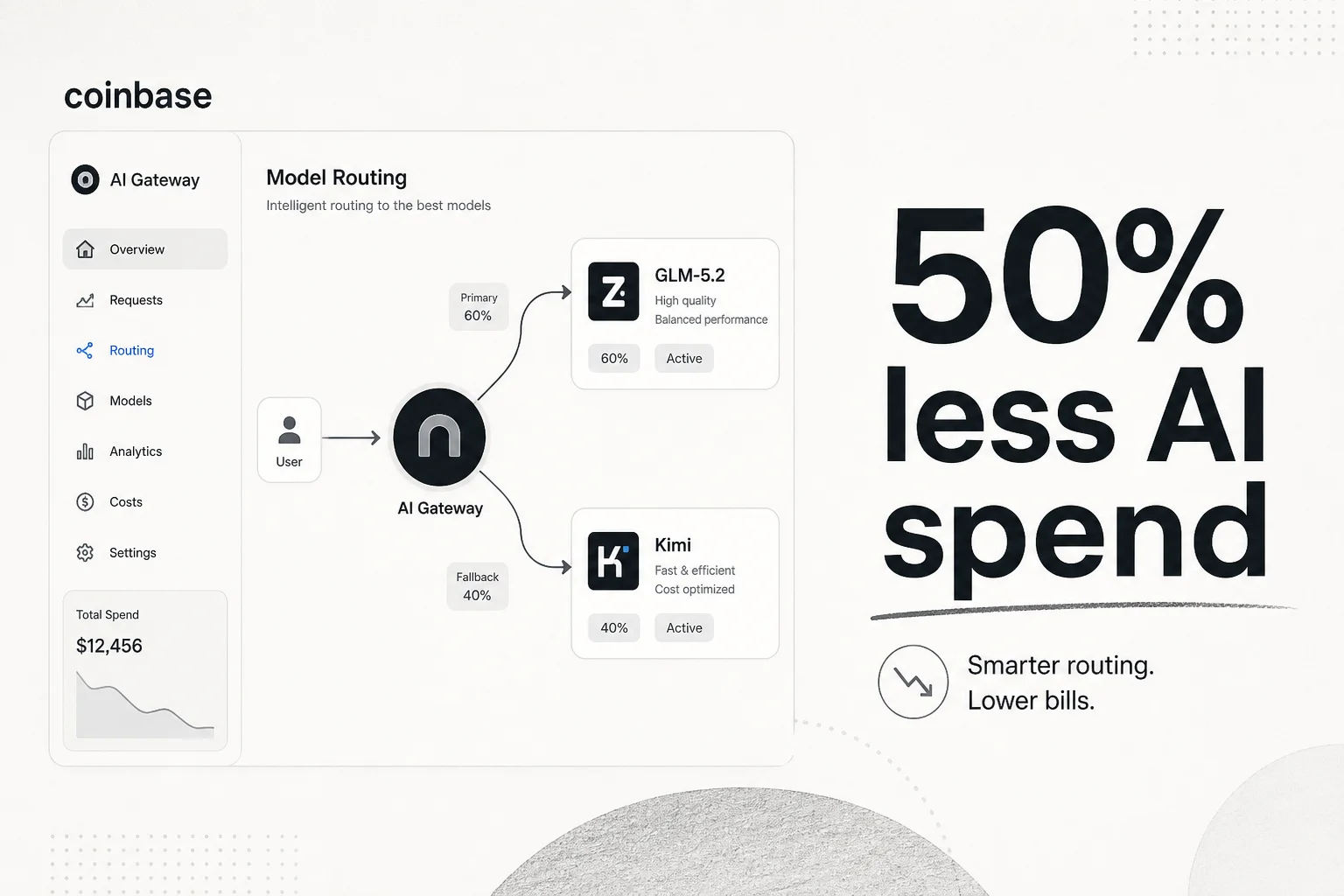
Coinbase is not a small startup experimenting with ChatGPT. CEO Brian Armstrong said the company now runs roughly 1,200 full-time AI agents, normalized from compute hours to a 40-60 hour workweek equivalent. Token usage keeps climbing. The AI bill dropped by about half.
That combination is rare. Most teams either cap usage or accept runaway spend. Coinbase did neither. Armstrong outlined five strategies on X in late June 2026, and they map cleanly to what I recommend for client agent deployments.
The problem every engineering org is hitting
After the first wave of closed-model adoption, finance started asking harder questions. API spend scaled with every new agent experiment. Vendor risk grew when frontier models faced export restrictions. Teams needed high-performance alternatives they could control without fear of abrupt platform loss.
Coinbase's answer was not "use less AI." It was "use AI smarter." The more you spend, the more impact Armstrong expects. Usage is visible per developer but not capped. Accountability without blocking experimentation.
That mindset only works if the infrastructure makes cheap defaults easy and expensive overrides intentional.
Strategy 1: Better default models
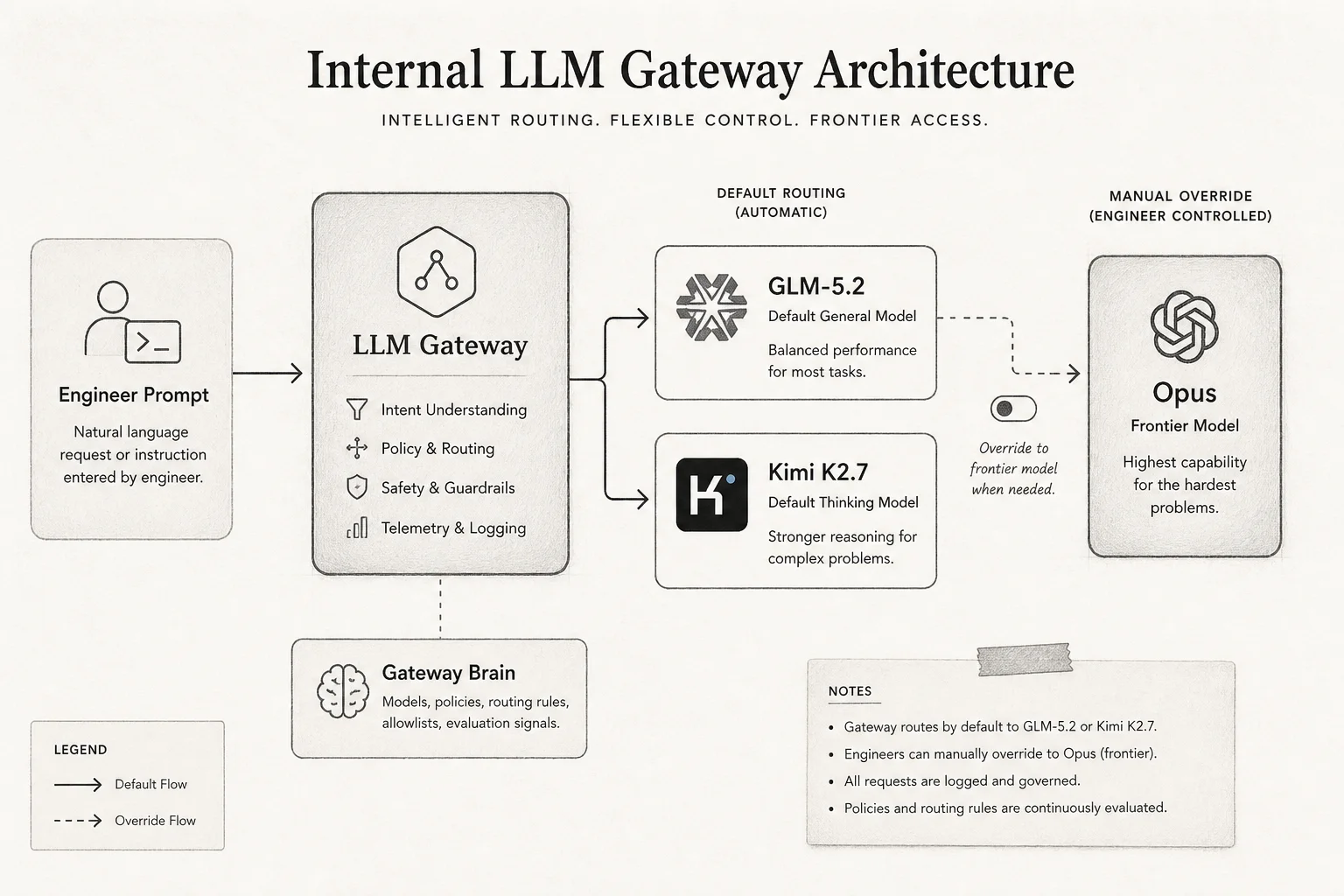
The first lever is what model loads when an engineer opens a prompt. Coinbase switched defaults to open-weight models: GLM-5.2 and Kimi K2.7.
Engineers can still pick any model for a specific job. Armstrong's point is that defaults shape 80% of behavior before anyone thinks about routing.
| Model tier | Input $/M | Output $/M | Typical use |
|---|---|---|---|
| GLM-5.2 | $1.40 | $4.40 | Scoped coding, refactors, context-heavy reads |
| Kimi K2.7 | low (open) | low (open) | Alternative open workhorse |
| Claude Opus 4.8 | $5.00 | $25.00 | Planning, hard edge cases |
The pricing gap is three to six times per token. Coinbase also self-hosts these open models, so code and query data stay inside their environment. That removes a separate compliance conversation from the cost one.
For teams without Coinbase's GPU fleet, hosted APIs on OpenRouter or Z.ai still capture most of the per-token savings. Self-hosting is a later optimization, not a prerequisite to start routing.
Strategy 2: Task-based autonomous routing
Armstrong's second strategy: humans should not choose models. AI should.
The pattern is familiar from production ML systems. You want a frontier model for planning and architecture. You do not need one for execution tasks where a cheaper model performs the same work.
Coinbase built an internal LLM gateway that intercepts every prompt and routes based on:
- Task complexity
- Real-time pricing
- Cache state
- Model availability
The gateway makes a split-second decision: does this workload need expensive reasoning, or can a faster alternative handle it?
That is the same architecture Cursor Router productizes for IDE users. Early enterprise customers reported 30-50% lower spend versus routing everything to Opus 4.8. Coinbase's results suggest the savings hold at 1,200-agent scale.
If you are building your own gateway, start with simple rules before training a classifier:
planning:
  models: [opus-4.8, gpt-5.5-high]
  triggers: [new_repo, architecture, security_review]

execution:
  models: [glm-5.2-high, kimi-k2.7]
  triggers: [refactor, test_fix, lint, scoped_edit]

escalation:
  on: [test_failure, diff_apply_error, loop_stall_count > 2]
  to: opus-4.8
Keep a fallback path. When GLM-5.2 fails a self-check, retry that specific task on frontier rather than failing the user.
Strategy 3: Aggressive caching
Caching is the lever most teams ignore because it is boring infrastructure work.
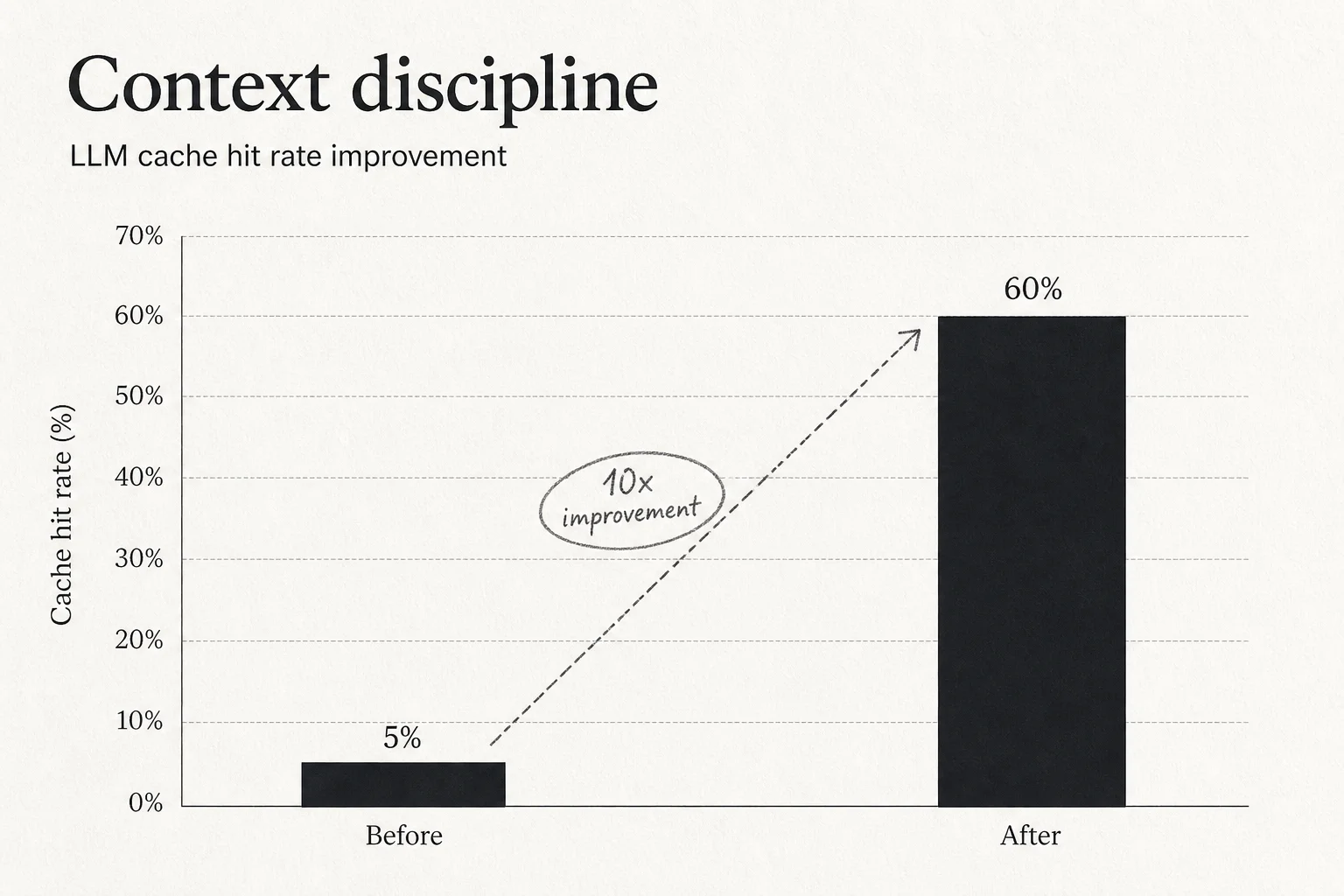
Coinbase pushed cache hit rate from about 5% to 60% by:
- Keeping a conversation locked to the same model while cached context stays valid
- Enforcing lean context windows
- Starting fresh sessions for new tasks instead of dragging stale history
A 12x jump in cache hits is not a model upgrade. It is context discipline. Every redundant re-read of a 500K-token repo costs money whether the model is cheap or expensive.
I call this context engineering in client work. The model choice matters less when you feed it garbage context on every turn.
Strategy 4: Visible spend without hard caps
Armstrong's fourth point: make usage visible per developer, but do not cap it.
That sounds like a culture bet, and it is. Coinbase reports that 91% of engineers never hit their old usage limits anyway. Visibility creates accountability. Caps create workarounds.
For smaller teams, the equivalent is a weekly spend dashboard per project or per engineer, tied to shipped outcomes. If someone burns $200 in tokens and ships a feature that saves 20 hours of manual work, that is a win. If they burn $200 debugging a harness bug, that is a signal to fix the harness.
Strategy 5: Measure impact, not tokens
The fifth strategy ties spend to expected impact. More AI investment should correlate with more output, not more idle experimentation.
Coinbase tracks agent compute hours as a normalized headcount metric. That is extreme at their scale. The portable version: log cost per finished task inside your agent harness. Tokens consumed, tool steps, human corrections, and whether the ticket actually closed.
Artificial Analysis publishes cost-per-task on their Coding Agent Index. That is the benchmark I put in proposal decks because it measures finished work, not list price per million tokens.
What this looks like without Coinbase's budget
You do not need eight H200 GPUs on day one. A practical rollout for a 20-person engineering team:
| Week | Action |
|---|---|
| 1 | Add spend logging per developer and per project in your existing agent tool |
| 2 | Change IDE or gateway defaults to GLM-5.2 or another open workhorse |
| 3 | Write routing rules for planning vs execution tasks |
| 4 | Audit context windows; enforce fresh sessions for new tickets |
| 5 | Run A/B on cost per finished task, not vibes |
Tools that support custom Anthropic-compatible endpoints let you point Claude Code or Cline at GLM-5.2 without rebuilding your workflow. OpenRouter gives you one API key across multiple providers if you want a thinner integration layer.
The broader shift Armstrong is betting on
Vercel CEO Guillermo Rauch is making a similar architectural bet: design production systems that route across multiple model providers instead of building around one.
Foundation models are becoming interchangeable at the API layer. The durable moat is the gateway, the caching layer, the eval harness, and the routing logic you control.
Closed frontier models still win the hardest 20% of tasks. Open-weight workhorses like GLM-5.2 and Kimi K2.7 handle the routine 80% at a fraction of the cost. Coinbase proved that split works at scale when the infrastructure automates the decision.
If you are wiring agents into ops or product and want help designing a routing layer that actually reduces spend, book a free discovery call. I will map your current harness to a gateway pattern that fits your team size.