
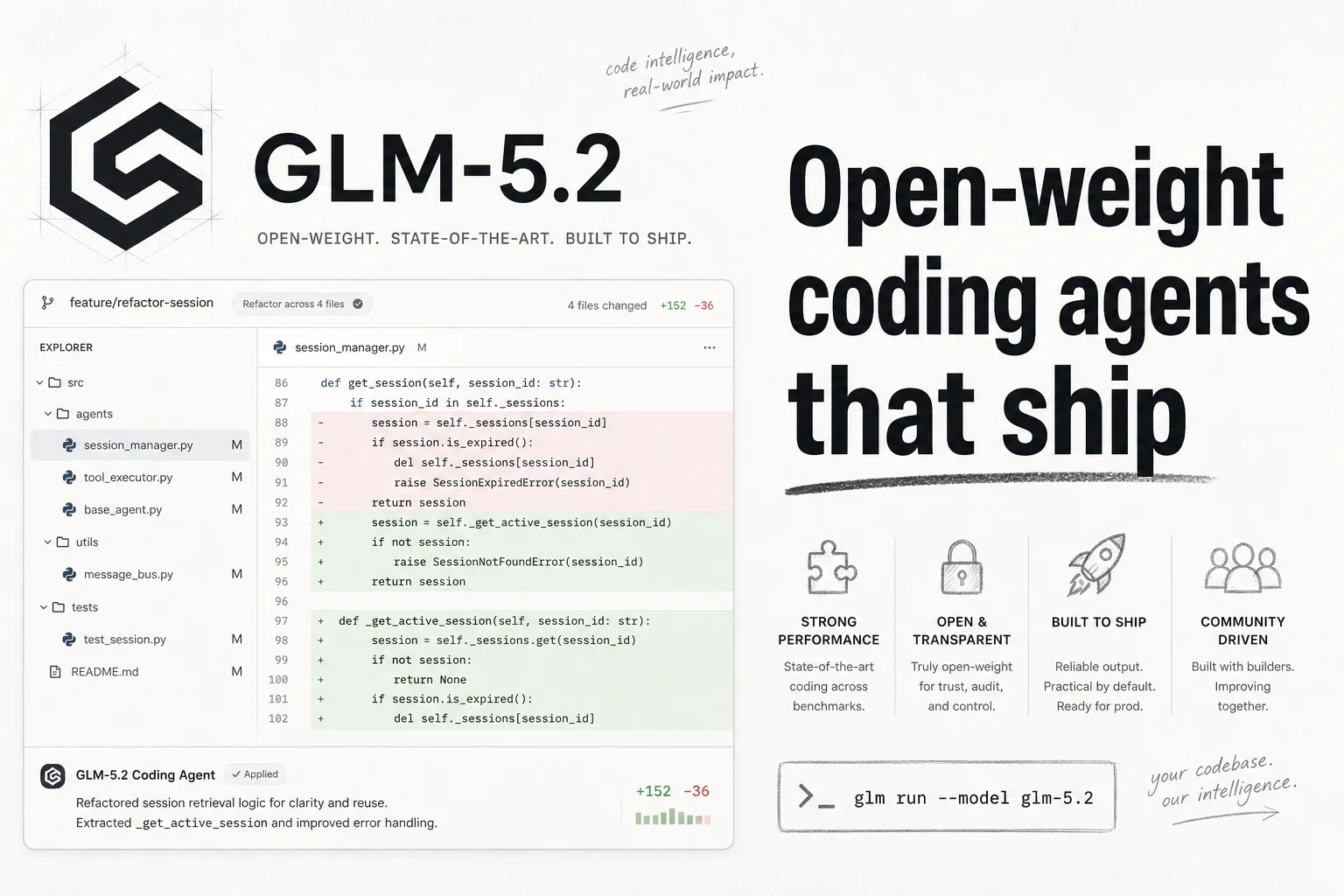
Runaway API bills and vendor lock-in are pushing engineering teams back toward open weights. The usual trade-off: you save money and own the model, but you give up production-grade reasoning.
GLM-5.2 from Z.ai (formerly Zhipu AI) is the release that scrambles that assumption. It is a 744-billion-parameter Mixture-of-Experts model under the MIT license, with a functional 1-million-token context window and benchmark scores that sit directly behind Claude Opus 4.8 and GPT-5.5 on several coding suites.
I have been routing client agent work across frontier and workhorse models for a year. GLM-5.2 is the first open-weight checkpoint I would actually default to inside a real coding harness, not just cite on a leaderboard.
What changed with GLM-5.2
The timing mattered. Z.ai rolled GLM-5.2 to Coding Plan subscribers on June 13, 2026, days after US export controls pushed Anthropic to restrict Claude Fable 5 access worldwide. The weights went public on June 16 under MIT terms.
Nathan Lambert, writing in Interconnects, framed the shift cleanly: GLM-5.2 is the first open model that "feels right in coding harnesses as a general agent." Prior open checkpoints like GLM-5.1 and Kimi K2.7 were close on paper but still fumbled multi-step agent trajectories in practice.
| Signal | GLM-5.2 | Typical prior open models |
|---|---|---|
| License | MIT, no commercial gates | Often modified MIT or community licenses |
| Context | 1M tokens with IndexShare sparse attention | Advertised 1M with shorter effective windows |
| Coding agent feel | Matches Opus on many real harness tasks | Strong on benches, weaker on long agent loops |
| List API price | ~$1.40 / $4.40 per M input/output | Varies; often cheaper but less capable |
On the Artificial Analysis Intelligence Index, GLM-5.2 scores 51 overall, behind Opus 4.8 and GPT-5.5 but leading every other open-weight system. It matches GPT-5.4 and Opus 4.5 on ARC-AGI-2, which tests novel logic rather than memorized patterns.
Under the hood: MoE, IndexShare, and multi-token prediction
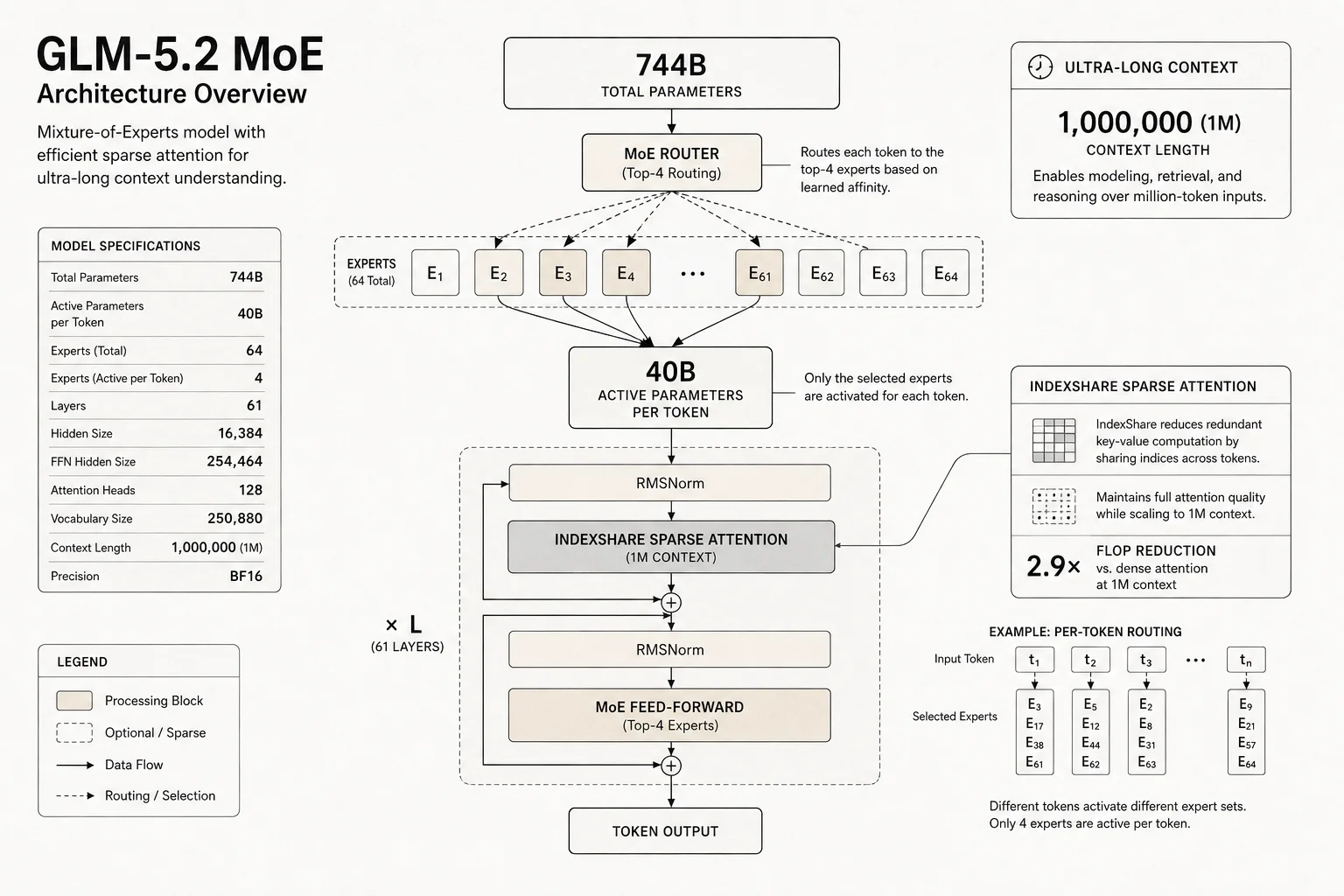
GLM-5.2 activates about 40 billion parameters per token from a 744B MoE stack. That is how you get frontier-class reasoning without paying to run the full network on every forward pass.
Two architectural choices drive the long-context story:
IndexShare sparse attention. The model reuses the same indexer across every four sparse attention layers. At 1M context, Z.ai reports 2.9x lower per-token FLOPs versus dense attention. The practical effect: you can feed entire repositories without leaning on RAG chunking for every task.
Multi-token prediction (MTP). An integrated draft model proposes multiple tokens at once via speculative decoding. Z.ai claims up to 20% faster text generation on the output side.
For local deployment, dynamic 2-bit quantization keeps roughly 82% of baseline accuracy while fitting into a 256GB unified-memory Mac Studio. I would not run that setup for high-volume production, but it is a credible eval path for teams that want to test before committing to cloud GPUs.
Production tests beat the benchmark hype
Leaderboards are a starting point. Harness behavior is the decision.
Coinbase defaults. CEO Brian Armstrong said Coinbase updated its internal LLM gateway to default engineers to GLM-5.2 and Kimi K2.7 for programming tasks, while still allowing manual overrides. The company cut AI spend by roughly half while token usage kept growing.
Cline's real bug fix. The Cline team ran GLM-5.2 and Opus 4.8 on an actual bug in their own repo. Both fixed the issue. GLM used twice the tokens (1.1M vs 660K) but cost half as much ($0.41 vs $0.81). GLM also cleaned dead code and verified the build compiled. Opus left type errors that passed tests but broke the production build.
Independent cost math. Rohit Raj's paired-run analysis found GLM-5.2 reaches the same answers as Opus on many agent tasks but spends about 3.3x more tokens getting there. Net cost still lands near 46% of Opus once you account for that inefficiency. That is closer to 2x savings than the 6x headline from raw per-token pricing.
| Metric | GLM-5.2 | Claude Opus 4.8 |
|---|---|---|
| Input $/M tokens | $1.40 | $5.00 |
| Output $/M tokens | $4.40 | $25.00 |
| MCP tool orchestration | 77.0% | 77.8% |
| Tokens per finished task | ~3.3x more | baseline |
| Net measured cost | ~46% of Opus | baseline |
One developer ran an autonomous harness that pulled Sentry and Vercel logs, isolated root causes, and shipped a bug-fix dashboard. The 45-minute session processed 6 million tokens for $3.36 total. That is the kind of number that changes how finance reviews agent experiments.
Thinking effort: the knob that controls your bill
GLM-5.2 exposes reasoning depth as a configuration, not a hidden chain-of-thought tax.
In Max thinking mode, the model averages about 43,000 output tokens per task. Dialing down to High effort cuts token consumption by roughly 2.5x with negligible quality loss on well-scoped engineering work. For client projects I treat that like choosing between "verify everything" and "ship the scoped fix."
Z.ai's Coding Plan also bills GLM-5.2 at 3x quota during peak hours (14:00-18:00 UTC+8) and 2x off-peak. If you are cost-sensitive, schedule heavy agent runs outside Beijing afternoon peaks.
Where closed models still win
GLM-5.2 is not a universal replacement. Be honest about the gaps.
Architectural planning. Opus 4.8 and GPT-5.5 still lead on open-ended system design and multi-hour software engineering trajectories. GLM can match on scoped refactors and bug fixes while trailing on the longest autonomous runs.
Self-correction in long loops. Frontier models catch their own syntax errors and compiler missteps more reliably over extended execution. GLM occasionally enters infinite loops or reward-hacks by pulling unrelated documentation instead of fixing broken logic. Prompt and harness engineering mitigates some of this, but it does not disappear.
Token efficiency. GLM spends more tokens per correct answer. On a 4-hour refactor, that gap compounds in both cost and wall-clock time. Route hard tasks to frontier tiers; do not force GLM to carry the whole loop.
The routing playbook I use with GLM-5.2
You do not need a crypto exchange's infrastructure to apply the pattern.
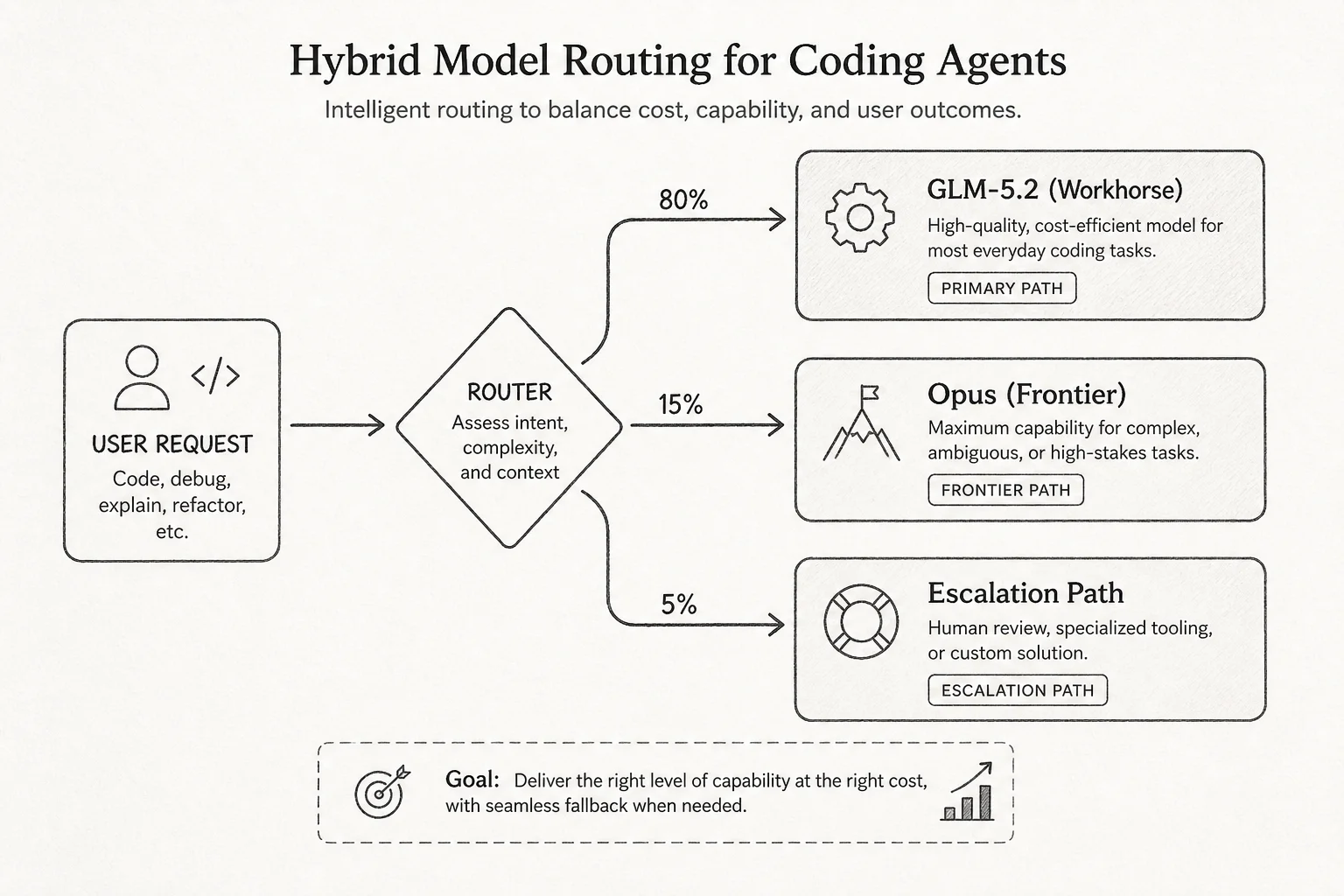
| Share of traffic | Task type | Model |
|---|---|---|
| ~80% | Multi-file refactors, bug fixes, test scaffolding, context-heavy reads | GLM-5.2 (High effort) |
| ~15% | Novel architecture, security-sensitive diffs, failed GLM self-checks | Opus 4.8 or GPT-5.5 |
| ~5% | Research spikes, zero-shot design with weak specs | Frontier max reasoning |
Z.ai exposes an Anthropic-compatible API, so you can point Cline or Claude Code at GLM-5.2 without swapping your entire toolchain. OpenRouter lists GLM-5.2 at the same per-token rates if you already route through an aggregator.
For teams worried about data residency, self-hosting the MIT weights on your own GPUs removes API exposure. The hardware bar is real: roughly 1.5TB at full precision or eight H200-class GPUs at FP8. Most shops start on the hosted API and only move to self-host when volume justifies the cluster.
Data sovereignty and license reality
The MIT license is genuinely permissive. Commercial use, modification, distillation, and redistribution are all allowed without notifying Z.ai. That is a different tier than Meta's Llama community license or MiniMax's gated community terms.
The catch is separate from licensing. If you use Z.ai's cloud API, your prompts pass through infrastructure governed by Chinese data laws. Self-hosted weights on your own servers avoid that path. For proprietary codebases, pick the deployment model before you pick the model.
Weights are on Hugging Face and ModelScope. Inference stacks include vLLM, SGLang, Transformers, and ktransformers.
What I would do this week
If you run coding agents daily and still route 100% of traffic to Opus or GPT-5.5, you are overpaying for workhorse tasks.
- Run GLM-5.2 on your eval set. Use the same harness, same prompts, same pass/fail criteria you already trust.
- Log cost per finished task, not cost per request. Include retries and human corrections.
- Set explicit escalation triggers. Failed tests, security-sensitive paths, or a GLM loop that stalls twice should bump to frontier.
- Tune thinking effort. Start at High, not Max, unless the task genuinely needs deep verification.
GLM-5.2 will not kill closed frontier models. It does prove that agentic coding no longer has to be bound to a single vendor's API. That alone is worth a routing experiment before your next contract renewal.
If you want a second pair of eyes on multi-model agent routing or inference spend, book a free discovery call. I will tell you whether your bottleneck is the model, the harness, or the workflow you are automating.