
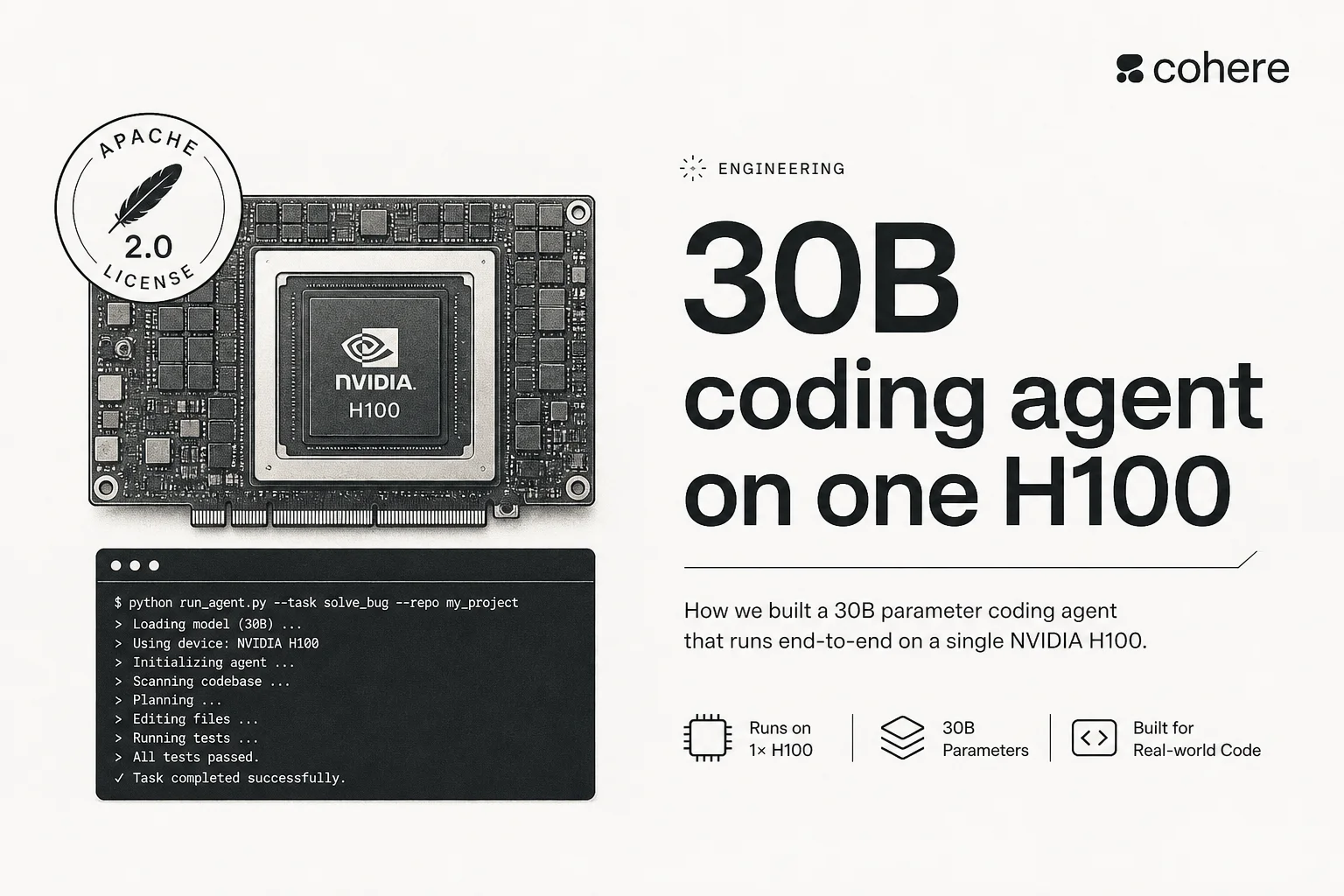
On June 9, 2026, the same week Anthropic and Cursor pushed frontier agent pricing up, Cohere shipped the opposite bet: North Mini Code, a 30B-parameter Apache 2.0 coding model you can run on one H100.
Alpha Signal framed the contrast cleanly: Fable 5 at $50 per million output tokens versus an open model you host where data never leaves your VPC. That architectural fork is real in 2026. The right choice depends on volume, residency, and how much output verbosity your agent loop tolerates.
Model card in plain language
Cohere's launch post positions North Mini Code as the first member of a new open generation aimed at sovereign developers.
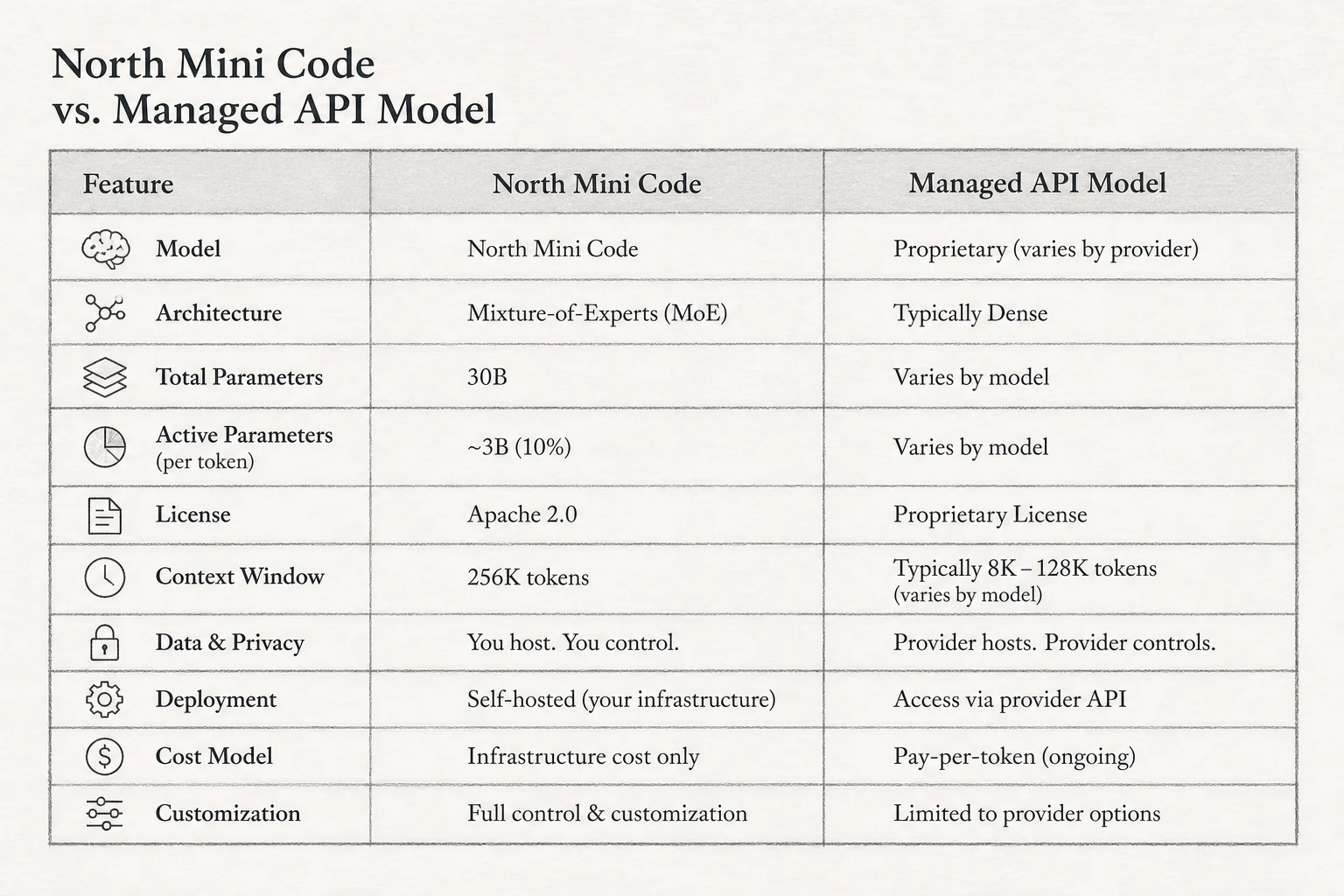
| Spec | Value |
|---|---|
| Architecture | Sparse MoE, 128 experts, 8 active per token |
| Total / active params | 30B / 3B |
| Context | 256K input, 64K max generation |
| License | Apache 2.0 |
| Weights | Hugging Face (CohereLabs/North-Mini-Code-1.0) |
| Hosted API | Cohere Chat V2, OpenRouter, Model Vault |
Training stack combines cascaded supervised fine-tuning with RLVR (reinforcement learning with verifiable rewards) over 70k+ coding tasks. Cohere optimized compatibility with OpenCode and common agent scaffolds (SWE-Agent, mini-SWE-Agent).
Reported benchmarks at release include 83.2% Pass@1 on SWE-Bench Verified, 63% on Terminal-Bench v2, and 2.8x output throughput versus Devstral Small 2 in Cohere's materials.
The verbosity catch nobody skips
VentureBeat and Artificial Analysis both flag the same production footgun: North Mini Code generates roughly 3x the output tokens of comparable models in independent testing (75M vs 25M tokens in one AA run).
For agent loops, verbosity is not a vanity metric. It is latency, cost, and context pollution:
- More tokens per step means slower turns on the same GPU
- More tool chatter fills the context window faster
- More "helpful" narration looks like progress while burning budget
Before you replace Claude API calls with self-hosted North Mini Code, benchmark on your repo's real task mix, not Cohere's press chart.
Co-founder Nick Frosst demoed the model on a Mac Studio via MLX (~20GB RAM). That matters for solo devs who will never rent an H100 but still want Apache 2.0 weights for experiments.
When self-hosting wins
I push clients toward open coding agents when at least two of these are true:
| Signal | Why North Mini Code fits |
|---|---|
| Data residency requirements | Weights and inference stay in your cloud |
| High-volume agent loops | Per-token API margin compounds monthly |
| Need to fine-tune on private repos | Apache 2.0 without commercial strings |
| Already paying for GPU fleet | Marginal cost of one more model is low |
When none of those apply, managed Fable or Composer tiers often win on time-to-green-CI despite higher list price.
When I keep managed APIs
Frontier managed models still make sense for:
- Teams without GPU ops muscle
- Tasks where the last 5–10 points on hard benchmarks pay for themselves once
- Workflows that need vendor SLAs and unified billing
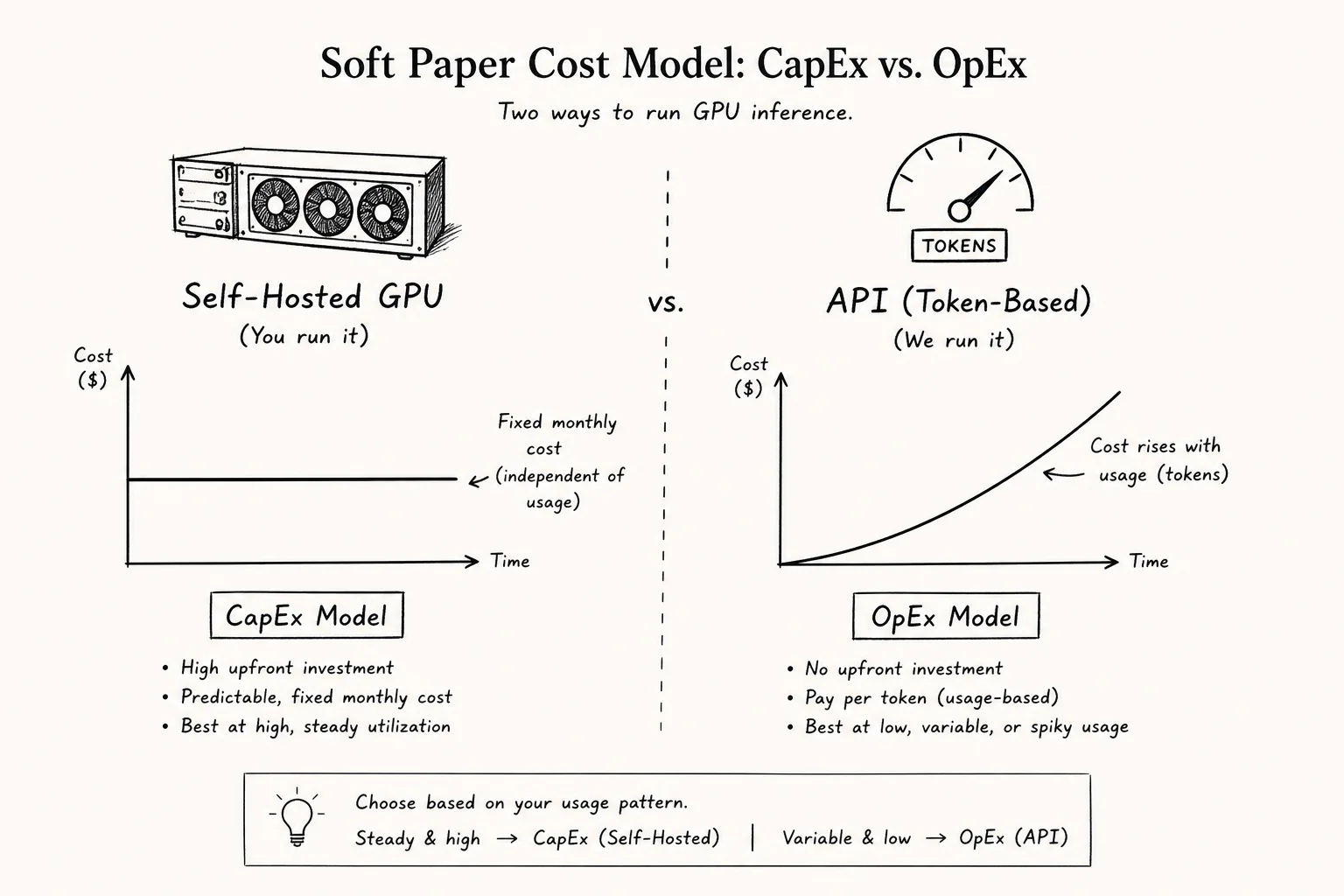
North Mini Code is not "free because open source." It is CapEx and ops instead of OpEx per token. Finance cares about that distinction even if Hacker News does not.
How I would evaluate it this week
Concrete eval script I would run before production routing:
- Pick 20 tasks from your last month of agent failures (not successes).
- Run each on North Mini Code via OpenCode or your harness with identical tools.
- Measure pass rate, wall time, output tokens per task, and human fix time.
- Compare total cost:
(GPU hourly * hours) + engineer reviewvs API bill.
If verbosity is 3x and pass rate is only 1.1x, you are worse off. If pass rate is 0.9x but data never leaves Frankfurt, you might still choose sovereignty.
Weights are on Hugging Face in BF16, FP8, and W4A16 quantizations. Start there before you commit infra.
Bottom line
North Mini Code is the most credible Apache 2.0 agentic coding release of mid-2026 for teams that can host inference. Cohere's bet ("small, open, sovereign vs large, expensive, proprietary") only holds if you measure your loops, including the verbosity tax.
If you want help designing a self-hosted agent stack or hybrid routing between open weights and managed APIs, book a free discovery call.