
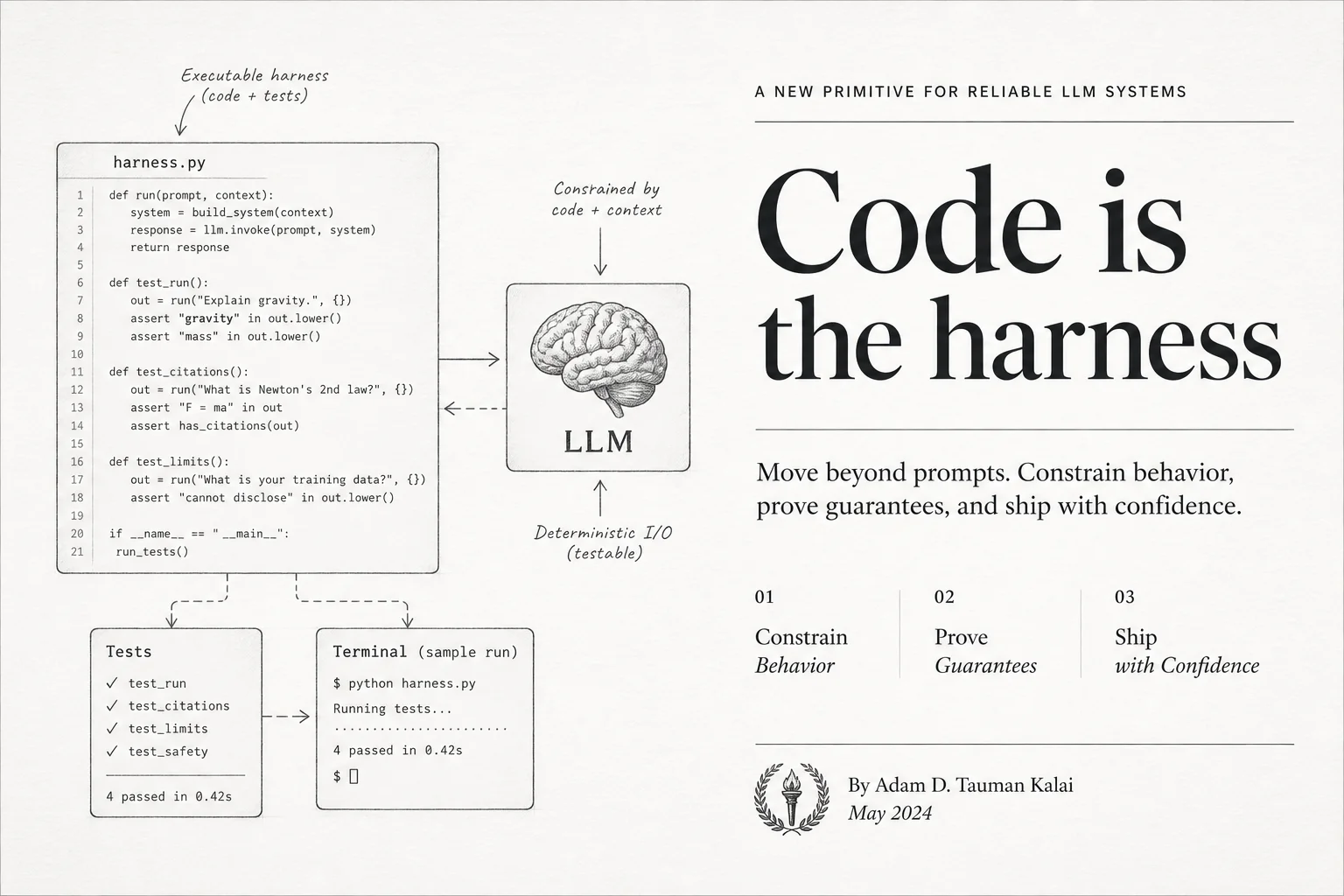
The hot take in my inbox was "Stanford and Meta say code should replace language as the backbone of AI agents."
The paper is subtler and more useful than that headline. The argument is not that LLMs stop predicting tokens. It is that long-horizon agents fail without an executable harness around the model, and code is the best material for that harness because you can run it, diff it, test it, and roll it back.
That matches what I see shipping client agents: the model is rarely the bottleneck. The bash loop, memory schema, and verification scripts are.
Two papers, one week of discourse
Alpha Signal bundled two related ideas:
| Work | Authors | Core claim |
|---|---|---|
| Code as Agent Harness (survey) | Meta, Stanford, Illinois | Code is how agents think and act, not just what they print |
| Meta-Harness (system) | Stanford, MIT, KRAFTON, others | Automate search over harness code with a coding-agent proposer |
Read together, they move the conversation from "pick a smarter model" to "engineer and optimize the shell."
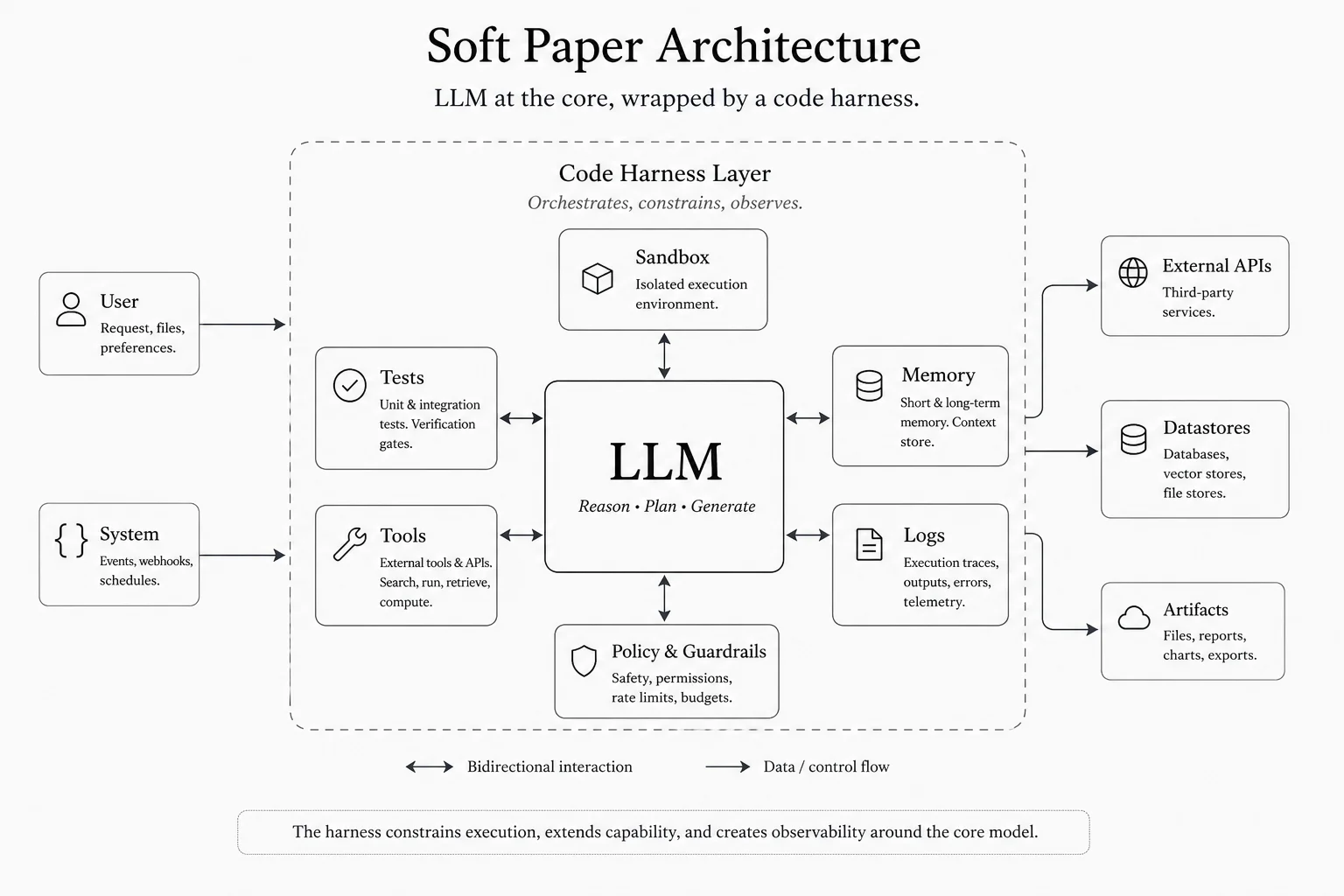
Code as Agent Harness (arXiv:2605.18747) synthesizes patterns across production systems: tests as sensors, repos as memory, logs as history, sandboxes as boundaries. A generated script is a handle the system can execute and revise, not a paragraph the user must interpret.
Meta-Harness (arXiv:2603.28052) asks the next question: if harnesses matter this much, can we search harness code the way we search hyperparameters?
Why text-only agents lose state
Pure prompting treats every turn like a fresh conversation with a sticky note. That fails when:
- Tasks span dozens of tool calls
- Mistakes hide inside long chain-of-thought
- Plans never become checkable artifacts
The survey's harness layer includes tools, interfaces, sandboxes, memory, tests, permission boundaries, execution loops, and feedback channels. Without it, a language model is stateless. With it, the same weights become an agent that can grind.
I stopped calling these "prompt engineering wins" once I saw clients debug bash wrappers more often than system prompts.
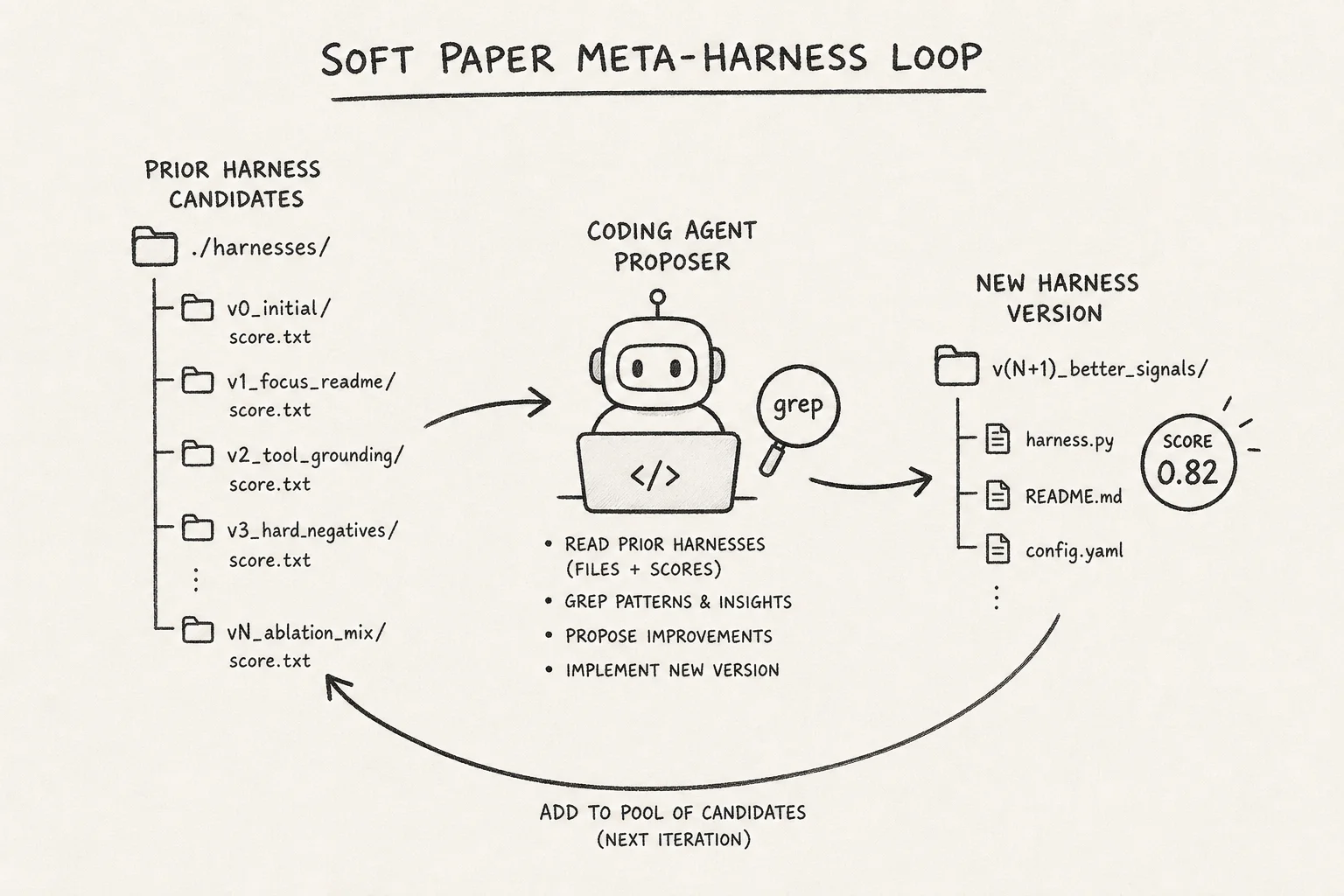
Meta-Harness: grep your failures, do not summarize them away
Meta-Harness is the empirical punchline. Instead of feeding optimizers a scalar score, it stores every candidate harness in a filesystem with source, evaluation scores, and execution traces (prompts, tool calls, state updates).
A coding-agent proposer reads that history with grep and cat, not a compressed summary. In their hardest setting, the proposer reads a median of 82 files per iteration, referencing 20+ prior candidates per step. A single evaluation can emit up to 10 million tokens of diagnostic data.
Results from the paper:
| Domain | Meta-Harness result |
|---|---|
| Online text classification | +7.7 points vs ACE with 4x fewer context tokens |
| RAG math (200 IMO-level problems) | +4.7 points average across five held-out models |
| Agentic coding (Terminal-Bench-2) | Beats hand-engineered baselines |
Reference code lives at stanford-iris-lab/meta-harness.
That workflow only became practical after coding agents improved sharply in early 2026. The outer loop is a coding agent optimizing coding agents. Gary Marcus might smile at "the bottleneck is software," but the benchmarks are not philosophical.
What I take into client work
Three harness patterns I already steal from this research line:
1. Executable plans beat bullet plans
If the agent's plan is markdown, I cannot run it. If the plan is a script with a dry-run flag, I can.
2. Tests are sensors, not afterthoughts
The survey warns that green checks can lie (incomplete tests, flaky simulators). Still, some automated sensor beats no sensor. Document which tests ran and which risks remain.
3. Treat harness code as versioned product surface
Meta-Harness treats harness directories like git history you can search. That is how I want client repos structured: agents/harness/ with eval logs, not one 400-line prompt in Notion.
Where the survey is blunt
The review does not hand you optimism for free. It calls out:
- Tests that miss bad intermediate GUI steps
- Simulators that hide physical-world risk
- Harnesses that breed false confidence because feedback looks rigorous
Every accepted action should ship with docs: which tests ran, what stayed untested, what could still blow up.
That is the adult version of "code as backbone." Not hype about replacing language, but accountability through executable artifacts.
How this connects to last week's shipping news
The same digest week Anthropic scheduled Managed Agents and Cursor landed Fable 5. Those products are harness investments:
- Cron plus vaults (ops harness)
- Parallel subagents with clean context (orchestration harness)
- CursorBench tasks drawn from real sessions (eval harness)
The Meta-Stanford line explains why those features cluster together. Agents are infrastructure; infrastructure is code.
What I would do Monday
If you maintain an in-house coding agent:
- Read the Code as Agent Harness taxonomy and tag your current loop (memory, tools, verification).
- Pick one failure mode and add an executable check, not a longer prompt.
- Log traces to disk in a structure you could grep later, even before you run Meta-Harness.
If you want help turning research harness patterns into something your team can deploy and measure, book a free discovery call. I live in the gap between arXiv and production bash scripts.