
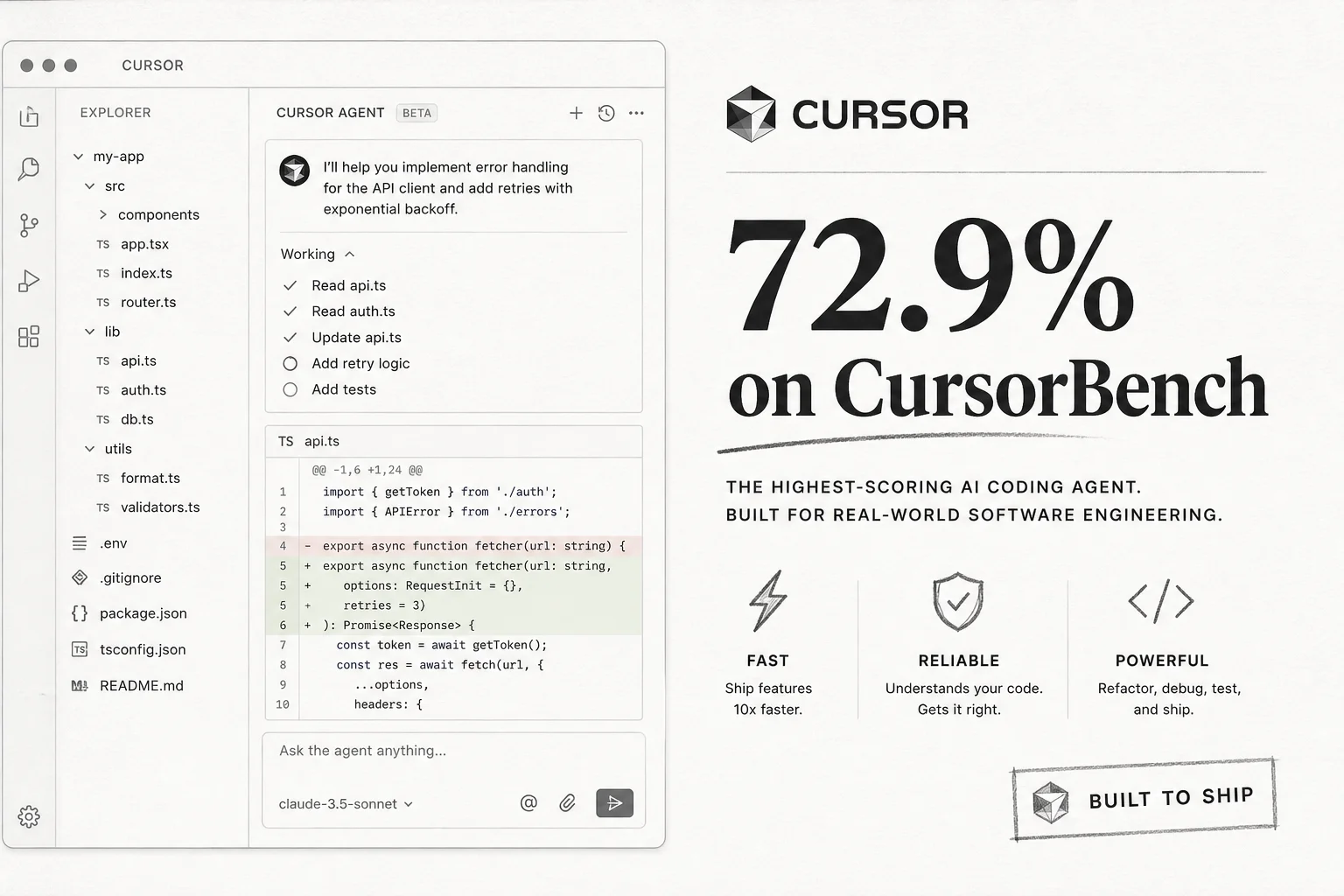
Cursor shipped Claude Fable 5 on June 9, 2026, and the number that traveled fastest was 72.9% on CursorBench, eight points above the previous best on the v3.1 task set.
That is a big jump on a benchmark Cursor built from real agent sessions: multi-file edits, tool loops, the messy work that does not show up in single-shot HumanEval charts.
I route models for clients who invoice by outcome, not by vibes. Fable 5 is the "break glass for hard agentic work" tier, not the default for every grep-and-patch loop.
What Fable 5 is optimized for
Anthropic positions Fable 5 as a Mythos-class model for autonomous knowledge work and coding. In Cursor's docs, the strengths cluster into three buckets:
| Strength | What it means in practice |
|---|---|
| Top CursorBench scores | Handles complex, multi-step repo work other models drop |
| Long-running sessions | Holds intent across async work with fewer check-ins |
| Thinking variant | Extra deliberation when the problem rewards it |
Cursor also documents automatic fallback to Opus when Fable's security guardrails trip. You keep moving without manually switching models mid-task.
Tools are the full Cursor agent stack: semantic search, file read/write, terminal, grep, and the rest of the harness you already use in agent mode.
The benchmark that maps to IDE reality
CursorBench is Cursor's answer to "scores on paper, pain in the repo." Tasks come from actual sessions: ambiguous specs, cross-module refactors, tests that fail for boring reasons.
On release, Fable 5 reported 72.9% on CursorBench v3.1. Independent trackers also cite strong numbers on SWE-Bench Pro (80.3%) and SWE-Bench Verified (95.5%), but I weight CursorBench higher when the buyer question is "will this model survive my Cursor agent loop?"
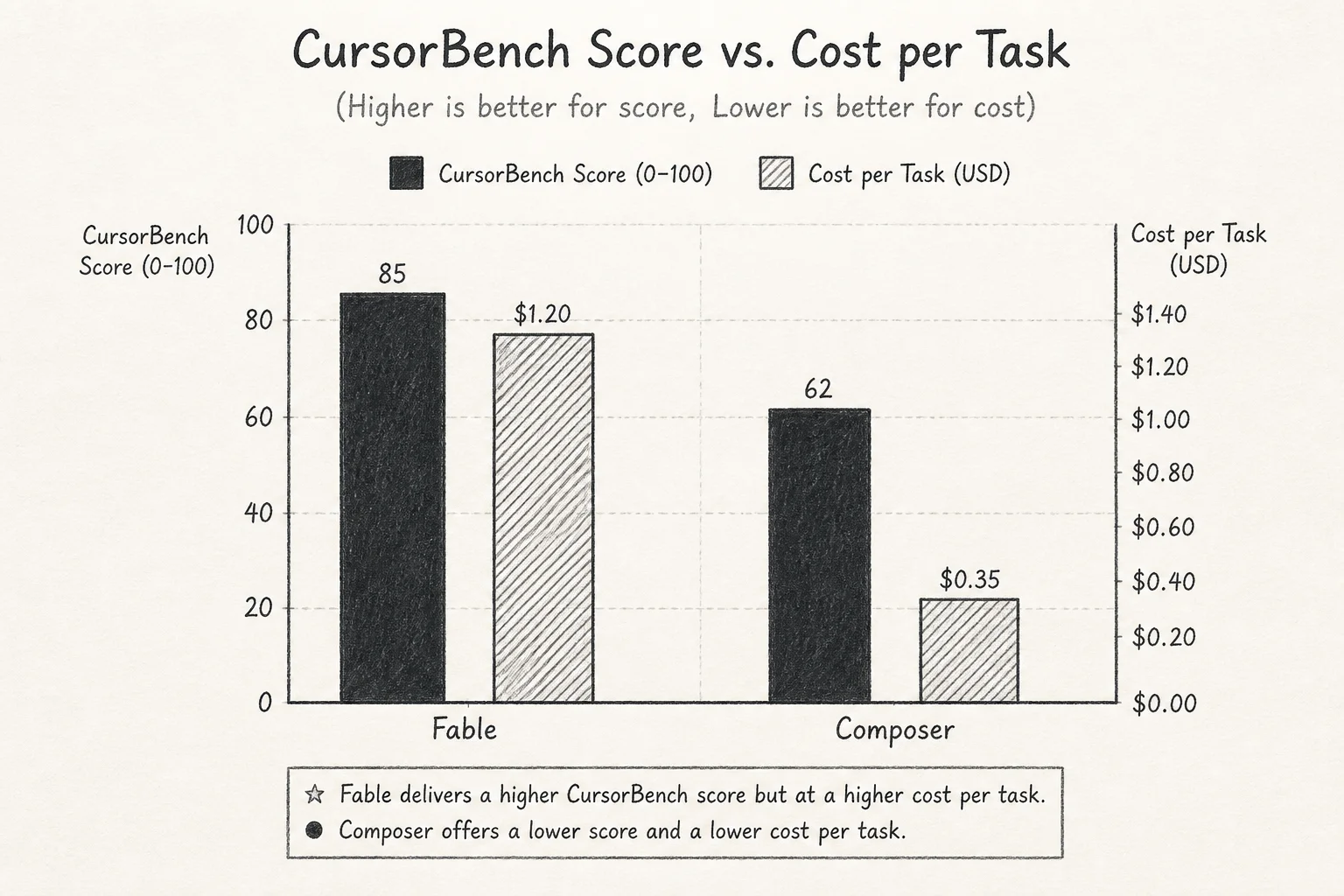
Cursor later refreshed the suite to v3.2 with harder tasks. Fable 5 Max scores around 70.5% there at roughly $17 per task and 72 steps in third-party cost breakdowns. Composer 2.5 still wins score per dollar on the same harness.
That tension is the whole story: capability up, bill up.
Pricing and privacy: read before you default to Fable
Fable 5 draws from Cursor's Other Models usage pool:
| Rate | Price |
|---|---|
| Input | $10 / million tokens |
| Output | $50 / million tokens |
That is about twice Opus 5 list pricing in the same docs. On long agent loops, output tokens compound fast.
Privacy is a separate gate. Fable models use Anthropic's 30-day retention policy for harm prevention, with enterprise data not used for training. If your team runs Cursor Privacy Mode, an admin must accept Fable's data retention terms before the model appears.
For regulated clients, I treat Fable as opt-in per team, not a silent default. The capability is real; so is the compliance conversation.
When I route to Fable vs Composer
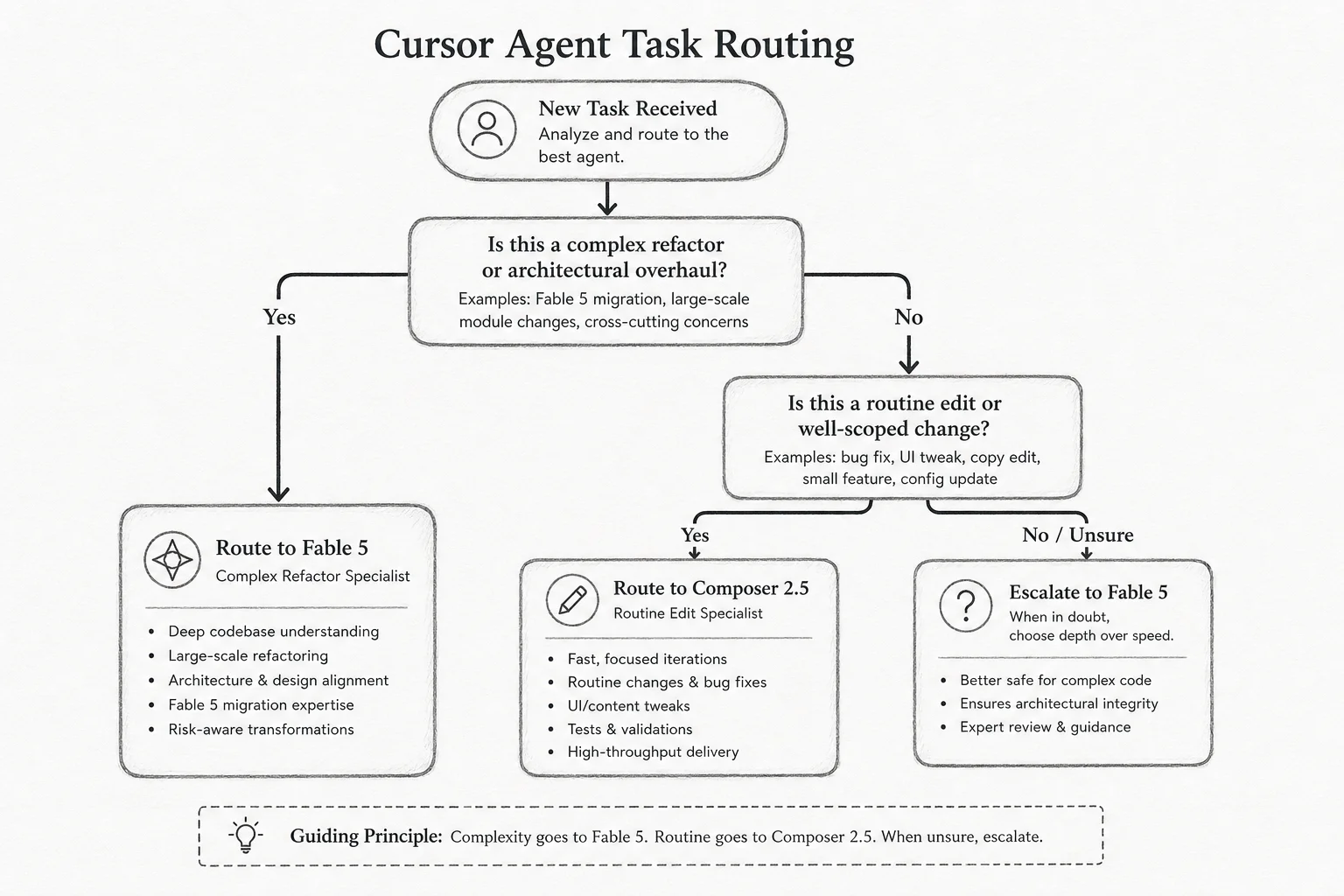
My routing table after the June 2026 wave:
| Workload | Model tier | Why |
|---|---|---|
| Module-wide refactor with weak spec | Fable 5 (thinking high) | CursorBench gap shows up on multi-file coherence |
| Lint fixes, tests, scoped edits | Composer 2.5 | ~$0.44/task vs ~$17 for Fable Max on v3.2 |
| Greenfield architecture with politics | Frontier + human review | Benchmarks underweight stakeholder ambiguity |
| Overnight agent on a client repo | Fable if budget signed off | Fewer check-ins, higher finish rate |
This mirrors what I wrote in agentic coding model routing: classify, route, escalate. Fable is the escalation tier inside Cursor, not the daily driver.
Cursor Router (for teams) productizes the same idea: cheap models for easy traffic, frontier for hard problems. Fable 5 gives you a manual version of that dial with a very explicit price sticker.
What changed in my client proposals
Three lines I added after Fable landed:
- Separate budgets for "hero refactors" vs "maintenance loops."
- Acceptance criteria tied to artifacts (tests green, PR description, migration notes), not model name.
- Retention review before enabling Fable on enterprise Privacy Mode accounts.
If a founder asks "should we just run everything on the top model?", I show the CursorBench cost table. Eight points of pass rate is not free when agents re-read half the repo every turn.
Limits I still hit in practice
Benchmarks do not capture:
- Cross-repo migrations with flaky CI
- Legal hold on code Anthropic retention policies might touch
- Teams that confuse "agent finished" with "agent was correct"
Fable reduces how often I babysit long sessions. It does not remove review. I still want human eyes on auth, billing, and schema changes no matter what the CursorBench score says.
Bottom line
Fable 5 in Cursor is the clearest "pay for finish rate" option Anthropic has shipped for IDE agents so far. 72.9% on CursorBench v3.1 is the headline; 2x Opus token pricing is the invoice.
Use it where autonomous completion saves calendar time you can measure. Keep Composer (or your own router) on the high-volume tail.
If you want help designing model routing for a production agent loop (Cursor or otherwise), book a free discovery call. I benchmark on your repo's failure modes, not someone else's leaderboard screenshot.