
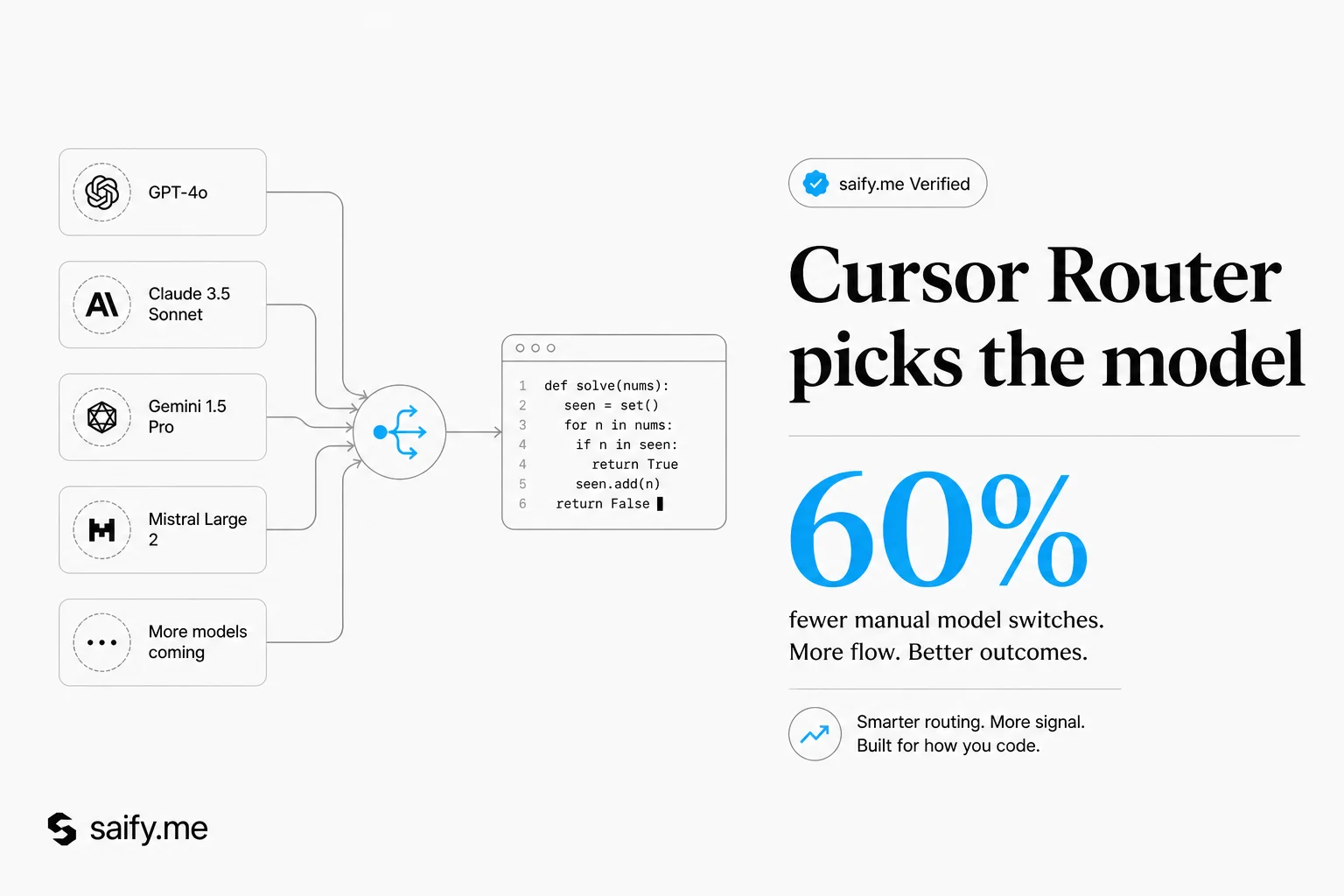
Roughly 60% of developers using Cursor pick one model and leave it there. Routine autocomplete rides frontier pricing. Spend climbs faster than output quality.
Cursor Router is the product answer: a classifier trained on hundreds of thousands of live requests that picks the model per turn. Teams and Enterprise get three tuning modes on the cost-intelligence frontier. Auto mode in the picker now runs on Router by default.
I route models for client agent stacks every week. This release is the clearest sign that defaulting to the biggest model is a billing bug, not a strategy.
How Router classifies before the model runs
Cursor routes hundreds of millions of coding requests weekly. Router uses that traffic to learn what each model does well.
The classifier reads query text, context size, task complexity, and domain. Simple edits go to price-efficient models. UI polish routes to models with stronger taste. Multi-file refactors and long-horizon bugs go to frontier reasoning tiers.
Training used 600k+ live requests. Evaluation ran as online A/B tests across millions of routed requests, optimizing for user satisfaction (AFC), not a static benchmark rubric.
Router is also cache-aware. Savings numbers include cache-miss cost from switching models mid-conversation. That matters because routing is not one decision per session. It is a sequence across dozens of turns.
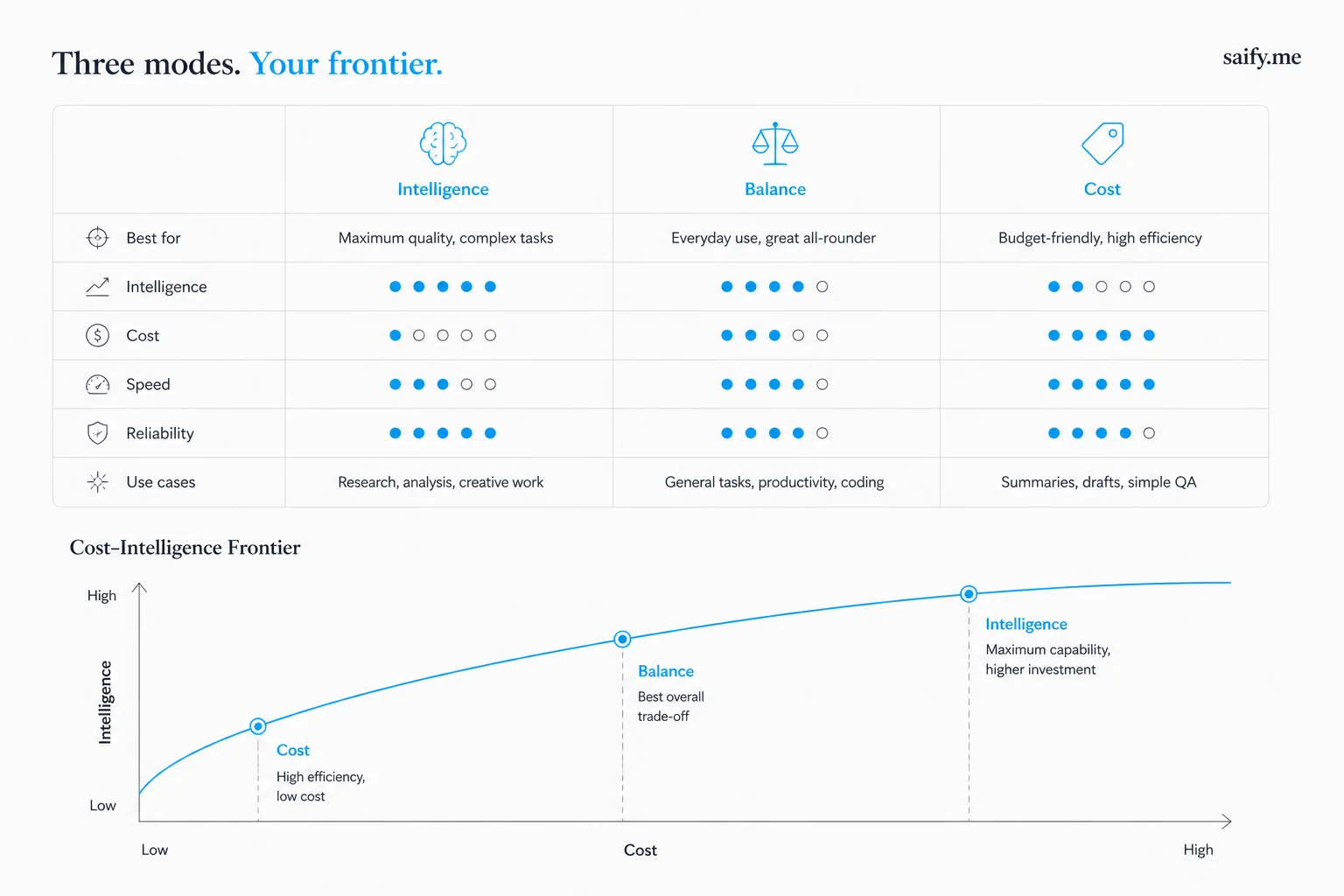
Three modes on the Pareto frontier
Admins and developers choose where Router sits on the tradeoff curve:
| Mode | What Cursor optimizes for | Reported positioning |
|---|---|---|
| Intelligence | Frontier quality without daily-driver frontier bills | Near Fable satisfaction at ~60% lower team cost; ~15% higher satisfaction than Opus 4.8 at similar spend |
| Balance | Strong quality for everyday work | Above Opus 4.8 satisfaction at ~36% lower cost; comparable satisfaction to GPT-5.6 Sol at lower spend |
| Cost | Token efficiency on lighter traffic | Highest intelligence available while minimizing spend |
Select Auto in the model picker, then pick the optimization mode. That is the user-facing control surface.
Enterprise admins can enable Router per team or group, set which modes members may use, pick the default, and allow or block specific models. That is how you roll out routing without surprise invoices from one power user on Opus all day.
Cost per commit is the metric leaders watch
Cost per request is easy to game. Engineering leaders care whether savings show up in shipped work.
Cursor compared early-access enterprise accounts (thousands of users each) against the same traffic priced entirely at Opus 4.8 API rates. Savings held at 30-50% on Auto-routed requests with no measured quality drop.
Then they looked at cost per commit:
| Path | Cost per commit (early access) |
|---|---|
| Router Intelligence mode | $6.76 |
| Router Balance mode | $4.63 |
| GPT-5.6 Sol | ~$6.76 (matched Intelligence cost, lower satisfaction) |
| Opus 4.8 | $7.34 |
| Fable 5 | $12.69 |
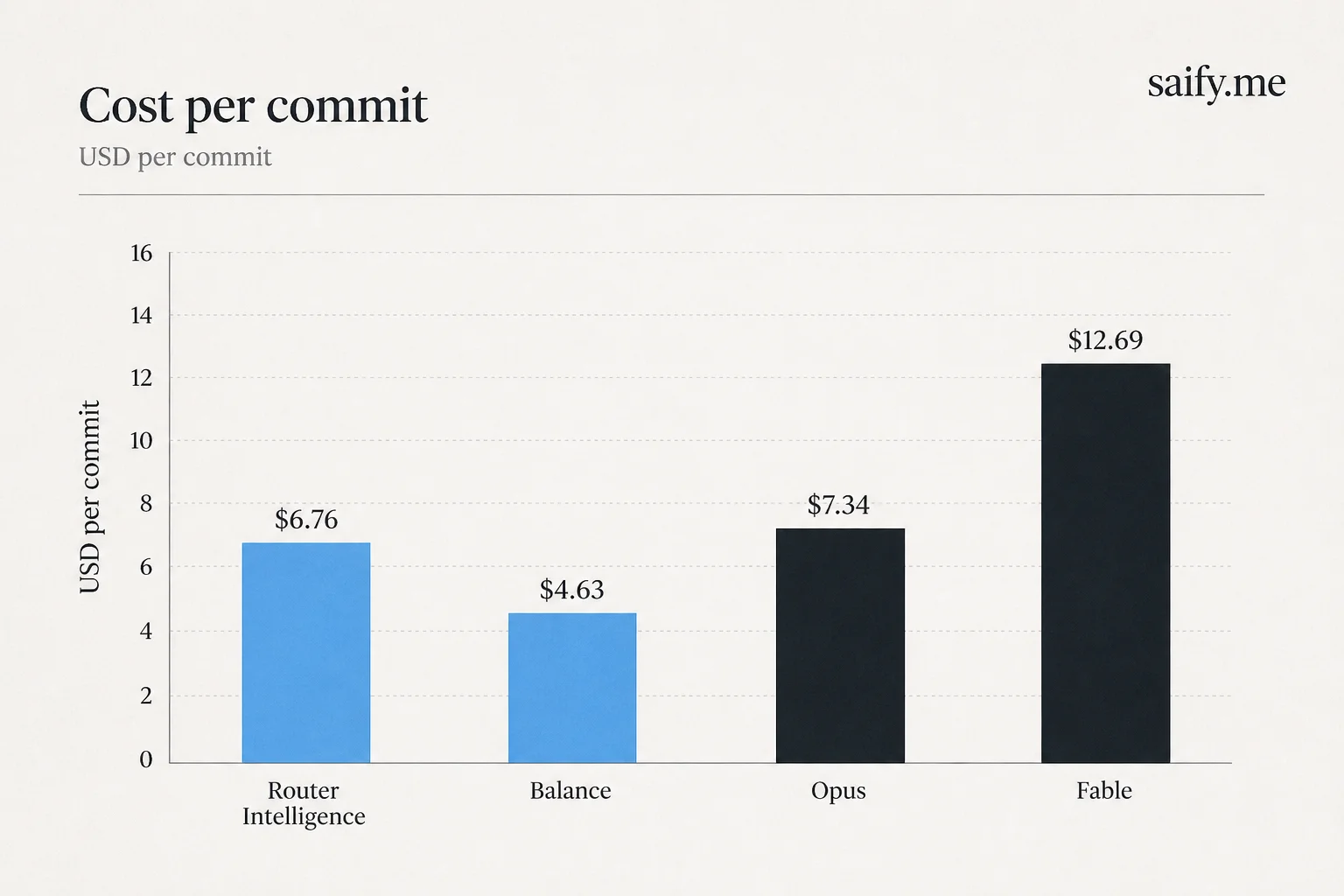
That gap is the business case. Hard tasks stay on capable models. Routine loops stop paying frontier list price.
If you already read my notes on agentic coding model routing in 2026, Router is Cursor productizing the same playbook with production-scale classifier data. Coinbase's 1,200-agent routing stack showed similar economics at a different layer.
Why online A/B beats offline eval here
Cursor chose large online tests over offline coding evals for Router quality. Offline suites are small, distant from real usage, and hard to reduce to a single score. They also miss cache-miss cost when models switch.
Online tests run across real conversations: follow-ups, errors, retries, context growth. Router metrics mirror what Cursor already uses for model launches:
- User satisfaction from conversational signals (moving on vs correcting the agent)
- Keep rate (how much generated code stays in the repo over time)
That aligns Router incentives with code that survives review, not code that wins a one-shot puzzle.
What ships alongside Router
Router is one token-efficiency lever. Cursor is also trimming harness waste:
- Dynamic tool calling loads tool schemas on first use instead of stuffing every description into every prompt
- Grok 4.5 widens the hard-task pool Router can draw from
- Composer improvements raise the floor on cheap turns
Router availability: Teams and Enterprise on desktop, web, iOS, CLI, and SDK today.
What I would configure first
If you admin a Cursor team still on a single frontier default:
- Enable Router for a pilot group with Balance as default.
- Watch cost per commit and keep rate for two weeks, not cost per autocomplete.
- Let power users opt into Intelligence for architecture spikes. Reserve Cost for docs and test churn.
- Block models you do not want in the pool before you blame Router for a rogue route.
Routing does not replace code review, branch protection, or secrets hygiene. It stops you from renting a bulldozer to plant houseplants.
If you are tuning agent spend across Cursor, Claude Code, or custom harnesses and want a second opinion on routing rules, book a free discovery call. I will tell you whether the bottleneck is model choice, harness bloat, or the workflow you are automating.