
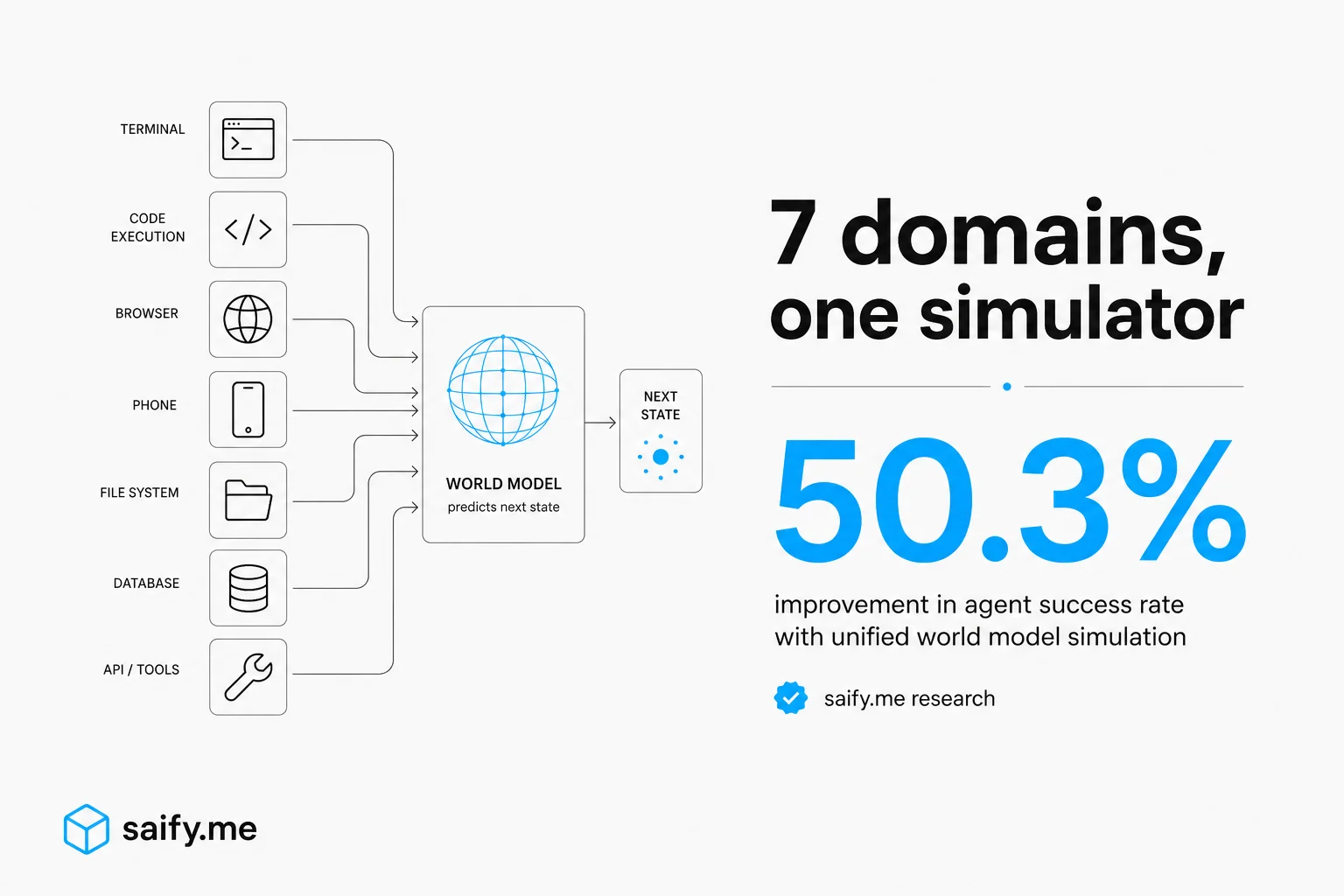
Agents got good at picking the next tool call. They still train like pilots who never touched a simulator.
On June 25, 2026, the Qwen team released AgentWorld, a native language world model that simulates what environments return after each action. Think flight simulator for coding agents: terminals, browsers, Android screens, MCP tool outputs, all predicted from one 35B MoE checkpoint instead of rented VMs.
I ship agent stacks for clients who burn budget on flaky browser farms. This is the release I would prototype before the next eval sprint.
What a language world model actually predicts
Classic agent training loops look like: model proposes action, environment executes, model reads observation, repeat. Most frontier work optimizes the policy. Qwen-AgentWorld optimizes the environment model.
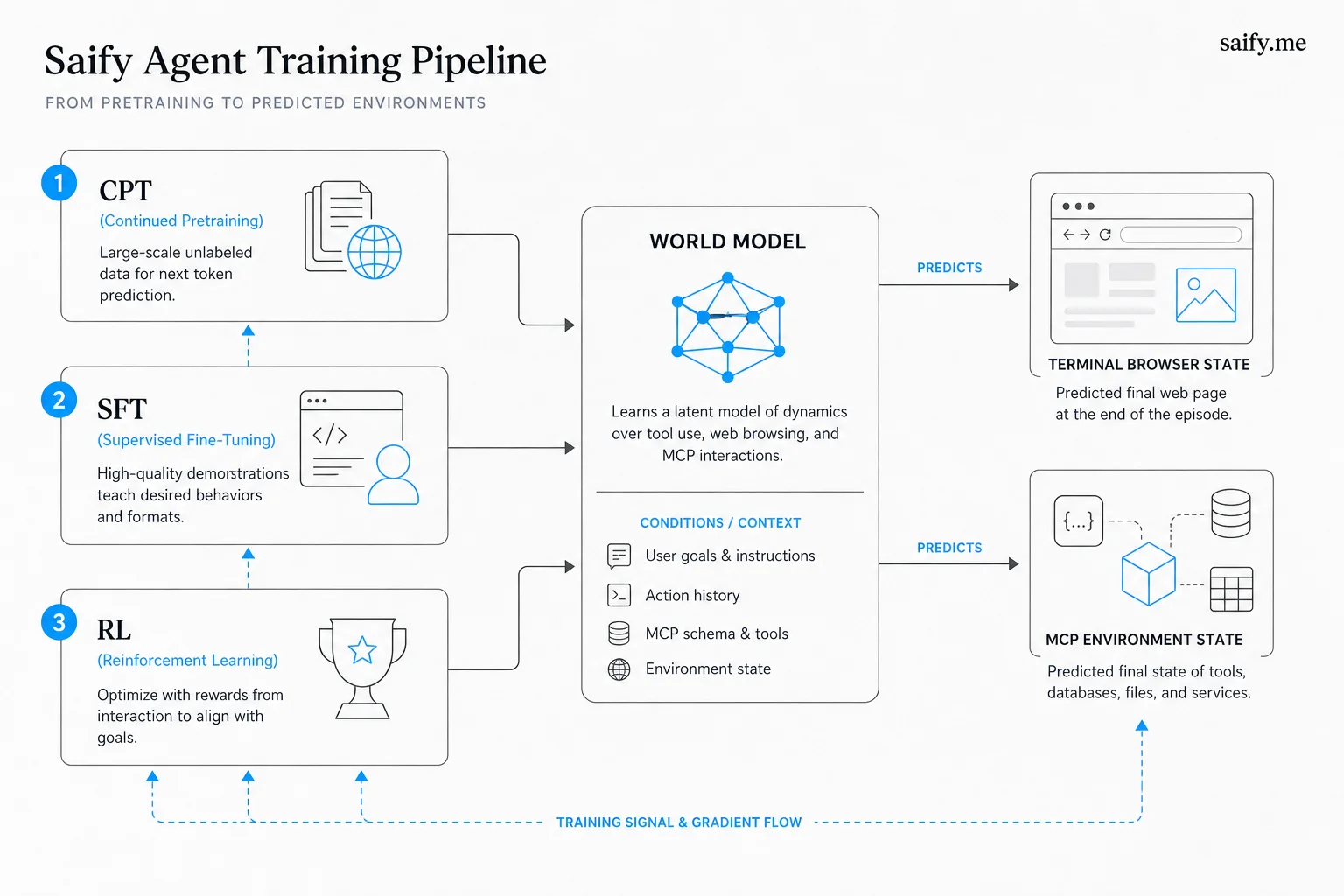
Given action history and the latest tool call, the model predicts the next observation: terminal text, HTML diff, file tree state, Android UI snapshot description, MCP JSON payload. That prediction becomes training signal for both the world model and downstream agents.
Qwen calls this a native world model because environment modeling starts in continual pre-training (CPT), not as a fine-tune bolt-on on a general chat model. Pipeline: CPT injects environment knowledge, supervised fine-tuning (SFT) teaches next-state reasoning, reinforcement learning (RL) sharpens fidelity.
Seven domains in one checkpoint
Previous world-model papers often targeted one surface (games, web only, terminal only). AgentWorld unifies seven:
| Domain | What gets simulated |
|---|---|
| MCP | Tool call requests and structured tool returns |
| Search | Query results and ranking snippets |
| Terminal | Shell output, prompts, process state |
| SWE | Repo edits, test output, CI-like feedback |
| Web | Browser DOM and navigation results |
| OS | Desktop GUI state and window actions |
| Android | Mobile UI interactions |
One model, 256K context, 35B total parameters with 3B active per forward pass (MoE). Weights live at Qwen/Qwen-AgentWorld-35B-A3B under Apache 2.0.
Benchmark data ships as AgentWorldBench: real trajectories from Tool Decathlon, Terminal-Bench, OSWorld-Verified, each step paired with ground-truth observations from live runs.
Numbers that matter for builders
AlphaSignal highlighted three results I would put in a proposal deck:
| Result | Why it lands |
|---|---|
| Sim RL 50.3% vs real RL 45.6% F1 on live search | Synthetic rollouts beat expensive real env training |
| Zero-shot transfer to agent tasks without extra training | World modeling generalizes beyond simulation |
| Tops AgentWorldBench vs GPT-5.4 and Claude Opus 4.8 | Not a toy sandbox model |
The sim-beats-real headline is the business case. Every client RAG eval I run fights the same constraint: real integrations are slow. A faithful simulator turns inference compute into training data.
Qwen also reports zero-shot generalization to out-of-distribution environments like OpenClaw and controllable perturbations (inject fictional worlds) that beat training only on live traces.
How to run it this week
Clone QwenLM/Qwen-AgentWorld for eval scripts and per-domain system_prompt.txt templates.
Launch SGLang (example from Alibaba's blog):
python -m sglang.launch_server \
  --model-path Qwen/Qwen-AgentWorld-35B-A3B \
  --port 8000 \
  --tensor-parallel-size 4 \
  --context-length 262144
Point your agent harness at http://localhost:8000/v1 and swap real tool execution for predicted observations during RL warm-up. Judge predicted states with the bundled LLM judge across format, factuality, consistency, realism, and quality.
vLLM works too if that is what your cluster already runs.
Where I would use it in production sketches
Agent eval before prod keys. Spin predicted MCP and terminal responses to fuzz permission prompts without touching customer CRMs.
Curriculum generation. Train junior policies on simulated hard failures (disk full, auth timeout) that are rare in logged data.
Regression harnesses. Snapshot predicted observations when upgrading harness versions. Diff world-model outputs before diffing live staging.
This pairs with my notes on tau0 unified robot world models for embodied stacks and agentic development lifecycle for where sim loops sit in shipping discipline.
Limits I would plan for
World models can hallucinate plausible-but-wrong tool JSON. You still need spot checks on real sandboxes before production deploys.
35B MoE is not a laptop model. Budget GPUs or a small tensor-parallel pod.
Simulation fidelity is domain-specific. Web and Android GUI prediction will lag terminal text for a while.
Bottom line
Qwen-AgentWorld is the clearest open-weight bet that environment modeling is the next layer in the agent stack, not just bigger policies. Apache 2.0 weights, public benchmark, sim RL beating real RL on search: that is enough for me to run a two-week pilot on the next client agent that still rents Browserbase hours for training.
If you are designing agent infra and want a second opinion on where simulators fit, book a free discovery call.