
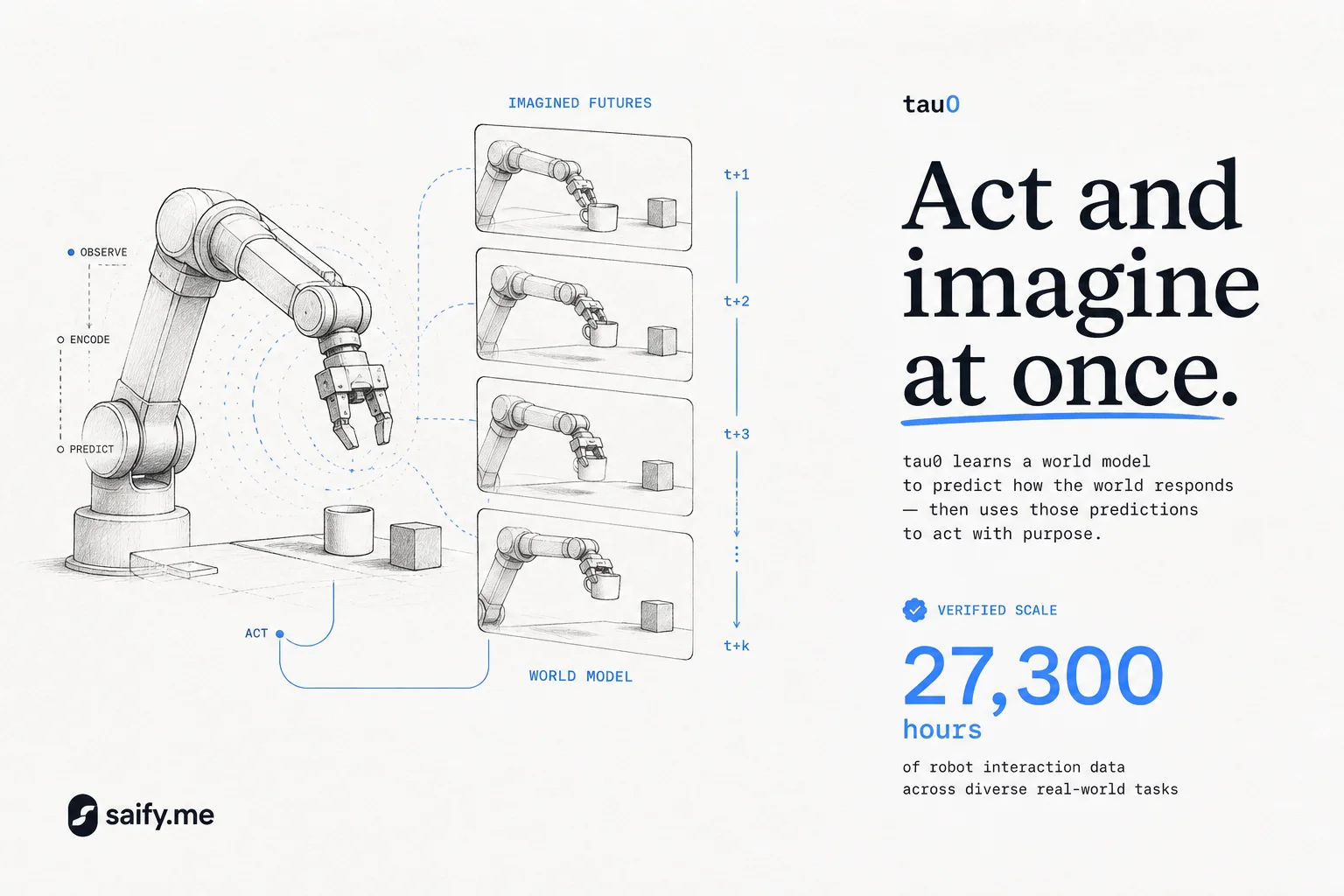
Most robot policies look at the world and pick an action. They do not imagine the consequence, score it, and revise before the gripper moves.
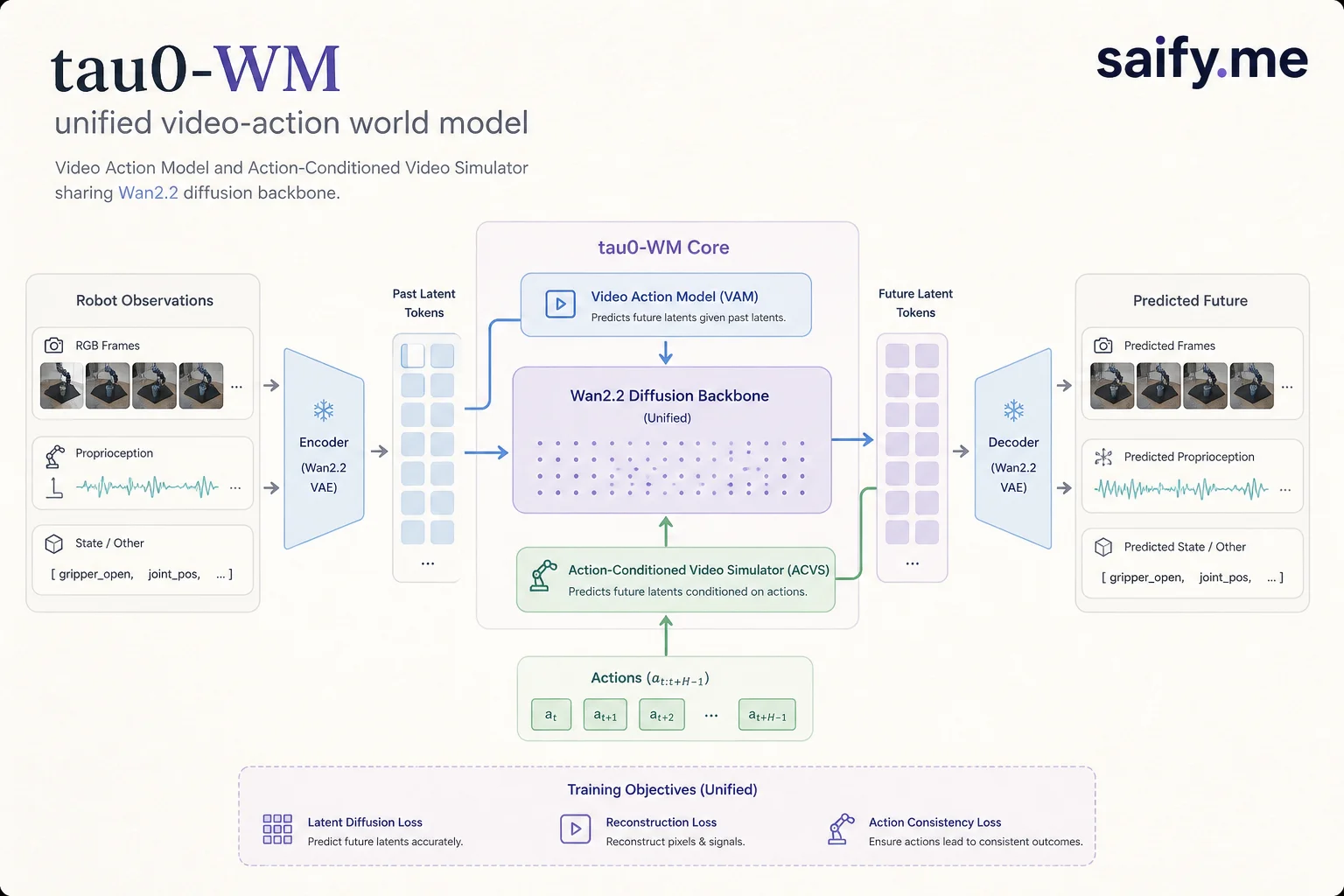
tau0-WM (τ₀-World Model) treats imagination as infrastructure. One shared video diffusion backbone powers both acting and simulating futures, trained on roughly 27,300 hours of mixed robot and human footage.
Alpha Signal highlighted it alongside Life-Harness and Mellum2 in the same "era of the harness" digest. Different domain, same idea: the wrapper around the core model does the heavy lifting.
Two interfaces, one backbone
Built on Wan2.2-TI2V-5B, tau0-WM exposes complementary modes:
Video Action Model (VAM)
Inputs: multi-view observations, language instruction, robot state.
Outputs: future visual latents and continuous action chunks jointly, not via two disconnected heads trained on different objectives.
Action-Conditioned Video Simulator (ACVS)
Inputs: candidate action chunks.
Outputs: rolled-out multi-view futures plus dense task-progress scores.
That second mode is the chess player thinking ahead. Sample moves, visualize outcomes, discard bad lines before touching the board.
Checkpoints live at sii-research/tau-0-wm with code on GitHub. The project page is on Finch / Agibot Research.
Training mix: not just teleop logs
The ~27,300 hour corpus is deliberately heterogeneous:
| Source | Supervision signal |
|---|---|
| Real-robot teleoperation | Deployment-aligned continuous actions |
| UMI-style demos | Broader behaviors, weaker action fidelity |
| Egocentric human video | Visual dynamics without robot-compatible actions |
| Rollout / failure trajectories | Task progress and negative examples |
Modality-specific supervision masks let one framework absorb unequal label quality. You do not pretend every hour of human hand video has the same action labels as factory teleop.
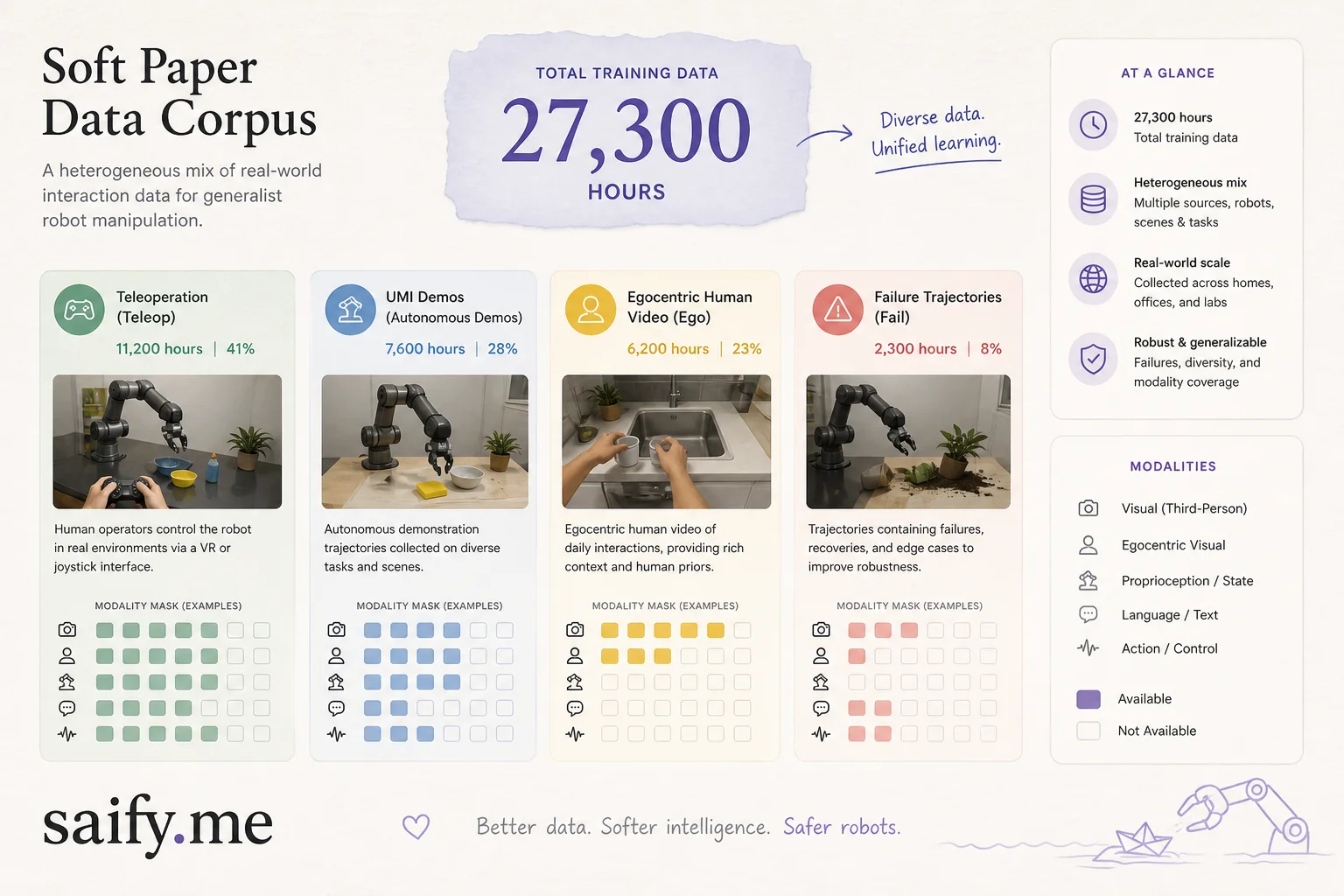
That is the fleet data flywheel story Alpha Signal emphasized: robots in the field generate trajectories that improve the next deployment. tau0-WM's training recipe is built to ingest that mix without collapsing when action labels are missing.
Test-time computation: rank before you execute
At inference, tau0-WM does not commit to the first action sample:
- Sample multiple action candidates
- Re-denoising Consistency Scoring (RCS) ranks candidates
- Low-quality Action Rectification (LAR) uses the simulator to fix weak candidates
Reported on single-attempt manipulation tasks, average success rate moves from 0.43 (no test-time computation) to 0.60 with RCS+LAR. That is a policy architecture win, not a bigger backbone.
| Inference mode | Approx. success rate (reported) |
|---|---|
| No test-time computation | 0.43 |
| RCS + LAR | 0.60 |
You pay extra compute at inference. You save failed grasps, dropped parts, and human interventions on the line.
Open weights in a crowded VLA field
I have covered other open robot stacks recently, including Qwen VLA unified policies and Xiaomi Robotics open VLA weights. tau0-WM differentiates on unification:
- Policy + world model + progress critic in one future-predictive framework
- Video diffusion backbone shared across prediction tasks
- Explicit test-time ranking loop shipped in the research code
It is 5.5B parameters (5B Wan backbone plus action decoder), not a 70B vision-language monster. That matters for edge deploys and for teams that need to reason about inference budget per pick-and-place cycle.
Practical deployment notes from the repo
The GitHub README is honest about setup weight:
- Download tau0-WM weights plus Wan2.2-TI2V-5B dependencies
- Point config paths for diffusion model, VAE, and text encoder
- Simulator weights and full test-time computation code were staged for follow-on releases when the digest dropped
This is research-grade robotics infra, not a pip install for your warehouse Tuesday. Budget integration time like any VLA pilot: calibration, safety zones, failure logging, human override.
When world models beat "policy only" thinking
Use tau0-WM's pattern when:
- Actions are continuous chunks over time, not single discrete labels
- Multi-view cameras are available
- Failed attempts are costly (fine manipulation, long horizons)
- You can afford inference-time sampling for ranking
Skip it when:
- You need a minimal pick model on one RGB frame today
- You cannot log or simulate failures safely
- Your bottleneck is mechanical, not policy
Connection to the harness thesis
Life-Harness fixes the language agent interface. Mellum2 fixes per-token compute. tau0-WM fixes action selection by imagining futures before commitment.
All three treat the model as a component inside a larger runtime. For robotics clients, that is the right mental model. The gripper driver is not the product. The closed loop is.
Evaluating open robot policies for a pilot? Book a free discovery call and we can map tau0-WM-style imagination loops to your camera layout and safety requirements.