
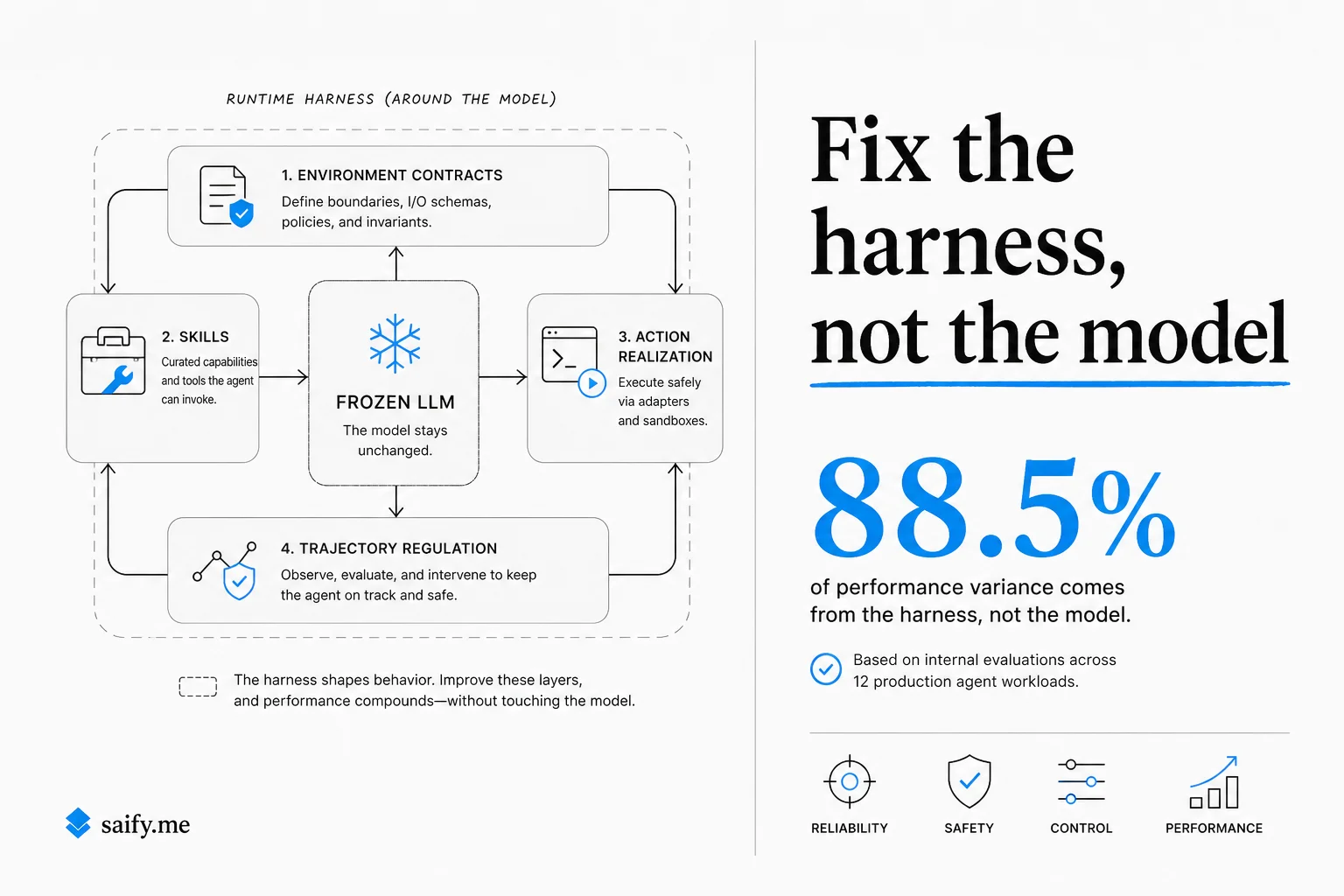
The headline in Alpha Signal's June digest was blunt: 88.5% average relative improvement across frozen LLM agents, with no weight updates.
That number comes from Life-Harness, a paper and codebase release from Tianshi-Xu/Life-Harness. The framing matches what I see on client agent projects every week. Teams buy a bigger model when the real failure is the translator sitting between the model and the environment.
Life-Harness calls that translator the runtime harness. Bad translator, great speaker still loses.
The harness is not the model
Most agent adaptation research chases parameter updates: fine-tuning, RL on trajectories, tool-specialized derivatives. Life-Harness argues many failures in deterministic, rule-governed domains are interface mismatches:
- Wrong tool argument shapes
- Misread environment feedback
- Trajectory limits violated before the task completes
- Procedural steps skipped because the contract was never explicit
The model may be capable. The mediation layer is wrong.
| Layer | What it controls |
|---|---|
| Environment contracts | What the agent is allowed to observe and assume |
| Procedural skills | Reusable step patterns for recurring subtasks |
| Action realization | Parsing model output into valid environment actions |
| Trajectory regulation | When to stop, retry, or escalate |
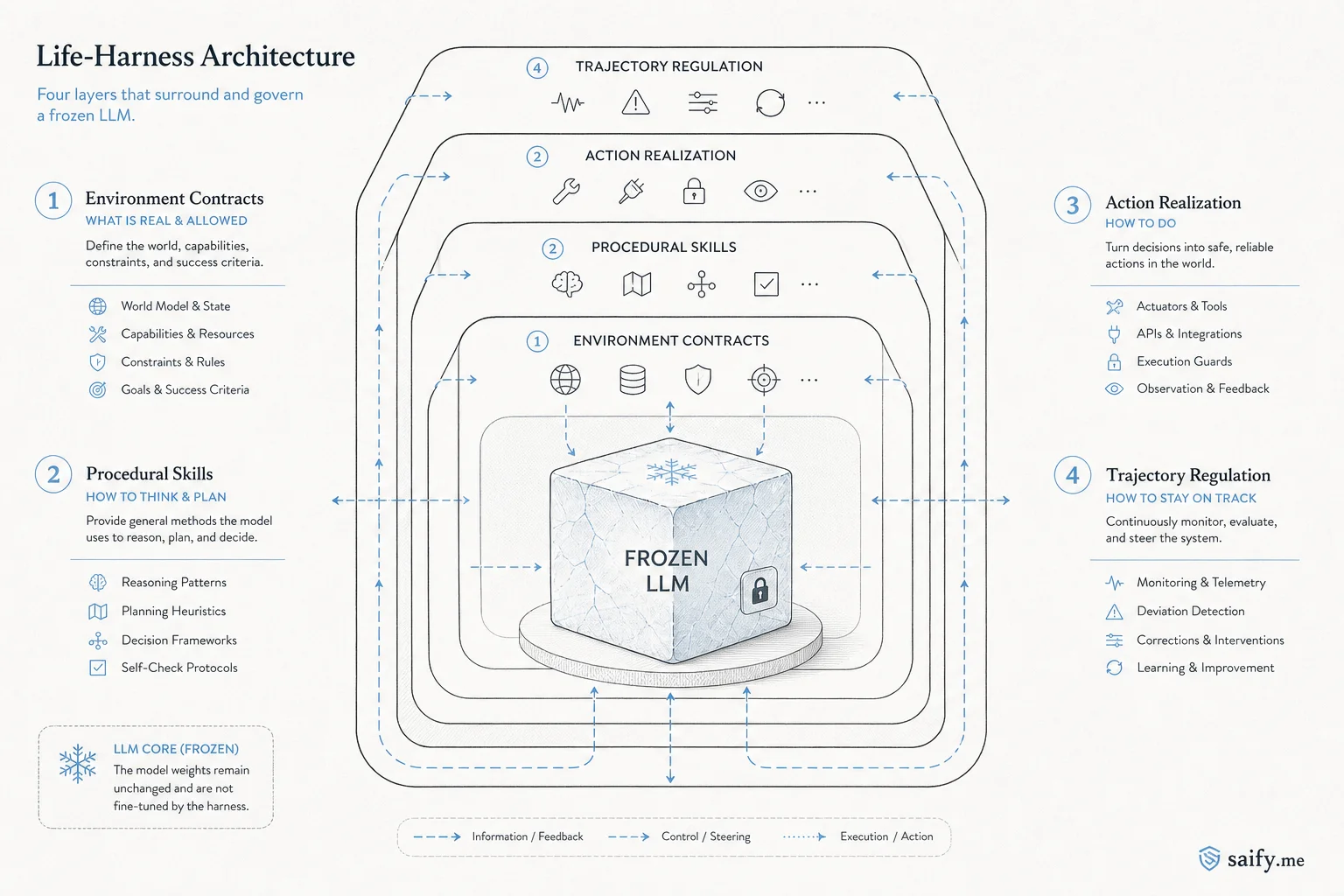
Think of it like internationalization. You do not retrain the speaker. You fix the protocol document and the microphone routing.
What the paper actually reports
Life-Harness targets seven deterministic environments drawn from τ-bench, τ²-bench, and AgentBench: household interaction, web shopping, OS control, and business-workflow style tasks.
Across 18 model backbones (instruction-tuned, reasoning, and agent-specialized variants), the harness improved 116 out of 126 model-environment settings. The 88.5% average relative gain is relative improvement on held-out evaluation, not a single cherry-picked benchmark.
The transfer result is the part I would bet engineering time on:
Harnesses evolved only from Qwen3-4B-Instruct trajectories transferred to 17 other models without re-evolving per backbone. That suggests the harness captures environment-side structure, not model-specific quirks.
They also report a complementary effect: base Qwen2.5-32B-Instruct with Life-Harness can outperform its tool-specialized derivative xLAM-2-32b-fc-r on some settings. Wrapper beats a fine-tuned fork when the mismatch was interface-shaped.
Evolution vs evaluation: a clean split
Life-Harness uses a lifecycle-aware design:
- Evolution phase: observe failures on training trajectories, convert patterns into harness interventions
- Evaluation phase: harness is fixed. Model frozen. Environment frozen.
That separation matters for audits. You can diff what changed between runs. You are not silently drifting weights and interface at the same time.
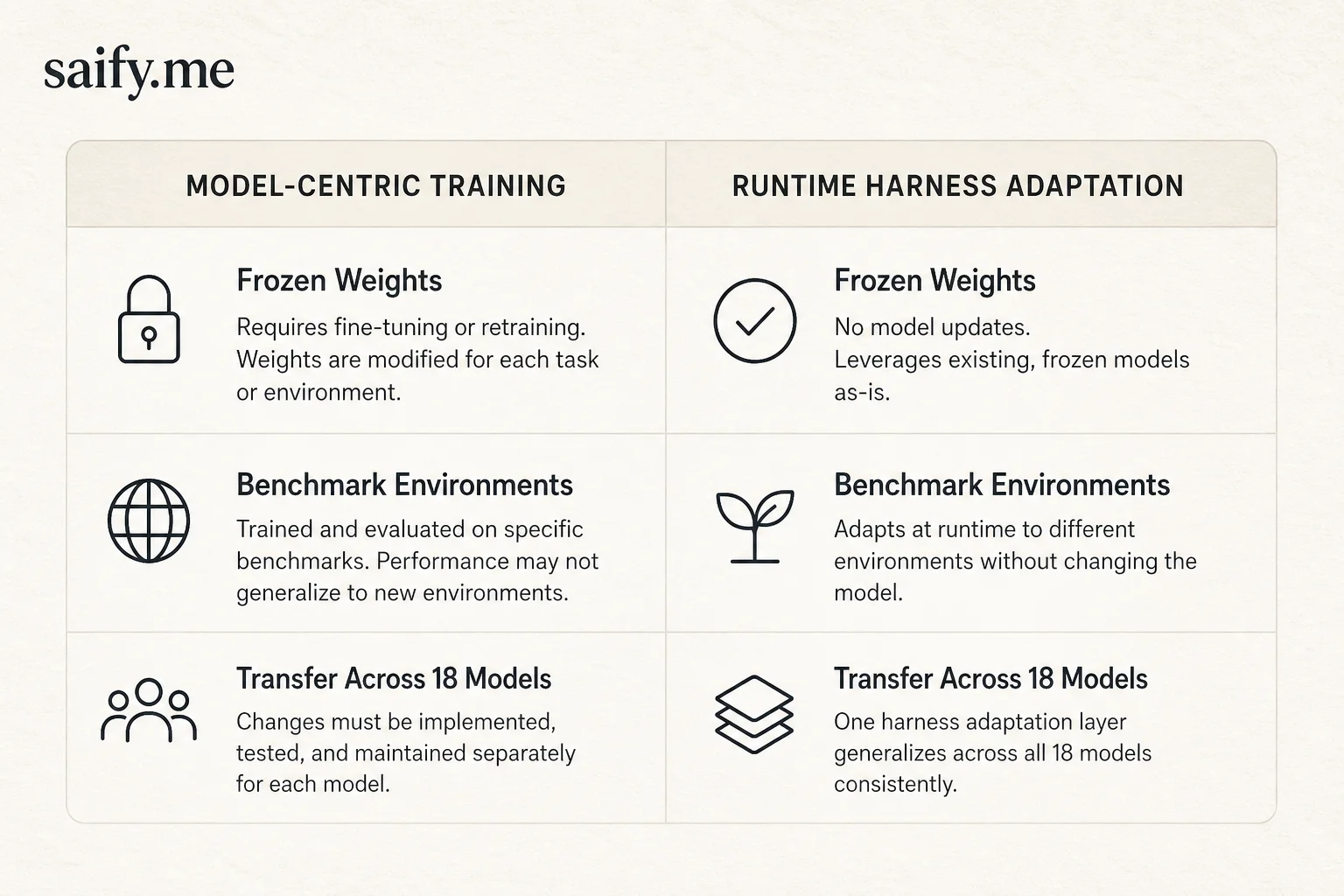
This is the opposite of "prompt and pray." It is closer to compiling a policy layer from logged failures, then shipping that layer as infrastructure.
Where this fits my applied AI stack
I have written about harness effects swamping model choice in posts on grep vs vector search inside agents and DeepSeek's open harness. Life-Harness is the research-side proof that interface adaptation can be a first-class optimization target.
It does not replace:
- Better base models when the task needs reasoning the model lacks
- Security review of tool access
- Production observability and cost caps
It does suggest a workflow I would run before the next model upgrade meeting:
1. Classify failures
Split trajectory logs into capability gaps vs interface gaps. Interface gaps repeat with similar error signatures across models.
2. Evolve harness artifacts, not prompts in chat
Store contracts, skill snippets, and action parsers in versioned files the runtime loads. Life-Harness's four layers map cleanly to repo folders in a serious agent deployment.
3. Measure on held-out tasks with frozen weights
If lift disappears when you swap models without the harness, you built model-specific glue. If lift transfers, you built environment infrastructure.
4. Pair with verifiers
Life-Harness targets deterministic environments where success is checkable. Same gate I use for loop engineering: no external oracle, no unattended adaptation.
Honest limits
Deterministic benchmarks are not your messy production CRM. Web UIs with A/B tests, flaky APIs, and human overrides break the "fixed environment" assumption.
Life-Harness also needs trajectory volume to evolve useful interventions. A demo with twelve runs will not compile a harness.
And 88.5% relative improvement is an average across many settings. Your single workflow might see 5% or 40%. Run your own eval harness.
The era of the harness (again)
Alpha Signal tied Life-Harness to Mellum2's "12B that runs like 2.5B" story in the same digest. Different layers, same thesis: infrastructure around the model is where marginal gains cluster right now.
For teams shipping agents in regulated or cost-sensitive environments, that is good news. You can iterate on wrappers with git diffs and compliance review, not GPU farms.
Want help separating interface failures from model failures in your agent logs? Book a free discovery call and we can design a harness eval before your next model contract renewal.