
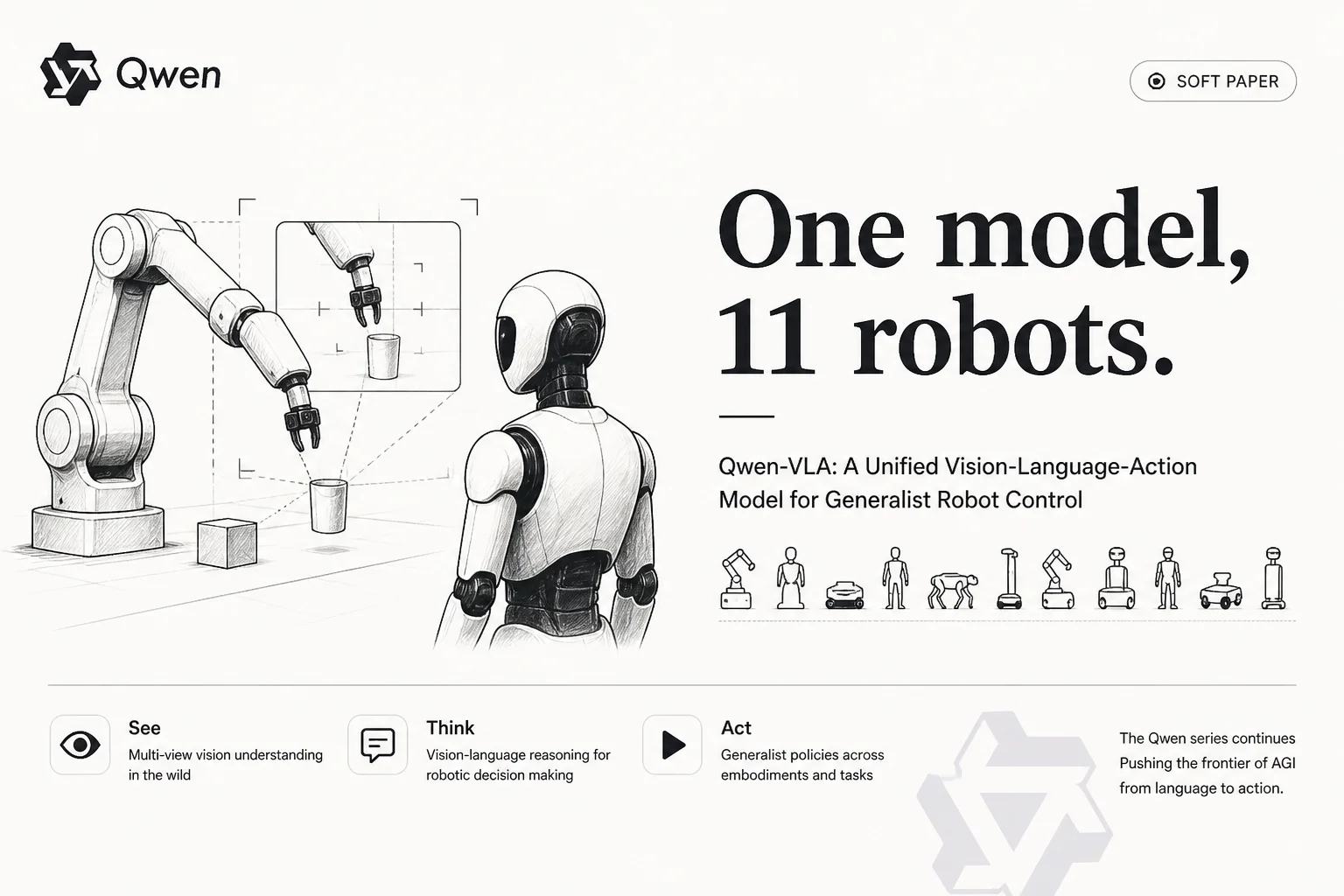
Most robotics stacks still look like microservices for hardware. One model for grasping. Another for navigation. A third for trajectory planning. Each trained on its own data, tied to one robot SKU.
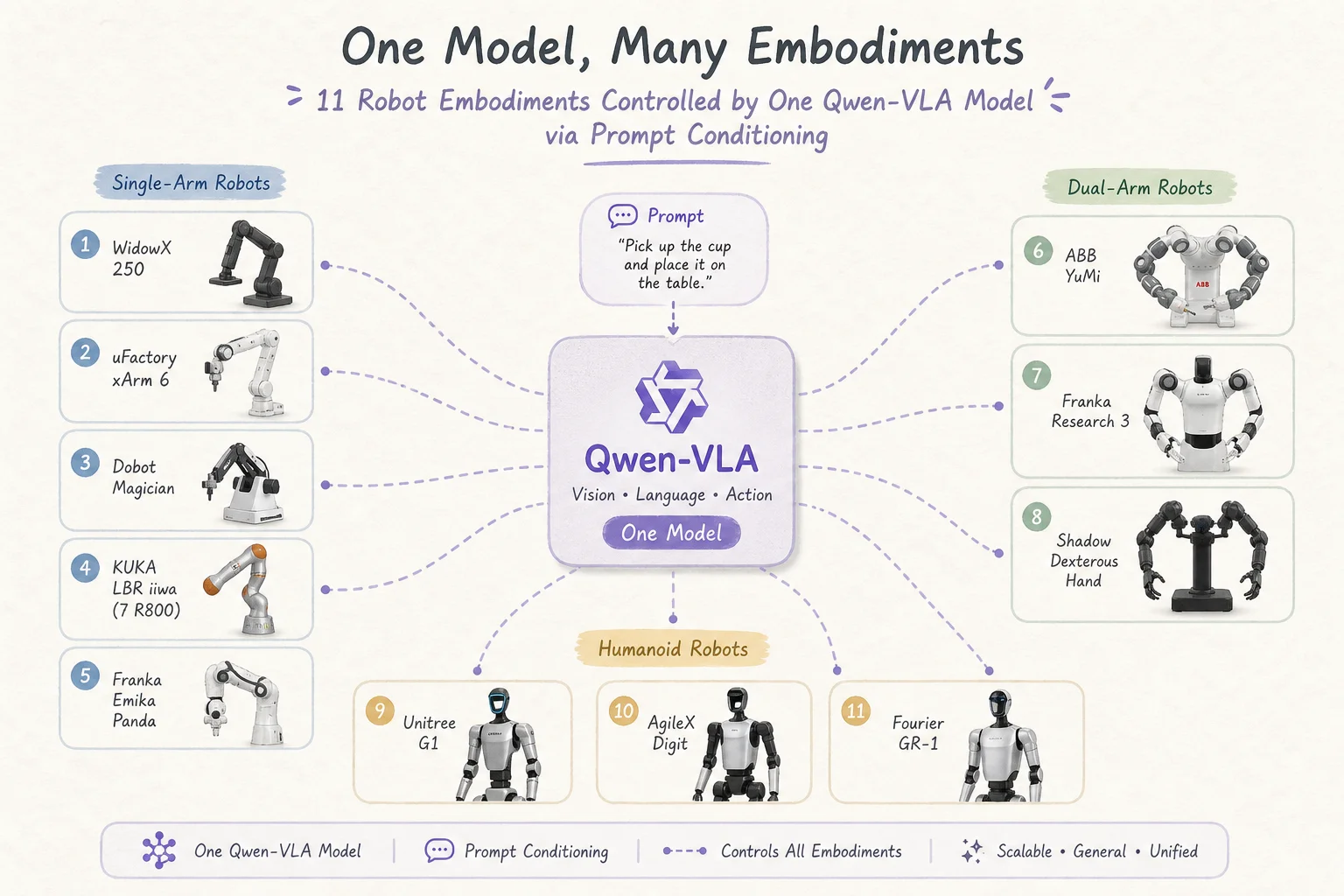
Qwen-VLA from Alibaba's Tongyi Lab challenges that fragmentation. One foundation policy handles manipulation, navigation, and trajectory prediction across 11 robot embodiments by changing a text prompt, not the network architecture.
I do not ship factory robots for a living. I do ship multi-tenant agent systems where the same orchestration layer has to behave differently per client. That is why this release caught my eye.
Architecture in plain language
Qwen-VLA stacks two pieces:
| Component | Size | Role |
|---|---|---|
| Qwen3.5-4B VLM backbone | 4B params | Sees the world, reads instructions, reasons about space |
| DiT flow-matching action decoder | 1.15B params | Outputs continuous actions and trajectories |
Alibaba Cloud's blog frames the design goal cleanly: extend visual perception and language understanding into continuous action generation, not just captioning what the camera sees.
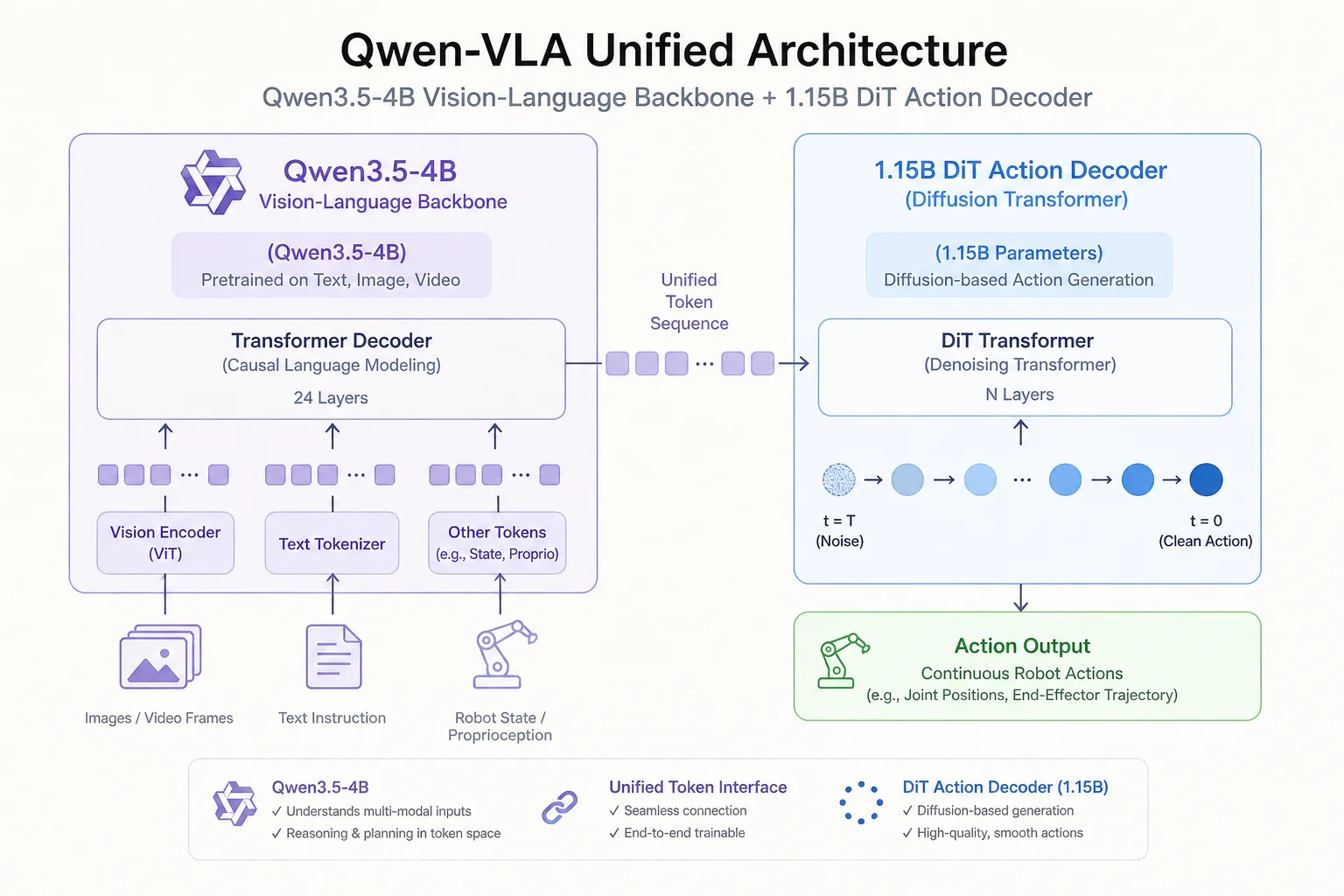
The training pipeline mixes real robot data, human egocentric video, synthetic simulation, and general vision-language corpora. That joint pretraining is what lets one checkpoint generalize across tasks that used to need separate fine-tunes.
Embodiment-aware prompt conditioning
The trick that makes "one model, many robots" plausible is embodiment-aware prompt conditioning.
Instead of bolting a different output head per platform, Qwen-VLA prepends robot-specific textual descriptions to the instruction. The same weights serve ALOHA bimanual arms, mobile bases, and humanoids. You swap the prompt, not the checkpoint.
On the ALOHA benchmark, specialist models like GR00T N1.6 and π0.5 are fine-tuned per task. Qwen-VLA is a single generalist evaluated across all tasks without per-benchmark adaptation. The GitHub README claims it matches or outperforms many of those specialists while staying unified.
That is the robotics version of a pattern I want in software agents: one orchestrator, many runtime profiles.
Benchmark numbers worth knowing
Tongyi Lab's weekly and the technical report highlight a few headline scores on manipulation:
| Benchmark | Qwen-VLA-Instruct |
|---|---|
| LIBERO | 97.9% |
| Simpler-WidowX | 73.7% |
| RoboTwin-Easy | 86.1% |
| RoboTwin-Hard | 87.2% |
Navigation and out-of-distribution generalization results are in the paper. The through-line is consistent: a generalist trained once, evaluated everywhere, without per-platform forks.
Robustness across varied colors, object instances, positions, backgrounds, and paraphrased instructions is the practical win. Labs care about leaderboard points. Warehouses care about whether the arm still works when someone moves the bin six inches left.
Why software builders should care
This is not a post arguing you should fine-tune Qwen-VLA for your dental clinic's front desk. It is a post about architecture patterns that are bleeding into mainstream AI products.
Three ideas transfer directly:
1. Runtime parameters beat model forks
Qwen-VLA treats the robot body like a runtime parameter (text prompt), not a separate model boundary. Multi-tenant agent platforms should steal this. One policy, many client profiles, swap prompts and tool allowlists instead of shipping ten fine-tunes.
2. Unified action spaces reduce integration tax
Manipulation, navigation, and trajectory prediction share one prediction framework. In software, the analog is unifying "send email," "update CRM," and "schedule callback" under one tool schema instead of three bespoke micro-agents that do not share memory.
3. Generalist vs specialist economics
Specialists still win on narrow leaderboards. Generalists win on deployment surface area. The same trade shows up in coding agents: Composer-style workhorses vs Opus-style frontier models. Robotics is just farther along the "one model many embodiments" curve.
Limits and honest caveats
Qwen-VLA is research-grade embodied AI, not a shrink-wrapped warehouse SKU. Real deployments still need:
- Safety interlocks and human oversight on physical hardware
- Sim-to-real validation on your actual end effectors
- Latency budgets that VLAs may not meet for sub-100ms control loops
- Regulatory review in environments with humans nearby
The official repo ships demos and a technical report, not a turn-key industrial controller. Treat benchmarks as signal, not purchase orders.
The pattern eating robotics (and agents)
Alpha Signal's framing is fair: the same unification pattern now eating robotics is the same one eating agent tooling. One orchestrator. Many embodiments. Prompt or config switches instead of architectural forks.
Qwen-VLA is the clearest 2026 example on the hardware side. On the software side, watch how Cursor, Codex, and Grok Build converge on one agent loop with different model routes and permission profiles.
If you are designing multi-tenant agent systems and want to borrow embodiment-conditioning ideas for client-specific behavior without ten fine-tunes, book a free discovery call. The robot arm is optional. The architecture lesson is not.