
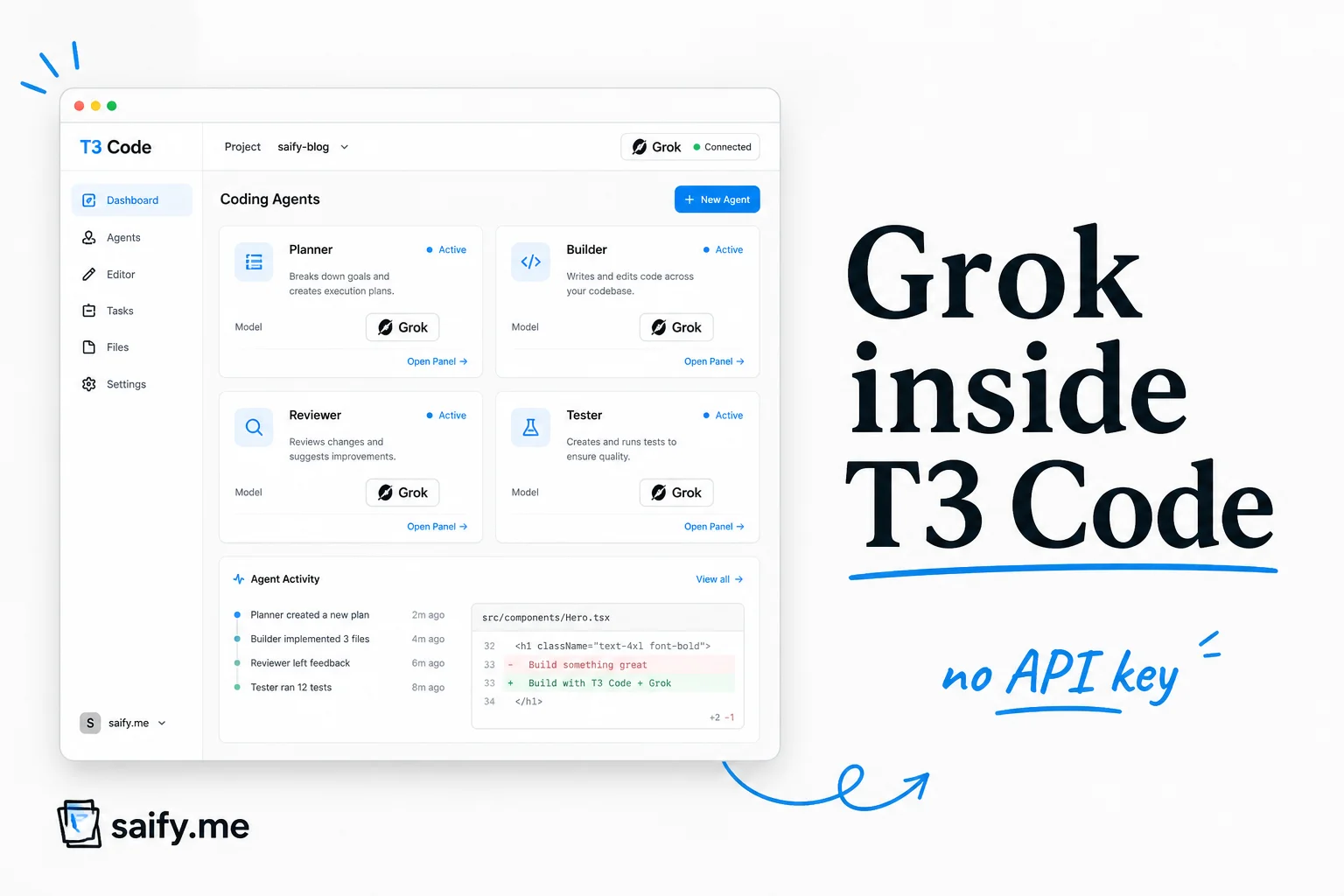
Grok Build won the terminal. T3 Code is how subscription subscribers get a GUI without buying twice.
On June 25, 2026, T3 Code merged Grok as a first-party provider. If you already pay for SuperGrok or X Premium Plus, you connect your account inside t3.codes and run Grok Build next to Claude Code, Codex, and Cursor agents. No separate xAI API key required.
I have separate posts on Grok Build in the terminal and the Grok Build API. This update is about subscription-native routing into a multi-agent control plane.
What T3 Code actually orchestrates
T3 Code is Theo's open-source agent control center: plan, diff, commit, branch, and monitor long-running coding tasks visually instead of juggling five terminal tabs.
Bring-your-own-subscription is the product thesis. You pay model vendors (or local inference) directly. T3 Code sells orchestration, not tokens.
Grok's addition matters because xAI's coding agent was CLI-first. Many developers want Grok Build autonomy with a timeline view of turns and permissions.
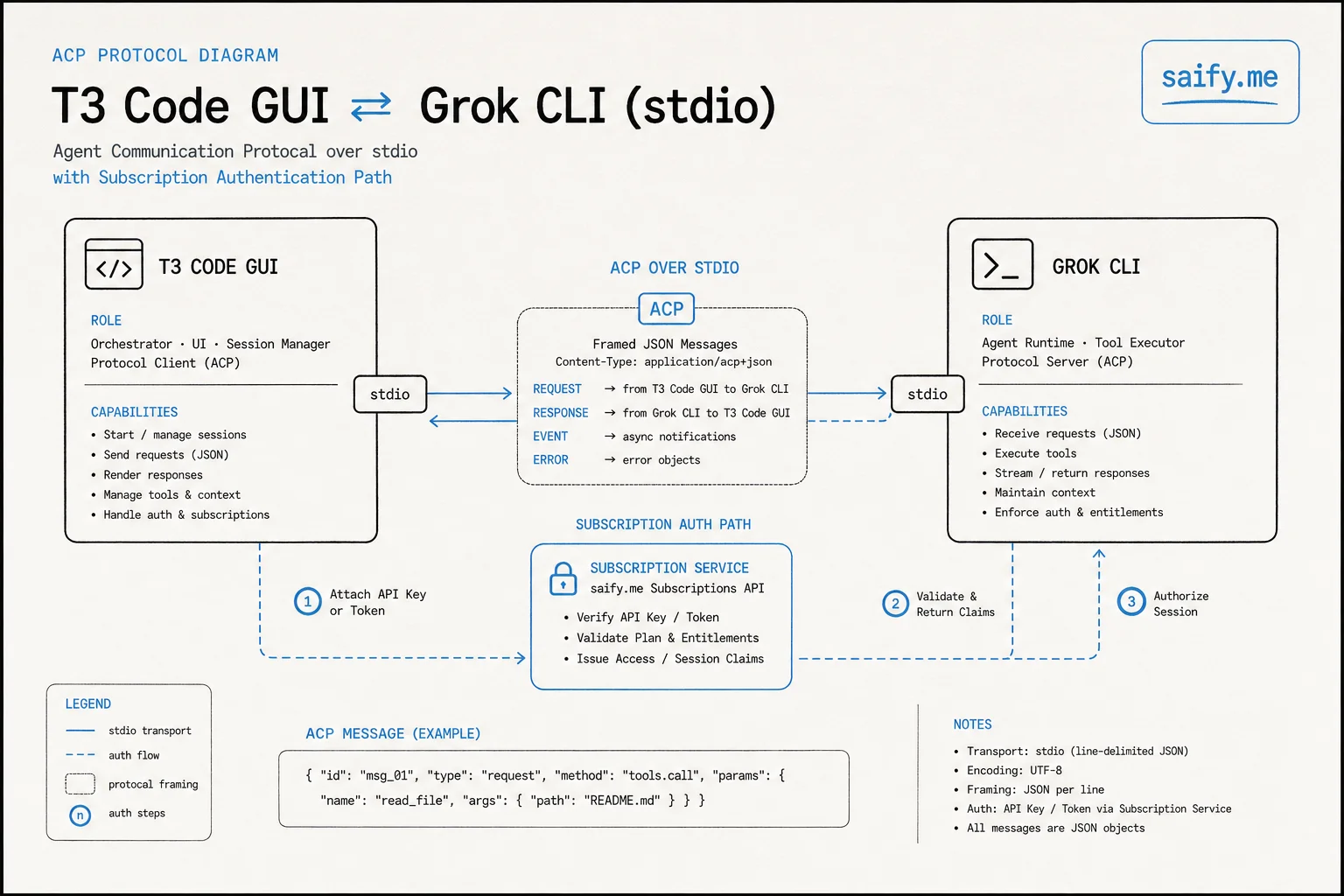
Technical integration (ACP, not a REST shim)
The merge introduces:
| Component | Role |
|---|---|
GrokDriver | Health checks, model discovery, status refresh |
GrokAdapter | Sessions, turns, permissions, model switches |
GrokTextGeneration | Commit messages, PR bodies, branch names, thread titles |
| ACP stdio | grok agent stdio as the transport |
Auth picks XAI_API_KEY when present, otherwise subscription OAuth paths that work in headless and desktop modes.
xAI-specific ACP extensions include ask_user_question and per-session session/set_model, so Grok's interactive clarifications survive inside T3's UI instead of dying in stderr.
Default model snapshot: grok-build. Provider picker shows Grok with a "new" badge alongside existing agents.
Subscription economics vs API metering
Basenor summarized the user story cleanly: no new payment if you already subscribe. Connect credentials in T3 settings and Grok sits beside other agents.
That lowers friction for developers who bought SuperGrok for chat and did not want a second billing relationship for GUI coding.
Tradeoff: subscription tiers cap usage differently than raw API keys. Power users running /goal loops still need to watch rate limits on the X side.
API key path remains for teams that centralize billing in a platform account.
Why xAI partnered on a third-party GUI
Grok Build launched May 2026 with /goal autonomous mode in June. CLI traction is strong for terminal natives. GUI orchestration platforms like T3 Code reach developers who will not install another shell agent.
Putting Grok inside T3 Code matches Codex and Claude Code distribution without xAI building a full IDE. Model routing nationalism loses when subscribers pick the best agent per task inside one dashboard.
Digg and Pivot News framed it as Theo integrating xAI so SuperGrok subscribers skip API setup. Fair. The deeper story is ACP as the integration layer every coding agent will need.
Comparison to my existing Grok coverage
| Topic | Grok Build CLI post | T3 Code post |
|---|---|---|
| Interface | Terminal /model, headless -p | Desktop GUI sessions |
| Auth | SuperGrok login in shell | OAuth inside T3 settings |
| Multi-agent | Manual terminal tabs | Shared project threads |
| Best for | Scripts, CI, power users | Visual diff review, parallel agents |
If your team already standardized on T3 Code for Codex and Claude Code, Grok is now a checkbox, not a migration.
Setup checklist I would run
- Install latest T3 Code from t3.codes
- Install Grok CLI:
curl -fsSL https://x.ai/cli/install.sh | bash - Open T3 settings → Providers → Grok → connect X or SuperGrok account
- Pick
grok-buildon a scratch repo with yourAGENTS.mdconventions - Run a parallel session with Claude Code on the same repo to compare harness token use (see my OpenCode harness benchmark)
Watch for overlapping turns if you fire two agents on one thread. T3 and ACP providers are still maturing lifecycle edge cases; follow-up PRs like pingdotgg/t3code#2932 extract shared ACP adapter code to reduce per-provider bugs.
Limits
T3 Code is orchestration, not sandboxing. Untrusted repos still need your own VM or container policy.
Grok in GUI does not remove xAI model lock-in for that provider slot. T3 remains multi-vendor; Grok slot stays Grok.
Desktop-only workflows may still prefer raw Grok Build for lowest latency.
Bottom line
Subscription-native Grok inside T3 Code is a distribution win: same SuperGrok bill, visual agent ops, ACP-native integration. For teams already paying xAI and orchestrating agents in Theo Browne's stack, this is the lowest-friction way to trial Grok Build without another API onboarding flow.
Routing multi-agent coding spend across vendors? Book a free call and we can map harness plus subscription math for your repo sizes.