
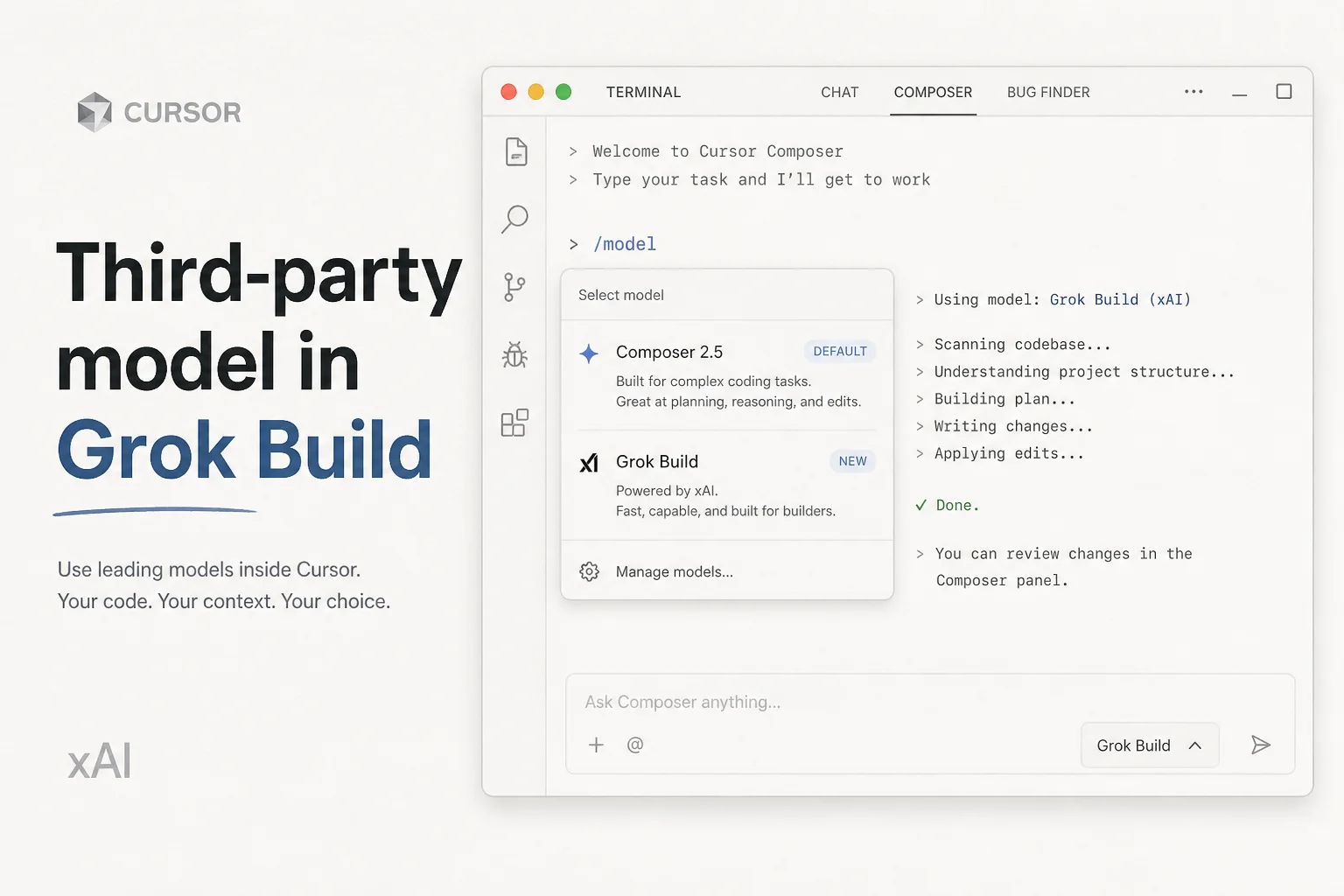
On June 1, 2026, xAI announced something that would have sounded absurd two years ago: a competitor's coding model inside their own terminal agent.
xAI: Composer 2.5 in Grok BuildCursor's Composer 2.5 now appears in Grok Build's /model picker alongside xAI's native grok-build-0.1 family. SuperGrok and X Premium+ subscribers can select it for the active session.
Why xAI would host a Cursor model
Grok Build launched as xAI's terminal coding agent: plan mode, diff review, parallel subagents, MCP and skills compatibility, headless -p mode for scripts.
The pitch for Composer 2.5 is narrower and sharper: sustained instruction following on long, multi-step engineering tasks. Not autocomplete. Agentic work where context retention and tool-call coherence matter across dozens of turns.
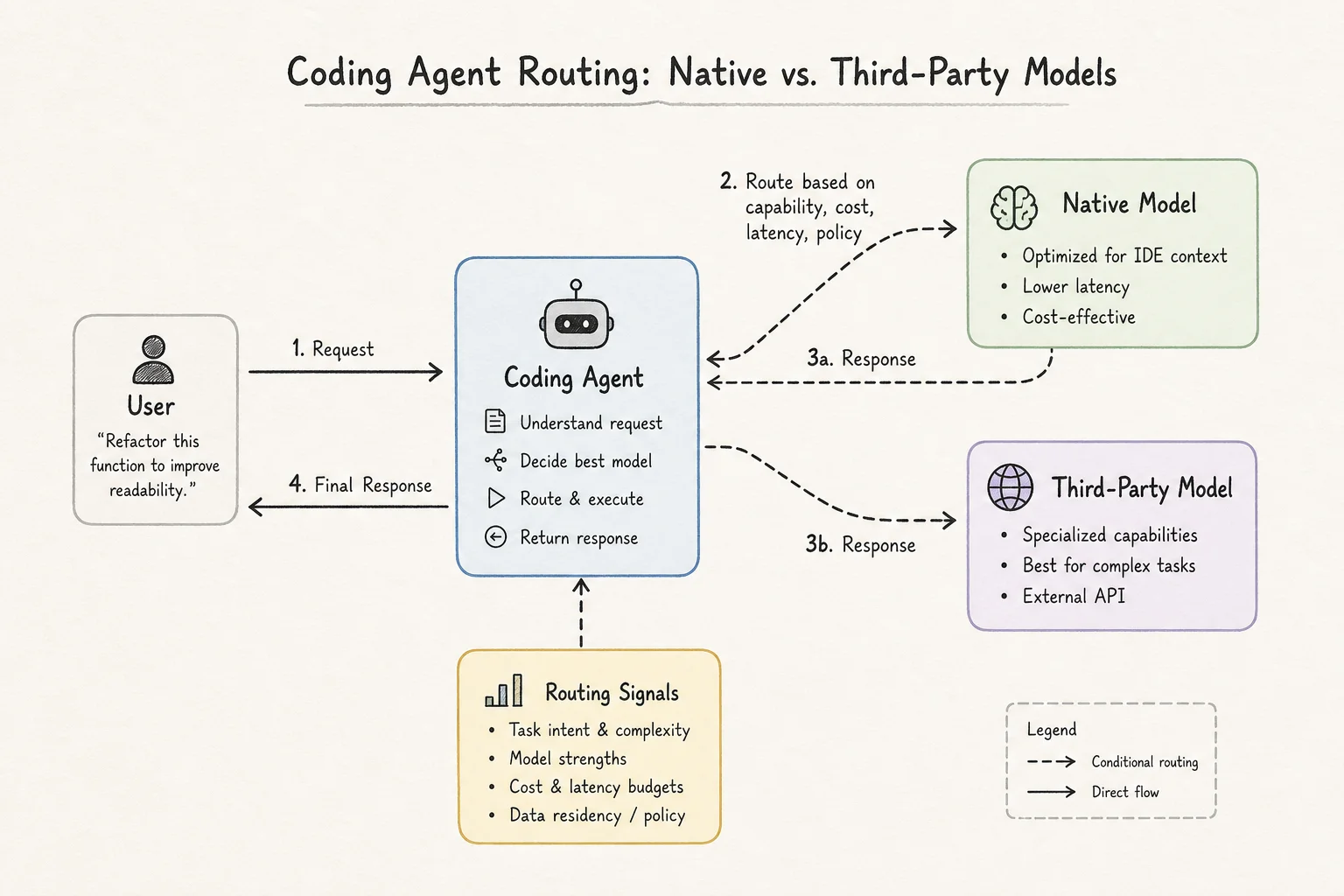
xAI is betting that model routing beats model nationalism. If Composer 2.5 wins on long repos, put it in the menu and keep subscribers inside Grok Build.
How to try it
Install Grok Build:
curl -fsSL https://x.ai/cli/install.sh | bash
Inside a session:
- Type
/model - Select Composer 2.5
- Run your task with the same AGENTS.md, hooks, and MCP servers Grok already respects
No separate Cursor subscription is required for this integration path. You're paying xAI for access, not Cursor for the IDE bundle.
What Composer 2.5 brings to the table
Cursor shipped Composer 2.5 on May 18, 2026 with more reinforcement learning, synthetic coding tasks, and testing-aware training. Early third-party benchmarks positioned it near Claude Opus 4.7 and GPT-5.5 class models on agentic coding, with trade-offs on terminal-specific suites.
Artificial Analysis: Composer 2.5 Coding Agent IndexI've written elsewhere about cost per task on the Coding Agent Index. Composer 2.5 scored 62 with strong economics versus frontier max modes. Grok Build adds distribution: same harness, different model menu.
| Model (harness) | Index score (reported) | Notes |
|---|---|---|
| Claude Opus 4.7 max (Claude Code) | 66 | Higher score, higher cost tier |
| GPT-5.5 xhigh (Codex) | 65 | Strong terminal tooling |
| Composer 2.5 (Cursor harness) | 62 | Favorable cost per task in AA data |
Numbers shift weekly. The structural point is routing: pick the model for the job inside one agent shell.
When I'd pick Composer 2.5 in Grok Build
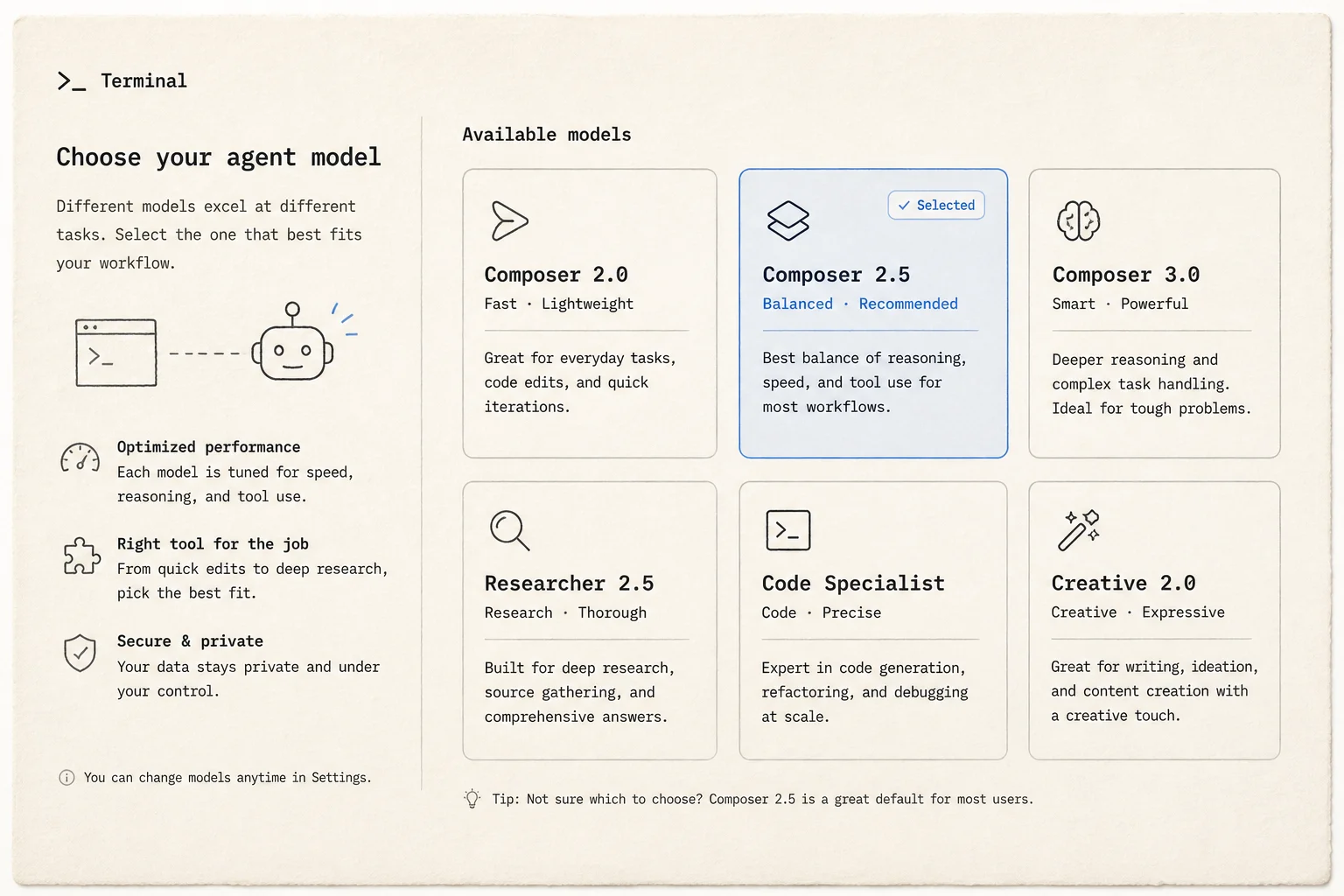
Reach for Composer 2.5 when:
- The task spans many files and long plan → implement → test loops
- You want Grok's subagents and worktree integrations with a model tuned for agentic coding
- You're already on SuperGrok and don't want a second IDE subscription
Stay on grok-build-0.1 when:
- You want a single-vendor stack for compliance narratives
- You're optimizing for xAI-specific fine-tunes on their roadmap
- Your team standardized evals only on native Grok models
The bigger trend: agents as routers
Cursor, Claude Code, Codex, Grok Build, and Antigravity are converging on the same shape: one human director, many workers, shared repo context.
The differentiator is shifting from "can the model write code" to "can the harness keep long jobs coherent without babysitting."
Letting a third-party model into the menu is the logical end state. Developers already swap models mid-session based on task type. Shipping that swap officially beats pretending one logo owns every benchmark.
Practical eval checklist
Before you switch defaults for the whole team, run the same repo task on both models:
- Multi-file refactor with tests that must pass
- Bug fix requiring
git blameand cross-package reasoning - Greenfield microservice with Dockerfile and CI stub
Track: wall time, human interventions, tokens (if exposed), and whether the final diff matches your conventions.
Grok Build's plan mode helps on (1) and (2). Composer 2.5 is worth testing when (2) or (3) stalls on context drift.
Bottom line
Composer 2.5 inside Grok Build is a distribution story and a quality bet on long tasks. If you live in the terminal and pay for SuperGrok, /model is now a serious routing knob.
Need help designing model routing policies for a team shipping with multiple agents? Book a free discovery call.