
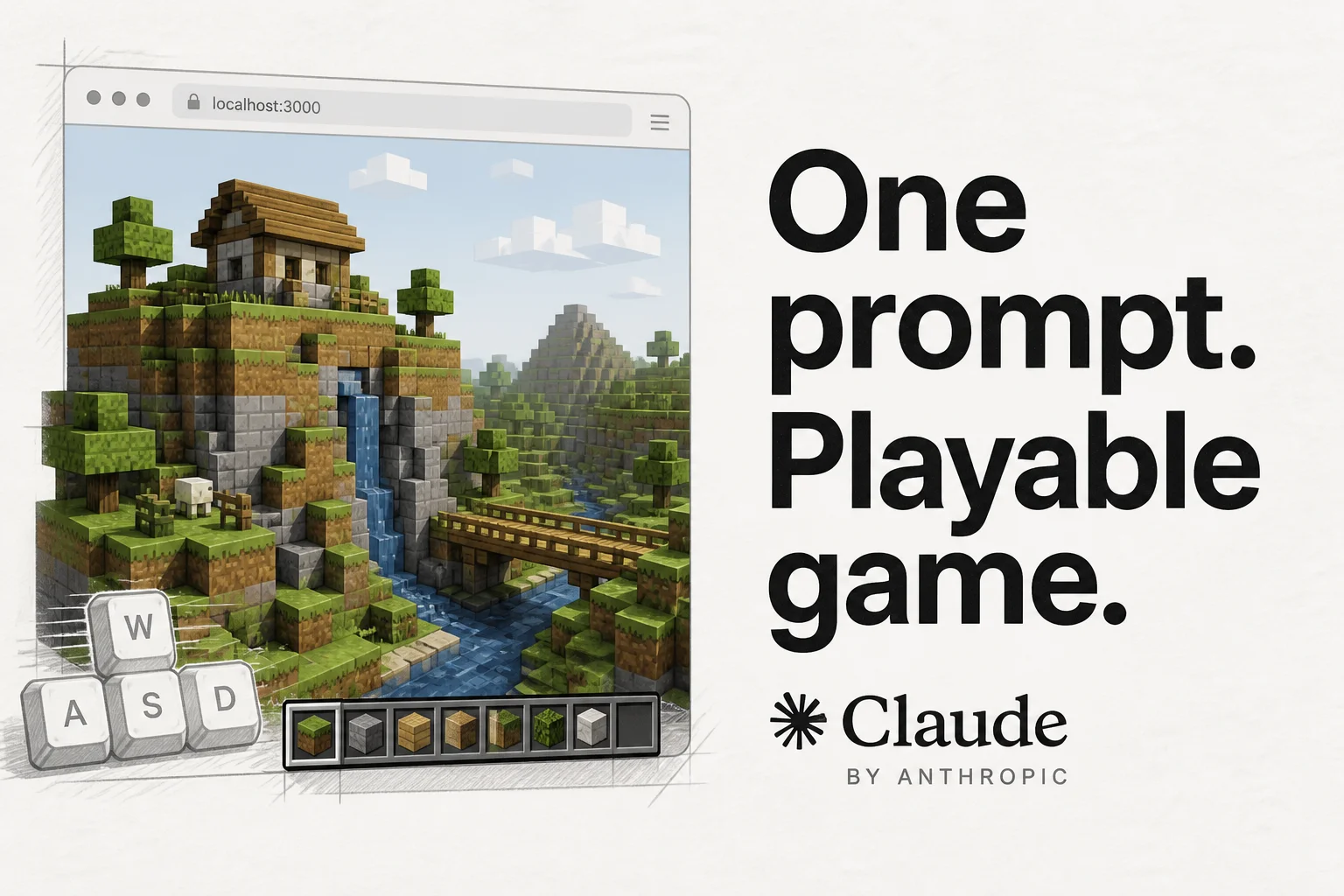
Someone asked Claude Fable 5 to "make a Minecraft clone." Twenty minutes later they had biomes, caves, ores, a day/night cycle, and background music. Cost landed around $30 on the high setting. Another builder reported 37 minutes and about $12 in API spend for roughly 3,000 lines of code.
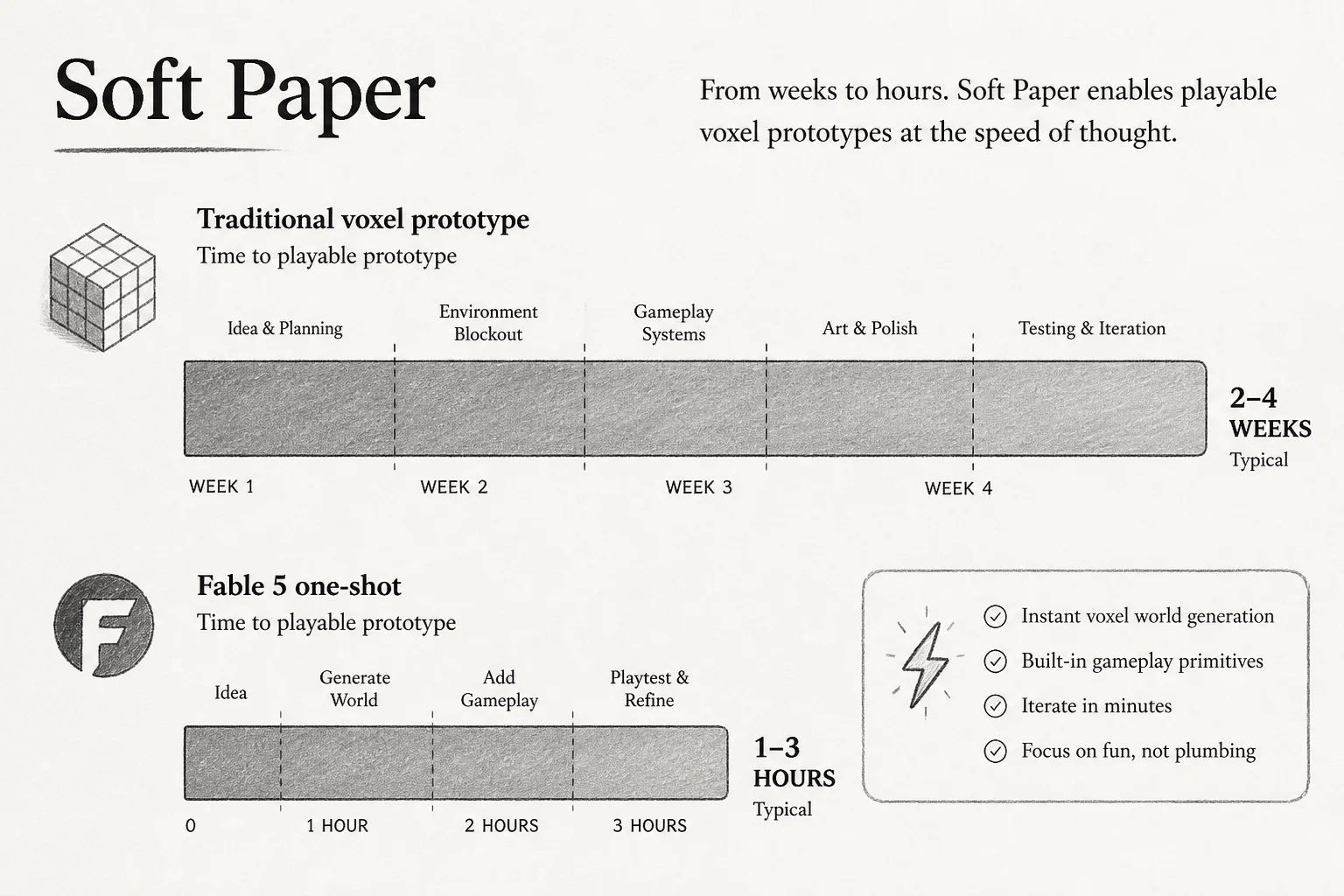
I have shipped enough prototypes to know that a voxel sandbox is not a weekend side project. Terrain generation, chunk meshing, lighting, inventory, and audio usually mean weeks of glue code. These demos suggest the bottleneck is moving from "write a function" to "ship a coherent system."
What actually got built
The public repos tell a consistent story. Take Angais/Fable5-mc on GitHub: a browser game with Three.js, no build step, and zero image or sound assets on disk.
Everything is procedural:
| Layer | What Fable 5 generated |
|---|---|
| World | Biomes, caves, ore veins, trees, skylight |
| Rendering | Chunk meshing, ambient occlusion, liquid blocks |
| Player | AABB physics, mining raycast, swimming, flying |
| Audio | WebAudio synthesis plus generative ambient music |
| Gameplay | TNT chain reactions, falling blocks, save/load |
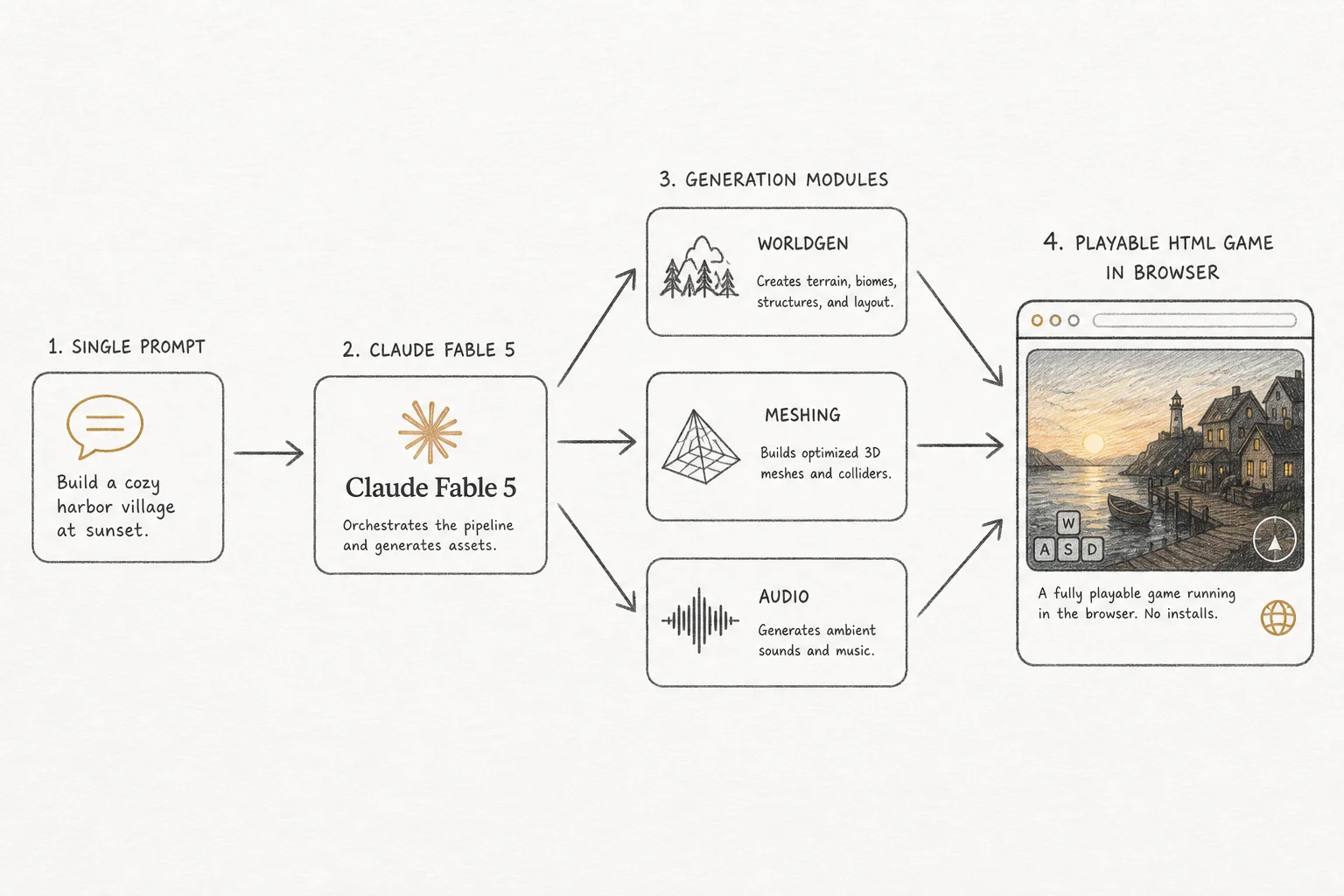
That is not a tutorial scaffold. It is a modular codebase with files like worldgen.js, mesher.js, and audio.js that read like something a small team would argue about in code review.
Jimmy7610's MineClone goes further with multiplayer and NPCs, also attributed to Fable-assisted development. Different builders, same pattern: one ambitious prompt, one long generation pass, a repo you can clone and run.
Why one-shot matters for applied AI
Most coding agents I use day to day still feel like fast autocomplete with terminal access. You steer. You fix imports. You rerun tests after the model forgets a file.
These Minecraft builds are closer to spec-to-system work:
- The model plans subsystems (noise, textures, meshing) instead of patching one function.
- Output stays internally consistent across thousands of lines.
- The artifact runs without a human wiring the last 20%.
That is the bar I care about when clients ask whether agents can replace a junior engineer for greenfield tools. Not "can it write React components," but "can it own architecture long enough to finish?"
A Minecraft clone is a stress test. If the model drops state after 800 lines, the world renders as soup. These repos mostly do not.
Cost, time, and the boring math
Reported numbers from builders in early June 2026 cluster like this:
| Builder | Time | Approx. cost | Notes |
|---|---|---|---|
| ChrissGPT (X demo) | ~20 min | not disclosed | Five-word prompt, "high" setting |
| @ydamitcodes | 37 min | ~$12 | ~3K LOC, mobs included |
| @Angaisb_ | not disclosed | ~$30 | Background music, HTML test |
Your mileage depends on reasoning depth, retries, and whether you accept the first pass. I would budget an hour of review time even when generation is fast. Procedural games hide edge-case bugs in chunk boundaries and save files.
How to run the demos yourself
Every repo I found shares the same constraint: you need HTTP, not file://. ES modules and CDN imports fail when you double-click index.html.
git clone https://github.com/Angais/Fable5-mc.git
cd Fable5-mc
npm start
# opens http://localhost:5173
For a quick sanity check without Node, python3 -m http.server 8000 in the repo root works too. Just open the served URL, not the raw file path.
What I would steal for client work
If you build internal tools or simulation UIs, three lessons transfer even if you never ship a game:
- Give the model a systems brief, not a ticket list. "Minecraft clone" works because the target architecture is well known. For ops dashboards, name the modules you expect (ingest, rules engine, audit log).
- Ask for procedural assets when static files are a pain. Synthesized textures and audio are a legit way to keep repos small and licensing clean.
- Treat the first output as a branch, not production. The win is collapsing weeks of scaffolding into an afternoon. You still own security review, performance profiling, and maintainability.
The hype filter
"No follow-up prompts" claims are marketing-adjacent. Even great repos ship with GitHub issues about performance, mobile controls, and multiplayer sync. Fable 5 did not replace game designers. It replaced the worst part of week one: empty folders and boilerplate.
I also will not pretend $30 per experiment is free at scale. For a funded prototype or a client demo, though, it is often cheaper than one billed hour.
Where this lands for builders
Fable 5's Minecraft moment is shareable because everyone recognizes the reference game. The deeper signal is architectural coherence at long context. That is directly relevant if you ship agents, internal tools, or vertical SaaS where the UI is custom but the domain rules are heavy.
If you are testing this on your stack, start with a system you can verify quickly: a playable web toy, a data explorer, or a fake checkout flow. Measure time-to-running-demo, not lines of code generated.
Useful links:
If you want help scoping an agent workflow that ships real software instead of slide decks, book a free discovery call. I spend most of my week on exactly that gap between demo and production.