
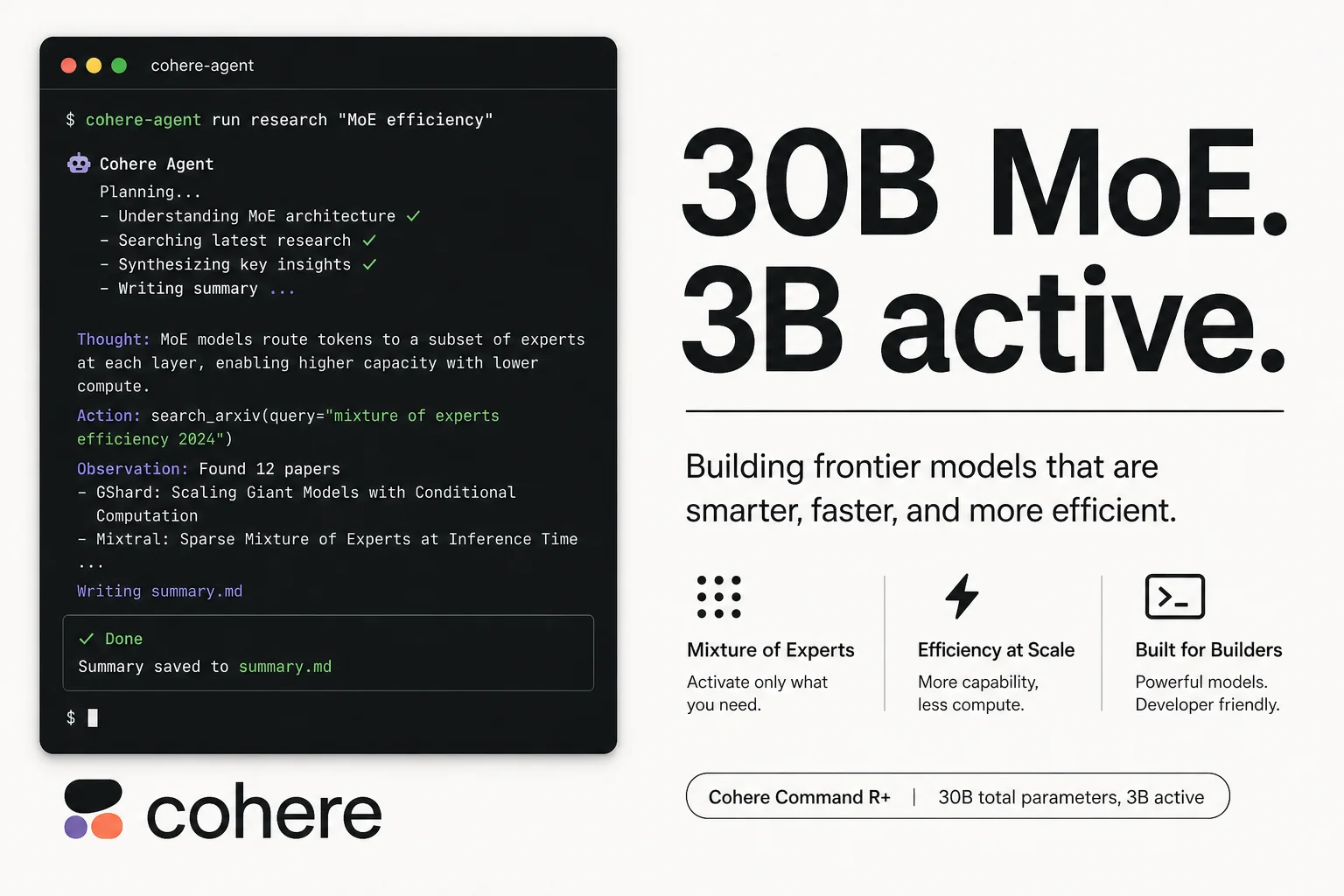
On June 9, 2026, Cohere shipped North Mini Code 1.0, its first open-weight model aimed at developers. The headline specs are easy to remember: 30B total parameters, 3B active, 256K context, Apache 2.0 license, optimized for agentic coding and terminal work.
That is a different bet than another cloud-only frontier API. Cohere is explicitly pushing sovereign AI: run the weights on hardware you control, wire them into harnesses you already use, keep source code off someone else's retention policy.
Model card at a glance
| Field | North Mini Code 1.0 |
|---|---|
| Architecture | Sparse MoE (128 experts, 8 active per token) |
| Active params | ~3B per forward pass |
| Context | 256K input, up to 64K generation |
| License | Apache 2.0 |
| Hardware floor | 1× H100 @ FP8 (per Cohere) |
| Hugging Face | CohereLabs/North-Mini-Code-1.0 |
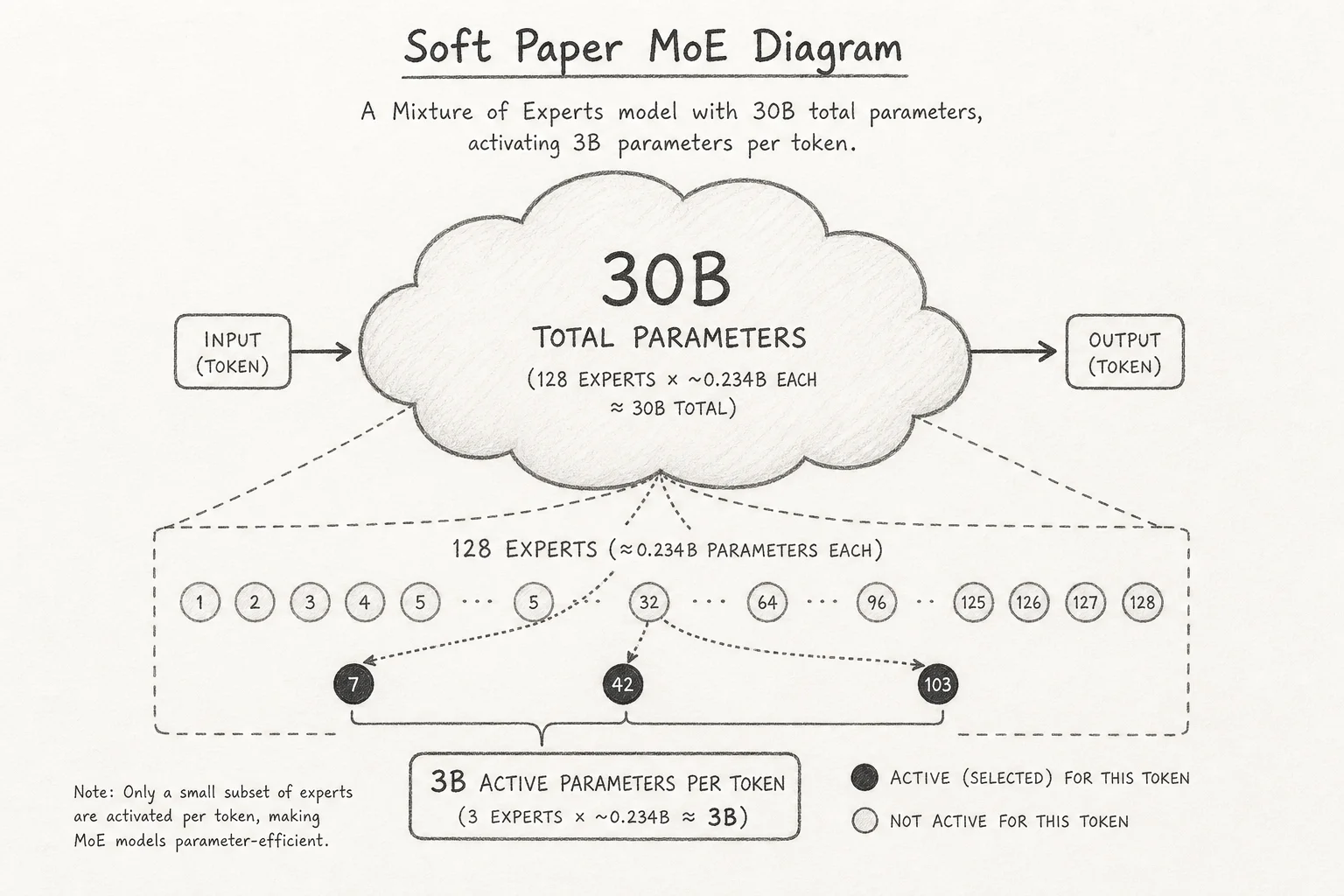
Cohere co-founder Nick Frosst demoed MLX on a Mac Studio at roughly 20GB RAM in launch materials. Your laptop may vary. The point is the active footprint is small enough to fantasize about local agents again.
What "agentic coding" means here
North Mini Code is not marketed as a chat model that happens to know Python. Cohere trained it against multiple harnesses so behavior generalizes across scaffolds:
- Repo-level edits inside tools like OpenCode
- Terminal sessions that chain shell commands
- Sub-agent orchestration and architecture mapping
- Code review flows with native tool use
Artificial Analysis reportedly scored it 33.4 on their Coding Index, with Cohere claiming up to 2.8× throughput versus Devstral Small 2 in some setups. I treat vendor benchmarks as directional. Still, the positioning is clear: this is for agents, not autocomplete.
Where to run it
Cohere listed several on-ramps at launch:
- Hugging Face weights (bf16, fp8, w4a16 variants)
- Cohere API (
north-mini-code-1-0) - Model Vault managed inference
- OpenRouter
- Ollama tag
north-mini-code-1.0for quick local experiments
If you already run OpenCode or similar harnesses, this is a drop-in model swap more than a platform migration.
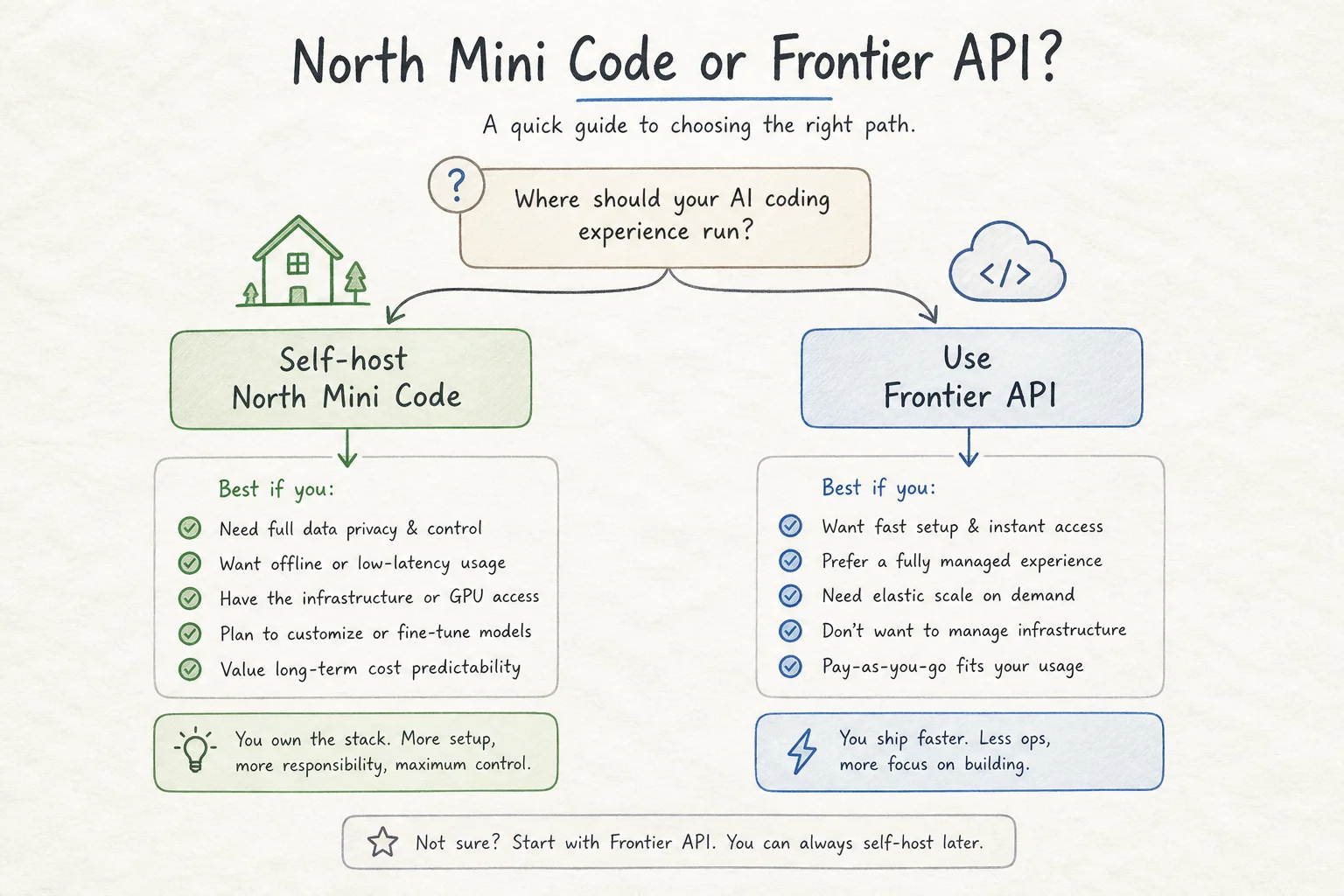
When I would pick North Mini Code over a frontier API
I default to frontier APIs when latency, reasoning depth, or multimodal input is non-negotiable. North Mini Code wins in a different column:
| Scenario | Why local/open weights help |
|---|---|
| Client code cannot leave VPC | Compliance beats benchmark points |
| High-volume triage bots | Per-token bills add up fast |
| CI comment bots | Predictable cost, customizable fine-tunes later |
| Air-gapped environments | You own the artifact chain |
The 256K context window also matters for agents that ingest whole repos. You still need retrieval discipline. Dumping an entire monorepo into context is how you turn a cheap model expensive.
Trade-offs I would plan for
Output token limits still bite. Cohere documents strong coding scores but also notes output-token behavior as a weak spot in third-party writeups. For agents that spew huge diffs, monitor truncation.
License nuance. Apache 2.0 is permissive, but always read the model card footnotes on Hugging Face before shipping a commercial product. Community posts flagged occasional non-commercial language in ancillary files. Verify before legal signs off.
You own the harness. A great weights file does not replace evals on your repo layout, test runner, and lint rules. Budget a week of side-by-side runs against your current default model.
Quick self-host smoke test mindset
I have not wired North Mini Code into a client production path yet. My first afternoon would look like this:
- Pull fp8 weights if you have one H100-class GPU; otherwise try Ollama on a dev box.
- Point OpenCode (or your harness) at the endpoint.
- Run five real tickets you closed last month. Same prompts, same tests.
- Log pass rate, diff size, and wall time. Numbers beat vibes.
ollama pull north-mini-code-1.0
Exact commands depend on your inference stack. Cohere's developer docs are the source of truth.
Why Cohere entering open weights matters
Cohere built its brand on enterprise retrieval and private deployments. North Mini Code is a signal that developer mindshare matters again in the MoE era.
For applied engineers, more Apache-licensed coding models means bargaining power: you can threaten to walk your agent workload to self-hosted inference when SaaS pricing moves.
Bottom line
North Mini Code is not going to replace Opus-class models for ambiguous architecture debates. It might become the default workhorse for repo agents you run on your own metal.
If you are building agent infrastructure and want help choosing between self-hosted MoE models and managed APIs, book a discovery call. That trade-off shows up in almost every ops automation project I take on.
Links: