
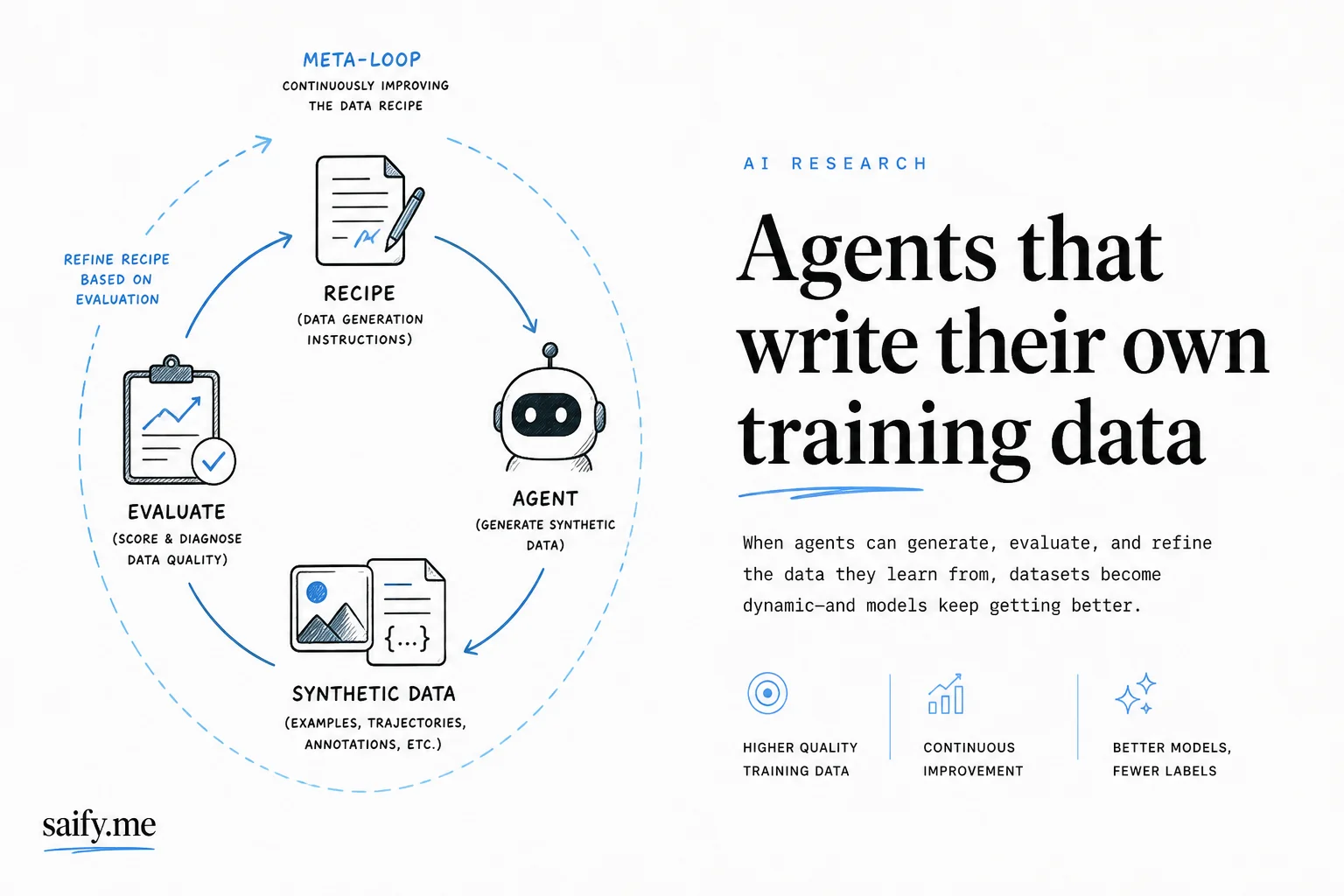
Karpathy's autoresearch meme optimized training code. Meta's Jason Weston team asked: what if the agent optimizes the data instead?
In June 2026, Meta FAIR published Autodata: An agentic data scientist to create high quality synthetic data with a RAM blog walkthrough. An agent plays data scientist: ground on domain docs, generate synthetic train or benchmark rows, eyeball failures, measure downstream model performance, write learnings, repeat with a better recipe. Then an outer loop meta-optimizes the data scientist itself.
AlphaSignal framed it as agents eating their own training data supply chain. That is directionally right.
Inner loop: act like a human data scientist
Autodata generalizes synthetic data pipelines (Self-Instruct, evol-instruct, benchmark builders) into one agentic template:
| Phase | Agent actions |
|---|---|
| Data creation | Tools + skills + inference compute to synthesize rows from seed corpora (legal, math, coding) |
| Data analysis | Inspect samples, run probes, compare weak vs strong solver performance |
| Learnings | Document what worked, what polluted the set, what to change |
| Iteration | Re-run creation with updated recipe |
The agent is not a one-shot generator. It curates, the same loop a human label team runs on Friday afternoon before shipping a fine-tune.
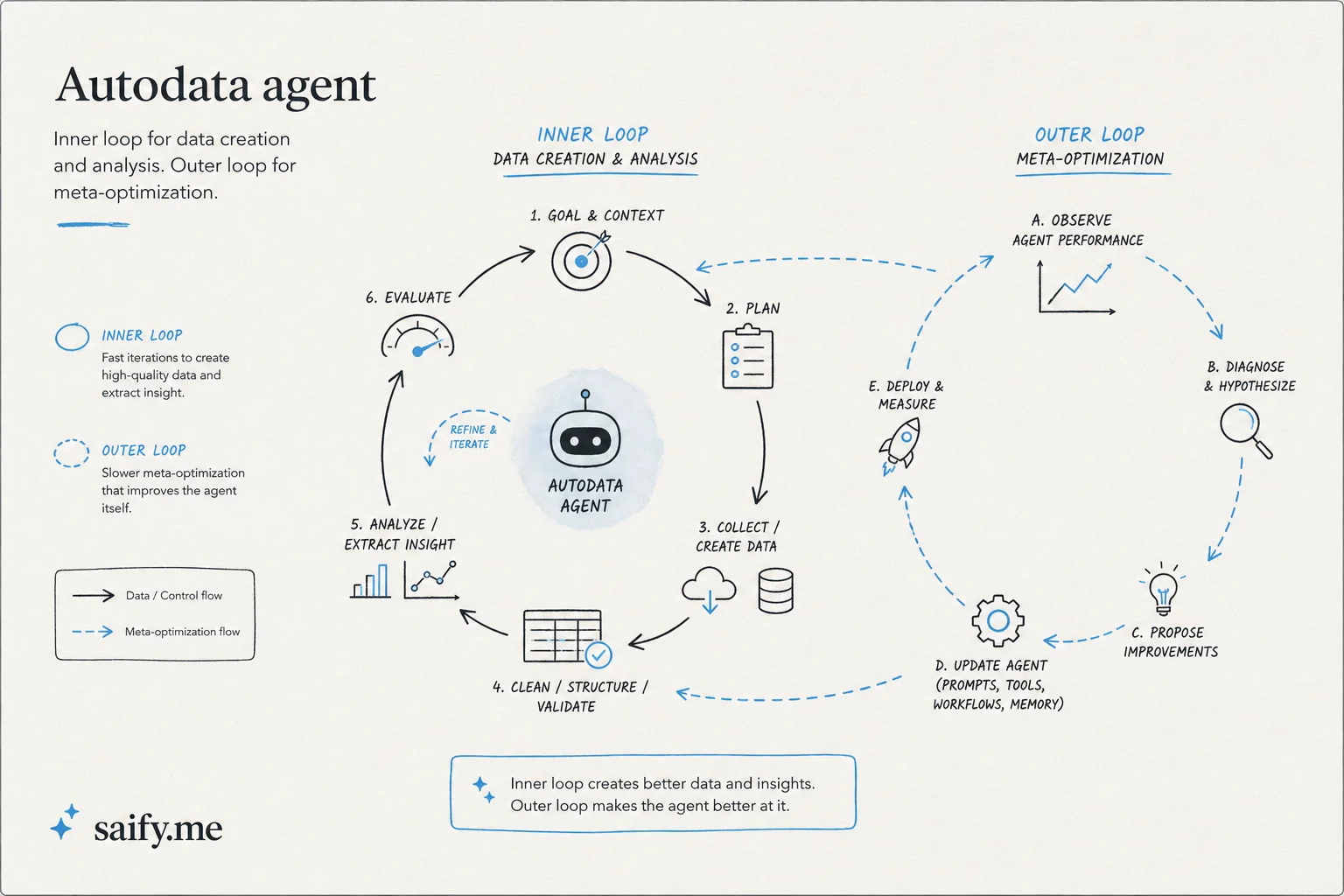
Concrete implementation highlighted in the paper: Agentic Self-Instruct, optimizing for examples that separate weak and strong solvers rather than maximizing volume.
Outer loop: meta-optimize the curator
Inner loop improves data for a fixed agent policy. Outer loop improves how the agent curates:
- Meta-optimization targets prompts, tool choices, and strategy weights
- No manual prompt engineering per domain once the outer loop runs
- Meta gains exceed inner-loop-only gains in Meta's reported experiments
That is the recursive infrastructure AlphaSignal noticed: less human recipe writing, more compute spent on agentic data loops.
Karpathy's 2026 autoresearch focus stayed on architecture and training recipes. Autodata argues data curation deserves equal inference budget because bad synthetic rows poison fine-tunes faster than a slightly wrong learning rate.
Results across domains
Meta tested computer science research tasks, legal reasoning, and mathematical object reasoning:
- Beat classical synthetic baselines on quality metrics
- Meta-optimized data scientist delivered additional uplift beyond inner-loop iteration alone
- Converts extra inference compute into higher-quality training signal
For applied teams, the actionable line is: spend tokens on curation agents before you spend tokens on another epoch on noisy JSONL.
How I would pilot this without a FAIR cluster
You do not need Meta's full stack to steal the pattern:
- Seed corpus: client docs, tickets, legal clauses, internal API specs (permissioned)
- Generator agent: produce candidate Q&A or tool-use traces
- Judge agent: score factuality, difficulty, solver separation
- Learner memory: store recipe tweaks (prompt fragments, rejection rules)
- Outer loop: weekly job that tunes generator prompts from judge stats
Pair with loop engineering for self-improving agents when you want production feedback to feed the outer loop.
Avoid shipping synthetic coding data without runtime validation. See Greptile Trex for why generated patches need execution checks.
Risks the paper does not hide
Synthetic data can encode generator biases. Meta-optimization can overfit to a narrow judge.
Legal and compliance domains need human spot audits even when agents eyeball samples.
Compute cost shifts from training GPUs to inference-heavy curation loops. CFOs need that line item.
Relation to Qwen-AgentWorld and eval culture
Autodata improves what models learn. Qwen-AgentWorld improves where agents practice before production. Together they push the stack toward less human labeling and more agent-generated infrastructure.
If your team still treats synthetic data as a one-off script, Autodata is the research memo explaining why that script should be an agent with memory.
Bottom line
Meta's Autodata is the clearest 2026 statement that data science is an agent loop, and that loop can train itself. Jason Weston's FAIR group showed meta-optimized curation beats hand-tuned Self-Instruct pipelines on hard reasoning tasks. For applied AI teams, the lesson is simpler: before you buy another labeling vendor, run a curator agent for two weeks and measure downstream pass rate.
Building private fine-tunes or eval harnesses? Get in touch.