
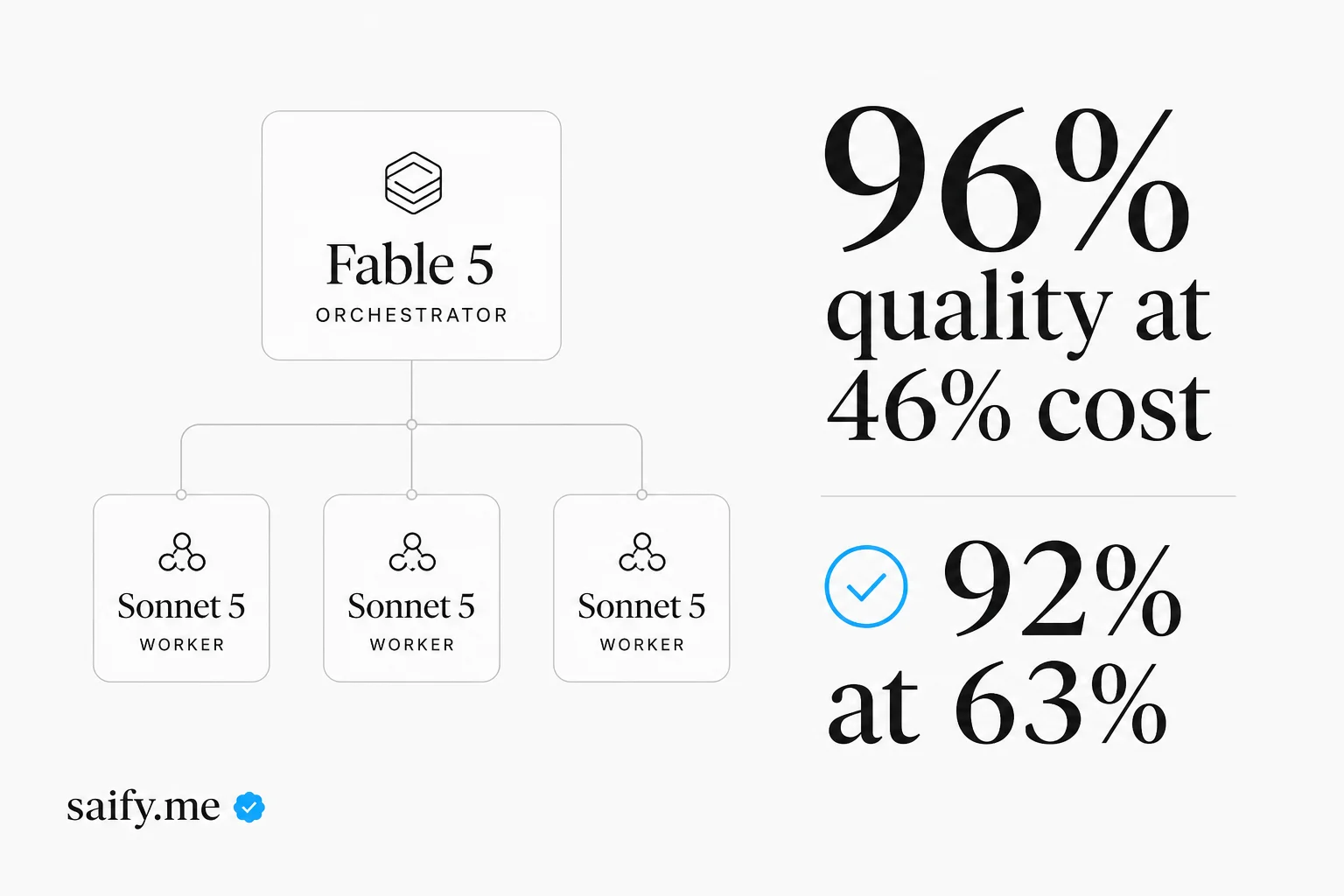
Running every agent turn through Claude Fable 5 is the fastest way I know to burn a production API budget. The model is excellent. The invoice matches.
Anthropic's July 2026 guidance is blunt: treat Fable as a brain, not a workhorse. Let Sonnet 5 execute. Call Fable when you need a plan, a course correction, or a decomposition of a messy task.
On Anthropic's own benchmarks, that is not a compromise. It is routing.
The two patterns in one sentence each
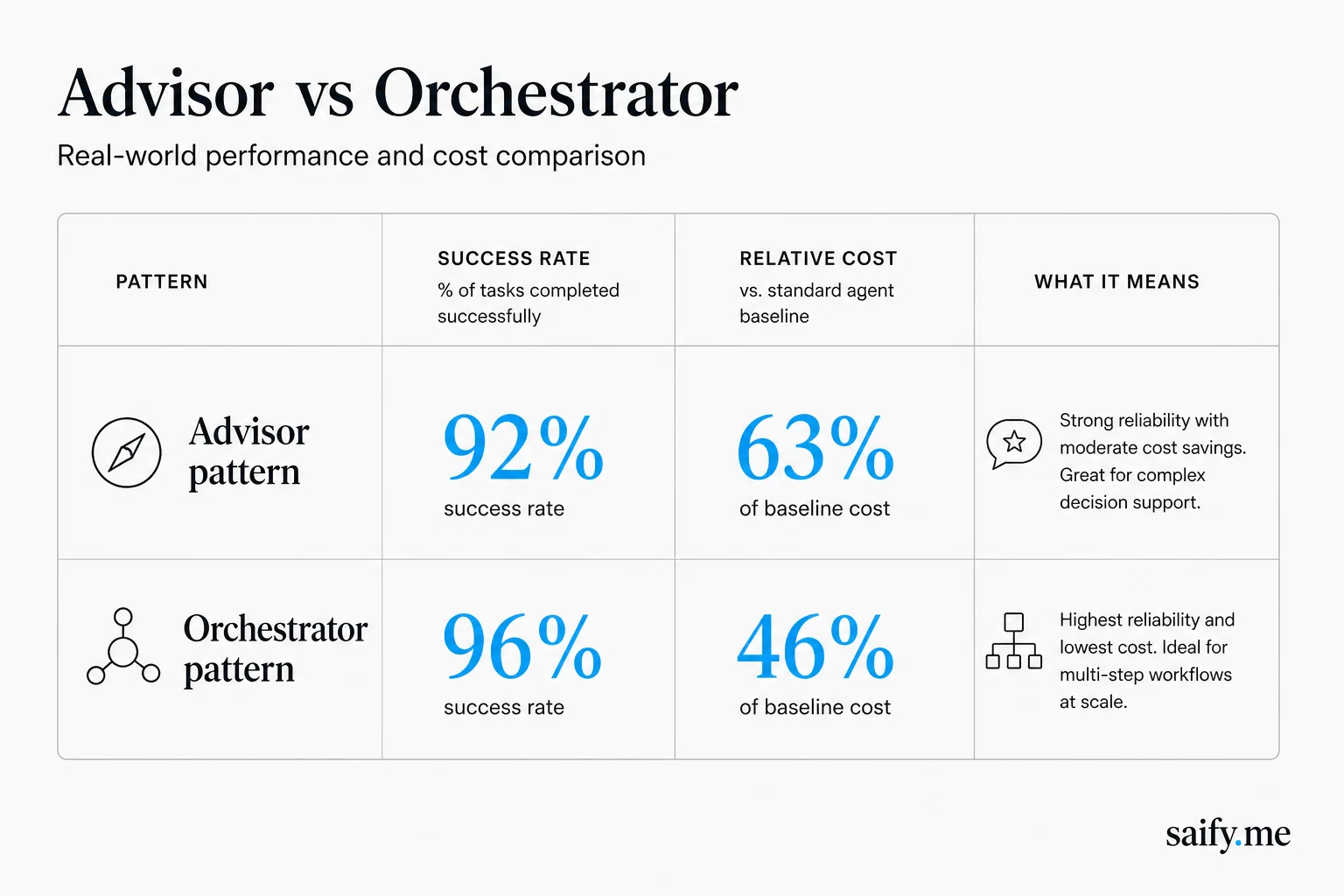
| Pattern | Who does what | Anthropic benchmark | Quality vs Fable solo | Cost vs Fable solo |
|---|---|---|---|---|
| Advisor | Sonnet 5 executes, Fable 5 advises (~1 call/task) | SWE-bench Pro | ~92% | ~63% |
| Orchestrator | Fable 5 plans, Sonnet 5 workers execute | BrowseComp (CMA) | ~96% | ~46% |
| Fable solo | Fable on every turn | Baseline | 100% | 100% |
That table is the whole economic argument for multi-model agent fleets in 2026.
Pattern 1: Fable as advisor
In the advisor setup, Sonnet 5 owns the tool loop. It reads files, runs commands, patches code, and only escalates to Fable when the task needs frontier judgment.
Anthropic ships this through the advisor tool (advisor_20260301 with beta header advisor-tool-2026-03-01). Think of it as a synchronous consult: Sonnet asks Fable for a plan or nudge, then keeps executing locally.
Why it works on coding:
- Most turns are mechanical (grep, edit, test, retry).
- One well-timed Fable call can prevent a bad architectural fork.
- Token-heavy output stays on Sonnet pricing.
I have written about the same philosophy in agentic coding model routing: classify, route, escalate. The advisor pattern productizes escalation inside Anthropic's stack.
Practical starting point for a single-repo coding agent:
{
  "executor": "claude-sonnet-5",
  "advisor": "claude-fable-5",
  "advisor_max_uses": 2
}
Cap advisor calls. Without a limit, a nervous executor will ping Fable every time tests fail.
Docs: Claude advisor tool.
Pattern 2: Fable as orchestrator
Research and multi-source tasks look different from SWE-bench. You want parallel workers, isolated caches, and a coordinator that does not re-read the entire web on every branch.
That is where Claude Managed Agents (CMA) comes in. Fable plans the task, breaks it into subtasks, and dispatches Sonnet 5 worker sub-agents. Each worker keeps its own cache, so shared context is not paid for twice.
On BrowseComp, Anthropic reports:
- ~96% of Fable solo performance
- ~46% of Fable solo cost
The orchestrator pattern is the one I reach for when a client asks for "deep research across ten sources" without a five-figure model bill. Fable writes the plan once. Sonnet workers chew through retrieval and synthesis.
Cookbook: Managed Agents subagent live watch.
If you already run Managed Agents with effort pins and webhooks, orchestration is the next layer: same fleet primitives, smarter model placement.
When each pattern fits
| Your workload | Start here |
|---|---|
| Single-repo coding agent | Sonnet executor + Fable advisor (max_uses: 2-3) |
| Multi-source research, parallel search | Fable CMA orchestrator + Sonnet workers |
| Simple Q&A or one-shot codegen | Sonnet alone |
| Every turn needs frontier reasoning | Fable solo (patterns optimize cost, not max IQ) |
| Haiku triage + occasional hard tasks | Haiku executor + Fable advisor on turn 2 |
The mistake I see in audits: teams buy Fable for the benchmark headline, then route every customer-facing agent loop through it. Margin dies before the demo ships.
How this connects to Claude Code today
Both patterns are supported in Claude Managed Agents natively. In Claude Code, you pin models in subagent definitions with the model field so workers and coordinators do not share one expensive default.
That matters for client work because sub-agent caches are per agent. A research fleet with three Sonnet workers and one Fable planner does not triple-bill the same system prompt on every branch.
I still treat Fable as opt-in for regulated accounts. Retention and pricing conversations from Fable in Cursor apply here too. The patterns save money; they do not remove compliance review.
What I changed in proposals after this drop
Three lines I added for July 2026 agent builds:
- Default executor is Sonnet (or your team's workhorse), not Fable.
- Advisor budget is explicit: max calls per task, logged.
- Orchestrator tasks get acceptance criteria per worker (artifact list, not "research more").
If a stakeholder asks "why not Fable everywhere?", I show the 96% at 46% row. Near-frontier quality with half the bill is a procurement story, not a lab result buried in a PDF.
Limits the benchmarks do not capture
Routing patterns do not fix:
- Flaky CI that turns agents into infinite retry loops
- Ambiguous product specs where "done" is political
- Teams that skip evals and trust model names instead of artifacts
Benchmarks also underweight latency. An advisor call adds a round trip. For interactive coding, I keep advisor max_uses low and accept slightly lower scores on edge-case refactors.
Bottom line
The moat in 2026 is not "who has the biggest model." It is who can afford to run complex pipelines at production volume.
Anthropic's advisor and orchestrator patterns are a playbook: Fable for judgment, Sonnet for tokens, CMA for fleet shape. That is the same hybrid stack I already recommend; now it has published numbers attached.
If you are wiring multi-agent research or coding fleets and want a second pair of eyes on model pins and cost caps, book a free discovery call.