
Ten thousand simulated agent communities sounds like a thought experiment. In August 2026 it is a dataset.
Physics of Agents (arXiv:2608.16578), from Stanford researchers including Surya Ganguli and James Zou, runs more than 10,000 groups of language-model agents through eight rounds of message exchange. Each community has 32 agents with distinct personas, a signed communication graph (friendly, unfriendly, or silent ties), and a shared question. Some questions are objective MATH problems with ground truth. Others are subjective political statements with no single correct answer.
The headline for operators is not "agents are social." It is that collective LLM behavior follows compact dynamical laws you can forecast, stress-test, and misconfigure on purpose if you ignore topology.
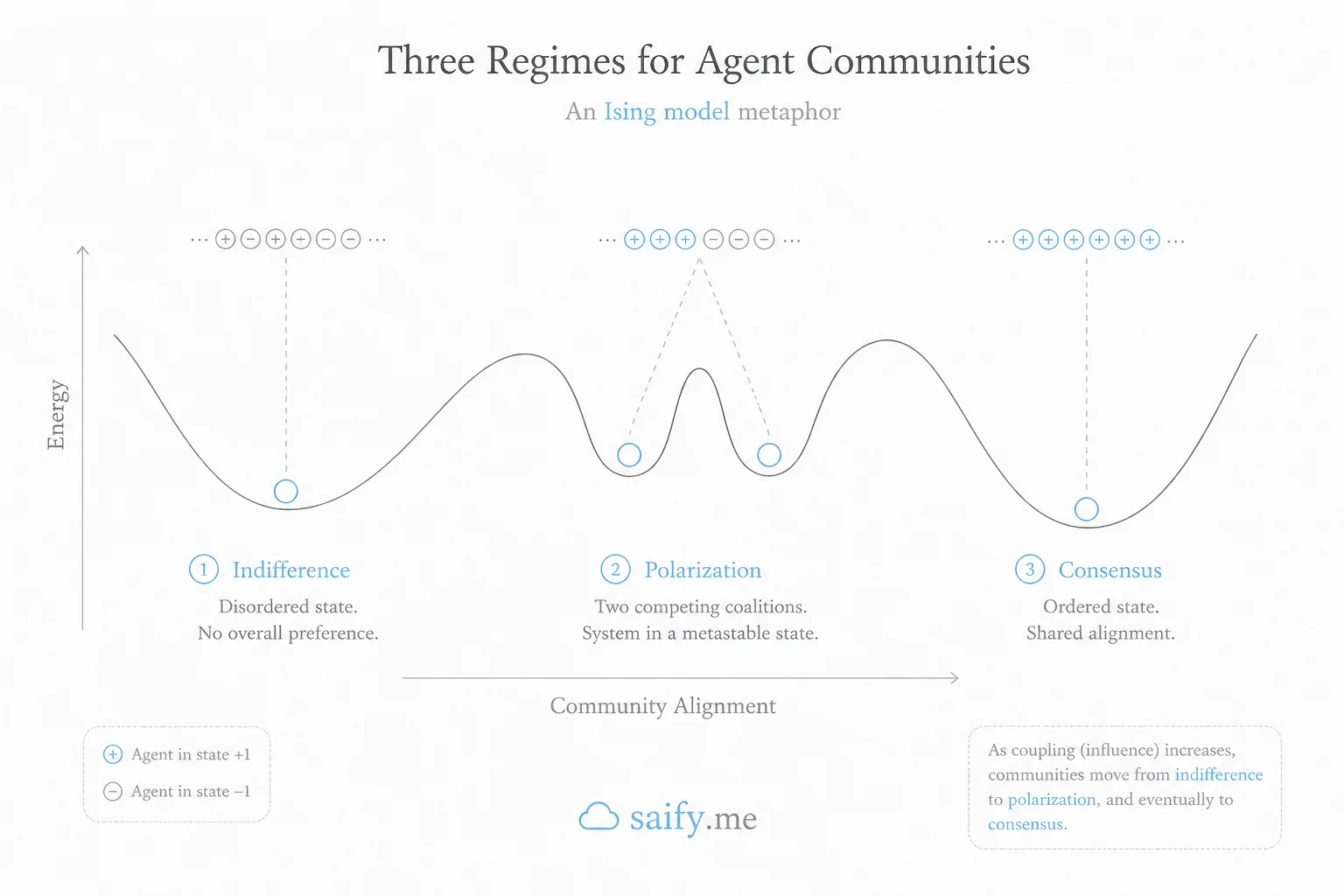
Three regimes, not chaos
Despite messy natural-language messages, group dynamics collapse into three characteristic regimes on a conviction versus net-opinion plane:
| Regime | Net opinion | Conviction | Plain English |
|---|---|---|---|
| Indifference | Near zero | Low | Agents are unsure; the group has no strong lean |
| Polarization | Near zero | High | Agents are committed but split into opposing camps |
| Consensus | Strong positive or negative | High | Most agents align on one side |
Early rounds are dominated by indifference. As agents talk, conviction rises in every setting. Communities do not stay mushy. They harden into consensus or polarization. That matches what I see when client fleets run open-ended debate loops without exit criteria: the system does not stay neutral. It picks a lane.
Objective math: interaction helps truth-seeking
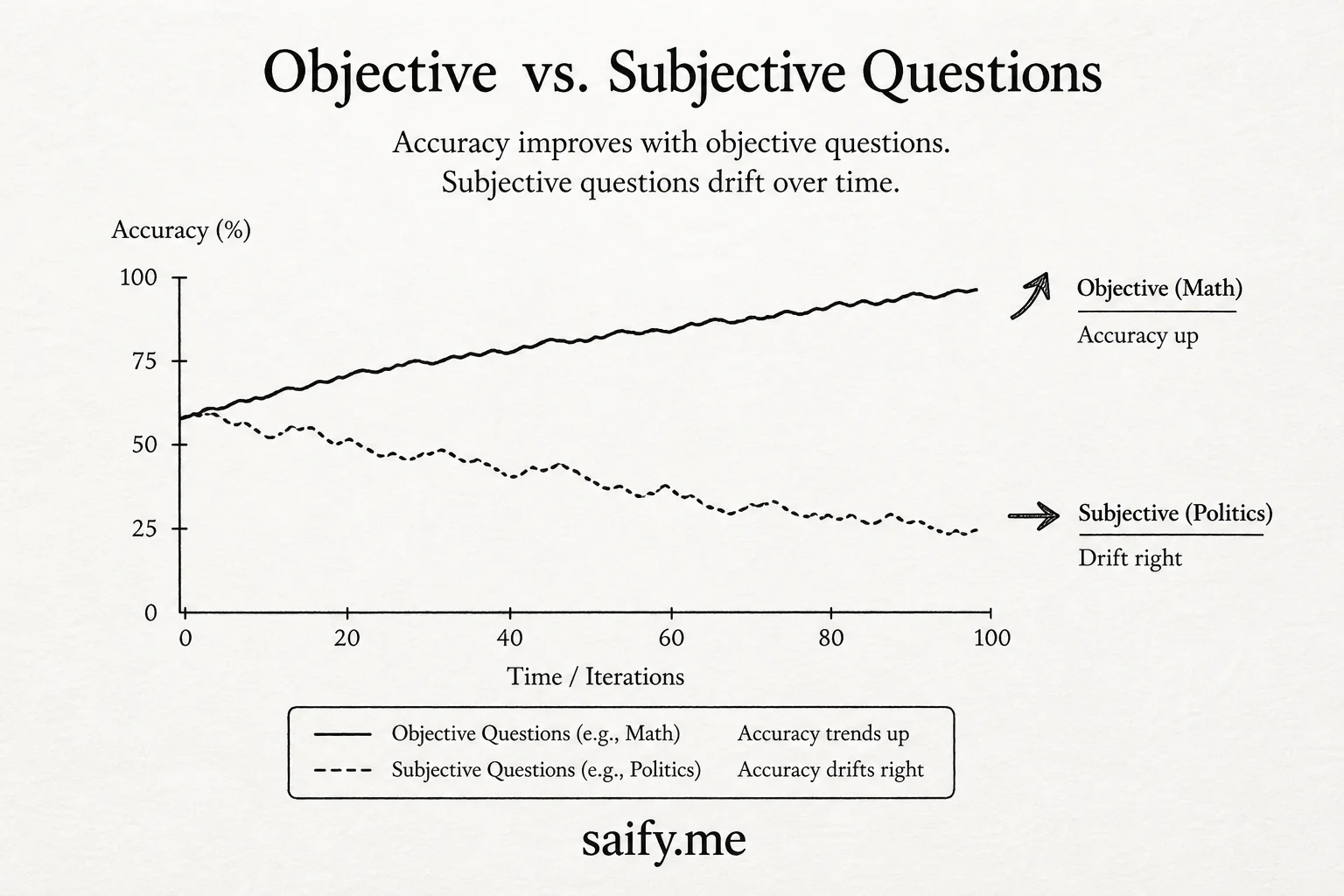
On MATH-derived multiple-choice questions, personas encode different slices of mathematical expertise (each agent sees a worked solution to a different problem). Agents start with weak collective accuracy, then communication pushes net opinion toward the correct answer.
The paper's majority-switch matrix is the number that stuck with me:
- Incorrect majorities that flip to correct are more common than correct majorities that flip to incorrect.
- That holds across GPT-4o-mini, Gemma, Qwen, and Llama backbones in their sweep.
So multi-agent math is not just extra inference compute. Under their graph, social pull amplifies agents who already hold the right answer. The fitted Ising-style model makes that explicit: neighbors with the correct sign exert stronger influence than neighbors who are wrong.
On verifiable tasks, debate can recover from a bad first vote. The improvement is statistical, not guaranteed per episode.
Subjective politics: the same machinery drifts right
Swap MATH for political agree/disagree statements and personas based on real demographic profiles. There is no ground truth. The same conviction buildup happens, but now collective opinion drifts toward the right of the spectrum more often than leftward.
That is not a bug in the plotting code. It is a warning for agent fleets that negotiate policy, hiring rubrics, moderation rules, or customer tone on value-laden prompts. Interaction does not average out model bias. It can directionally amplify it while making everyone sound more confident.
I treat subjective multi-agent loops differently from factual ones after reading this. Factual: more rounds can help. Subjective: cap rounds, log drift, and keep a human or hard constraint on the output channel.
The Ising model connection (without the physics homework)
The authors map agent opinion updates to a statistical mechanics formalism related to the Ising model. Each agent has a binary opinion state and feels two pressures:
- Intrinsic field (g_i): persona plus question bias, learned from embeddings.
- Social pressure along signed edges J_ij in (+1, 0, -1): friendly ties pull toward alignment, unfriendly ties push toward opposition.
Agents stochastically favor lower total "energy." The update rule is logistic: your next opinion depends on weighted neighbor votes plus your intrinsic lean. They extend the classic picture with three coupling strengths (concordant pull, discordant push, and baseline "being connected matters").
Fitted on one-step transitions, the model beats standard baselines and generalizes to unseen graph families. Rolled forward from round zero, it reproduces group archetype distributions. Three fitted facts explain the empirical story:
- Communities sit below critical social temperature (ordered regime), so conviction builds instead of staying noisy.
- Concordant ties outweigh discordant ones, favoring consensus over endless polarization.
- On objective questions, correct neighbors pull harder, which drives truth-seeking.
Code and data are public at github.com/batu-el/physics-of-agents and huggingface.co/physics-of-agents.
What this changes for agent fleet ops
This paper pairs well with Stanford's harness line of work. I wrote about code as agent harness when Meta and Stanford argued the shell around the model matters more than the prompt. Physics of Agents answers the next question: given a harness that lets agents talk, what collective outcome should you expect?
Practical checklist I am already stealing:
1. Graph topology is production config
Mixture-of-agents is a fully connected friendly graph. Debate with assigned critics is a graph with negative edges. Self-consistency is nearly disconnected. The paper shows the same question on different graphs produces different group archetypes. Version your topology like you version prompts.
2. Measure conviction, not just majority vote
Net opinion alone cannot tell polarization from indifference (both can sit near zero). Track mean squared opinion per agent over rounds. If conviction climbs while net opinion stays flat, you are polarizing, not undecided.
3. Split eval suites by task type
Run math or code-verification fleets with multi-round interaction enabled. Run policy, brand voice, or HR-scoring fleets with fewer rounds, dissent quotas, and drift monitors. The paper gives you license to stop treating "more agents talking longer" as universally good.
4. Do not confuse confidence with correctness
Conviction rises even when subjective drift moves the fleet rightward. "The team agrees" without showing what changed from round 0 will mislead stakeholders.
Multi-agent consensus does not mean more correct. Sometimes it means more certain about the same bias.
Monday morning version
- Read the abstract and Section 3 regime plots on arXiv:2608.16578.
- Draw your current fleet as a signed graph: who broadcasts, who critiques, who is isolated.
- Log net opinion and conviction per round on one factual eval you already run.
- Compare one-round vs eight-round accuracy before you add more agents.
If you are shipping multi-agent workflows and want help turning papers like this into monitored production topology (graphs, evals, drift alerts), book a free discovery call. I care about the bash scripts and the adjacency matrix, not just the model card.