
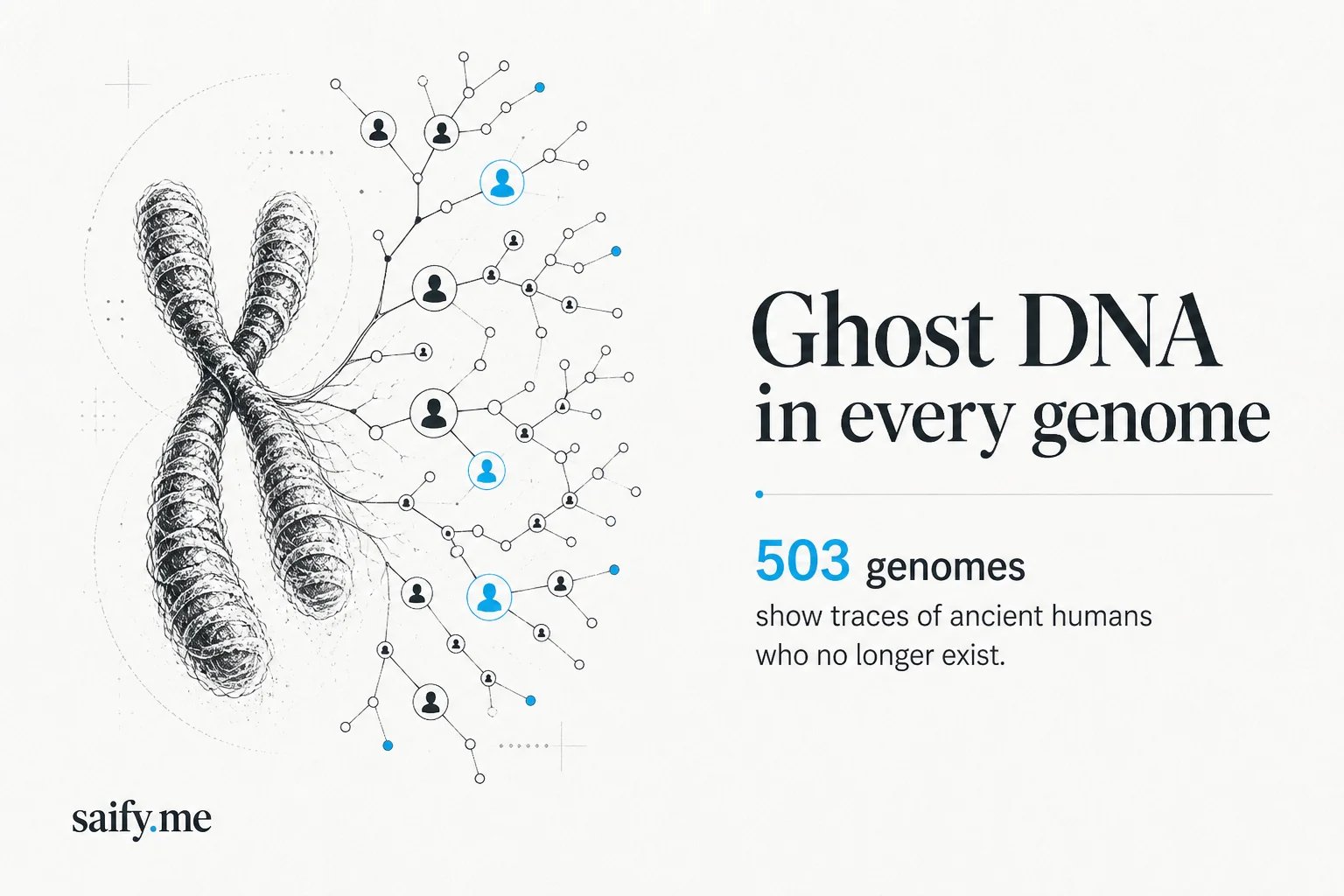
You carry thousands of family trees inside your genome. Most coalesce within the last 100,000 to 200,000 years. A new Science study covered by Scientific American says a slice of DNA in every population they tested branches back much further, matching no Neanderthal or Denisovan sequence anyone has ever sequenced.
That is a ghost lineage: real genetic signal, no named fossil owner.
I work on applied AI systems, not paleoanthropology digs. But the method here is the part I cannot ignore. The team did not need a new bone. They needed a better mathematical model for reading recombination history out of living genomes.
Why Africa made this hard until now
Neanderthal and Denisovan ancestry shows up clearly in non-African genomes because those lineages interbred after migrations out of Africa. Sub-Saharan African populations carry less of that signal, and scientists had few archaic reference genomes from Africa to compare against.
So the question sat open: did our direct ancestors mix with other hominin branches before the major out-of-Africa migrations roughly 70,000 years ago?
Without African archaic references, you cannot answer that by simple alignment to known fossils. You need a method that detects deep divergence from branch length alone.
How TRACE turns chromosomes into genealogies
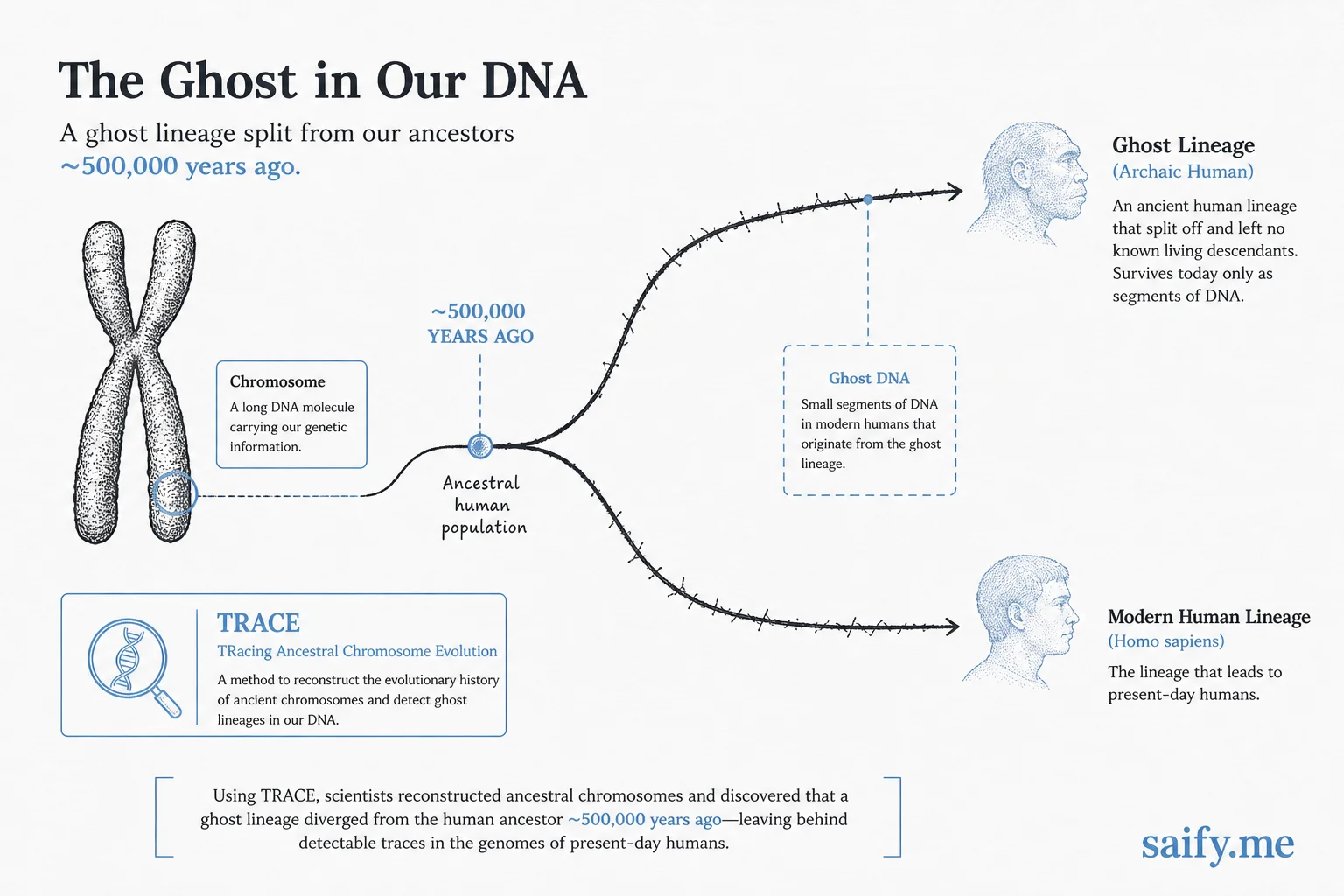
Co-lead authors Yulin Zhang (UC Berkeley) and Arjun Biddanda (Johns Hopkins) built TRACE (Tracking Archaic Contributions via ARG Estimation).
The intuition:
- Each chromosome carries many short segments, each with its own genealogical tree shuffled by recombination every generation.
- Most segments trace back to common ancestors on a human timescale.
- Segments inherited from deeply divergent populations produce unusually long external branches.
- TRACE scans 503 contemporary genomes and flags those long-branch regions.
Geneticist Priya Moorjani, a co-author, told Scientific American the team was surprised to see ghost signal in regions previously interpreted as uniquely modern, including around FOXP2, a gene linked to speech.
What the numbers say
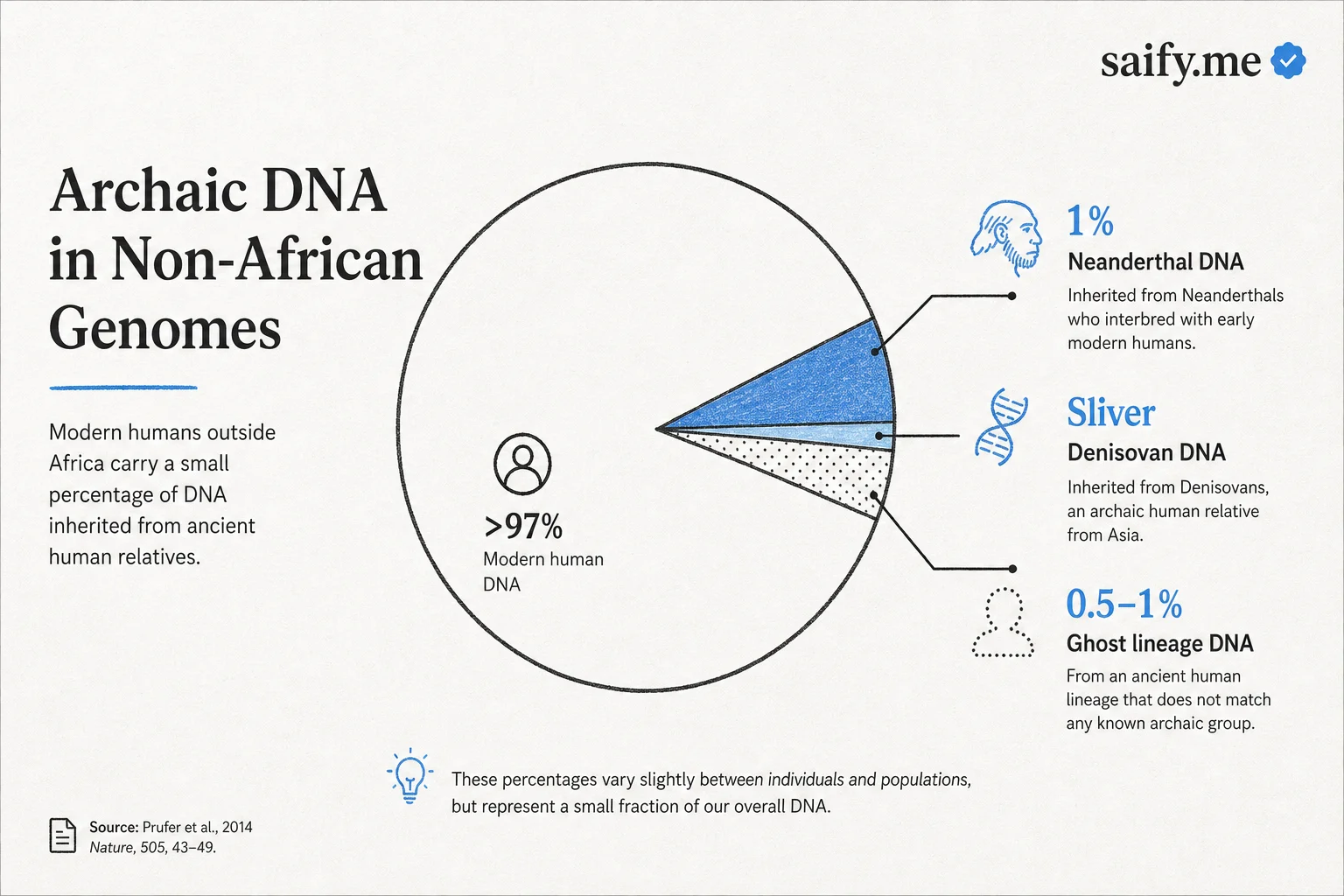
For non-African genomes, the study found about 2 percent archaic ancestry overall, consistent with prior work. The split:
| Archaic source | Share of genome (non-African) |
|---|---|
| Neanderthal (matched) | ~1% |
| Denisovan (matched) | small sliver |
| Ghost lineage (unmatched) | ~0.5% to 1%, varies by population |
The ghost branch likely split from our lineage more than 500,000 years ago, around when Neanderthals and Denisovans diverged. It appeared in every population Zhang and colleagues examined.
What skeptics want next
Patrick F. Reilly, a Yale computational biologist not involved in the study, told Scientific American that any method will produce false positives. Fair push.
He suggested checking whether ghost segments are equally dissimilar to Neanderthal and Denisovan references. If both comparisons look equally distant, the ghost group may be a sister lineage to known archaics rather than a sequencing artifact.
Confirmation paths:
- Independent computational methods with different assumptions
- Lucky ancient DNA preservation from sub-Saharan Africa
- Better fossil sampling (still the gold standard when it exists)
Reilly noted we may need methods like TRACE unless DNA preservation surprises us. That is the applied-AI angle I care about: when ground truth is missing, model design becomes the instrument.
Why this matters beyond anthropology Twitter
Regulatory and biobank pipelines. Population genetics models feed ancestry correction in GWAS, pharmacogenomics, and rare disease studies. Unmodeled archaic structure can create false associations. TRACE-class methods give biobanks a new QC lens.
Simulation-first discovery. The team found a global signal without a named fossil. That pattern shows up in other fields: infer structure from observational data, then hunt physical evidence. It is how a lot of modern ML science actually runs.
Speech-adjacent regions. FOXP2 is not a "language gene" switch. It is part of a regulatory network. Still, ghost ancestry sitting near speech-linked loci will drive years of careful functional follow-up. Jumping from population genetics to headline claims about talking ghosts would be silly. The location is worth watching.
How I'd pressure-test TRACE if this were a client model
If someone shipped TRACE output into production ancestry reports, I would ask:
- Calibration on simulated admixture with known ghost injection rates
- Cross-method agreement with at least one non-ARG approach
- Population holdouts (train TRACE parameters on subsets, validate on held-out geographies)
- Functional follow-up plan before marketing "ghost DNA" percentages to consumers
That is the same checklist I use when a client wants to deploy an LLM classifier on messy operational data. Impressive AUROC on a benchmark is step one. Step two is proving the errors are boring, not systematic.
Moorjani's closing line in Scientific American is measured: perhaps these methods opened a new frontier for human evolution. I think that is right, with the usual caveat that frontiers are noisy until replicated.
If you are building genomic or health-AI pipelines and want help separating publishable models from production-safe ones, book a free discovery call. Ghost lineages are fascinating. Bad QC in a biobank product is expensive.