
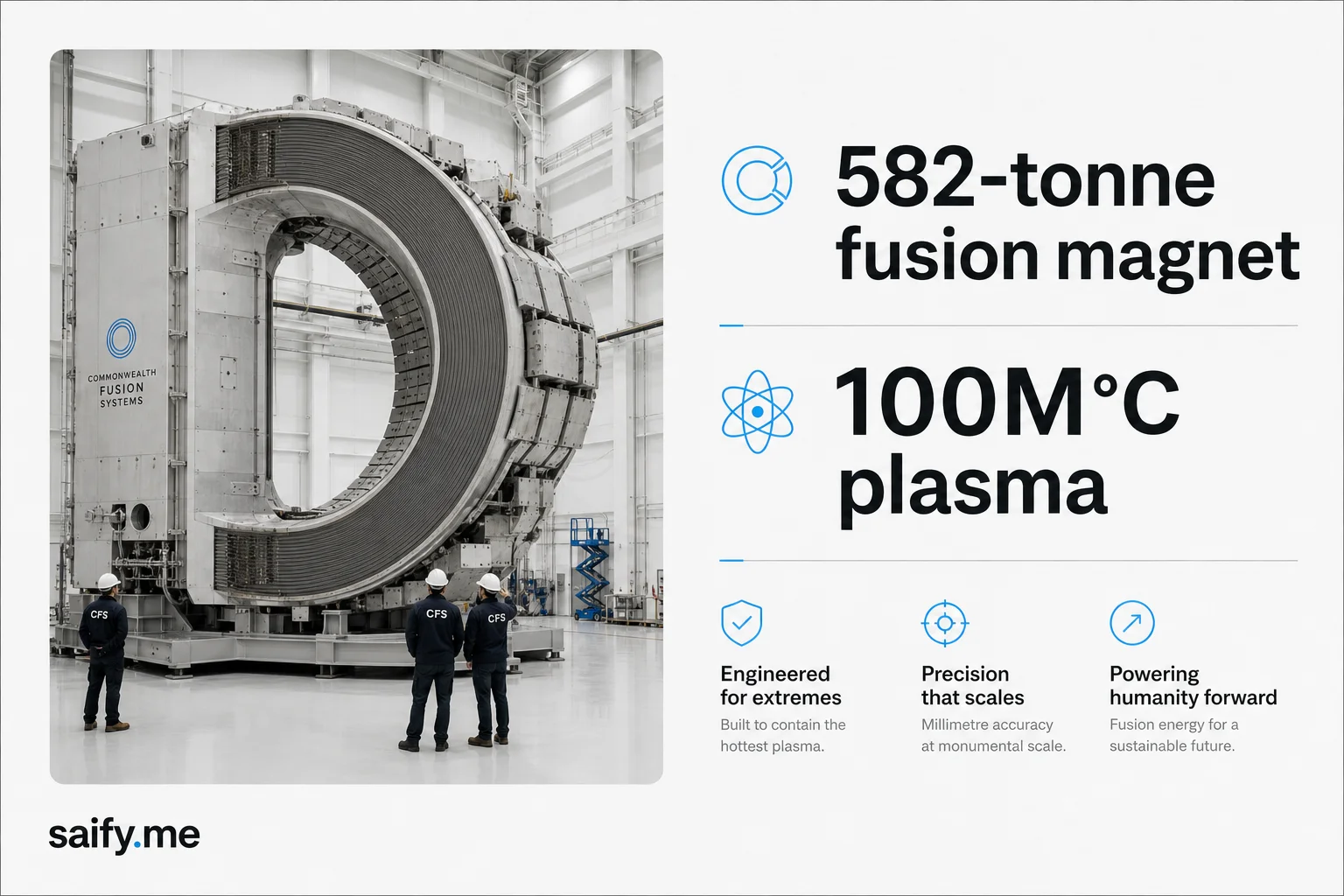
A single D-shaped magnet coil now weighs more than a fully loaded Boeing 747. That is not a metaphor from a pitch deck. It is the acceptance weight of China's newest toroidal field superconducting magnet for the CRAFT fusion program.
I do not build tokamaks for a living. I do build systems where a one-line schedule slip turns into a nine-figure write-off. Watching China ship a 582-tonne coil through full-load testing feels uncomfortably familiar: enormous custom hardware, zero tolerance joints, and a public roadmap that assumes everything after this step goes smoothly.
What just passed testing in Hefei
Daily Sun reported that the Institute of Plasma Physics under the Chinese Academy of Sciences accepted the coil after full-load testing. Sixteen of these magnets will eventually ring the reactor.
The numbers that stuck with me:
| Spec | Value |
|---|---|
| Weight | 582 tonnes |
| Footprint | 21 m × 12 m D-shaped coil |
| Volume vs ITER TF magnets | 1.3× |
| Stored energy vs ITER TF magnets | 3× |
| Operating temperature | ~−269°C |
| Design life | 60 years |
| Current in joints | >100,000 amperes, near-zero resistance |
The magnet's job is blunt: hold plasma at about 100 million °C off the walls long enough for fusion reactions to matter. Miss that confinement and you do not have a power plant. You have an expensive steam kettle.
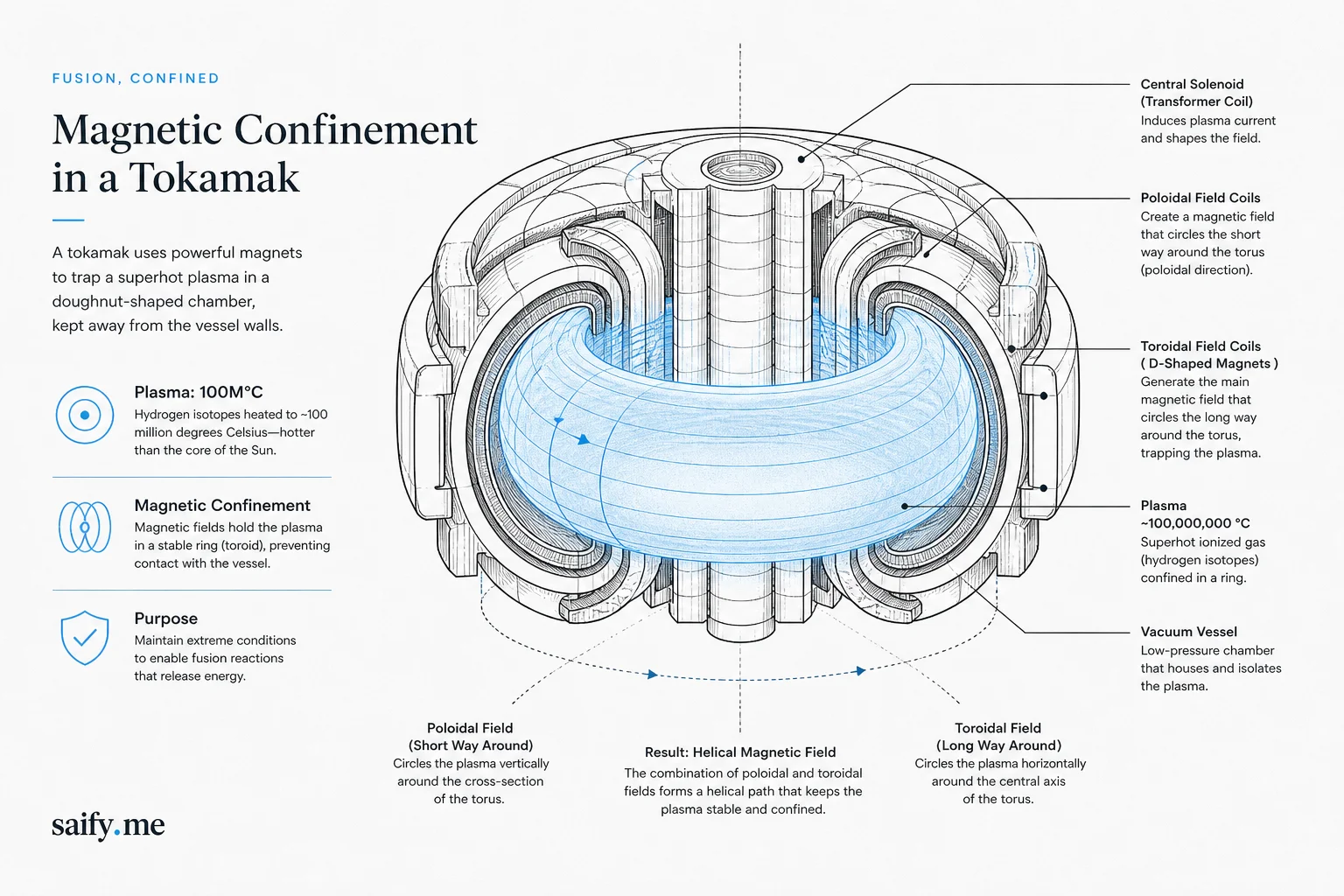
Researchers also tested a high-temperature superconducting central solenoid, the component that helps ignite and sustain plasma. China says both the giant coil and the solenoid were built with domestic materials and manufacturing, backed by 47 patents and 25 industry standards from a six-year program.
Why this sits on top of EAST, not instead of it
China's Experimental Advanced Superconducting Tokamak (EAST), often called the country's "artificial Sun," already set a duration record earlier in 2026: plasma at 100 million °C held for 1,066 seconds. Duration records and magnet acceptance tests measure different muscles.
Duration proves you can keep the plasma alive. A 582-tonne toroidal field coil proves you can build the structural and electromagnetic hardware that commercial reactors need at scale. Both have to work. Neither alone closes the business case.
The three-stage roadmap (and what still breaks)
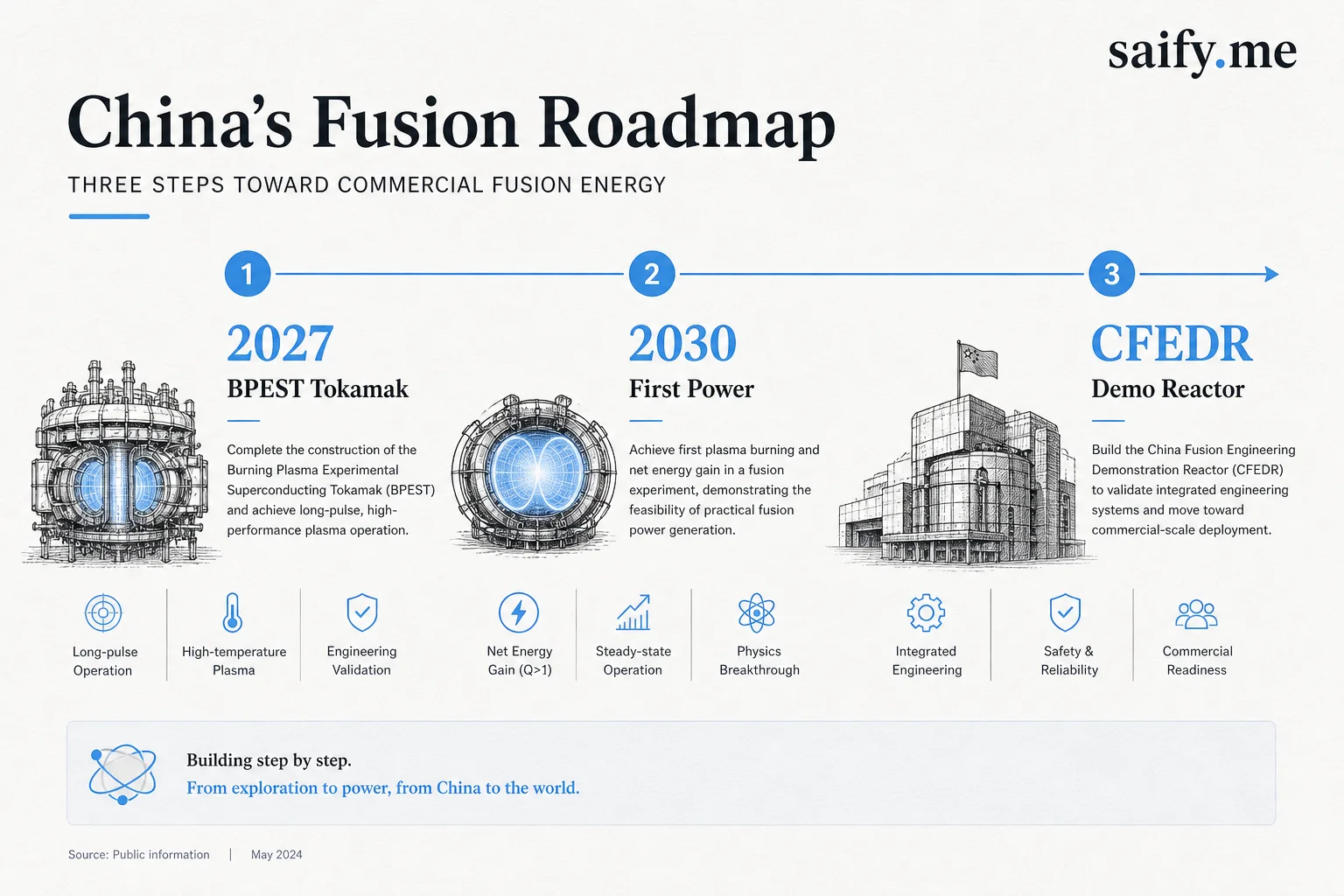
China's public plan has three beats:
- Burning Plasma Experimental Superconducting Tokamak (BPEST) finished by late 2027
- First fusion power generation around 2030
- China Fusion Engineering Demonstration Reactor (CFEDR) as a possible first fusion demonstration power station
That is aggressive even by fusion standards. The hard parts still ahead are the boring ones: full reactor assembly, years of integrated testing, and proving net energy gain reliably, not once on a good Tuesday.
ITER, the international megaproject, is the usual comparison point. China's coil team claims more volume and stored energy than ITER's toroidal field magnets. Winning on coil specs does not automatically win the race to grid electrons. It does move the supply chain center of gravity.
What this means if you run infra, not plasma physics
Most of my clients will never buy a fusion PPA in 2026. They will buy power on contracts that already price in data-center growth, GPU clusters, and the RAM crunch we wrote about in AI data center RAM pressure.
Fusion still matters to that world for three reasons:
Baseload narrative. Hyperscalers keep signing long-duration clean power deals. If even one country delivers demonstration fusion watts in the 2030s, it reshapes how boards talk about 2040 capacity planning.
Superconducting manufacturing. Coils this size force advances in joints, cryogenics, and QA traceability. Those skills leak into MRI magnets, particle accelerators, and grid-scale storage research.
Geopolitical redundancy. China emphasizing domestic fusion supply chains mirrors what we see in chips and launch slots. When a critical component has one friendly supplier, smart operators hedge.
I am not betting my consulting pipeline on fusion timelines. I am noting that the hardware photo is no longer a render. A 582-tonne coil passed full-load testing while many software "AI platforms" still cannot pass a SOC 2 read-through.
How I would read the next 18 months
If you track energy or hard-tech procurement, watch these signals instead of headline dates:
- Second and third coil acceptance (one magnet is a prototype victory; sixteen is a production story)
- BPEST assembly milestones through 2027
- Independent replication of joint resistance and quench behavior data
- Grid interconnection studies for any 2030 power claim (fusion without a substation plan is still sci-fi)
Fusion remains a physics problem wearing a project-management costume. China's July 2026 milestone is real engineering. Whether it becomes real electricity is still an open question, but the coil on the floor in Hefei is not.
If you are sizing power and compute architecture for workloads shipping this quarter, book a free discovery call. Fusion is a horizon bet. Your inference bill is due now.