
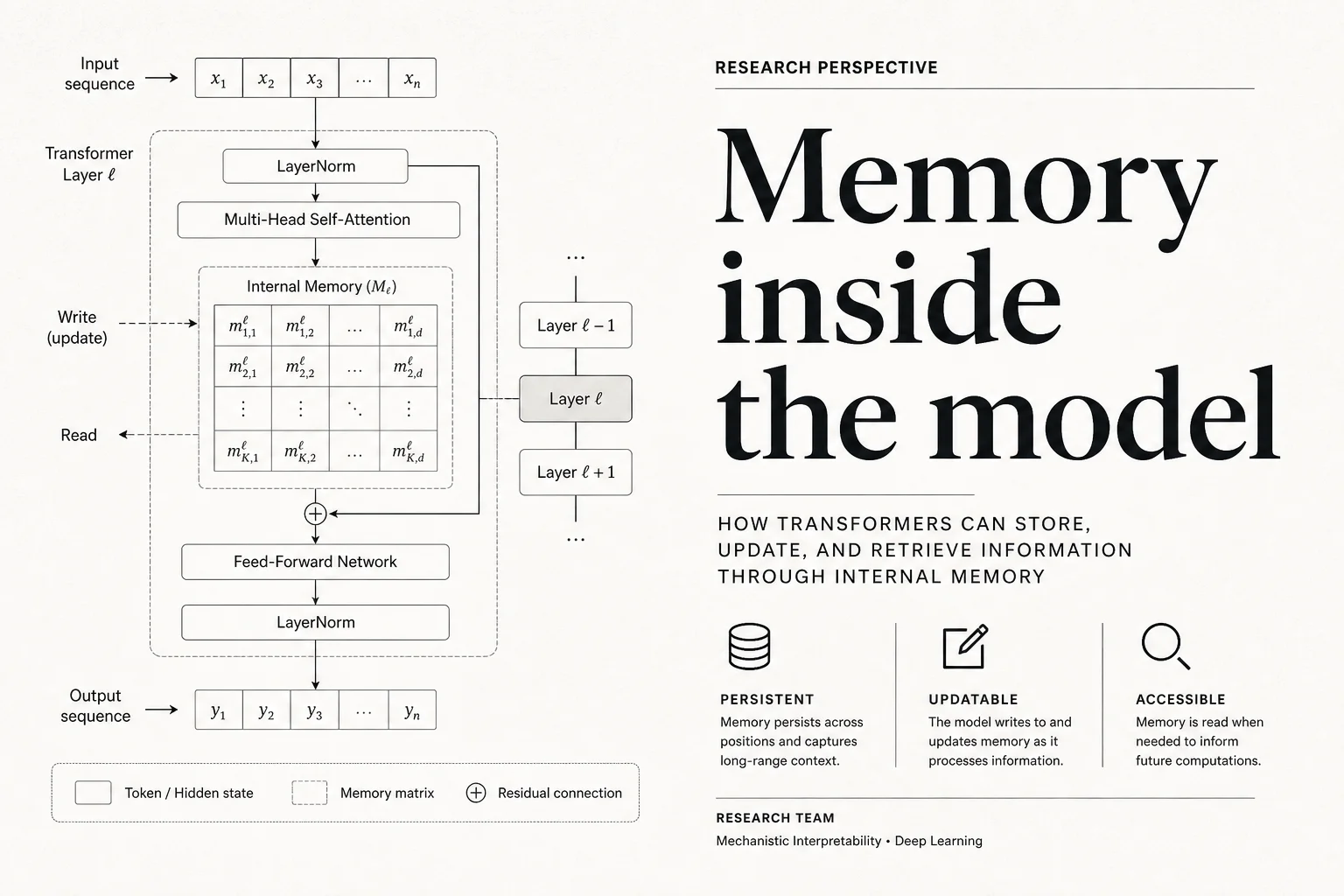
Every production agent I touch still treats memory as a sidecar: vector DB, summarization job, retrieval reranker, then paste the hits back into the prompt.
Metis asks a different question. What if the model carried a persistent memory state inside its forward pass and updated it without gradients or full history replay?
The paper and MemTensor/Metis checkpoints dropped July 29, 2026. Hugging Face's daily papers feed gave it 241 upvotes the day it landed. That is researcher buzz, not a product launch. Still, the design is worth understanding before your next agent architecture review.
Native memory vs external RAG
| Layer | External memory (typical RAG) | Metis native memory |
|---|---|---|
| Persistent state | Files, rows, embeddings outside the model | Dense matrices inside transformer layers |
| Write path | Insert, index, summarize explicitly | Learned state update during forward pass |
| Read path | Retrieve, rerank, paste into context | Memory attention on latent state |
| Online gradients | Usually none | None; weights stay frozen at inference |
| Inspectability | Individual records stay readable | Facts entangled in latent matrices |
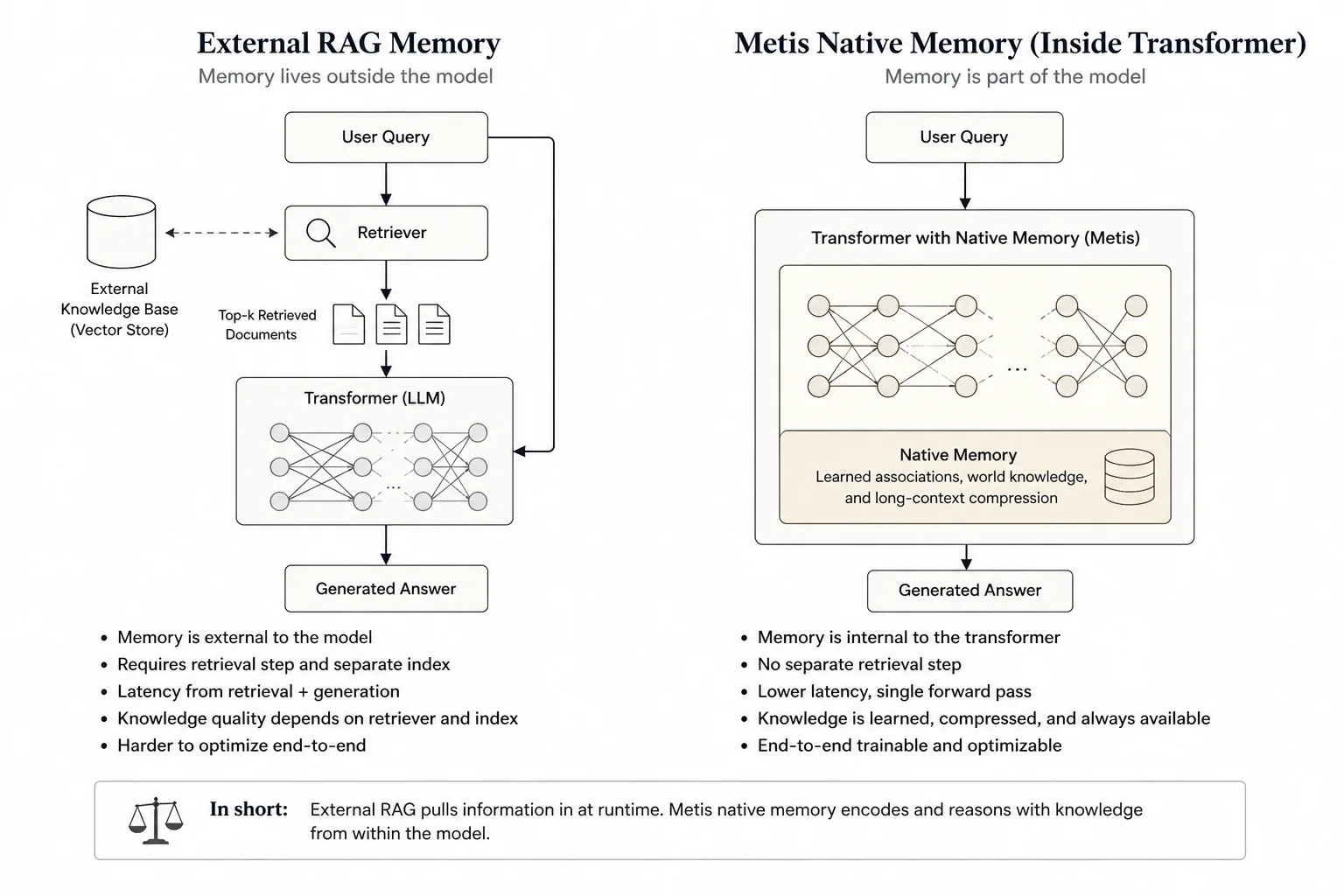
External memory wins auditability today. Native memory wins when you need fixed-size state and cannot afford to re-prefill megatokens of chat history on every turn.
How Metis updates memory without backprop
At inference, all learned weights stay frozen. Only the memory state changes.
Updates happen through standard forward computation with commit_memory=True. No backprop after each conversation. That is what makes per-interaction updates affordable.
Architecture pieces from the repo:
- Local Memory Block holds the dynamic memory matrix and normalization state across steps.
- Hyper Memory Block learns token selection, key/value projections, memory queries, and the update procedure.
- Default update uses a Gated Delta Network (GDN). On Qwen3.5 hybrid layers, Metis attaches to full-attention layers while linear-attention layers keep their original path.
During a memory step, Metis selects informative hidden states and writes them into local memory. Later queries read that state through memory attention fused with the standard attention branch.
Minimal API shape from the project:
# Write one interaction into native memory
model(
    memory_inputs,
    commit_memory=True,
    use_cache=False,
    logits_to_keep=1,
)

# Query without replaying original memory text
answer_ids = model.generate(
    query_inputs,
    max_new_tokens=32,
    do_sample=False,
)
New sessions start with model.reset().
What the paper claims (and where it stops)
Metis introduces memory foundation models as a category: foundation models with native procedures to store and use information through computation, not separate retrieval rules.
Training uses large-scale memory-specific data and mid-training objectives. Memory utilization cost depends mainly on memory state size, not linear growth with every past interaction.
Experiments show native memory capabilities with documented strengths, limitations, and failure modes. The authors release checkpoints and call hybrid native-plus-external memory an important next step.
Metis is not a complete RAG replacement yet. Latent memory is harder to audit than a Postgres row with timestamps.
Why this matters for agent builders
Three design shifts if native memory matures:
- Context window pressure drops for long personalization histories when state compression works.
- Harness complexity shifts from retrieval orchestration toward memory commit/query semantics in the model API.
- Compliance gets harder until interpretability tools catch up. You cannot easily show which memory row caused a bad answer.
For client work today I still ship external memory with clear data boundaries. I watch Metis for the sub-agent tier where session state is dense, updates are frequent, and replaying full transcripts is killing latency.
Read alongside what is RAG for business and grep vs vector agentic search for the external-memory baseline.
Bottom line: Metis proves one layer of agent memory can live inside the model with forward-only updates. Production teams should not rip out vector DBs tomorrow. Architects should stop assuming retrieval is the only memory game.
Designing memory for voice agents, CRM bots, or long-running coding agents? Book a free discovery call. I map retention, audit, and latency trade-offs before you pick a stack.