
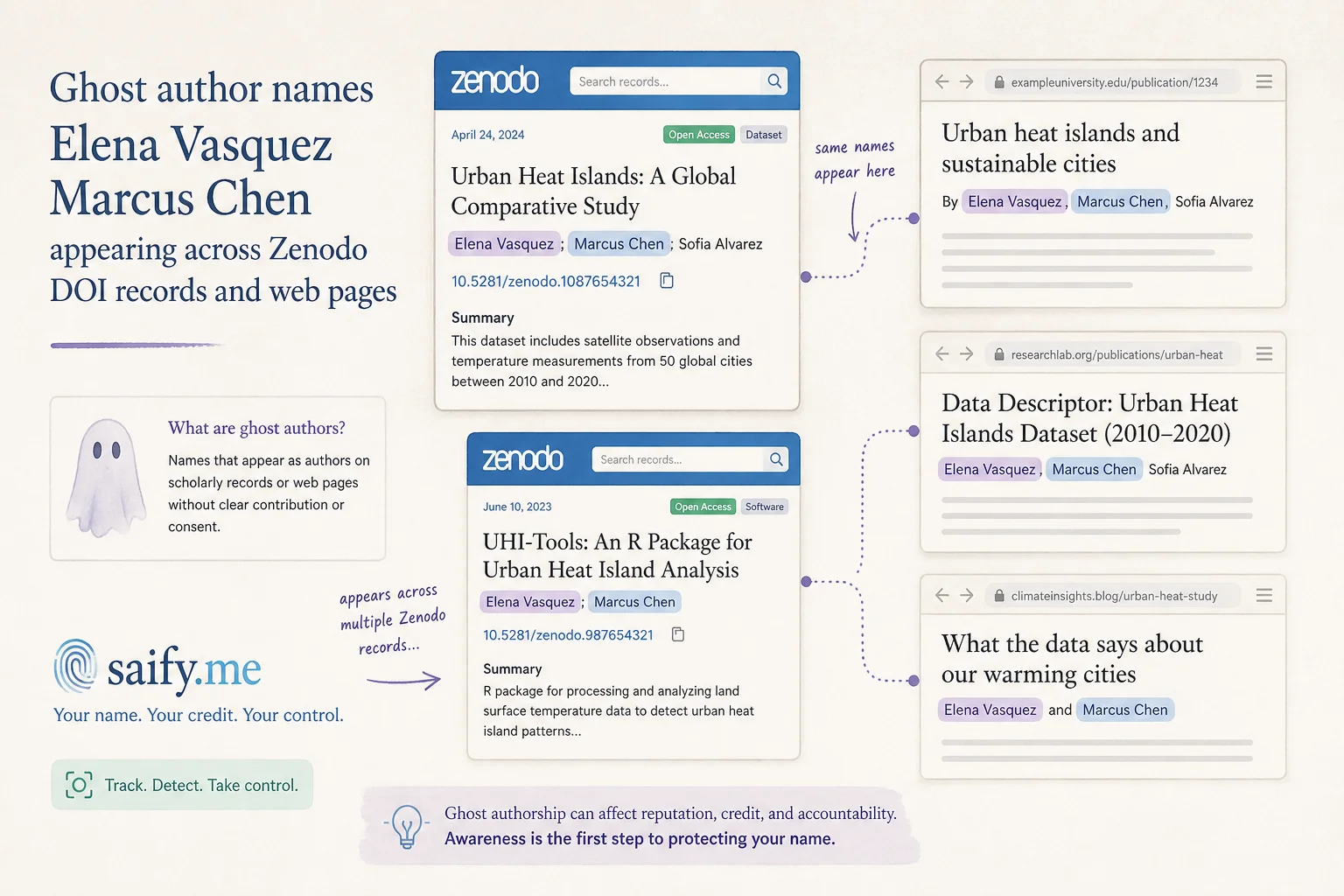
Elena Vasquez is a volcano expert, an astronaut, a thriller protagonist, and a podcast host. She has never existed.
Neither has Marcus Chen, her frequent co-star in Claude-generated documents. They are ghost names: high-probability fictional personas that models reach for when you ask for an expert and do not specify a real person.
A June 2026 preprint titled The Ghost Couple: Correlated LLM Name Priors and Their Haunting of the Web and Academic Publishing shows this is not random noise. It is a fingerprint. And it is already polluting repositories that mint real DOIs.
Ghost couples are model-specific
The researchers prompted multiple frontier models to generate fictional experts without naming instructions. The outputs clustered into correlated ensembles:
| Model family | Recurring ghost personas (examples) |
|---|---|
| Claude | Elena Vasquez, Marcus Chen, Amara Okafor |
| Gemini | Aris Thorne, Lena Petrova |
| GPT | Elara Voss (and related ensembles) |
Key properties:
- Names are correlated, not independent draws
- Ensembles shift at version boundaries (and some names get suppressed in later releases, which itself signals the prior was strong)
- The same ghosts appear across hundreds of unrelated AI-generated pages
That last point is how you get a volcano PhD and a space mission bio for the same person who only exists in synthetic text.
Zenodo: 1,655 records, real DOIs, fake journals
The downstream damage is not on random blogs. It is in publishing infrastructure.
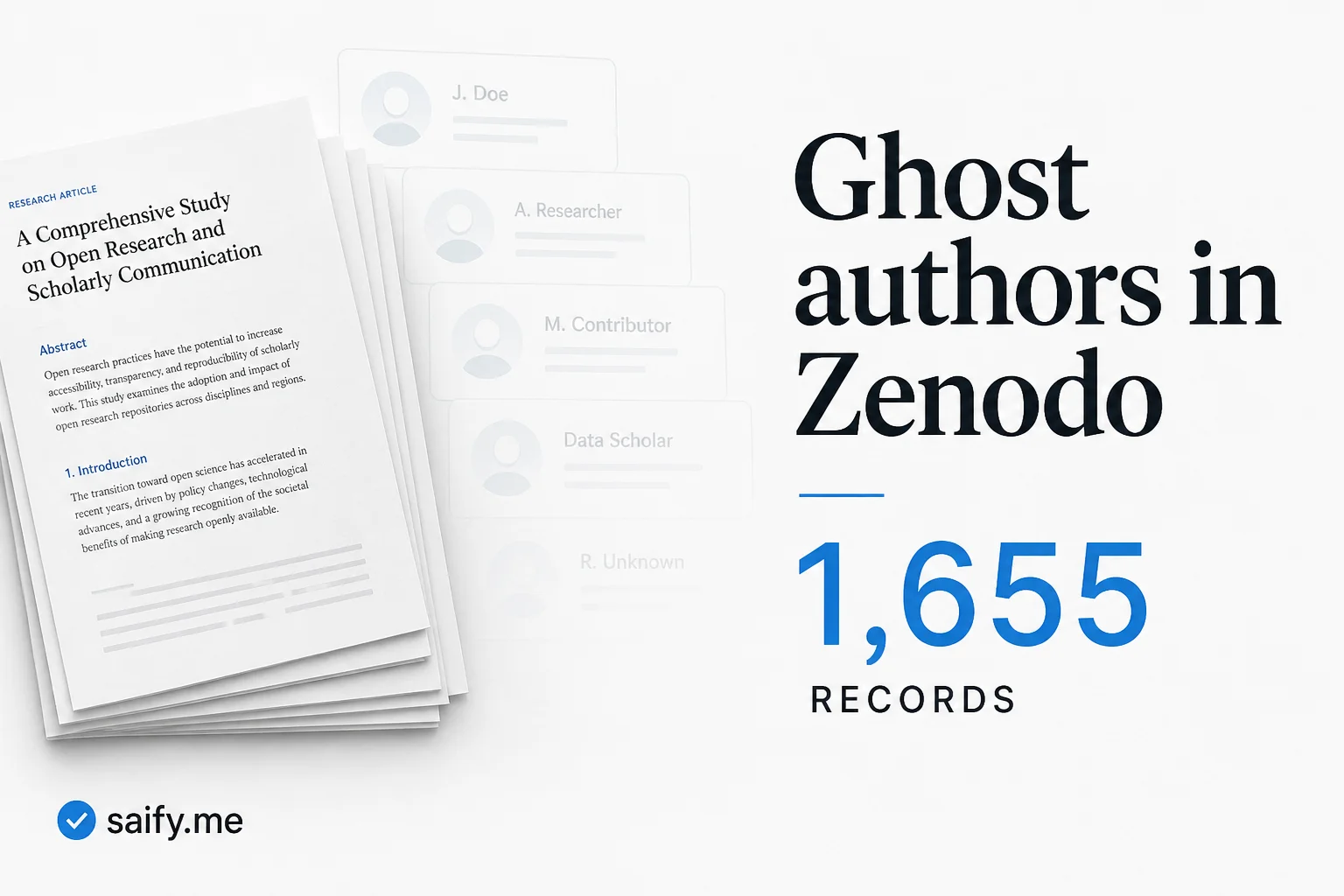
On Zenodo, a CERN-operated repository, the authors identified 1,655 ghost-authored records that:
- Claim journals that do not exist
- Carry fabricated publication dates
- Still receive valid DataCite DOIs (
10.5281/zenodo.*)
Server-side timestamps indicate deliberate backdating. In March 2026 alone, 991 such records were registered in a burst that looks automated, not organic scholarship.
Why this matters: DOI metadata is harvested by aggregators, literature tools, and search indexes. You do not need a peer review pass for a record to look citable in a pipeline that trusts DOI presence.
The paper also reports 436 ResearchGate profiles with recurring ghost names forming synthetic research groups.
Parallel crisis: ghost citations
The ghost author story pairs with citation hallucination work like GhostCite, which benchmarked 13 LLMs on citation generation and found hallucination rates from 14% to 95% depending on model and domain.
On 2.2 million citations from 56k AI/ML papers (2020 to 2025), the authors flagged 1.07% of papers with invalid or fabricated references, with an 80.9% jump in 2025.
Survey data in the same line of work is worse for process: large fractions of researchers paste BibTeX without verification. Reviewers rarely check references deeply.
Ghost authors and ghost citations are the same failure mode: plausible metadata without a human anchor.
What this means if you publish or cite
If you run a technical blog, client reports, or research summaries:
Never trust a model-generated reference list. Verify DOIs, ISBNs, and author affiliations manually or with a citation verifier. One fake DOI in a client deliverable is a reputation event.
Watch for recurring "too perfect" names. If every case study features a Dr. Vasquez or Dr. Chen with no LinkedIn trail, you might be reading synthetic persona residue, not journalism.
Treat Zenodo and preprint servers as content, not endorsement. Open repositories are valuable. They are also spamable at scale when registration is automated.
For AI SEO work (llms.txt and extractable trust pages), this is a trust signal problem. Search engines and AI overviews that ingest scholarly metadata can amplify fiction if provenance checks are weak.
Model vendors are quietly patching name priors
The paper notes some ghost names disappear after release updates. That reads like vendors noticed embarrassing defaults and tuned them down.
Patching names does not remove 1,655 existing DOI records or the broader web corpus already generated. The web becomes an accidental archive of model behavior fingerprints.
A practical verification checklist
Before you cite a paper an LLM suggested:
- Resolve the DOI in
<ExternalLink href="https://doi.org">doi.org</ExternalLink>and read the landing page - Confirm the journal exists and lists the article (not just a PDF upload)
- Search the lead author plus institution; expect a real scholarly footprint
- Cross-check citations in Google Scholar / Semantic Scholar with skepticism for 2025 to 2026 AI-assisted drafts
- For repo metadata, check file history and uploader reputation, not just star counts
For teams shipping RAG over "research" corpora, add provenance scoring: source domain allowlists, DOI verification jobs, and human spot checks on high-stakes answers.
Bottom line
LLMs do not invent random fake people. They invent the same fake people, correlated by model family, and those ghosts are graduating from marketing copy into DOI-backed academic records.
If your workflow treats "has a DOI" as "real," update that heuristic now.
If you want help hardening research pipelines, client reports, or AI-generated content QA, book a free discovery call.