
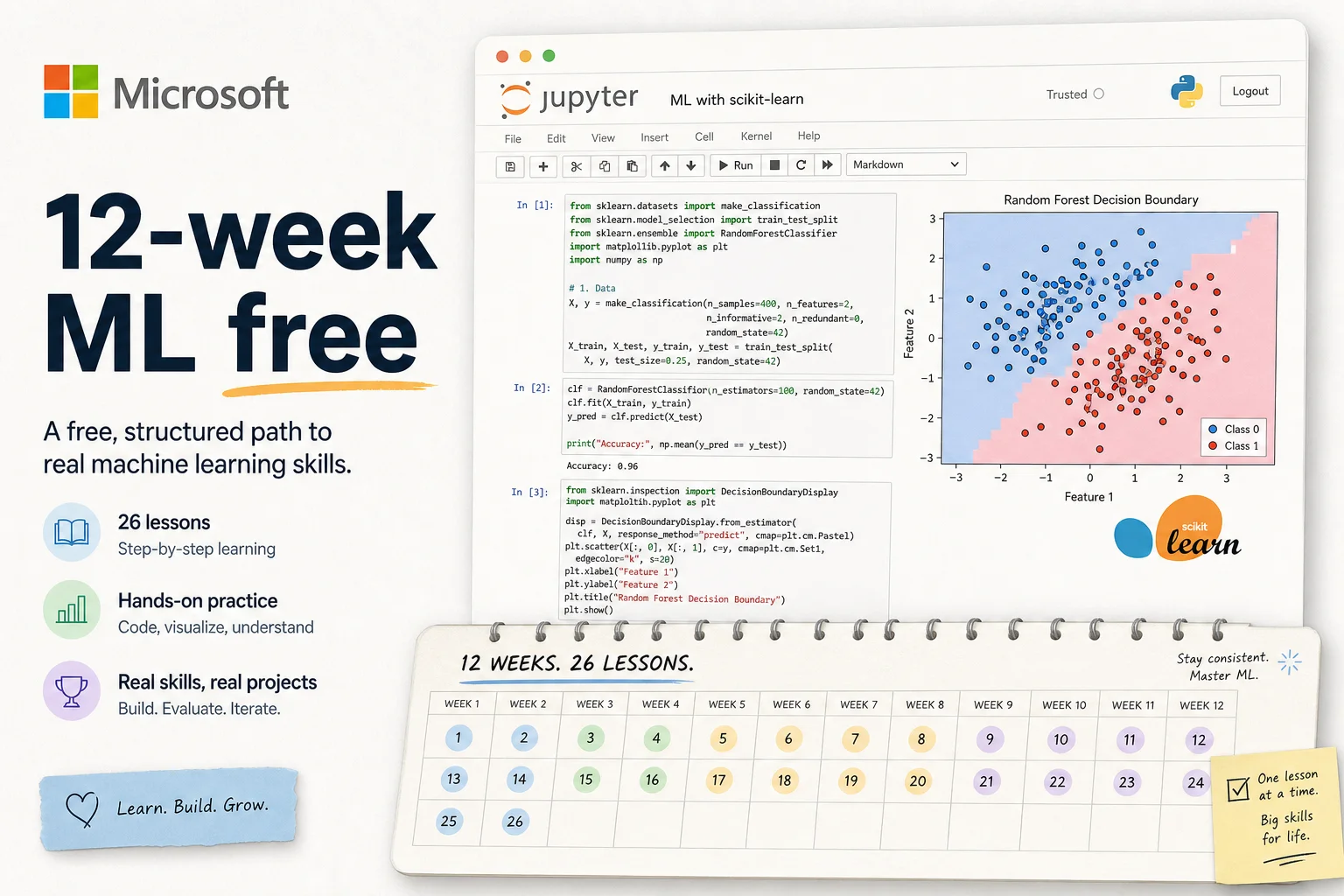
Microsoft re-promoted its Machine Learning for Beginners curriculum this week in the AlphaSignal digest, and it is worth stating plainly: if you want classic ML without drowning in neural network hype first, this is still the best free structured path on the internet.
Twelve weeks. Twenty-six lessons. Fifty-two quizzes. MIT license. Scikit-learn instead of PyTorch. Real datasets from around the world. That combination is rare.
What "classic ML" means here
This course deliberately skips deep learning. You learn the toolbox most businesses still run in production:
- Regression and classification
- Clustering
- Natural language processing basics
- Time series forecasting
- Reinforcement learning fundamentals
- Fairness and responsible AI framing early, not as an afterthought
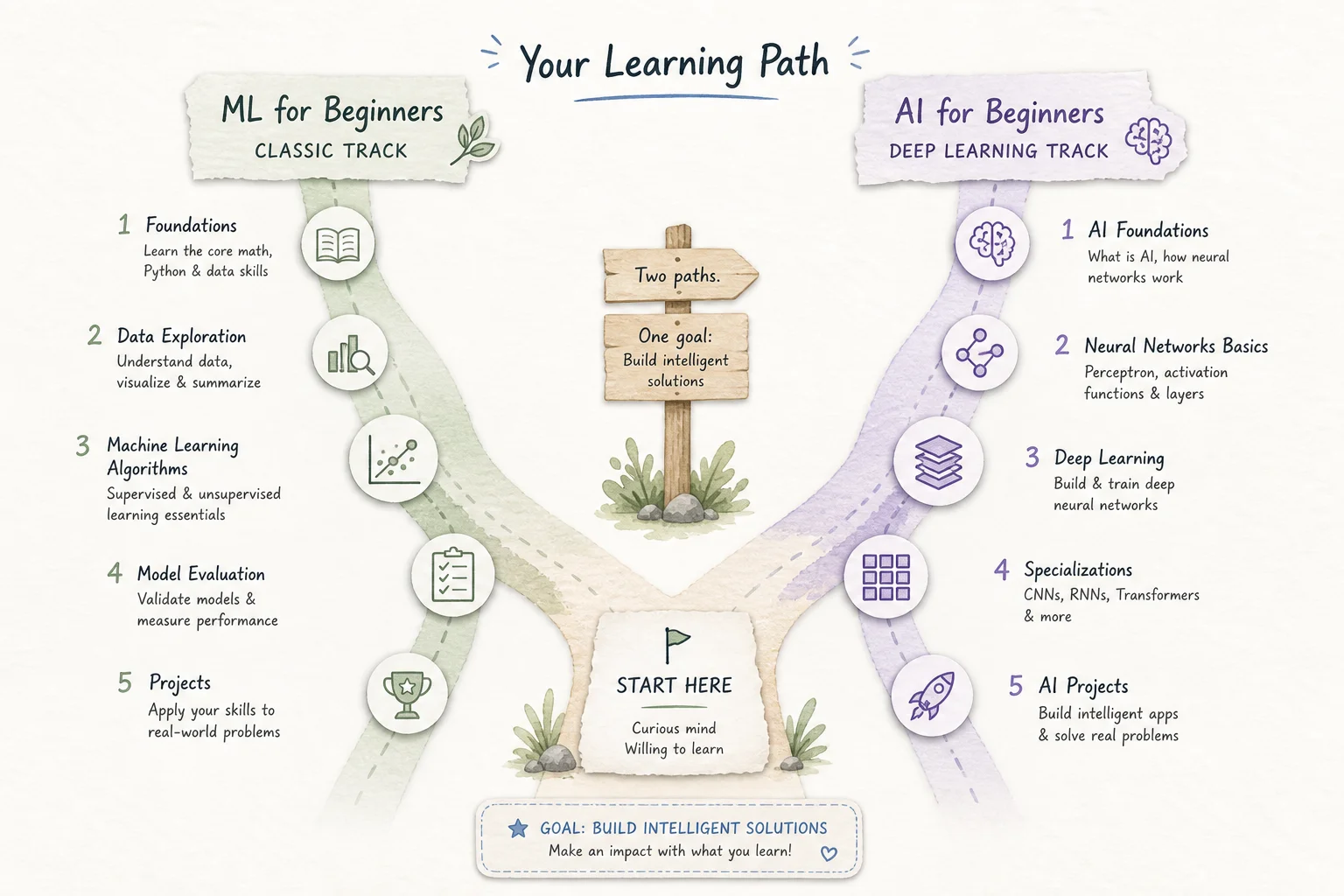
Deep learning lives in Microsoft's separate AI for Beginners track. Pair both if you want the full stack. Start here if you need models that train on a laptop and deploy without a GPU farm.
Repo: microsoft/ML-For-Beginners
Curriculum site: microsoft.github.io/ML-For-Beginners
Pedagogy that actually sticks
Microsoft's Cloud Advocates built this around project-based lessons with low-stakes quizzes before and after each module. The pattern works because it mirrors how I train junior engineers on client projects:
- Quiz primes attention ("what do I already know?")
- Short lesson with code
- Project that produces an artifact (chart, web app, recommender)
- Quiz checks retention
Lessons cover global datasets on purpose: Nigerian music tastes, Asian and Indian cuisine classification, North American pumpkin prices, European hotel sentiment, world power usage time series. You learn ML and data cleaning on messy real tables, not just iris.csv.
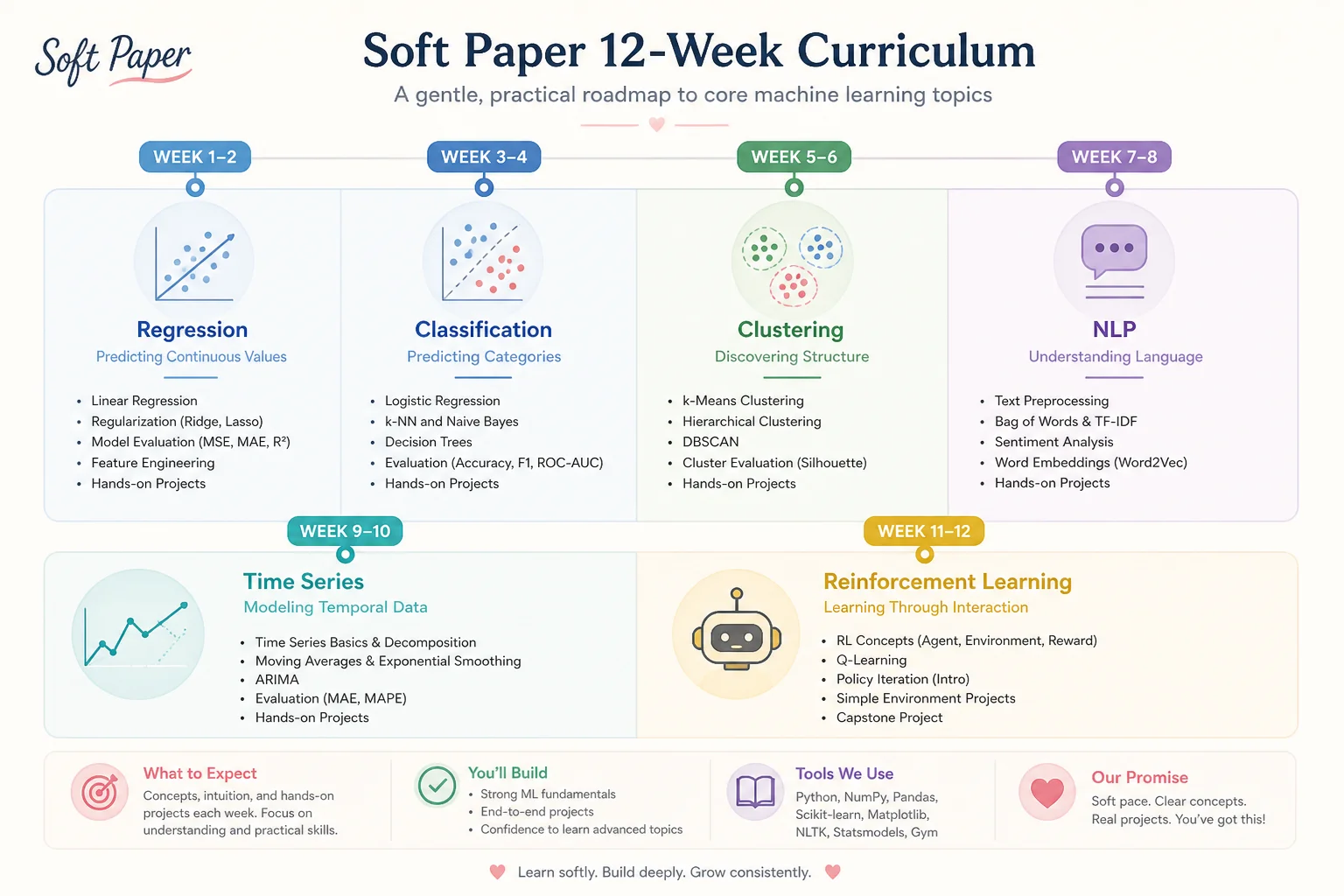
Lesson map (high level)
| Week band | Topics |
|---|---|
| Introduction | ML basics, history, fairness, techniques |
| Regression | Pumpkin pricing, logistic models, web app inference |
| Classification | Cuisine datasets, recommender web app |
| Clustering | Music taste exploration |
| NLP | Bots, translation, sentiment on hotel reviews |
| Time series | ARIMA and SVR on power usage data |
| Reinforcement learning | Q-learning, Gym environments |
| Postscript | Real-world ML, RAI dashboard debugging |
Each lesson ships Python and often R notebooks. JavaScript appears when you deploy models to small web apps (lesson 9 and 13 pattern).
How to run it locally
Prereqs from Microsoft's intro lesson:
- Python basics
- Node.js for occasional web app lessons
- GitHub account to fork the repo
- VS Code recommended
- Familiarity with Scikit-learn
Quizzes live in the quiz-app folder (52 quizzes, three questions each). Run locally or deploy to Azure following repo instructions.
Video walkthrough series on Microsoft Learn if you prefer watch-and-code.
Who this is for in 2026
Strong fit
- Operators moving from spreadsheets to predictive models
- Engineers who jumped straight to LLMs and want foundations
- Founders evaluating whether they need custom ML vs off-the-shelf APIs
- Students building portfolios with demonstrable projects
Weak fit
- You only want ChatGPT prompt tricks
- You need cutting-edge diffusion or LLM fine-tuning this month
- You hate Jupyter (fix that first, seriously)
For applied AI consulting, I still ask discovery callers: "Have you shipped a regression model you can explain?" This curriculum gets you to "yes" with artifacts you can show.
Pairing with modern agent stacks
Classic ML is not obsolete because agents exist. It is the evaluation layer underneath:
- RAG quality checks (classifiers on retrieval chunks)
- Lead scoring before your voice agent prioritizes callbacks
- Anomaly detection on automation logs
- Forecasting inventory before your LLM writes marketing copy
Learn numpy/pandas/sklearn here. Layer LangChain or MCP tools later. Reverse order produces fragile demos.
Responsible AI baked in
Lesson 3 tackles fairness before you touch gradient descent on pumpkin prices. The postscript covers Model Debugging with Microsoft's Responsible AI dashboard components. That ordering matters when EU AI Act conversations show up in SMB sales calls.
Bottom line
Microsoft ML for Beginners is not new, and that is a feature. It is maintained, open, globally scoped, and free. In a feed full of model launch noise, a twelve-week path that teaches measurable skills is the useful signal.
Fork the repo. Finish lesson 5's regression project. Post the chart. You will understand more about production ML than another weekend of random YouTube tutorials.
Helping your team upskill from demos to deployable ML? Book a free discovery call and we can pair curriculum with a real dataset from your ops.