
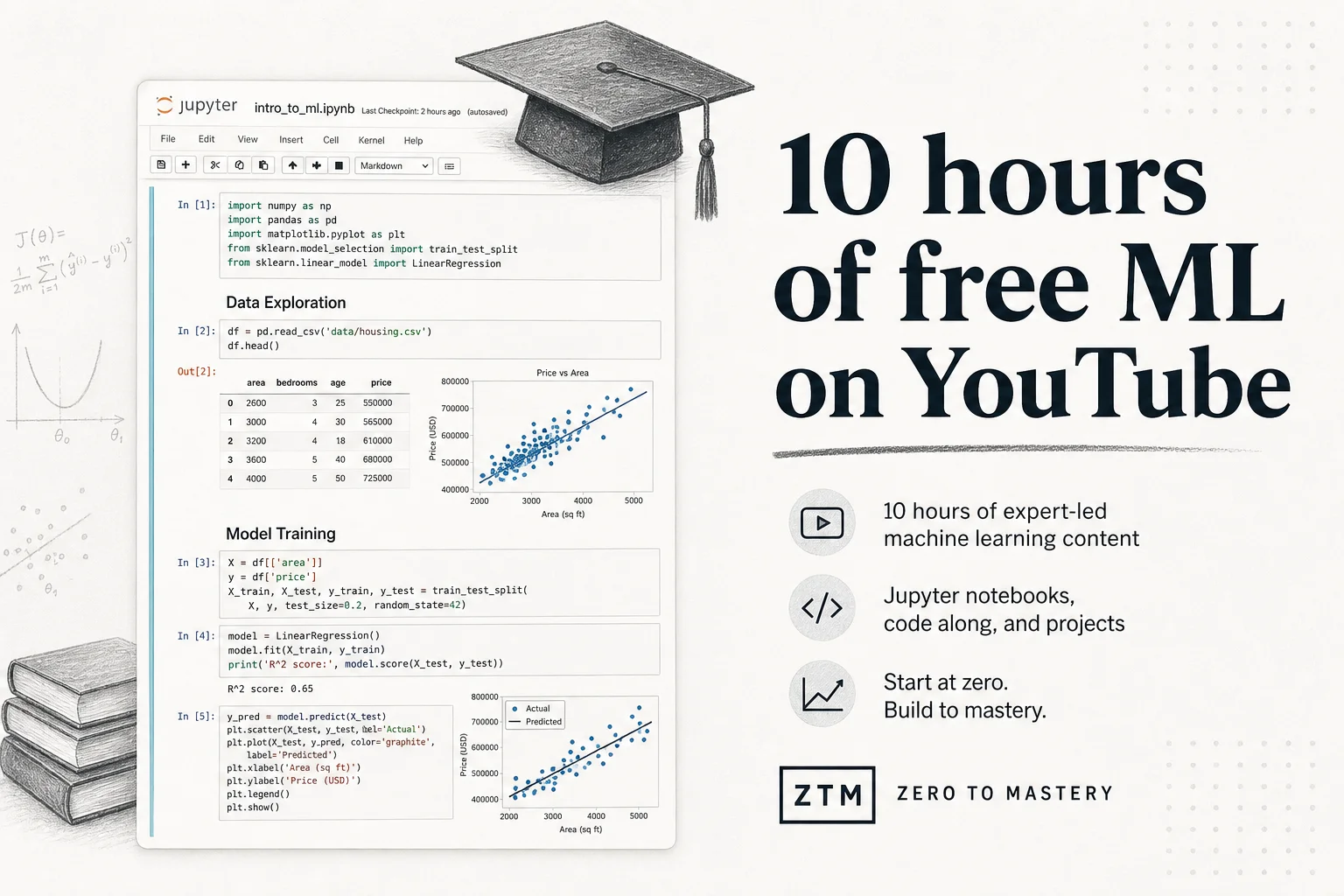
You do not need another $2,000 bootcamp to start machine learning in 2026. Daniel Bourke's Zero to Mastery ML repo ships the full notebook library on GitHub, plus the first 10 hours free on YouTube.
I recommend this path to clients who want their ops team to understand what the AI vendor is actually doing. Not to replace a production ML engineer, but to build enough literacy to ask better questions.
What is free vs paid
| Resource | Cost | Link |
|---|---|---|
| First 10 hours on YouTube | Free | Below |
| GitHub notebooks and datasets | Free (MIT) | GitHub repo |
| Online course book | Free | dev.mrdbourke.com |
| Full Udemy / ZTM bootcamp | Paid | zerotomastery.io |
The paid bootcamp adds structured pacing, updates, and community. The free tier is genuinely usable for self-study if you are disciplined.
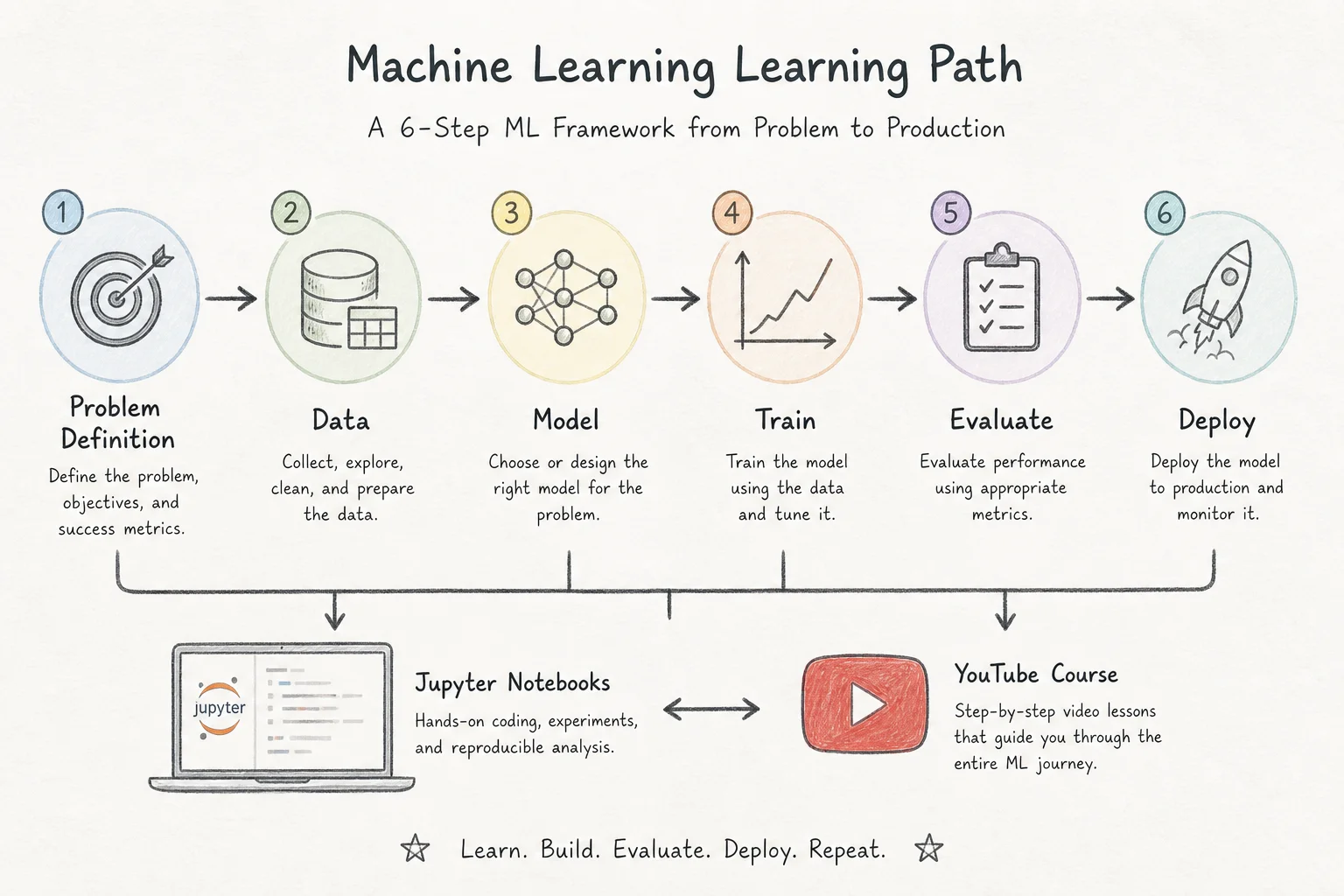
The 6-step framework (the useful part)
Bourke teaches a repeatable modeling loop, not just API calls:
- Problem definition — What are you predicting and why?
- Data — What do you have, and what is missing?
- Model selection — Which algorithm fits the problem shape?
- Training — Fit on training data, tune hyperparameters.
- Evaluation — Holdout metrics that match business goals.
- Deployment / communication — Ship or present results clearly.
That framework shows up across every milestone project. It is the same skeleton I use when scoping client RAG or scoring projects, even when the final stack is LLMs instead of sklearn.
Milestone projects you can build from the repo
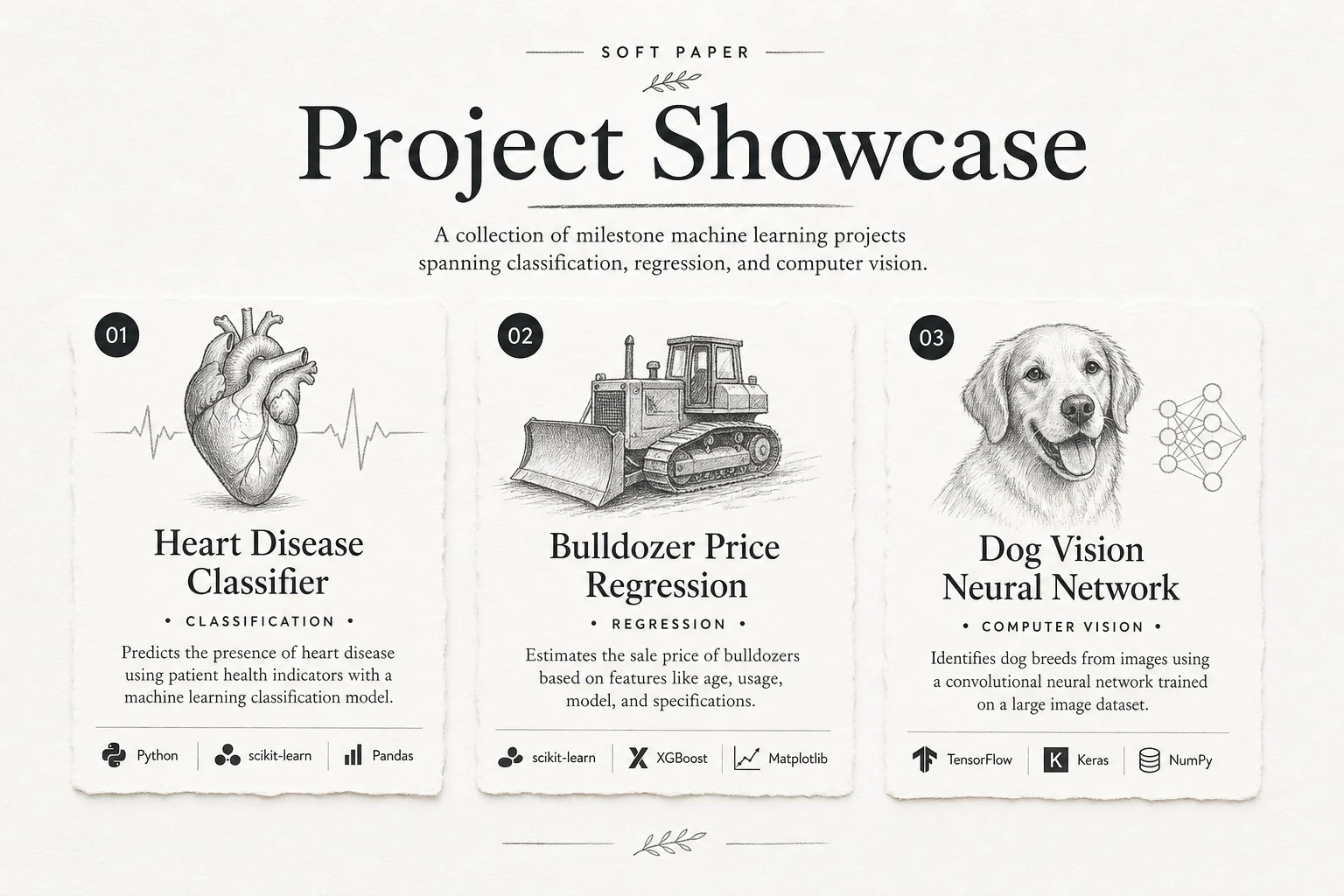
The online book mirrors the course sections. Three projects worth your time:
| Project | Skill | Why it matters |
|---|---|---|
| Heart disease classifier | Structured data, random forests | Classic tabular ML baseline |
| Bulldozer price regression | Feature engineering, ensembles | Real Kaggle-style messy data |
| Dog Vision (TensorFlow/Keras) | CNNs, transfer learning | Bridge to deep learning |
The 2024–2025 updates refreshed milestone notebooks, including an overhauled bulldozer regression path. Check the 2025 update discussion for current section status.
How I would study this in two weeks
Week 1: Foundations
- Watch YouTube hours 1–5 at 1.25x, pause for notebook exercises.
- Clone the repo and run the heart disease notebook locally.
- Read the online book chapters on pandas, sklearn, and train/test splits.
Week 2: Depth
- Complete bulldozer regression end to end.
- Skim Dog Vision even if you skip training (understand image pipelines).
- Write a one-page summary of what you would deploy vs what stays experimental.
Tools you need: Python 3.10+, Jupyter, and the packages in the repo requirements. Everything runs locally. No cloud bill required for the free tier.
Who this is for (and who should skip it)
Good fit:
- Operators who need ML literacy for vendor conversations
- Junior devs moving toward data or ML roles
- Founders who want to prototype sklearn baselines before jumping to LLMs
Skip or supplement if:
- You already ship production PyTorch daily (go straight to domain projects)
- You only care about LLM agents (pair this with an agents course, not instead of)
- You want math-first theory (this is applied, project-driven)
For a broader free curriculum that includes LLMs and RAG, also bookmark community forks like zero-to-ai.dev , but Bourke's repo remains the most polished free structured ML path I send to non-specialists.
Practical links
Bottom line
Free ML education that includes real notebooks beats another Twitter thread about "top 10 AI tools." Start with the YouTube hours, run one milestone project, and you will know whether you need the paid bootcamp or a hired engineer.
If you finish Dog Vision and still cannot explain train/val/test leakage, do not buy GPU credits yet. Fix the fundamentals first.
Need help turning ML literacy into a real ops or product feature? Book a free discovery call.