
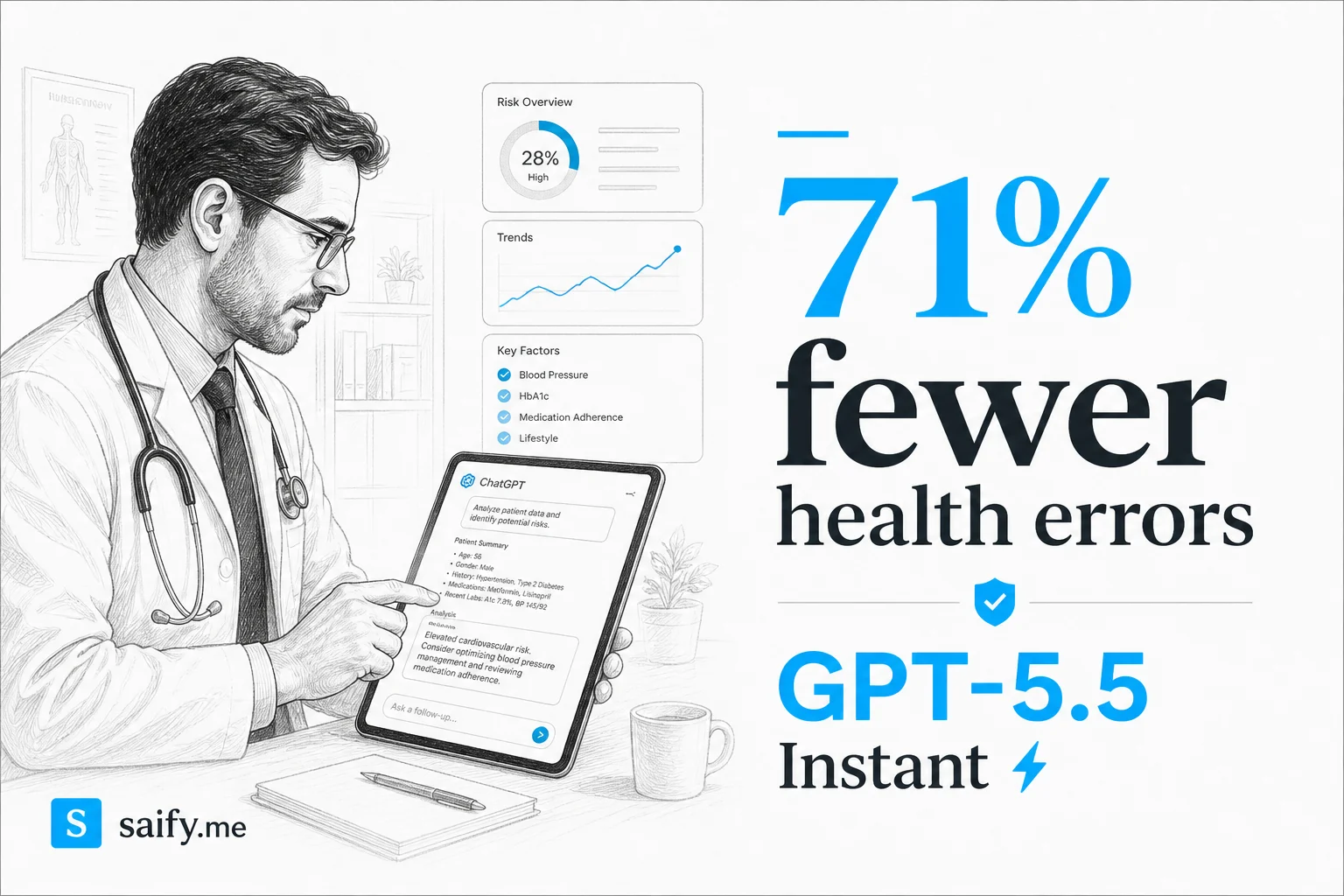
Health is already one of ChatGPT's largest use cases. OpenAI says more than 230 million people ask health or wellness questions each week.
On June 18, 2026, OpenAI shipped a health intelligence update for GPT-5.5 Instant, the fast default ChatGPT tier that replaced GPT-5.3 Instant in May. The story is not a new parameter count. It is physician-shaped evaluation plus production monitoring on the model most free users already hit.
What changed in the health update
OpenAI's health intelligence post describes three production-facing shifts:
| Capability | Behavior |
|---|---|
| Urgent care recognition | Better escalation when symptoms may need immediate care |
| Context gathering | Asks for missing details instead of guessing |
| Uncertainty | Explains limits without false confidence |
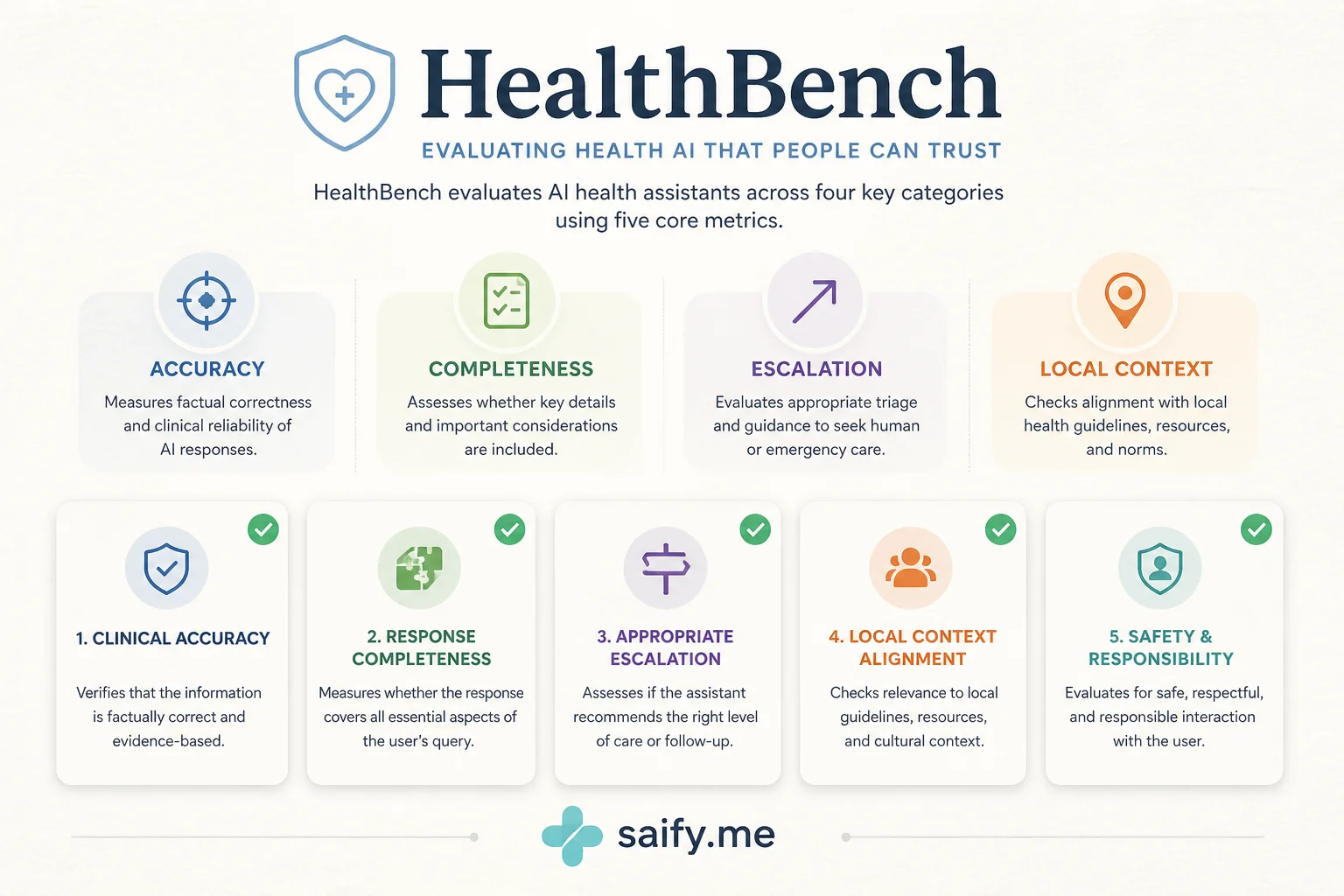
GPT-5.5 Instant now reaches health performance similar to OpenAI's latest frontier models on an aggregate of evaluations including HealthBench Professional, with a large jump from GPT-5.3 Instant.
Separately, the May Instant release already cut hallucinated claims 52.5% on high-stakes medicine, law, and finance prompts versus GPT-5.3 Instant in internal evals. The June health package adds clinician review loops on top of that base model tune.
The physician network is the training signal
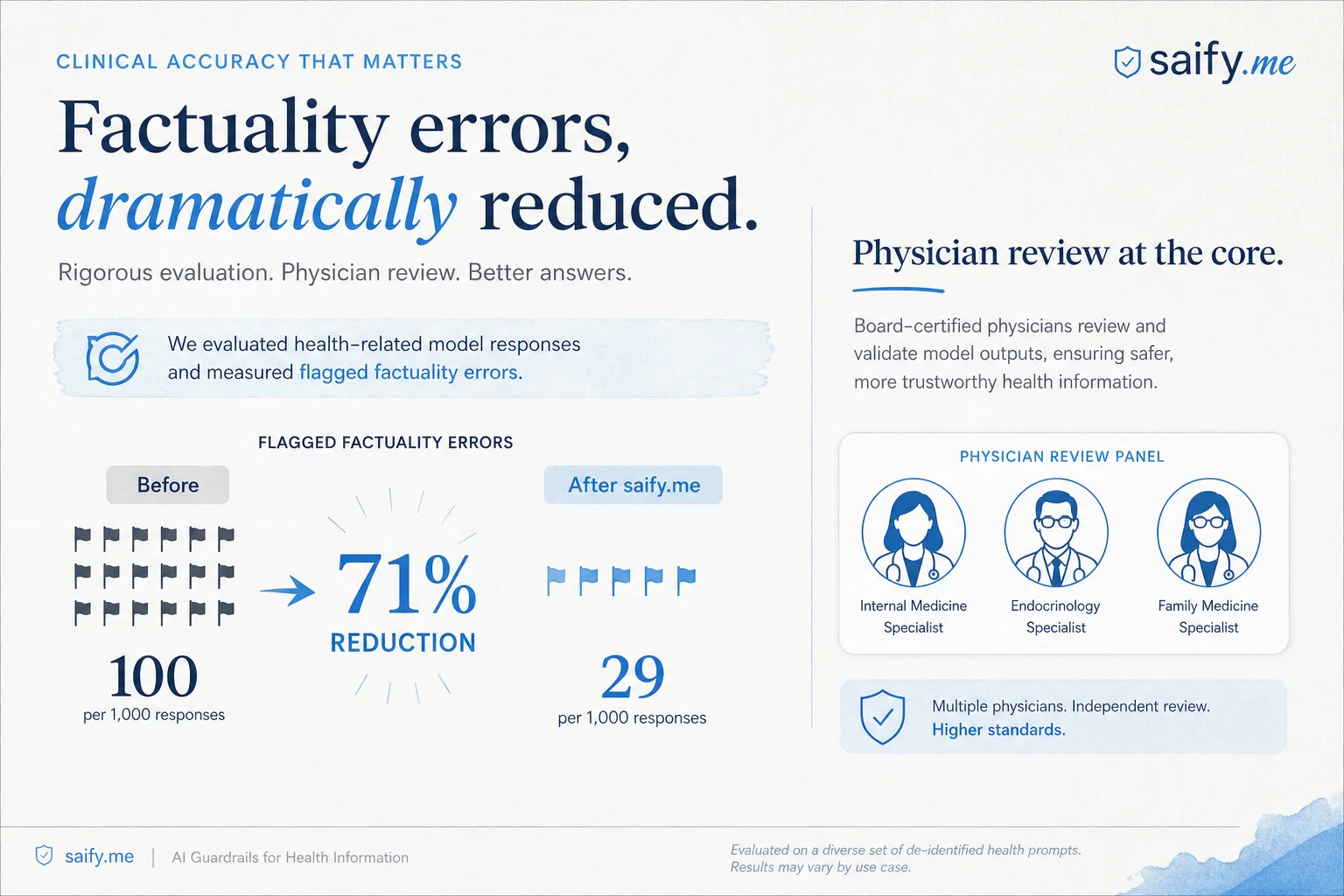
OpenAI's physician network (260+ doctors, 60 countries, 26 specialties) does not just grade trivia. They define what "good" looks like in real conversations: tailoring to local care systems, catching red flags, seeking context, and helping users decide next steps.
Evaluation workflow:
- Physicians write reference answers for representative health conversations (unlimited time, internet access, no AI).
- A separate panel compares model outputs to those references and to older models.
- Reviewers score accuracy, communication, completeness, instruction following, and health decision helpfulness.
Across 3,500 reviewed responses, physicians rated GPT-5.5 Instant above older models and above physician-written answers on several failure modes, including missing local healthcare context and weak escalation.
That is a strong product claim. It is still OpenAI grading its own outputs with contracted clinicians, not a published randomized trial.
The 71% production metric
The number everyone quoted from the AlphaSignal digest: 71% fewer incorrect health statements over two months.
OpenAI's wording in the health post: the rate of health responses with at least one flagged factuality issue fell 71% based on privacy-preserving monitors over production traffic spanning billions of weekly messages.
Read that carefully:
- It measures flagged issues in live traffic, not chart review in a hospital.
- It compares recent Instant builds to prior Instant builds, not to human clinicians in the same pipeline.
- It is directionally huge for a default free-tier model, but it is not proof ChatGPT should replace your clinician.
API and product implications
| Surface | Access |
|---|---|
| ChatGPT Free / Go | GPT-5.5 Instant default (subject to limits) |
| ChatGPT paid | Instant default; GPT-5.3 Instant remains selectable for three months |
| API | chat-latest alias points at newest Instant; pin gpt-5.5 for stable production |
If you route consumer health questions through ChatGPT-parity behavior, chat-latest is the canary. If you need stable billing and regression tests, pin an explicit model slug and run your own eval suite.
For a broader Instant behavior tune (shopping, constraints, personalization), see my post on the June intent update.
What builders should do differently
Treat health as a policy surface, not a prompt tweak. Escalation rules, locale-aware disclaimers, and audit logs matter more than clever system prompts.
Run specialty evals. HealthBench-style rubrics are a start. Add your own cases from support tickets and clinician review.
Never confuse benchmark wins with clinical clearance. Even if panel ratings beat physician-written samples on OpenAI's tests, your product still needs jurisdiction-specific compliance review.
Monitor production like OpenAI does. Flagged factuality rates, escalation clicks, and "user disagreed" signals beat offline accuracy alone.
Doctors as training and evaluation signal, not only end users, is the pattern here. Specialist knowledge gets embedded upstream so the default model is less dangerous at scale.
If you are shipping a health-adjacent agent (intake, benefits navigation, clinic FAQ) and want eval design that survives clinician review, book a free discovery call.