
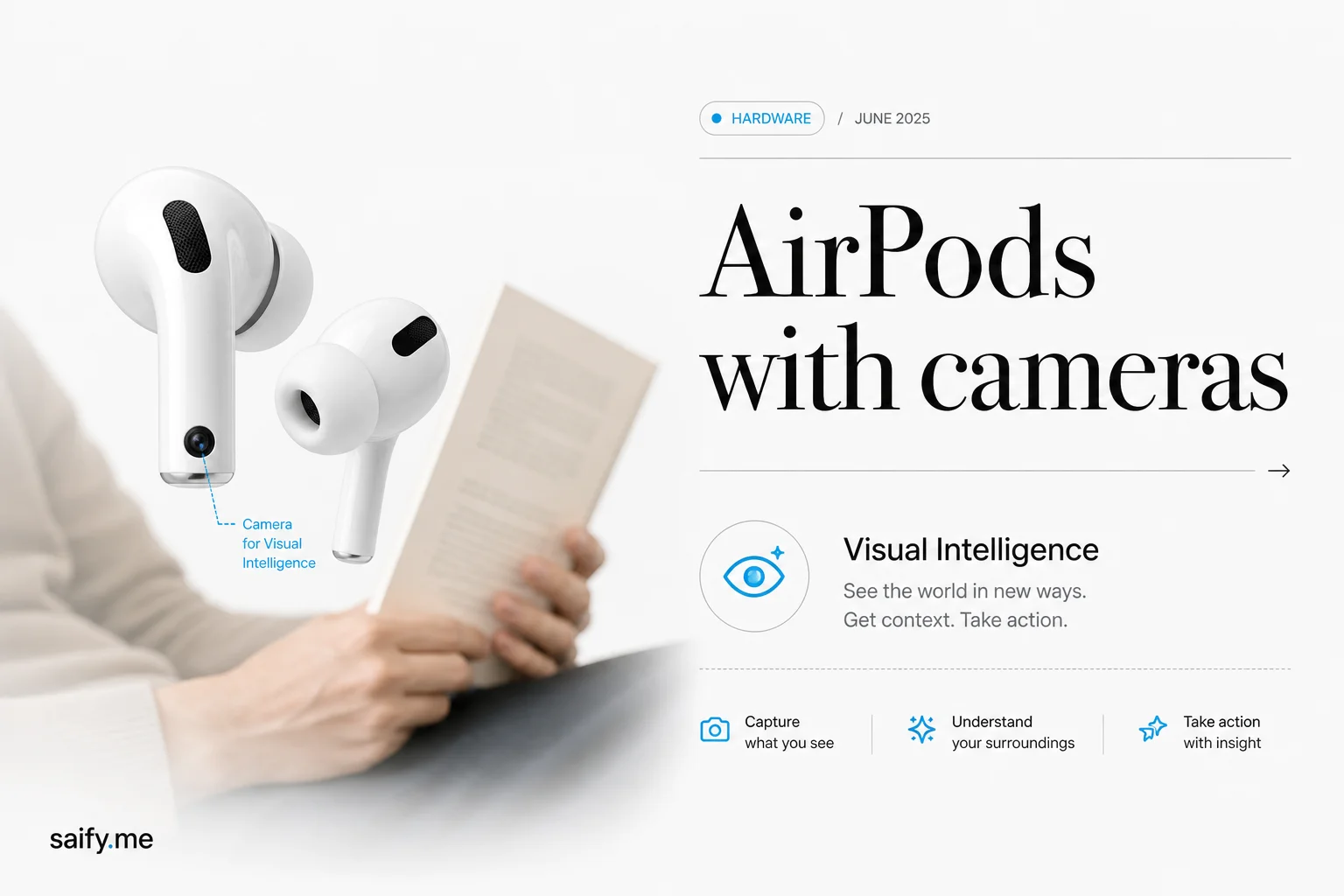
Apple's next wearable might not add a screen. It adds a camera on the stem and asks you to trust Siri with what you are looking at.
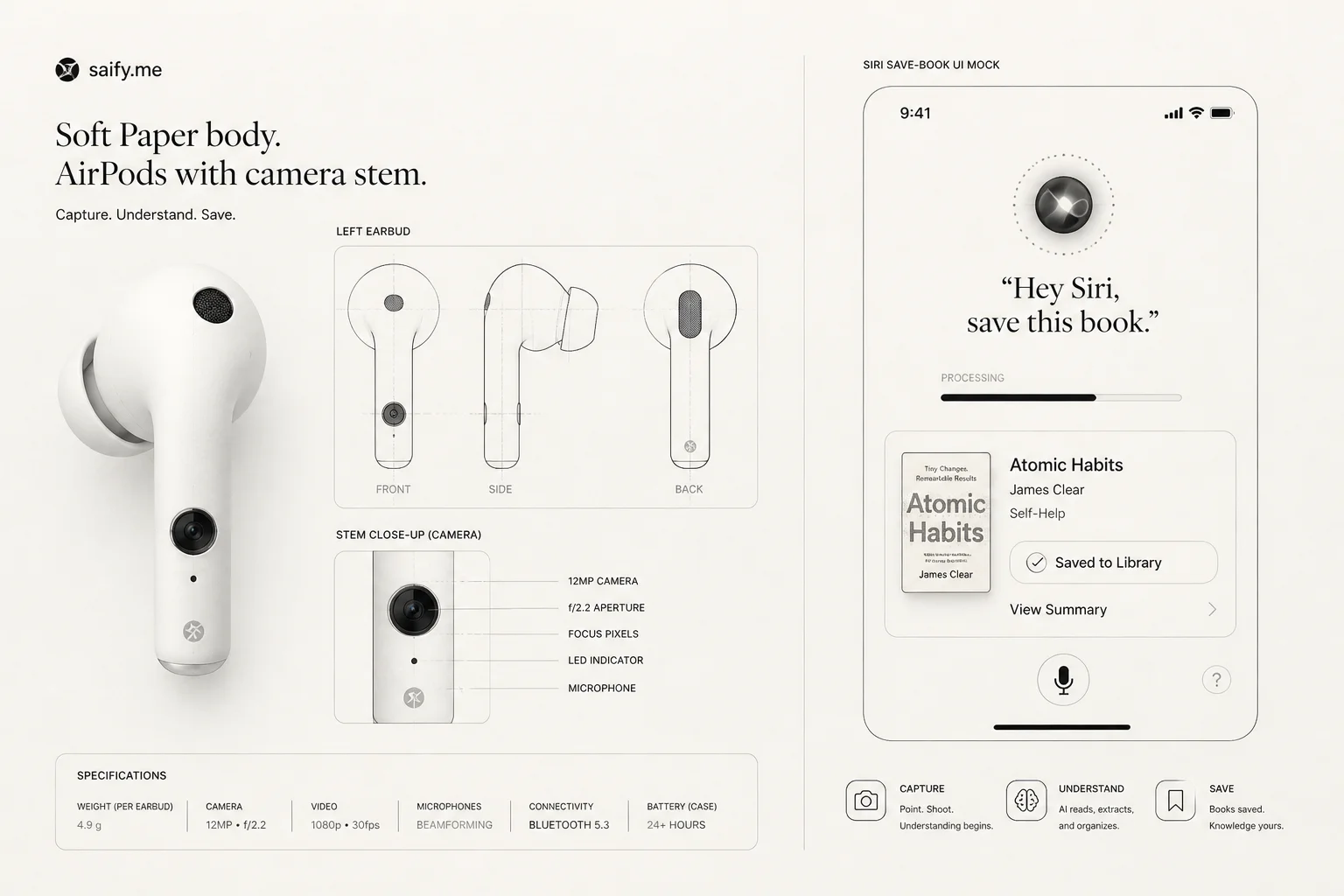
A short demo buried in the macOS Tahoe 26.7 release candidate shows the idea in motion: a user holds up a book, the AirPods camera reads the title, and a voiceover promises that Visual Intelligence makes "your world savable." You see something you like, ask Siri to save it, and the OS remembers.
MacRumors confirmed the clip after Aaron (@aaronp613) pulled the video from the RC build on X.
What the leak actually shows
The demo is product marketing, not a lab prototype. That matters because shipping software references (B790 codename, setup strings, hair warnings) usually mean hardware is close.
| Signal in macOS 26.7 | What it implies |
|---|---|
| B790 product strings | Internal name matches prior Bloomberg reporting |
| Visual Intelligence setup flow | Feature parity with iPhone camera intelligence |
| Hair obstruction alert | On-device vision quality depends on line of sight |
| Siri save-for-later prompt | Memory layer tied to gaze, not screenshots |
The buds look nearly identical to current AirPods Pro, with a slightly thicker stem. Cameras are not visible in the marketing frame, which fits Apple's habit of hiding sensors until they are unavoidable.
Visual Intelligence as a screenless AI interface
Apple already routes camera input on iPhone into Visual Intelligence for object and text understanding. Moving that pipeline to ears is a different UX bet: ambient capture without pulling a phone out.
For developers watching Apple's stack, the pattern is consistent:
- Sensors on devices you already wear (watch pulse, AirPods motion, now vision)
- On-device models for low-latency context
- Siri as the spoken command layer
- Cloud only when the task needs it
That is the same architecture I recommend for voice agents in ops: capture at the edge, act with policy, log with consent.
Privacy lands in your hairline
One string from the RC is blunt: if hair covers the AirPods, you get an alert to keep the buds unobstructed for accurate environment data.
That is Apple acknowledging occlusion and false confidence. Vision models that guess when the lens is blocked will hallucinate context. Surfacing uncertainty in UI is good product hygiene. It also previews the fight over always-on wearables that The Rundown linked to Meta's smart glasses "creep era."
AirPods are more inconspicuous than face-mounted cameras. That makes the privacy debate harder, not easier.
Launch timing and hardware context
Mark Gurman has reported camera AirPods could debut as soon as Apple's September event, alongside iPhone 18 Pro and the foldable iPhone Ultra narrative. macOS carrying demo assets in a 26.7 RC in mid-August fits that cadence.
AirPods 4 and AirPods Pro 3 already gained beta firmware in iOS 27 cycles with new adaptive audio UI. Camera buds likely slot into the Ultra tier Gurman describes: Pro-like industrial design, more sensors, higher price.
What builders should watch
Even if you are not shipping earbuds, three product lessons apply:
Memory from gaze changes retrieval. If Siri saves "that book" from your glance, your personal knowledge graph gets richer without manual tagging. Competing assistants will need equivalent capture hooks or feel dumb in physical spaces.
Multimodal agents need occlusion handling. Any robot or wearable pipeline should detect blocked sensors and refuse high-confidence answers.
Consent UX will get weird. "Save what I am looking at" is intuitive in a demo. In a crowded cafe it is surveillance-shaped. Apple will need clear indicators when cameras are active.
The takeaway
The macOS leak is the clearest proof yet that Apple wants ears as an AI input, not just audio output. Visual Intelligence on AirPods is a screenless interface to the world around you, with privacy strings already arguing about hair in front of the lens.
If you are designing multimodal agents for field work (inventory, inspections, retail), watch how Apple packages save for later without a display. Get in touch if you want help mapping a similar capture-to-memory flow for your ops stack.