

Someone hid a GPS tracker inside a rare book and watched it drive to a Las Vegas warehouse where Amazon employees cut the binding off and fed the pages through scanners.
That is how 404 Media documented a book-buying pipeline that had not been publicly reported before August 2026. The destination was an Amazon facility tied to team VGT3, with a logo of a dinosaur clutching a book.
What the investigation found
404 Media suspected AI companies were buying obscure printed books because post-2022 web scrapes are noisy and rights-heavy. They shipped rare titles with a tracker and followed the carton to Las Vegas, Nevada.
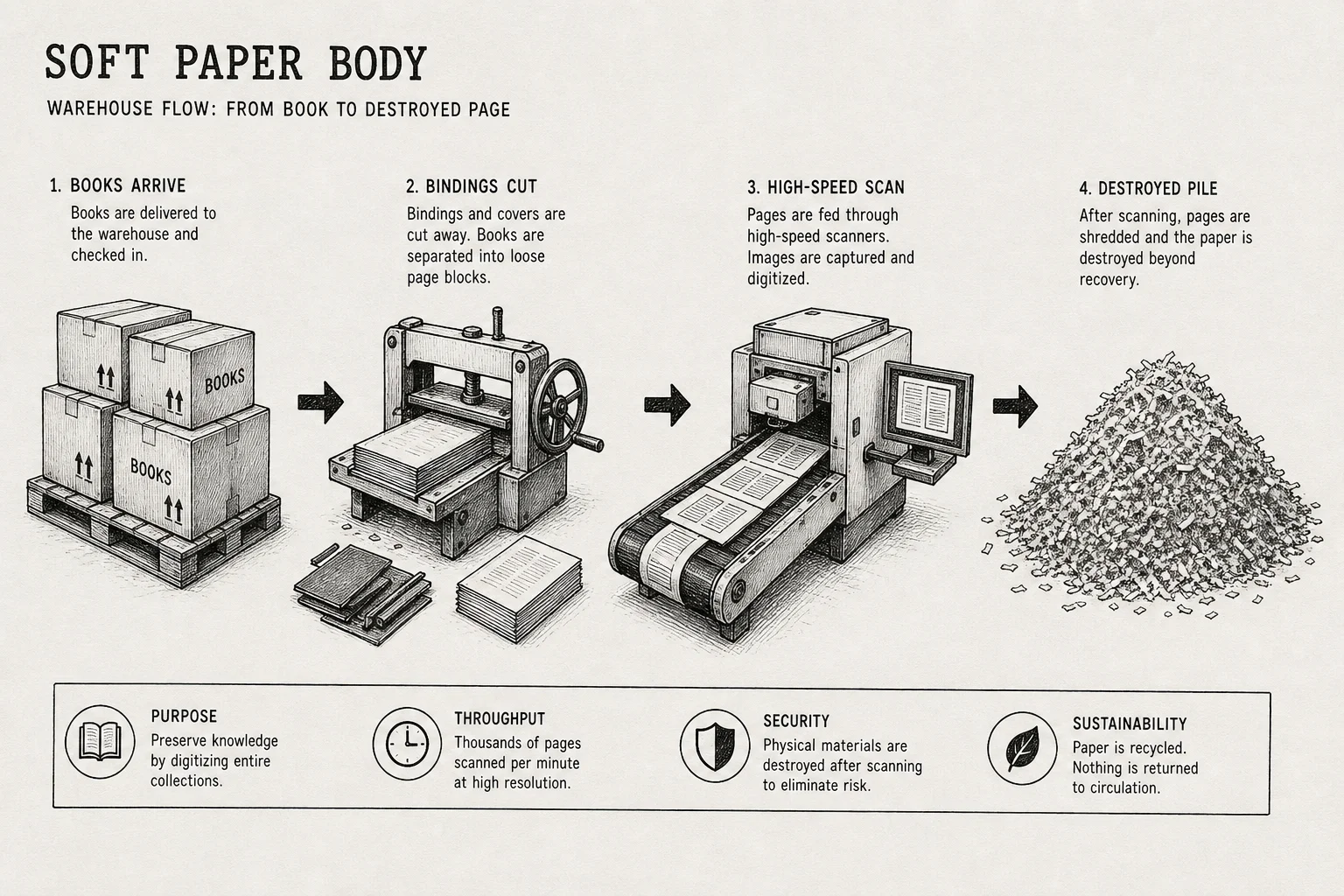
Workers at the site told 404 Media their job is simple: receive massive shipments of printed books, remove bindings so pages scan faster, run high-speed digitization, and discard what is left. The physical book does not survive.
| Step | Operational detail |
|---|---|
| Acquisition | Bulk purchases of rare and used titles |
| Transport | Consolidated shipments to Las Vegas |
| De-binding | Bindings cut for throughput |
| Scan | Page text captured for datasets |
| Destroy | Printed artifact discarded |
Amazon has not publicly detailed this program in the reporting 404 Media cited. The story landed behind their paywall for full detail, but the core chain is clear: printed scarcity converted into tokens, then trashed.
Why books still matter for training
Web text is infinite but contaminated: SEO spam, duplicate mirrors, forum slop, and licensing fights. Printed books, especially older or niche titles, can hold clean long-form prose that never lived in a crawlable HTML page.
We have seen the same incentive structure elsewhere. The Rundown's same digest noted Google paying $10 million for bankrupt Spirit Airlines' internal business data. AlphaSignal digests covered pre-2022 printed books as a training theme. Physical artifacts are becoming competitive datasets.
For model teams, books offer:
- Long coherent context (good for narrative and reasoning evals)
- Less duplicate pollution than Common Crawl slices
- Harder for competitors to replicate quickly if titles are rare
For society, the trade is uglier: cultural objects destroyed to shave cents off scan time.
Supply chain ethics and security
The tracker stunt matters methodologically. When acquisition is opaque, supply chain tracing is how journalists and regulators map data provenance.
If you run RAG or fine-tuning for a client, ask the same questions 404 Media answered:
- Where did this corpus physically originate?
- Was the source destroyed or altered after capture?
- Do licenses survive if the book was bought retail then digitized?
- Could rare or stolen materials enter the pipeline?
Amazon's retail scale makes bulk buying look like inventory optimization until you see VGT3's dinosaur logo and binding cutters.
Parallel to other Amazon AI data stories
Amazon already trains models on shopping behavior, Alexa utterances, and AWS customer workloads under various contracts. A dedicated book destruction scan line is different. It signals hunger for unique text at industrial throughput, not just user-generated content.
404 Media's piece invites more whistleblower contact from scan-facility workers. Expect follow-on reporting on which models consume VGT3 output and whether publishers get paid.
What builders should do differently
I am not your lawyer. As an engineer, I still recommend provenance tooling:
- Dataset cards with acquisition method per shard
- Retention of physical sources when legally possible
- Redundant checksums so destroyed books still have audit trails
- Vendor diligence when buying third-party text bulk
Destroying sources after scan is a throughput hack that becomes a PR and litigation liability the moment a rare book or manuscript enters the pile.
The takeaway
404 Media proved that rare books can end at an Amazon warehouse built to scan and shred for AI training. The story connects hardware logistics, dataset economics, and cultural loss in one supply chain.
If your team buys training data, assume investigators (and competitors) will eventually track a box. Design provenance before the tracker ships. Book a free call if you want a practical data-governance review for RAG and fine-tuning pipelines.