
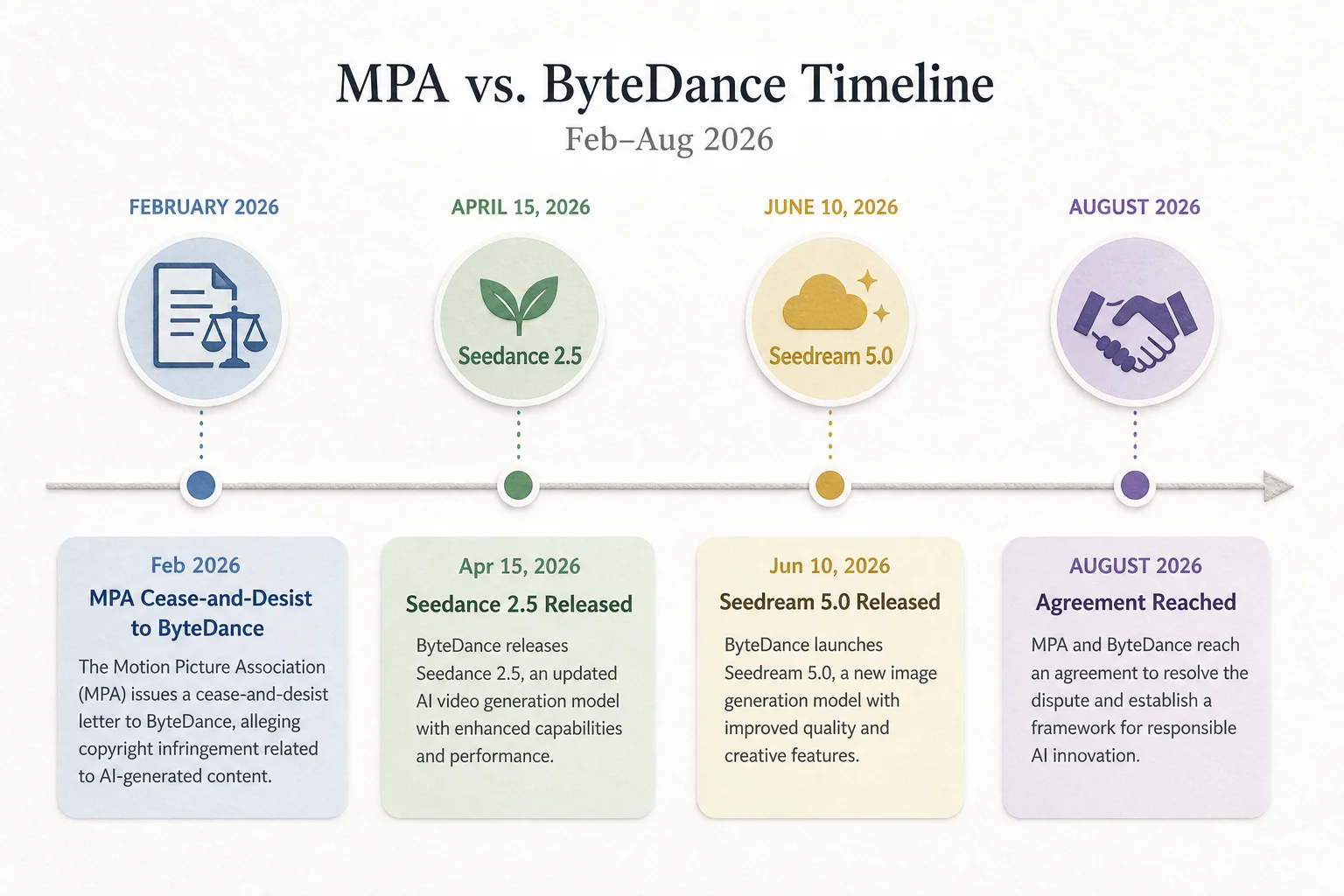
The Motion Picture Association announced on August 17, 2026 that it reached an agreement with ByteDance on copyright guardrails for Seedance (text-to-video) and Seedream (text-to-image). It is the MPA's first formal deal with a major AI company, and it follows the association's first cease-and-desist to a major AI firm back in February.
If you build with generative video, this is the template other studios will point at.
How we got here
In February, the MPA sent ByteDance a cease-and-desist alleging Seedance 2.0 trained on copyrighted material and generated unauthorized clips featuring characters like SpongeBob and visuals echoing Stranger Things. A viral Tom Cruise fight clip from director Ruairi Robinson amplified the fight.
ByteDance delayed Seedance 2.0's worldwide release and shipped Seedance 2.5 and Seedream 5.0 Pro with stronger IP protections, per the joint statement. The August agreement codifies that work across every surface running those models, including CapCut, Dreamina, TikTok, and the U.S. TikTok spinoff.
The Los Angeles Times notes MPA declined to publish specific guardrail text. We know the framework exists. We do not know the enforcement knobs.
What the parties said
MPA CEO Charles Rivkin framed copyright as "a cornerstone of the film and television industry." ByteDance's John Rogovin echoed "responsible innovation" and "meaningful protections for rightsholders."
Indie filmmakers have praised Seedance for cost and quality relative to some Western tools. Studios want the quality without the liability. This deal tries to split that difference at the model layer.
Why it matters beyond one company
Chinese labs (ByteDance, Kling, Alibaba's Wan family, and others) have pushed video quality fast. The Will Smith spaghetti meme era is over. Clips now pass a casual glance test. That shifts legal risk from theoretical to daily.
Hollywood cannot sue every tool. The MPA picked a high-visibility target, won a public concession, and created a precedent. Expect similar letters to other vendors, especially where models surface on consumer apps with billions of installs.
| Stakeholder | Win | Open question |
|---|---|---|
| Studios | Public guardrails, delayed releases as leverage | Compensation for training data |
| ByteDance | Keeps shipping to global apps | Auditability of filters |
| Indie creators | Clearer rules on major platform | Whether quality regresses |
| Enterprise buyers | Signal for compliance conversations | Cross-border enforcement |
Practical takeaways if you ship AI video
- Treat celebrity and franchise likeness as radioactive unless you have explicit rights. Filters will get better; lawsuits will not slow down.
- Read platform ToS per app surface. The MPA deal covers ByteDance properties, not your custom API wrapper.
- Document your pipeline. If you fine-tune or chain models, "the base vendor signed with MPA" is not your get-out-of-jail card.
- Watch training-data deals. Guardrails address generation. They do not settle whether Hollywood gets paid for past ingestion.
I have clients ask whether they can auto-generate ad variants from a single hero shoot. The answer is increasingly "yes, with a legal review layer," not "yes, because the model is smart."
The competitive lens
Western labs face the same pressure. Adobe, Google, OpenAI, and startups all negotiate with rights holders. ByteDance moving first with MPA gives them a story for partners worried about TikTok-scale distribution of infringing clips.
It does not end the arms race. Kling and others remain outside this specific agreement. The MPA's job gets harder as the field fragments.
Bottom line
Hollywood drew a line in February. ByteDance stepped back, hardened models, and signed a framework in August. The details are private. The direction is public: major AI video tools will ship with studio-facing guardrails or face MPA-scale legal heat.
If you are productizing generative video for marketing or internal ops and want help mapping rights risk before you scale, book a free discovery call.