
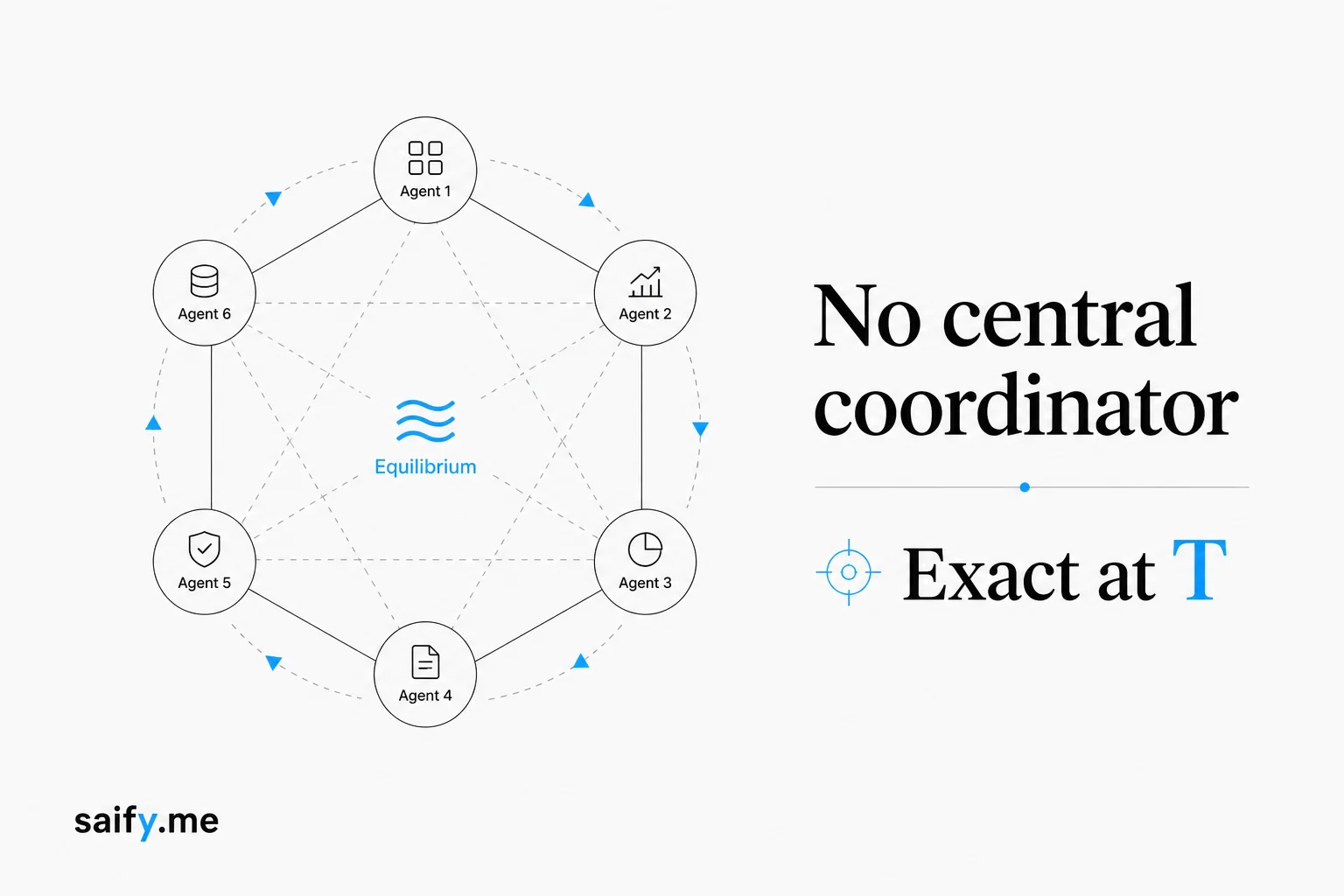
The AlphaSignal digest flagged a paper I would have missed otherwise: Prescribed-Time Distributed Generalized Nash Equilibrium Seeking on arXiv. It is control-theory heavy, but the headline for builders is simple. Multiple agents can reach a fair shared equilibrium on a network without a central coordinator, and you can set the deadline.
If you run robot fleets, energy grids, or any system where autonomous agents share scarce resources, that is not academic trivia. It is the math behind "everyone stops fighting at 3:00:00 PM exactly."
The problem in plain language
Imagine warehouse robots that must avoid collisions while each robot tries to minimize travel time. Or pricing agents on a mesh network where everyone adjusts bids but nobody can break a shared capacity constraint.
Classical solutions often assume:
- A central server that sees everyone's state
- Infinite time to converge
- Simple coupling (each agent only cares about a global average, not full neighbor decisions)
Real deployments break all three assumptions. Radios drop packets. Privacy rules block sharing Lagrange multipliers. Pairwise collision avoidance forces each robot to estimate full neighbor trajectories, not a single aggregate statistic.
Generalized Nash equilibrium (GNE) is the formal name for "everyone is locally optimal and shared constraints hold." Variational GNE (v-GNE) is the subset most distributed papers target because it matches centralized solutions when they exist.
What this paper adds
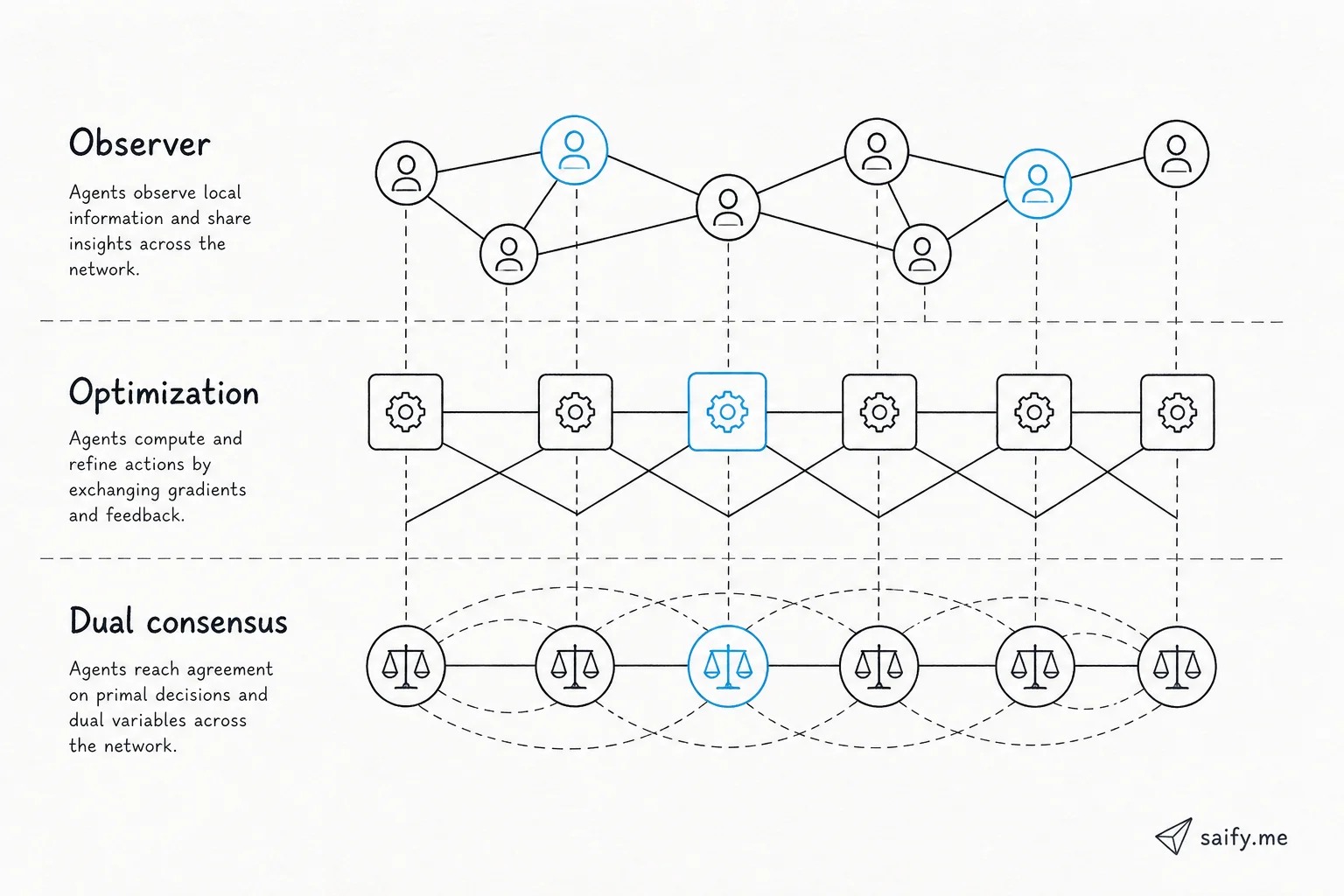
The authors propose a fully distributed algorithm where each agent runs three layers at the same time:
| Layer | Role |
|---|---|
| Prescribed-time observer | Estimates the full network state without fixing a permanent leader |
| Gradient optimization | Updates local decisions toward lower individual cost |
| Dual consensus | Aligns shared multipliers so agents satisfy coupling constraints |
The novelty is prescribed-time convergence. Prior predefined-time methods gave you an upper bound on finish time. This design aims for exact equilibrium at deadline T, a stronger guarantee for safety-critical schedules.
It also handles the standard GNEP class with arbitrary coupling in costs and shared constraints. That covers pairwise collision avoidance and bilateral contracts, problems outside aggregative-game shortcuts where each cost only depends on a scalar aggregate.
Why the observer layer matters
Distributed GNE papers often assume agents can track moving leaders asymptotically. Here leaders are not static. They are other agents whose states are themselves driven by coupled optimization.
The paper combines prescribed-time scaling with a self-anchored observer: each agent pins its own state and is tracked by neighbors. That closes a gap between prescribed-time consensus (static leaders only) and asymptotic observers (moving leaders, no hard deadline).
For robotics, the observer is the piece that says "I know where everyone will be at time T" without calling a cloud planner every 50 ms.
Related work you should know
Two other 2026 threads show the field is moving fast:
- Graph-based distributed Nash equilibrium seeking for potential games introduces DAPD, a discrete-time scheduler that picks which player updates next based on largest cost decrease. Parallel updates on non-neighbors speed convergence.
- Distributed GNEP algorithms without multiplier sharing removes Lagrange multiplier exchange for privacy, targeting multi-robot coordination with primal-dual dynamics.
The prescribed-time paper is complementary. It optimizes for deadline certainty on continuous-time v-GNE seeking. DAPD optimizes update scheduling in discrete potential games. The multiplier-free line optimizes privacy and equilibrium class reachability.
None of these are LLM agents. They are the coordination layer underneath them.
Connection to AI agent systems
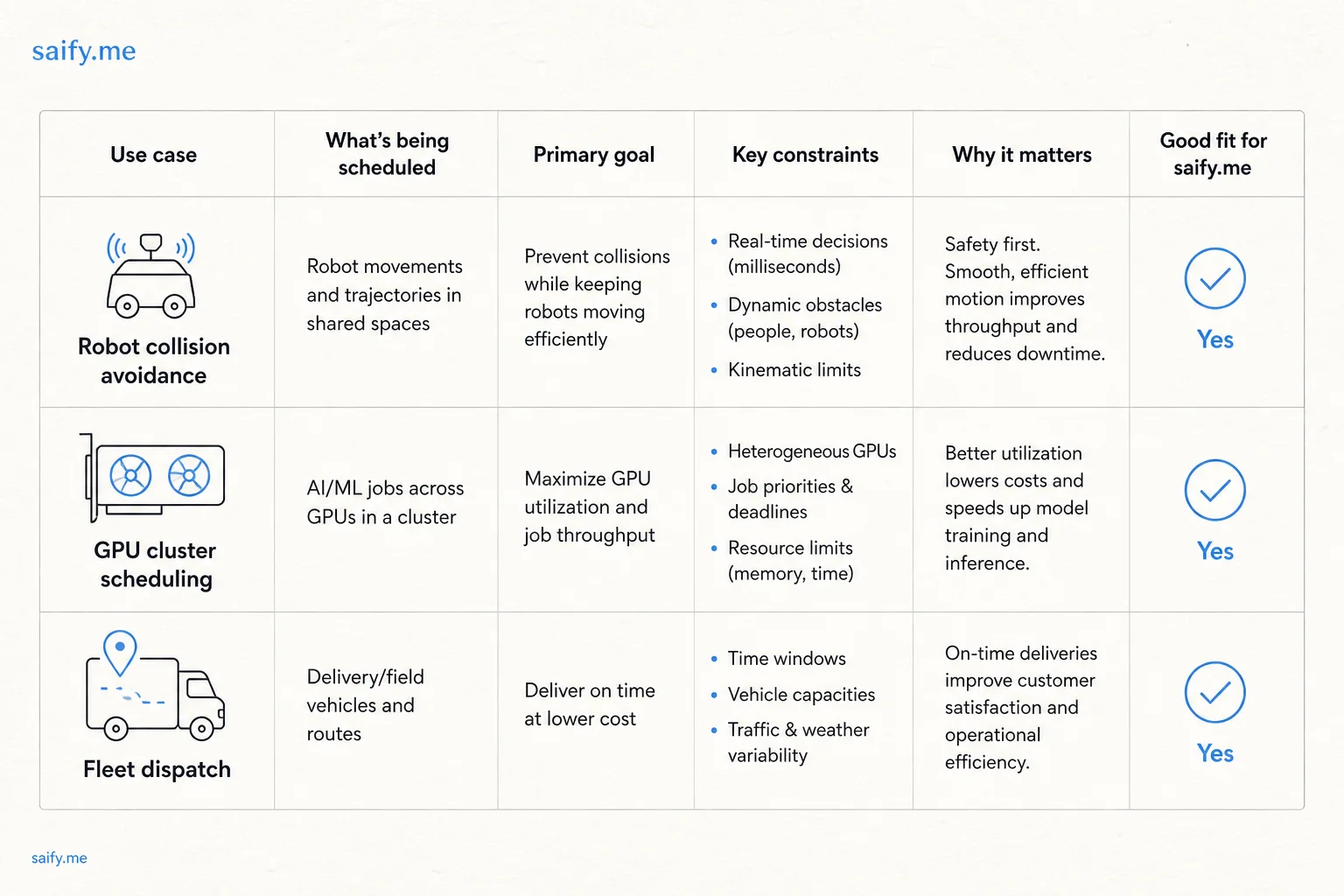
Most "multi-agent AI" demos are orchestration graphs: a planner calls tools in sequence. Production systems that put agents on shared infrastructure hit GNE-shaped problems quickly:
- GPU cluster schedulers where each training job maximizes throughput but shares power caps
- Fleet dispatch where each vehicle agent optimizes route cost under collision or lane constraints
- Ad auction micro-bidders with coupled budget constraints across campaigns
Large language model agents do not replace this math. They sit above it. When five coding agents share one CI queue, something still has to decide fair concurrency without a human clicking "approve" every minute.
Prescribed-time guarantees help when you need auditable SLAs: "all agents settle before the shift handoff" or "robots clear the intersection before the next pallet arrives."
Implementation reality check
This is not a pip-install library yet. It is a theory paper with Lyapunov proofs and simulation validation. Before you bet a factory on it:
- Model your coupling correctly. Pairwise collision constraints are not aggregative games. Wrong model class means wrong algorithm.
- Measure communication graph. Prescribed-time observers assume connected undirected graphs. Sparse meshes change gain schedules.
- Compare against your current coordinator. Many teams already run a central OR-Tools or MILP planner. Distributed GNE wins when centralization is too slow, too brittle, or illegal (data residency).
- Watch discretization. Continuous-time proofs do not automatically survive aggressive step sizes on real hardware clocks.
I would prototype in simulation (Gazebo, Isaac, or a discrete grid world) before touching production AMRs.
When I would reach for this vs a central planner
| Scenario | Central planner | Distributed prescribed-time GNE |
|---|---|---|
| 10 agents, full state visible | Often simpler | Extra complexity |
| 100+ agents, intermittent comms | Bottleneck risk | Natural fit |
| Hard safety deadline at time T | Needs custom scheduling | Designed for it |
| Privacy blocks multiplier sharing | Harder | Look at multiplier-free variants too |
| LLM-only task routing | Wrong tool | Wrong tool |
The middle rows are where this research matters.
Bottom line
The AlphaSignal blurb called it "multi-agent networks to equilibrium without a central coordinator." The paper delivers more precision: variational generalized Nash equilibrium at a prescribed time, with a simultaneous observer-optimizer-dual architecture that handles coupling beyond aggregative games.
That is not a product launch. It is a design pattern for the coordination layer AI agents still lack.
Resources:
- Prescribed-Time Distributed GNE Seeking (arXiv)
- HTML version with architecture diagrams
- DAPD for potential games (Nonlinear Analysis)
If you are wiring multi-agent ops (robots, dispatch, or shared inference clusters) and need help choosing coordination math vs orchestration glue, book a free discovery call. The failure mode is usually the model class, not the framework.