
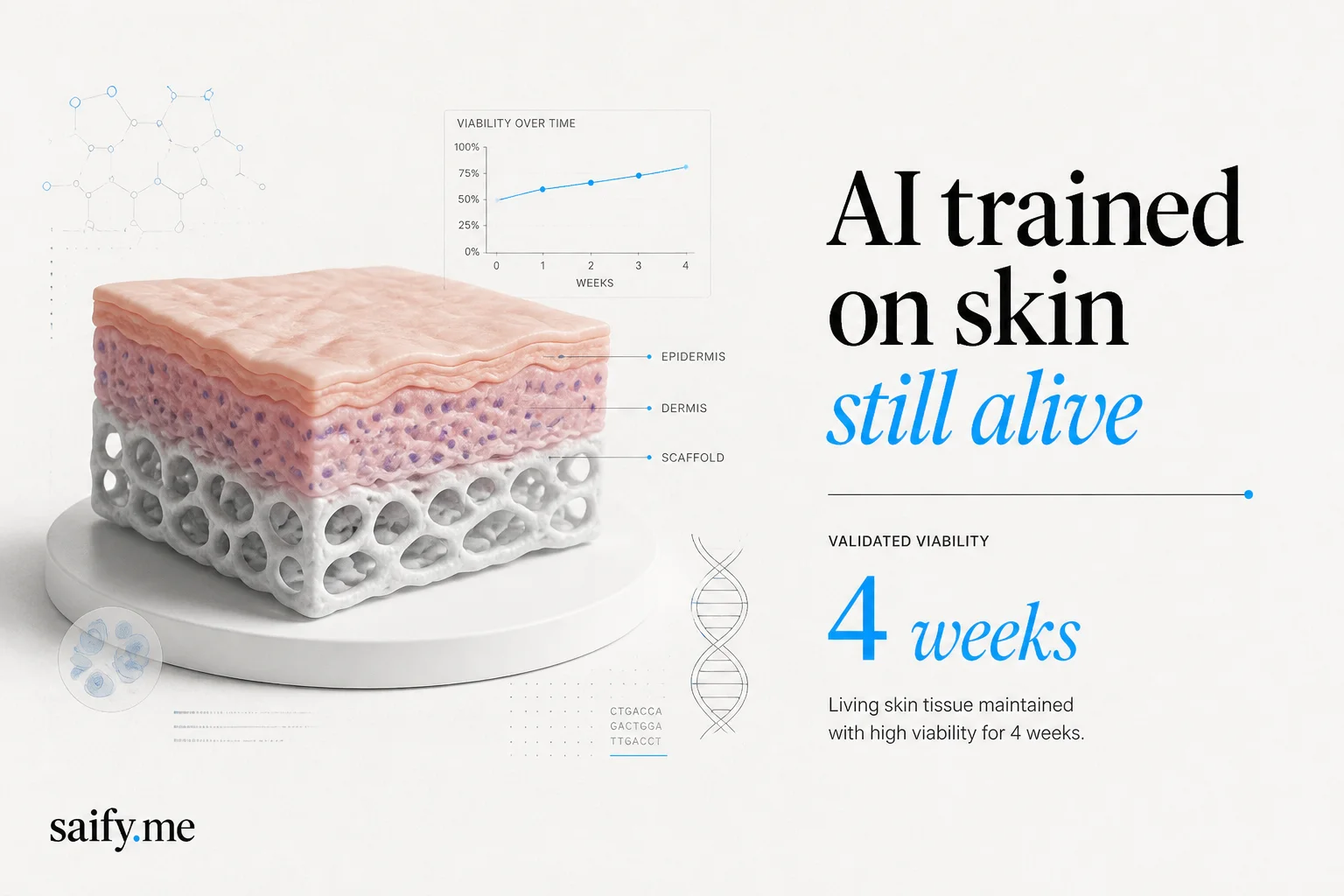
Skincare keeps recycling the same actives because lab skin dies in about a week. That kills the slow experiments that would tell you what else actually works.
Outer Bio, co-founded by Michael Polansky and Lady Gaga (Stefani Germanotta), just came out of stealth with a fix: keep real human skin alive for four weeks, measure what happens, and let an AI learn from every pass.
The bottleneck is time, not ideas
Polansky is not a bench scientist. He spent years in cancer immunotherapy philanthropy with Sean Parker before spinning up Outer Bio in 2022 with Kyung-Jin Jang, Chris Hinojosa, and Stanley King.
Their insight is blunt: software iterates in hours. Biology iterates in weeks, and most lab proxies lie.
| Model type | Typical viable window | What you can learn |
|---|---|---|
| Standard ex vivo skin | ~7 days | Acute toxicity |
| Organoids / simplified cultures | Varies | Partial pathways |
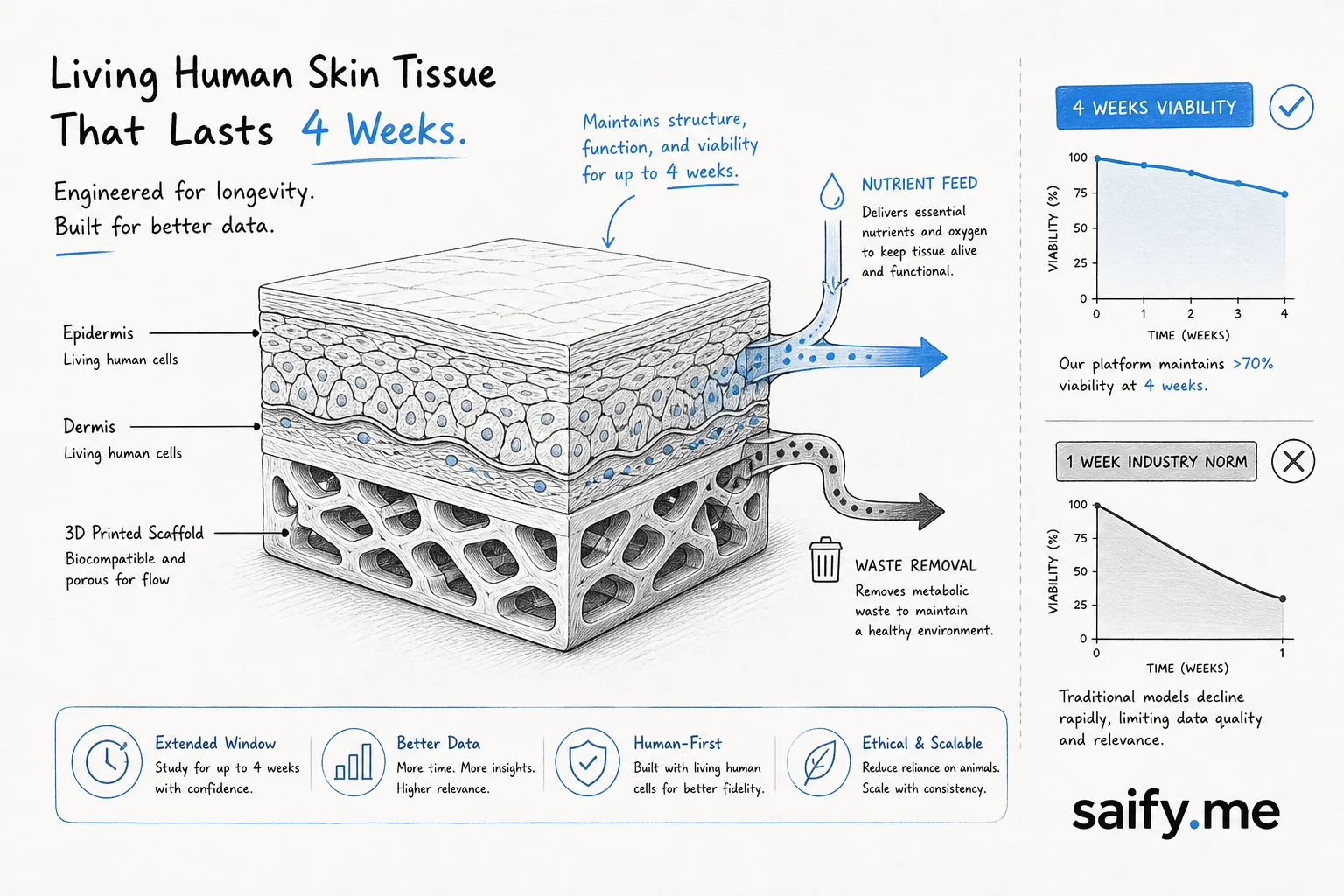
| Outer Bio Yuna tissue | Up to 4 weeks | Collagen remodeling, pigmentation, barrier repair, UV recovery |
The team sources de-identified full-thickness skin from surgical discards through vetted biobanks (National Disease Research Interchange, Cooperative Human Tissue Network) under IRB oversight. A proprietary scaffold feeds nutrients and clears waste so tissue keeps day-zero architecture for weeks, not days.
The closed loop is the product
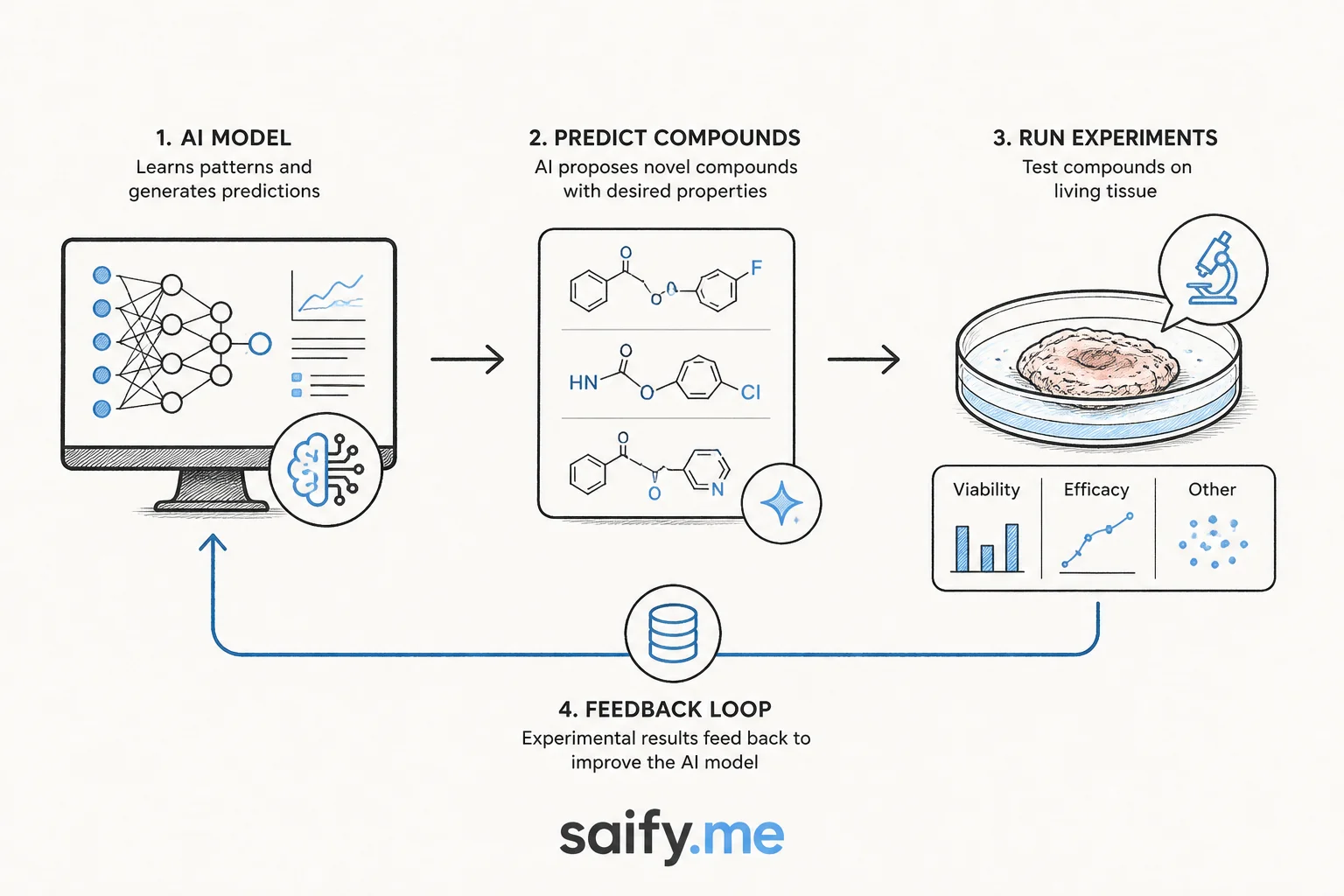
Outer Bio is not selling a single serum. It is selling a prediction loop:
- AI proposes compounds likely to affect a target skin process
- Yuna runs controlled experiments on living tissue
- Results, right or wrong, retrain the model
- Repeat
Early on the company brute-forced literature and NCI natural-compound partnerships. That produced two leads in ~18 months. With AI in the loop, Polansky says they now generate a new candidate every six weeks, with six active leads and dozens of logged hits.
The universe of proven skin actives is tiny. FDA OTC drug categories cover roughly 120–130 approved actives. Add cosmetic ingredients with real research and Polansky puts the total near 200. Most marketing claims still orbit that short list.
What the data actually showed
Outer Bio posted a bioRxiv preprint (linked from their site) reproducing known biology:
- A psoriasis-like state reversed by a JAK inhibitor
- UVB damage eased by sunscreen over multi-week observation
Those are sanity checks, not magic. Yuna still lacks blood flow and the immune cells skin recruits in vivo. Polansky is careful about that. The win is time under realistic stress, not a perfect organ replica.
Commercial path for cosmetic ingredients runs through standardized naming plus OECD safety testing, then partner brands formulate and sell. Haus Labs (Gaga's cosmetics line) collaborates at the margins; Outer Bio's chief scientist sits on Haus Labs' scientific advisory board.
Why this matters for applied AI teams
This is the opposite of a chatbot trained on Reddit skincare threads.
- Data moat: experiments that do not exist on Hugging Face
- Modest compute: all AI work runs on-prem today, not hyperscaler training runs
- Human-in-the-loop productization: discovery is automated; formulation and scale-up still need experienced chemists (Polansky says that hire class is next)
Competitor Vivodyne raised tens of millions for lab-grown organ tissue causal data. The category is heating up because pharma and beauty both need faster, human-relevant readouts.
For builders, the lesson is familiar from RAG and agent evals: your model is only as good as the feedback loop you own. Outer Bio bought a longer loop by engineering the wet lab, not by fine-tuning on public text.
If you are shipping AI where domain feedback is slow (clinical ops, manufacturing QC, regulated forms), ask whether you need a Yuna-style physical or transactional loop, not another general LLM wrapper.
Questions about closed-loop ML in ops-heavy businesses? Book a free discovery call.