
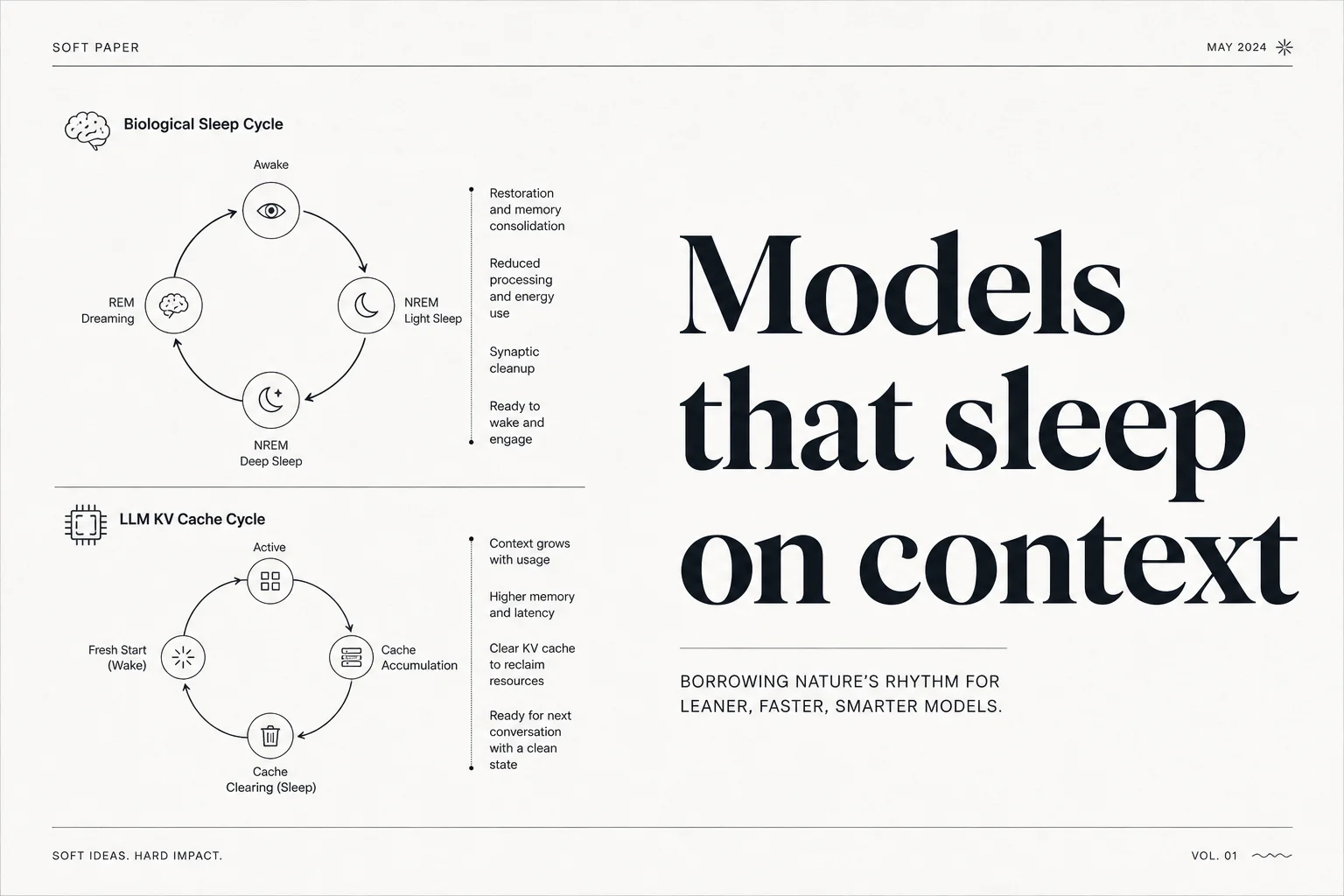
Long-running agents hit the same wall every product team eventually discovers: context either truncates (you lose history) or accumulates (KV cache memory and latency balloon).
A May 2026 paper, Do Language Models Need Sleep? Offline Recurrence for Improved Online Inference, proposes a biologically inspired fix. Let the model sleep: consolidate recent context into persistent fast weights, then clear the KV cache and keep serving users at normal speed.
The AlphaSignal blurb called it a trick to compress long context without slowing down. That is close, with an important caveat: sleep adds offline compute, not magic. You pay somewhere. You just stop paying on every user-facing token.
Wake phase vs sleep phase
Standard transformers keep every past token in attention KV cache. Long conversations mean linear memory growth and quadratic attention cost in the worst case.
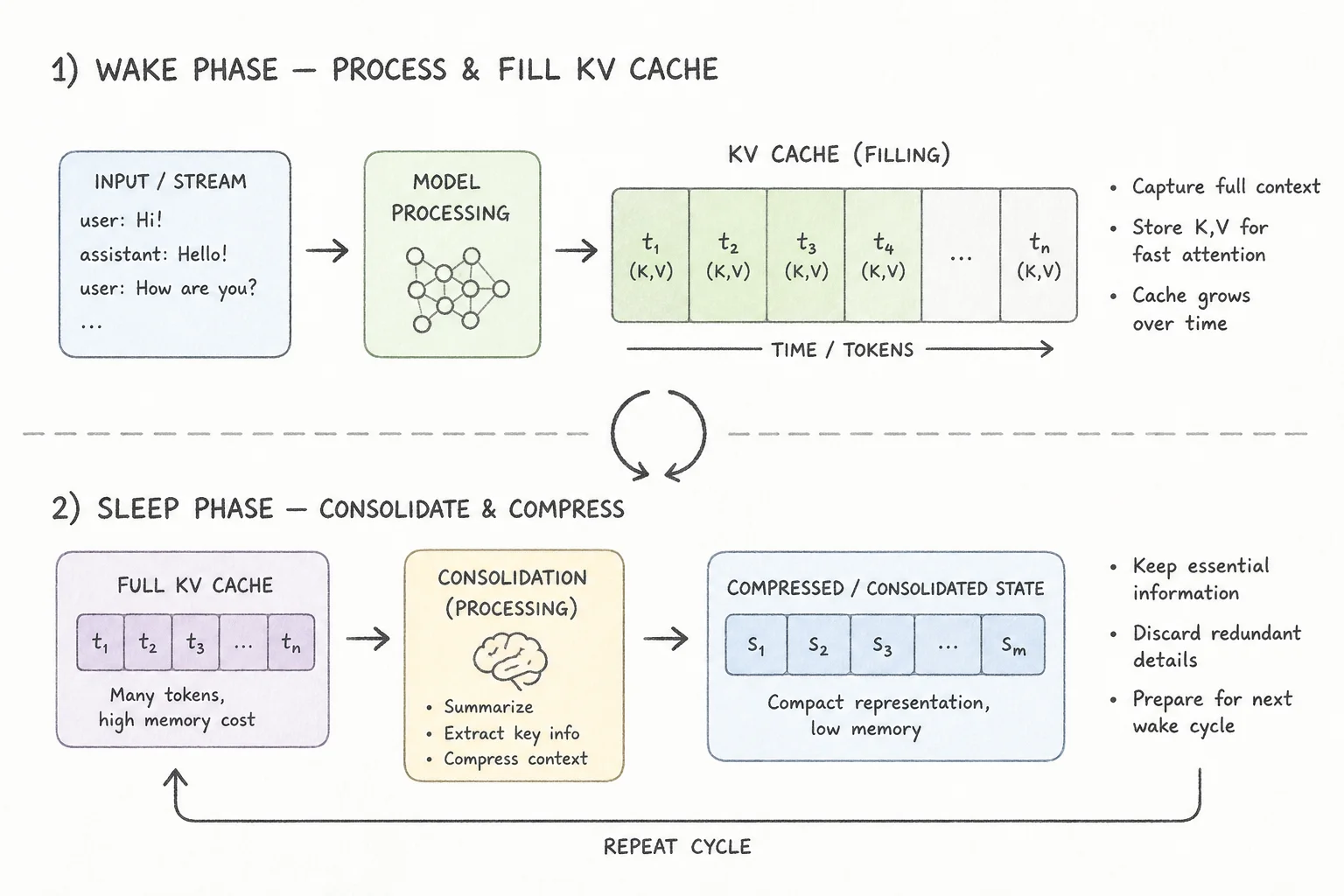
The paper's loop:
- Wake (online): process incoming tokens with a normal forward pass
- Sleep (offline): when context fills, run N recurrent passes over accumulated context and update fast weights in state-space model (SSM) blocks via a learned local rule
- Evict: clear the KV cache and continue with consolidated state in fast weights
Think hippocampal replay during sleep, but for logits.
Where it wins (and where it stops)
Authors test controlled synthetic tasks (cellular automata, multi-hop graph retrieval) plus a realistic math reasoning benchmark where vanilla transformers and naive SSM-attention hybrids fail.
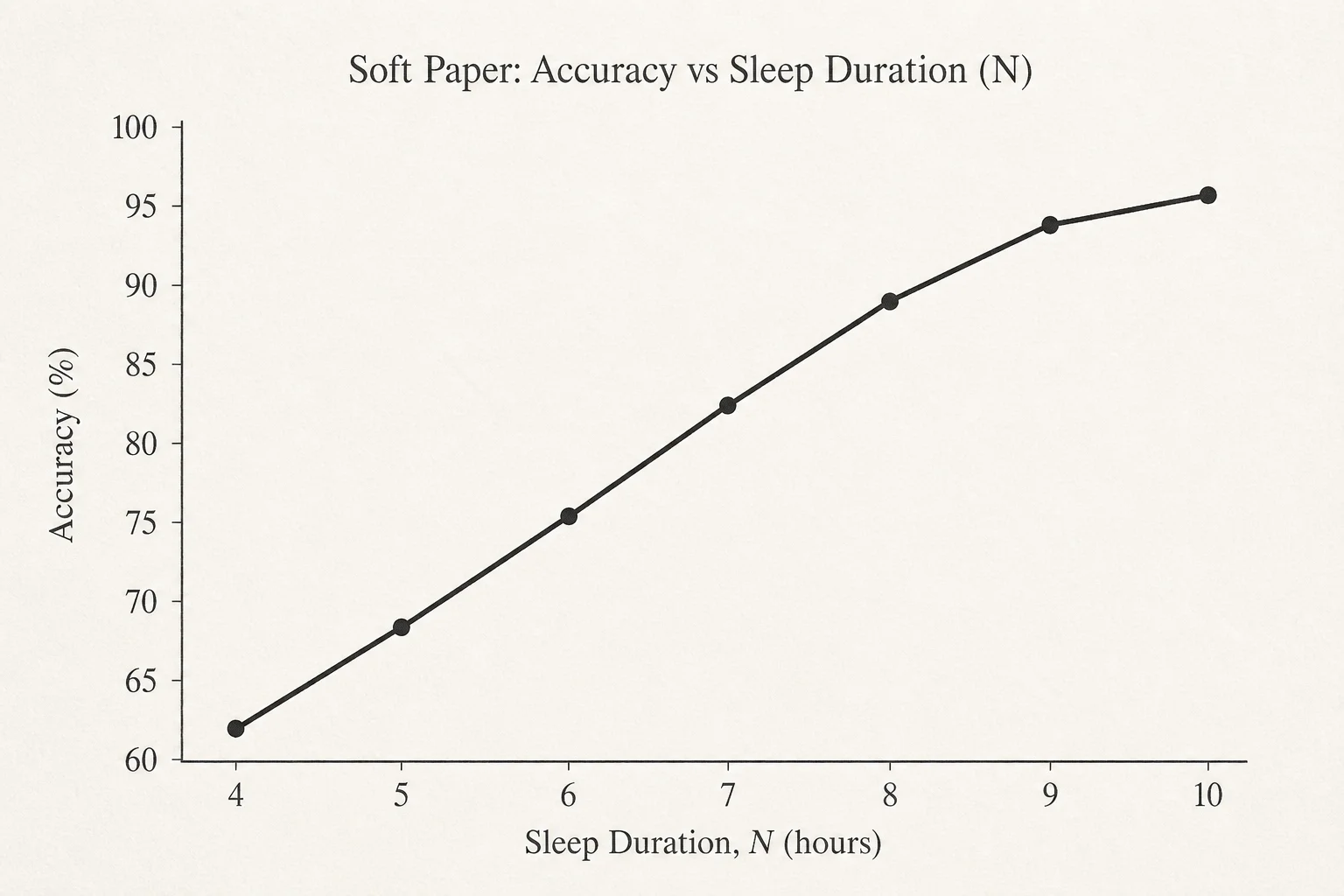
The headline result: increasing sleep duration N improves performance, with the largest gains on examples needing deeper sequential reasoning over evicted context.
One concrete number from summaries of the paper: with a sliding window of 512 tokens on Ouro 1.4B, pushing sleep on two-operation problems moved accuracy from about 0.596 to 0.905. That is a huge relative lift on a toy regime, not a ChatGPT-scale production claim.
| Setting | Effect of longer sleep N |
|---|---|
| Deep multi-hop reasoning | Largest gains |
| Compression under small active window | Strong gains |
| Wake-time latency | Preserved (by design) |
| Production chat at GPT-4 scale | Not demonstrated |
Why agent builders should care
If you ship copilots that run hours or days (support triage, coding agents, ops automation), brute-force 1M-token windows are not the only research direction. Sleep-like consolidation is a bet that compute moved offline can beat ever-larger caches online.
That pairs with the same endurance theme as Qwen3.7 Max marathon runs and GPT-5.5 agentic coding: the industry is optimizing for sustained tasks, not single replies.
Practical limits today:
- Requires SSM-style fast weights and training for sleep, not a plugin for existing GPT-class APIs
- Evaluated on research benchmarks, not your production dialogue logs
- Sleep duration N trades offline GPU time against retention quality
Useful references:
How this fits next to RAG and long context
I still reach for RAG and explicit memory stores in client work because they are shippable now. Sleep research matters as a design pattern to watch: periodic consolidation beats naive truncation for agents that cannot afford to forget mid-task.
If your roadmap includes custom small models for private agent loops, offline recurrence is worth a lab notebook entry. If you are on frontier APIs only, the actionable move is simpler: design review gates before context eviction, because your model cannot sleep yet.
The takeaway
Sleep is not a product feature you can toggle tomorrow. It is a credible direction for long-horizon AI: spend compute when the user is not waiting, keep inference snappy when they are.
If you are architecting agent memory for a real ops or product workflow and want help choosing between RAG, long context, and checkpointing today, book a free discovery call.