
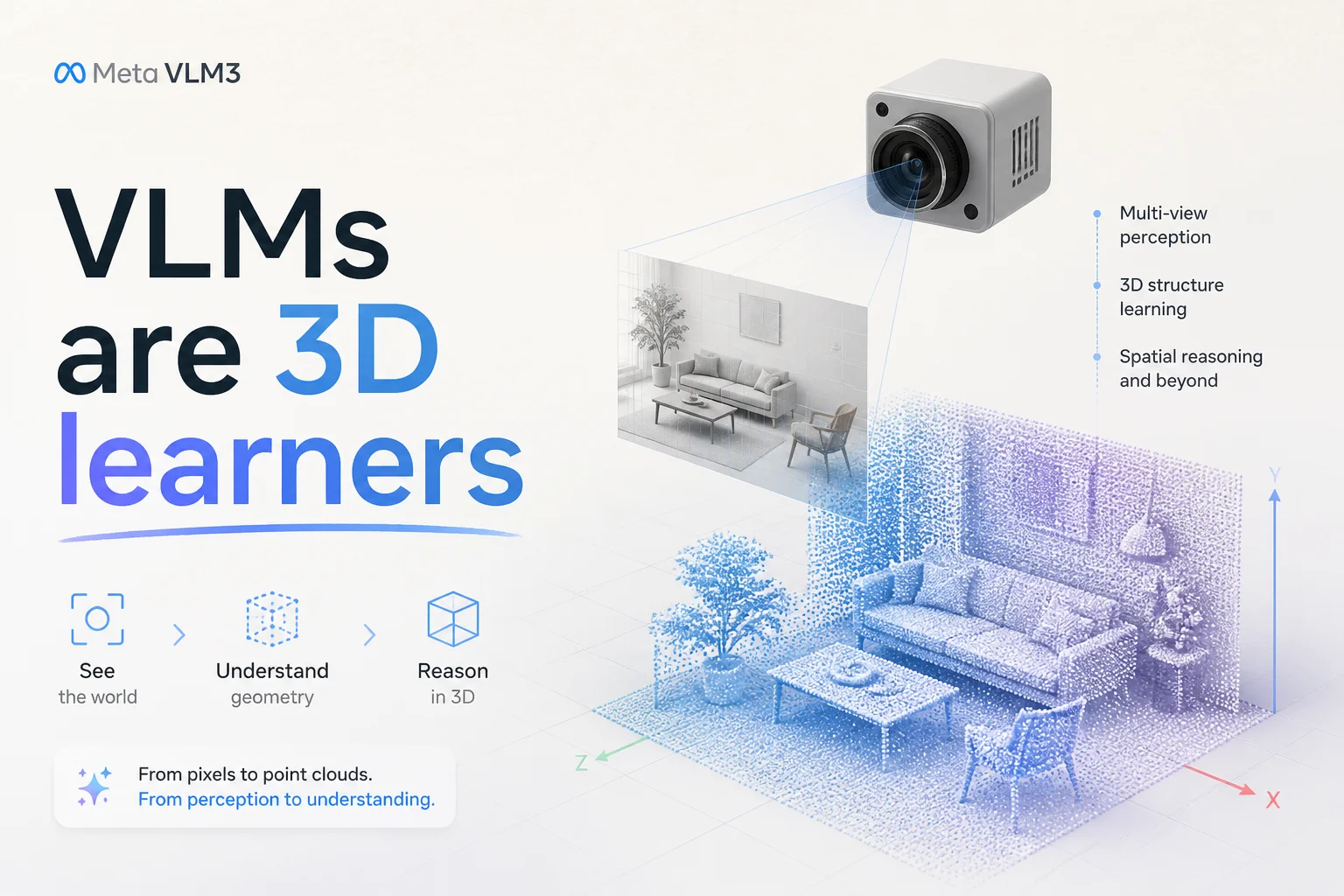
3D vision has a tradition of heavy machinery: custom architectures, regression losses, augmentation pipelines tuned for one benchmark at a time.
Meta's VLM3 paper (May 2026) makes a provocative claim: standard vision-language models already are native 3D learners. You mostly need data, scaling, and three design choices. Not a new expert head for every task.
The three ingredients
VLM3's large-scale study boils effective 3D learning down to:
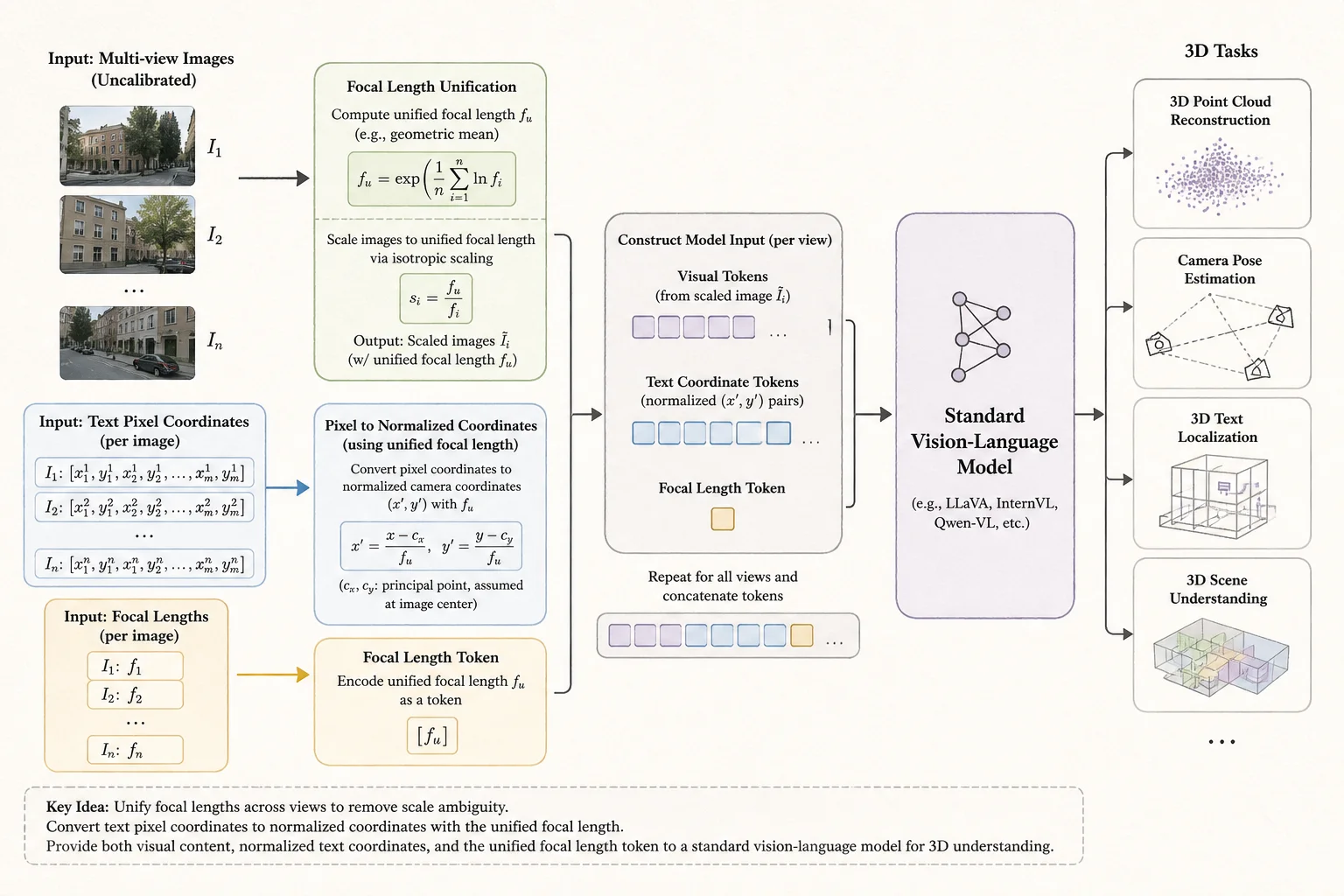
- Focal length unification (resize images so focal length is consistent, e.g. 1000 px)
- Text-based pixel reference (refer to objects and pixels with normalized coordinate text, not special visual markers)
- Data mixture and scaling (collect diverse 3D supervision and SFT at VLM scale)
What's not required, according to the paper:
- Task-specific architecture changes
- Heavy data augmentations
- Complex regression losses (foundational for many SOTA 3D expert models)
- Extra encoders for object-level 3D (as in some prior VLMs)
Results against expert vision models
VLM3 reports matching or beating specialist systems while keeping standard VLM architecture and text outputs:
| Task | VLM3 vs expert reference |
|---|---|
| Metric depth | DepthLM accuracy 0.84 → 0.9; competitive with UniDepthV2, Moge-2 |
| Pixel correspondence | Surpasses DKM and RoMa |
| Camera pose | Matches DepthAnything3, beats VGGT on reported suites |
| Object-level 3D | Surpasses SpatialRGPT on SpatialRGPT-bench without extra encoders |
The unified output domain is text. Depth, correspondence, pose, and object understanding all route through the same decoder humans already prompt for captions and VQA.
Why this matters outside research Twitter
If you're building robotics, AR, or spatial agents, the industry default was a zoo of models: one for depth, one for matching, one for pose, glue code in between.
VLM3 suggests a generalist path: one VLM + scaled 3D data. Trade-offs:
| Approach | Pros | Cons |
|---|---|---|
| Expert model zoo | Mature SDKs, predictable latency | Integration tax, conflicting coordinate frames |
| VLM3-style generalist | One prompt interface, shared pretraining | Training cost, eval on your cameras |
For applied teams, the actionable takeaway is simpler: before you fine-tune a bespoke depth net, check whether your base VLM with focal normalization and text coordinate prompts gets "good enough" on your sensor data.
How VLM3 refers to pixels
Instead of rendering markers on images, VLM3 uses normalized text ranges for horizontal and vertical axes (e.g. [0, 2000) or [0, 1000)). Objects and pixels are described in language the model already speaks.
That removes custom visual prompting modules and keeps the stack closer to standard SFT tooling.
Example prompt shape (conceptual):
"Point A is at pixel (450, 320). Point B is at (890, 410).
 Estimate the relative depth ordering."
No new tokenizer. No auxiliary vision encoder slot for markers.
Contrast with tool-chaining spatial reasoners
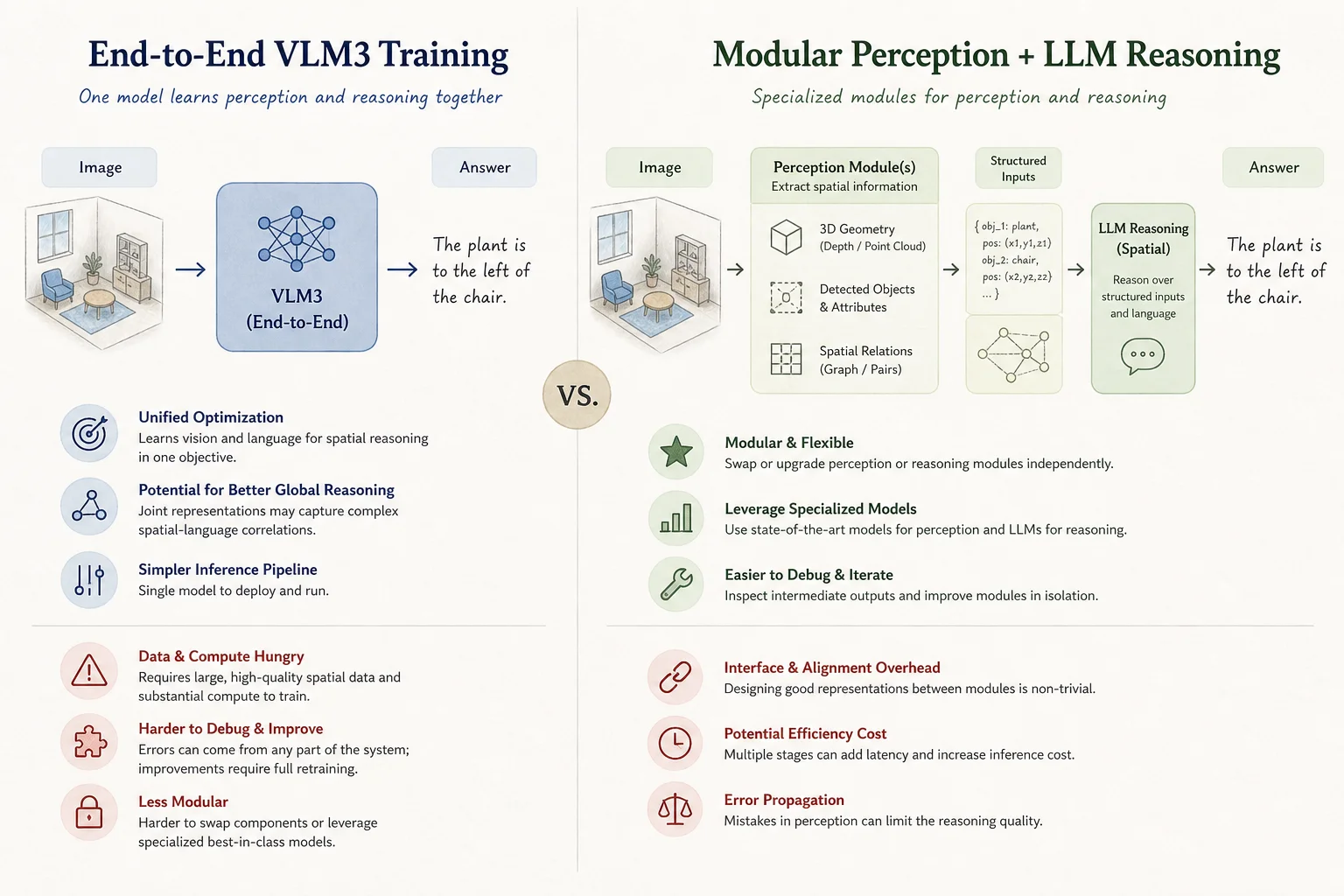
Other 2026 work (e.g. disentangled spatial reasoners) feeds explicit 3D evidence text from off-the-shelf perception models into an LLM with LoRA. Different philosophy: modular perception, language-only reasoning.
VLM3 bets the VLM can internalize geometry with enough diverse 3D SFT. DiSR-style systems bet on interpretable intermediate evidence.
Both can be right depending on safety and debuggability requirements. VLM3 optimizes for scalable generalism. DiSR optimizes for attribution (was the error perception or logic?).
What I'd test first on a client project
- Collect 200 to 500 labeled frames from your cameras (not NYUv2 nostalgia)
- Apply focal length unification consistently in preprocessing
- SFT a mid-size open VLM with text coordinate labels
- Compare to your current depth/matching stack on downstream task accuracy (pick rate, collision rate), not just benchmark δ
Paper code and checkpoints live under the Meta repo. Hugging Face paper page: 2605.30561.
Bottom line
VLM3 is a permission slip to stop over-engineering 3D heads before you scale data. If you're still stitching five expert models because "that's how CV works," rerun the ablation on a modern VLM baseline.
Custom vision when off-the-shelf fails is what I do for clients. Book a free call if you want help scoping a spatial ML pilot.