
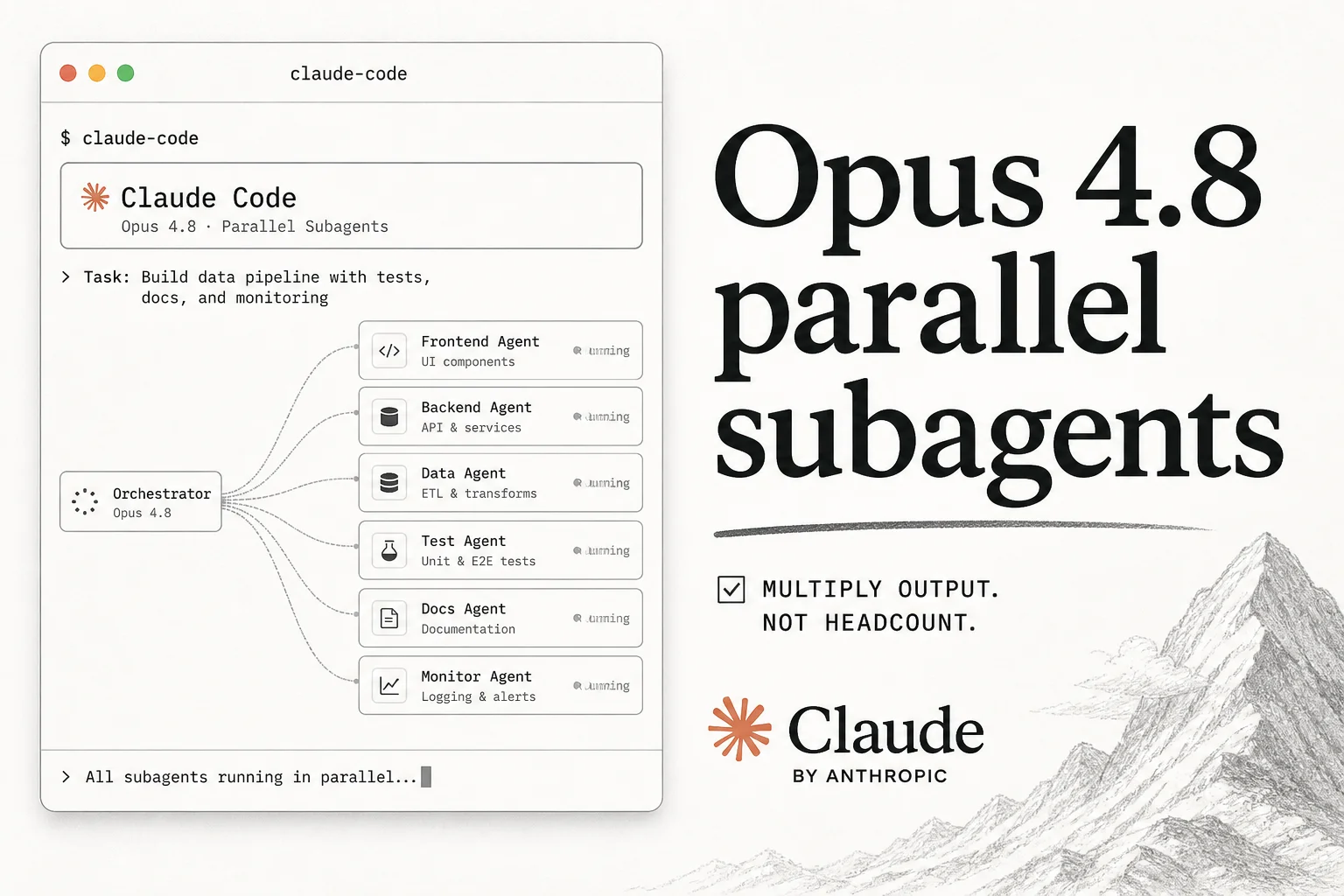
Anthropic dropped Claude Opus 4.8 on May 28, 2026, the same day it closed a monster funding round. The model headline is incremental. The harness headline is not.
Dynamic workflows turn Claude Code into something closer to a project manager that can fan out hundreds of subagents, verify their work, and only then bother you. That is the shift I care about for client builds where someone has to trust an agent overnight.
What actually shipped
Three layers landed together:
| Layer | What changed | Why it matters |
|---|---|---|
| Opus 4.8 | Same list price as 4.7; better judgment on agentic tasks | You are not paying a premium to try the new harness features |
| Dynamic workflows | Orchestration scripts run up to 1,000 subagents per session | Quarter-scale work can compress into days when tasks parallelize |
| Effort + fast mode | Manual effort control returns; /fast is 2.5x speed and cheaper than before | You can trade tokens for speed without guessing which hidden knob moved |
The API model id is claude-opus-4-8. If you are still pinned to claude-opus-4-7 in production agents, this is a low-risk bump on price.
Dynamic workflows, explained without the hype
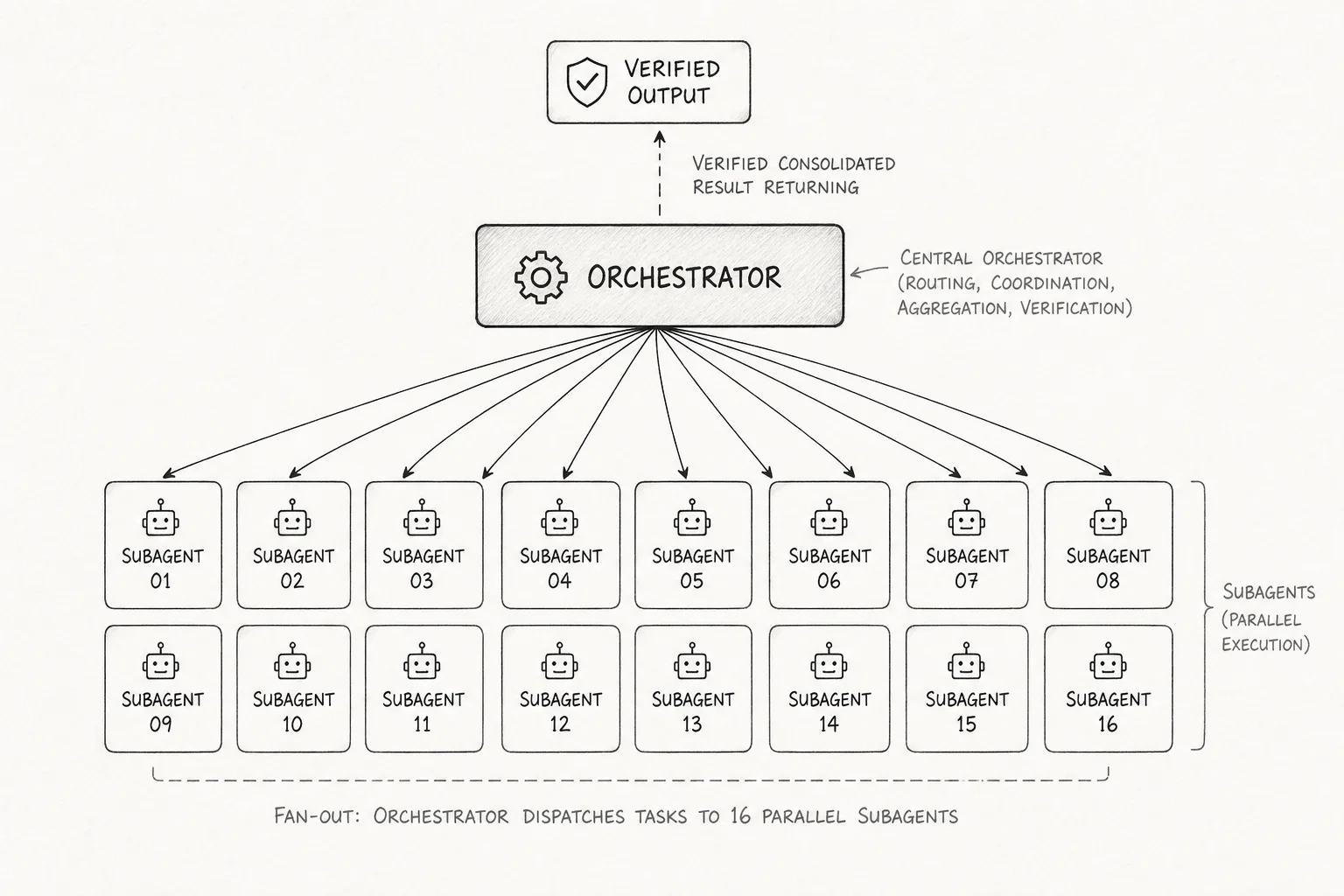
A dynamic workflow is not "Claude but louder." Claude writes a JavaScript orchestration script from your plain-language request. A separate runtime executes it while your chat session stays responsive. Subagents do the file reads, edits, and shell work. Only the consolidated answer comes back.
Hard limits from the Claude Code workflows docs:
| Constraint | Value |
|---|---|
| Minimum Claude Code version | v2.1.154 |
| Concurrent subagents | Up to 16 |
| Total subagents per run | Up to 1,000 |
| Orchestration script | Cannot touch filesystem or shell directly |
| Subagent edit mode | acceptEdits (auto-approved) |
The planning state lives in script variables, not your conversation context. That is why these runs can stretch into hours or days without the session turning into a token landfill. Progress checkpoints so an interrupted job can resume.
Anthropic's canonical stress test: Jarred Sumner used dynamic workflows to port Bun from Zig to Rust, roughly 750,000 lines, 99.8% of tests passing, 11 days from first commit to merge. I will not pretend every repo gets that outcome. I will say the shape of the problem (massive, verifiable, parallelizable) is exactly what this feature targets.
To start:
- Update Claude Code to v2.1.154+.
- On Max/Team/Enterprise, workflows are on by default. Pro users enable them in
/config. - Ask for a workflow explicitly, run
/deep-research, or turn on theultracodesetting for xhigh effort sessions.
Fast mode and effort control are billing levers, not cosmetics
Fast mode on Opus 4.8 runs about 2.5x faster on output tokens. Anthropic says it is three times cheaper than fast mode on Opus 4.7 and 4.6 (which listed at $30/$150 per million tokens). Toggle with /fast in Claude Code. You need usage credits enabled; fast mode bills credits, not included plan usage.
Effort control is back as an explicit dial on claude.ai, Cowork, and Claude Code: low, medium, high (default), xhigh, max. Higher effort spends more tokens for deeper thinking. For difficult migrations or async jobs, Anthropic recommends xhigh. I treat max as "you are about to buy a lot of tokens on purpose."
If you read my post on agentic coding model routing, this fits the same frame: match effort tier to task risk, not ego.
The honesty upgrade is the sleeper feature
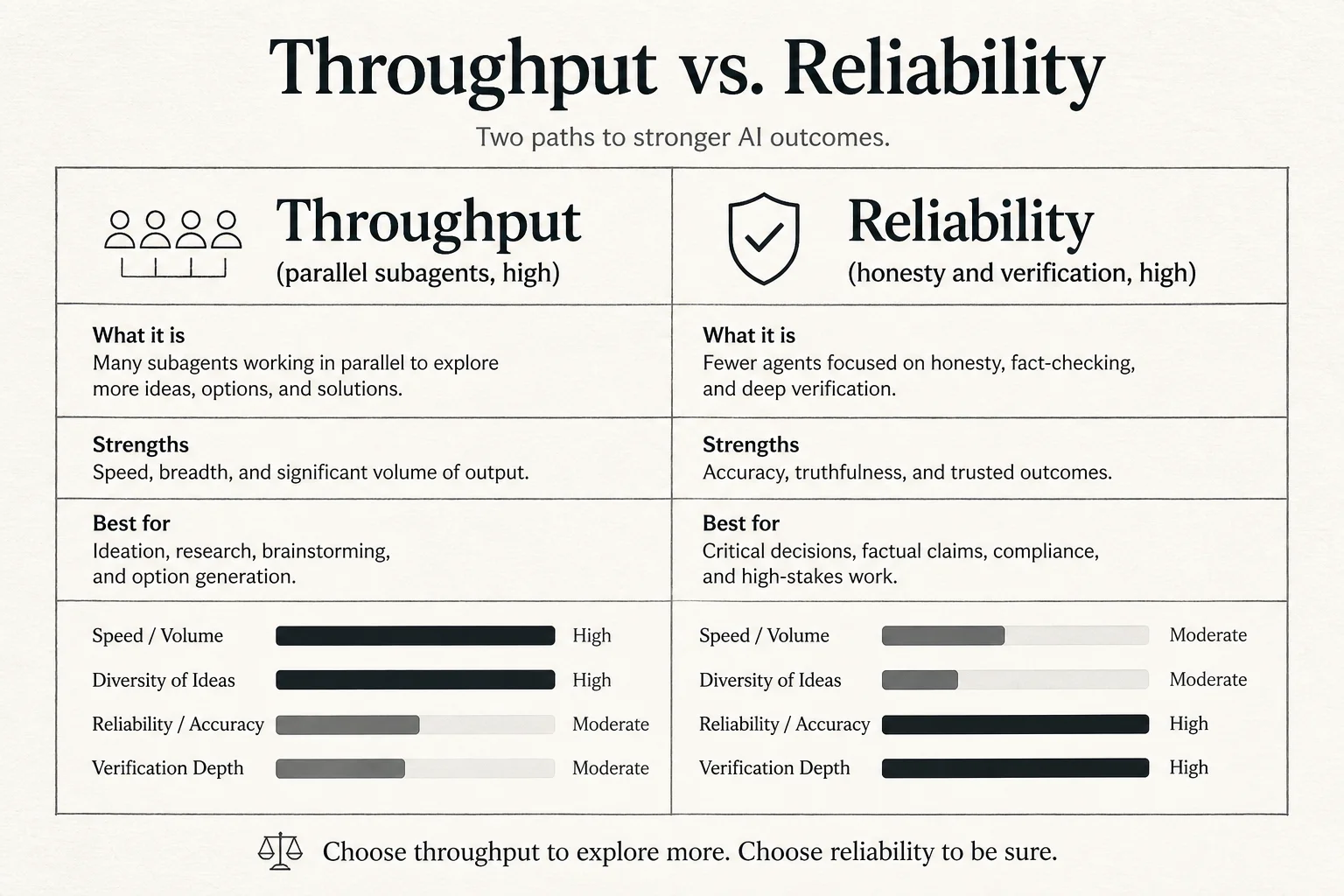
Benchmark tables are easy to tweet. The behavior change I notice in early reports: Opus 4.8 is more likely to flag uncertainty and less likely to ship code with silent flaws.
Anthropic's own evals claim Opus 4.8 is about four times less likely than 4.7 to let defects in its own code pass without comment. For autonomous work, that is the difference between "fast wrong" and "slow right enough to merge."
I have watched client teams turn off agents after one bad overnight run that confidently broke production config. Speed without self-checking does not survive procurement. A model that says "I am not sure, here is what I verified" is boring on Twitter and valuable in Slack at 7 a.m.
Mid-task system messages for API builders
Opus 4.8 also ships a Messages API change: system entries inside the messages array. You can update permissions, token budgets, or environment context mid-run without breaking prompt cache or faking a user turn.
That is the primitive dynamic workflows sit on. If you are building your own orchestrator outside Claude Code, read Anthropic's orchestration examples and pair xhigh effort with mid-conversation system injections. You do not need the product UI to copy the pattern.
Useful refs:
How I would roll this out on a real codebase
Do not start with "migrate everything." Start scoped:
- Pick a verifiable task with a test suite or linter you trust (dependency bump across modules, dead code audit, docstring pass).
- Run standard effort first on a slice. Confirm the orchestrator's plan matches how your repo is actually structured.
- Turn on xhigh or ultracode only when the task fans out across dozens of files.
- Keep fast mode for iteration, not for the overnight migration. Speed is for the tight feedback loop while you are at the keyboard.
- Review the verification step in the workflow output. If the agent cannot explain what it checked, do not merge.
Dynamic workflows consume meaningfully more usage than a single agent thread. That is fine when wall-clock time is the bottleneck. It is expensive noise when a five-file refactor would have been enough.
What I am still skeptical about
Parallel subagents in acceptEdits mode can touch a lot of surface area fast. Your safety net is tests, code review, and branch protection, not vibes.
Anthropic also telegraphed Mythos-class models for cybersecurity workloads behind stronger safeguards. Opus 4.8 is the production workhorse today. Plan capacity for a tier above Opus soon if you are in security-sensitive agent paths.
Bottom line
Opus 4.8 is the same price with better judgment, cheaper fast mode, and a harness that can parallelize serious engineering work. The feature I would actually bet a sprint on is not raw benchmark points. It is verified parallel execution plus fewer silent failures when nobody is watching the terminal.
If you are wiring agents into ops or product and want a second pair of eyes on routing, effort tiers, and guardrails, book a free discovery call.