
Anthropic's June 2026 economic research report is the clearest dataset I have seen on who actually wins with agentic coding tools.
Agentic coding and persistent returns to expertise is built on a privacy-preserving sample of ~400,000 Claude Code sessions from ~235,000 people between October 2025 and April 2026. The headline is uncomfortable for pure "learn to code" narratives: the skill that amplifies Claude Code is understanding the problem, not writing syntax from scratch.
If you run agent fleets for clients, this report is a hiring and training signal, not just a vendor press release.
What Anthropic measured
The study focuses on interactive sessions through the CLI, Claude.ai, or the Claude Code desktop app. Headless claude -p, SDK, and third-party IDE usage are excluded, so treat this as a large but incomplete slice of real agent work.
Anthropic's framework tracks three layers:
| Layer | Question |
|---|---|
| Work mode | What is the session trying to accomplish? |
| Collaboration | Who decides what versus how? |
| Outcome | Did the session succeed with verifiable evidence? |
Success means the user accomplished what they set out to do, with evidence like passing tests or committed work, not just a polite model reply.
The division of labor is stable
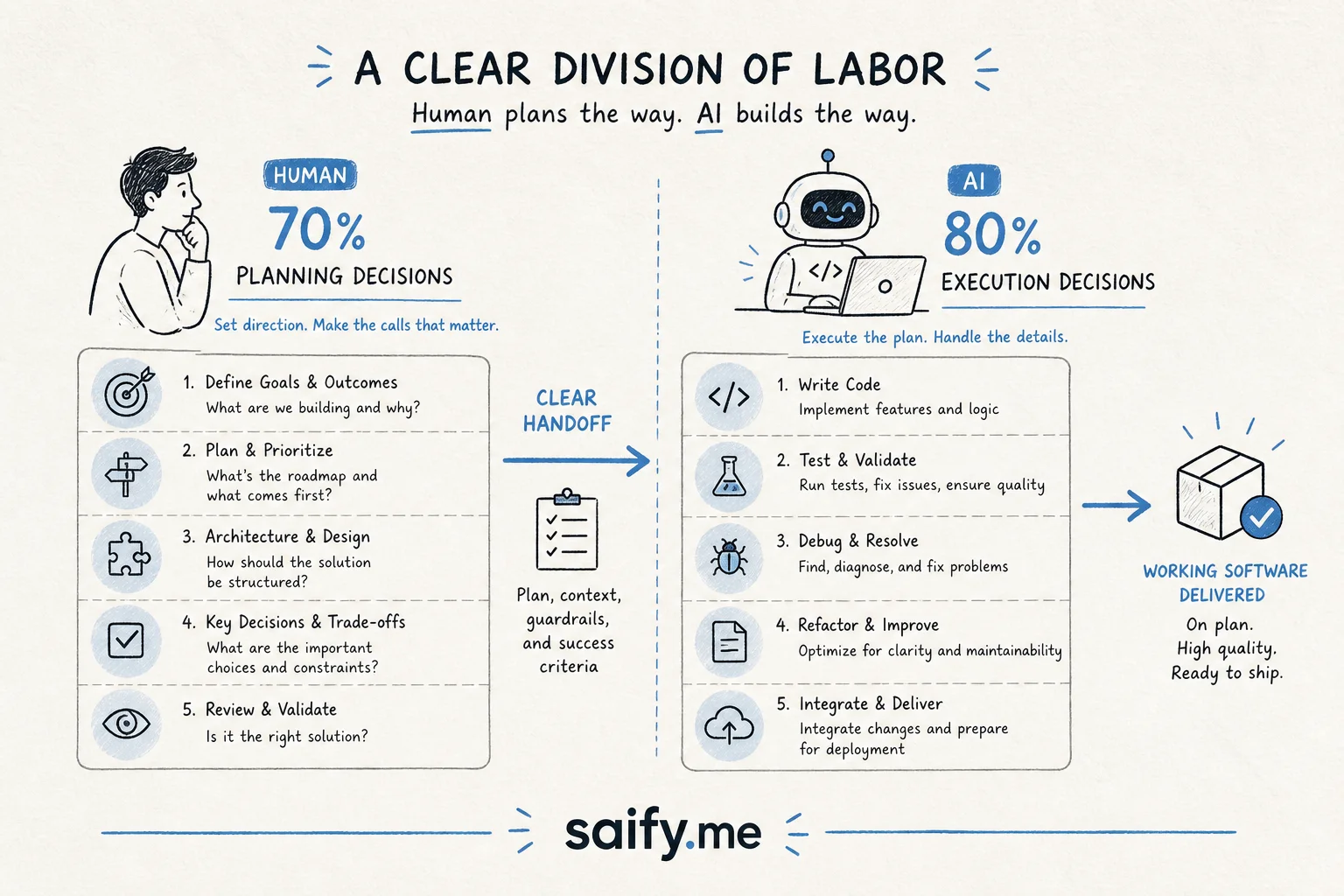
In a typical session, people make about 70% of planning decisions (what to do, which approach, what counts as done). Claude makes about 80% of execution decisions (which files to edit, which commands to run, which language to use).
Each user prompt sets off a chain of roughly 10 Claude actions on average, sometimes over 100. Claude reads files, edits code, runs commands, and writes about 2,400 words of output per turn.
That is not "autocomplete." It is delegated implementation with human steering at the goal layer.
Domain expertise, not coding pedigree
Anthropic's expertise classifier rates task-specific skill from novice to expert based on how precisely users frame directions, what they ask Claude to verify, and who corrects whom when things go wrong.
A senior engineer asking their first Rust question is a Rust novice. An accountant who specifies reconciliation rules and catches a month-end edge case is an expert for that task.
The numbers:
| User level | Verified success (approx.) | Actions per prompt | Output words per prompt |
|---|---|---|---|
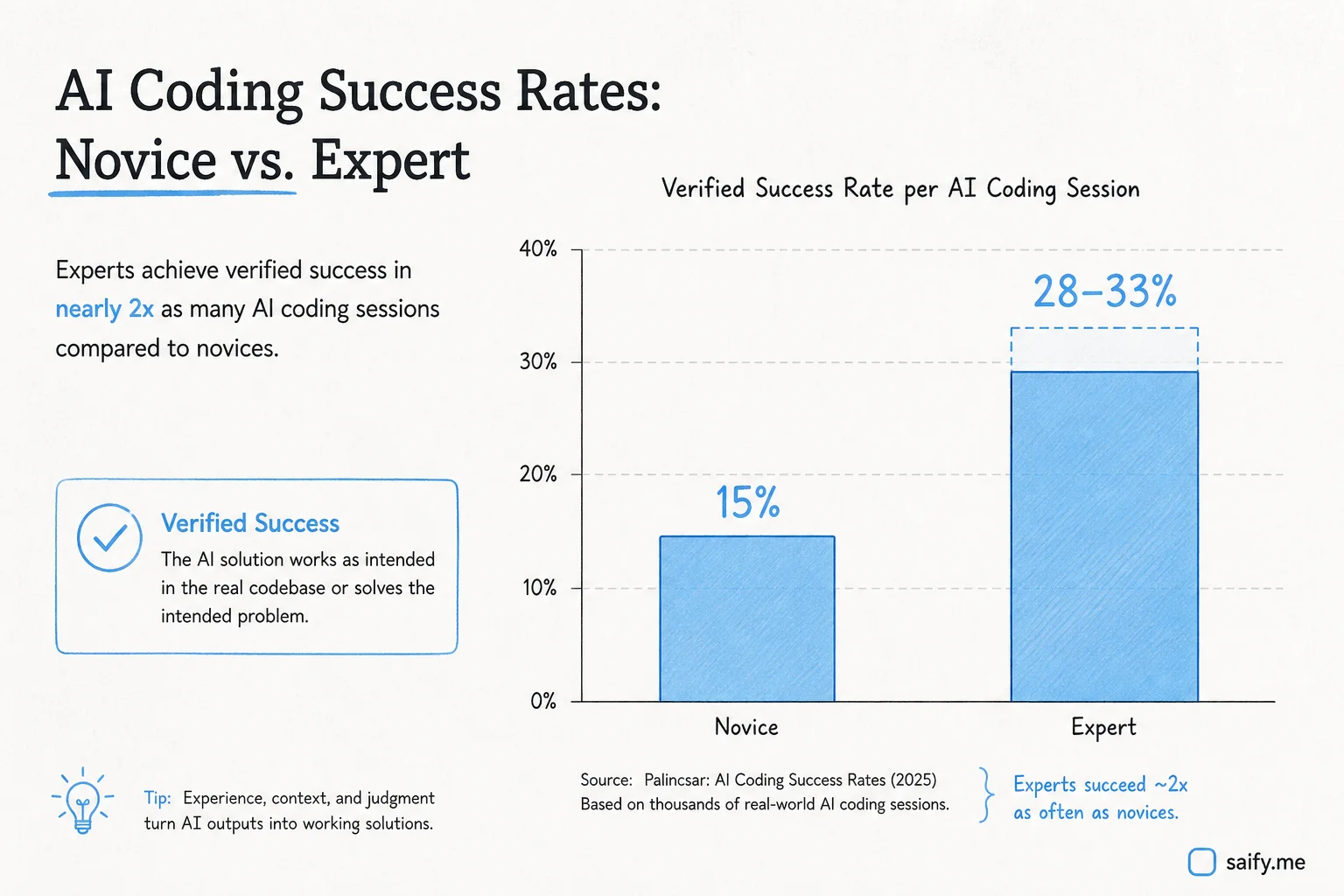
| Novice | ~15% | ~5 | ~600 |
| Intermediate / expert | 28% to 33% | ~12 | ~3,200 |
The gap between intermediate and expert is modest. A working grasp of the domain captures most of the benefit. Mastery adds polish, not a step change.
On coding-producing sessions, every major occupation group lands within about seven percentage points of software engineers on average. Lawyers, finance professionals, managers, and designers are not decorative outliers in the chart. They are peers at the success metric Anthropic chose.
Work is shifting up the stack
Between October and April, the session mix changed:
| Work mode | October share | April share | Direction |
|---|---|---|---|
| Fixing broken code | ~33% | ~19% | Down sharply |
| Operating software (deploy, configure, monitor) | ~14% | ~21% | Up |
| Data analysis and prose documents | ~10% | ~20% | Roughly doubled |
Debugging is still common, but agents are absorbing more end-to-end work: ship, operate, analyze, document.
Anthropic also estimates economic value by comparing session work to freelance marketplace postings. Average task value rose about 27% (report text also cites ~25% in the key findings block). Building, operating, and fixing tasks all grew roughly a third or more in estimated value. Treat dollar figures as ordinal signals, not invoices.
What I take from this as a builder
1. Spec quality is the product. If your team cannot describe success, verification, and edge cases, more model capability mostly burns tokens.
2. Hire and train for judgment. The scarce input is someone who knows when the agent is wrong. Coding skill helps, but occupational expertise is the variable that moves success rates in this dataset.
3. Instrument verification, not vibes. Anthropic's success definition depends on tests, commits, and artifacts. Your internal agent workflows should too.
4. Read the caveats. First-party telemetry, classifier-labeled outcomes, interactive-only coverage. Howardism's write-up calls this empirical with honest limits: Returns to expertise in agentic coding.
Practical checklist for teams rolling out Claude Code
- Pair domain owners with agents, not only staff engineers babysitting prompts.
- Write acceptance checks before the first agent turn (tests, SQL sanity queries, diff review rules).
- Track recovery rate when agents stall, not just green builds on happy paths.
- Budget for operate and analyze workflows, not only feature branches.
If you want help designing agent workflows where lawyers, ops leads, or clinicians can steer safely, book a free discovery call.