
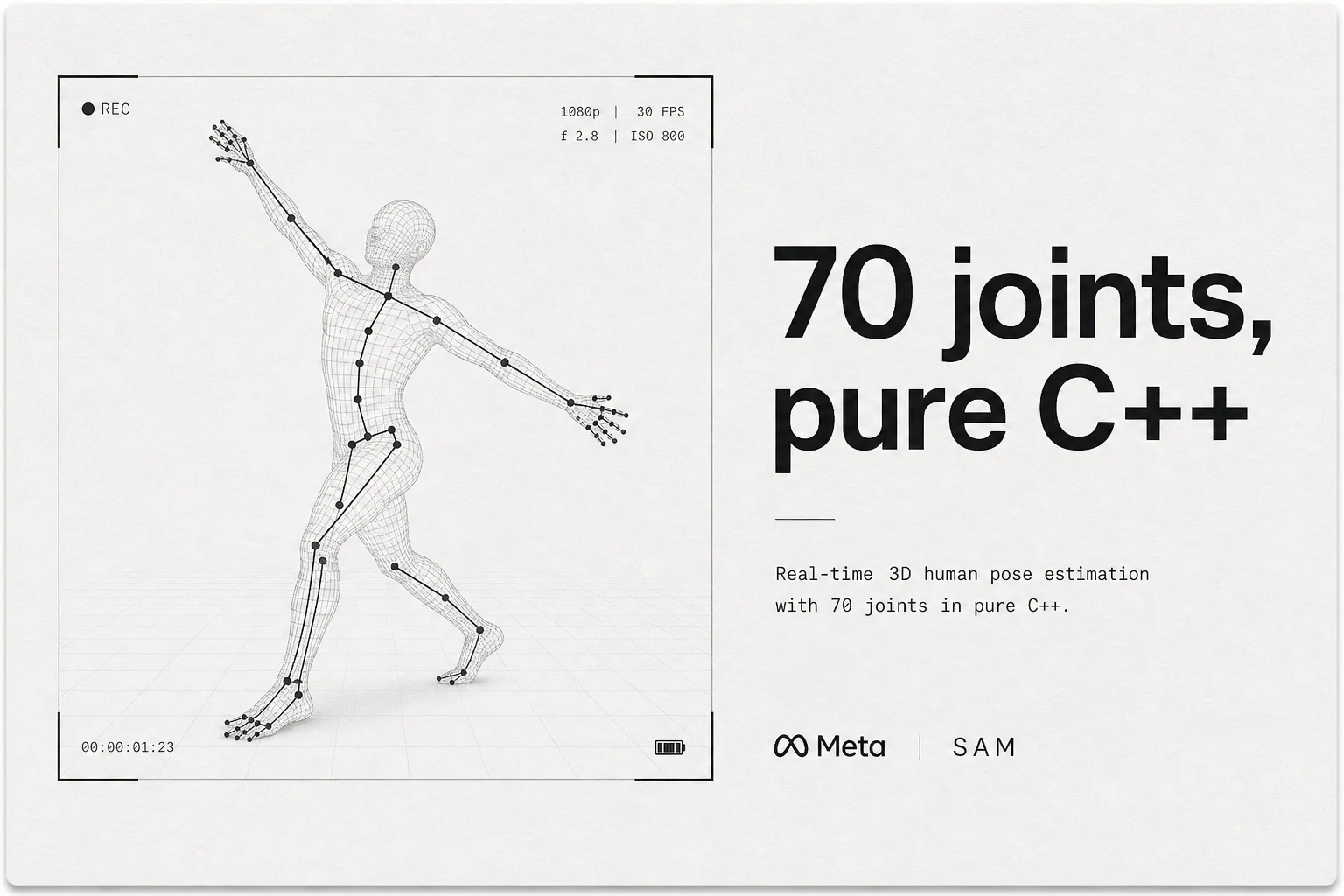
If you have ever tried to ship human pose estimation inside a game, robot stack, or AR app, you know the usual pain: Python inference servers, GPU drivers on edge devices, and latency that kills the product feel.
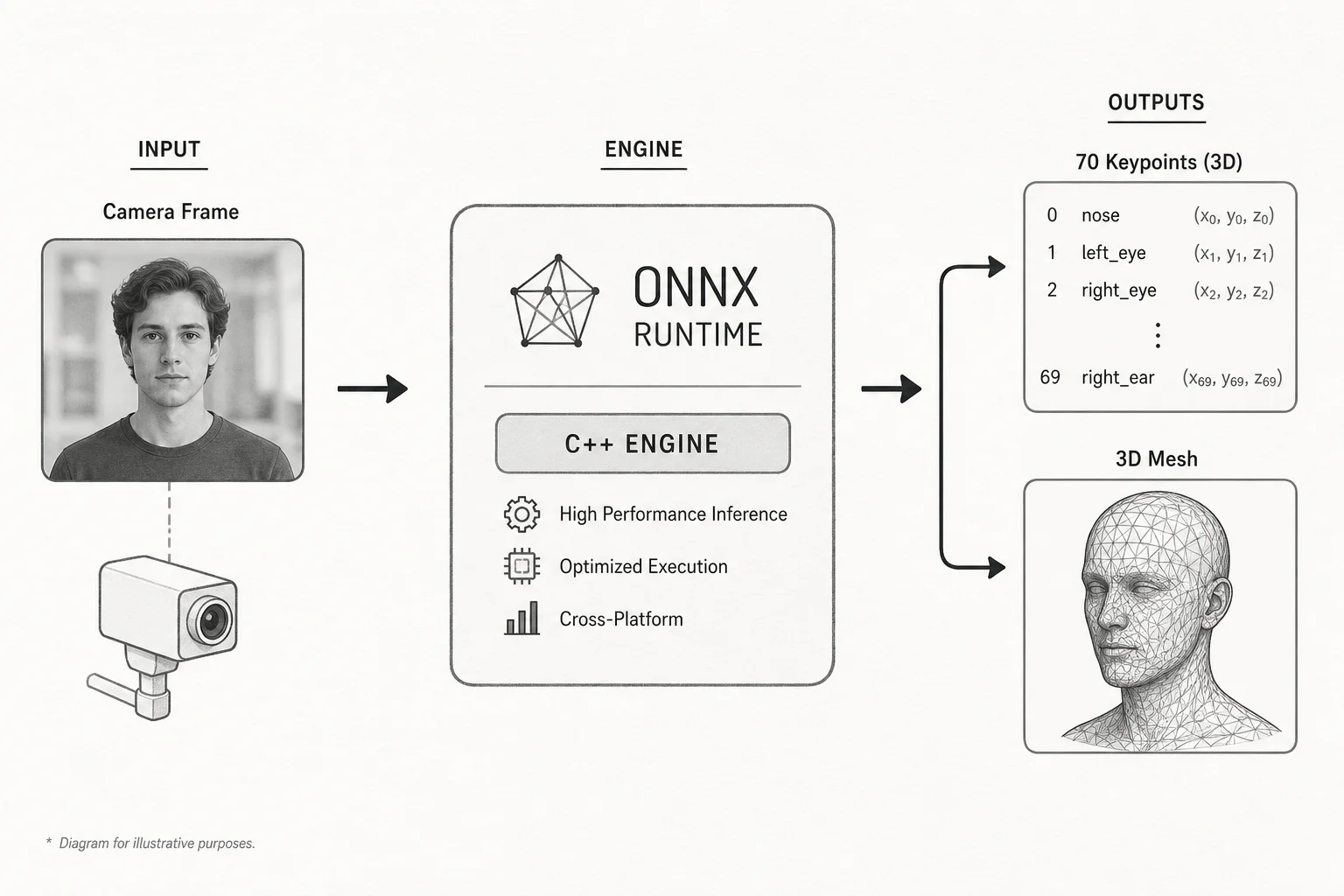
SAM3DBody-cpp is a community port that wraps Meta's SAM 3D Body model in a standalone C++ runtime. No Python dependency at inference time. Feed a BGR camera frame, get per-person 3D pose, optional mesh vertices, and 70 body + hand keypoints via ONNX Runtime and ggml.
Why Meta's model matters
SAM 3D Body (3DB) recovers a full-body human mesh from a single image. It estimates body, feet, and hands using the Momentum Human Rig (MHR), a parametric representation that separates skeletal structure from surface shape.
That decoupling helps with hard poses and unusual body shapes compared with older SMPL-only pipelines. The model also supports prompt-style inputs (2D keypoints, masks) similar to the SAM family, which is useful when you need to nudge tracking in cluttered scenes.
The official research repo targets PyTorch and Hugging Face checkpoints. SAM3DBody-cpp is for teams that need native deployment.
What the C++ engine ships
Prebuilt ONNX and supporting files live on Hugging Face. The stack includes:
| Component | Role |
|---|---|
| DINOv3-ViT-H/14+ encoder (~4.8 GB) | Image features (CUDA EP) |
| PromptableDecoder (~93 MB) | 6-layer pose decoder |
| YOLO11m-pose (~81 MB) | Person detection |
| pipeline.gguf + body_model.lbs | MHR heads and native linear blend skinning |
Outputs include global rotation, body pose (133 params), hand pose (108 params), shape betas, optional 18,439-vertex mesh, and 70 3D keypoints covering body, hands, and extra landmarks (olecranon, acromion, neck, etc.).
The project exposes a lightweight C API, so you can bind from Rust, Swift, C#, or Unreal without dragging in a Python interpreter.
Where I would use this
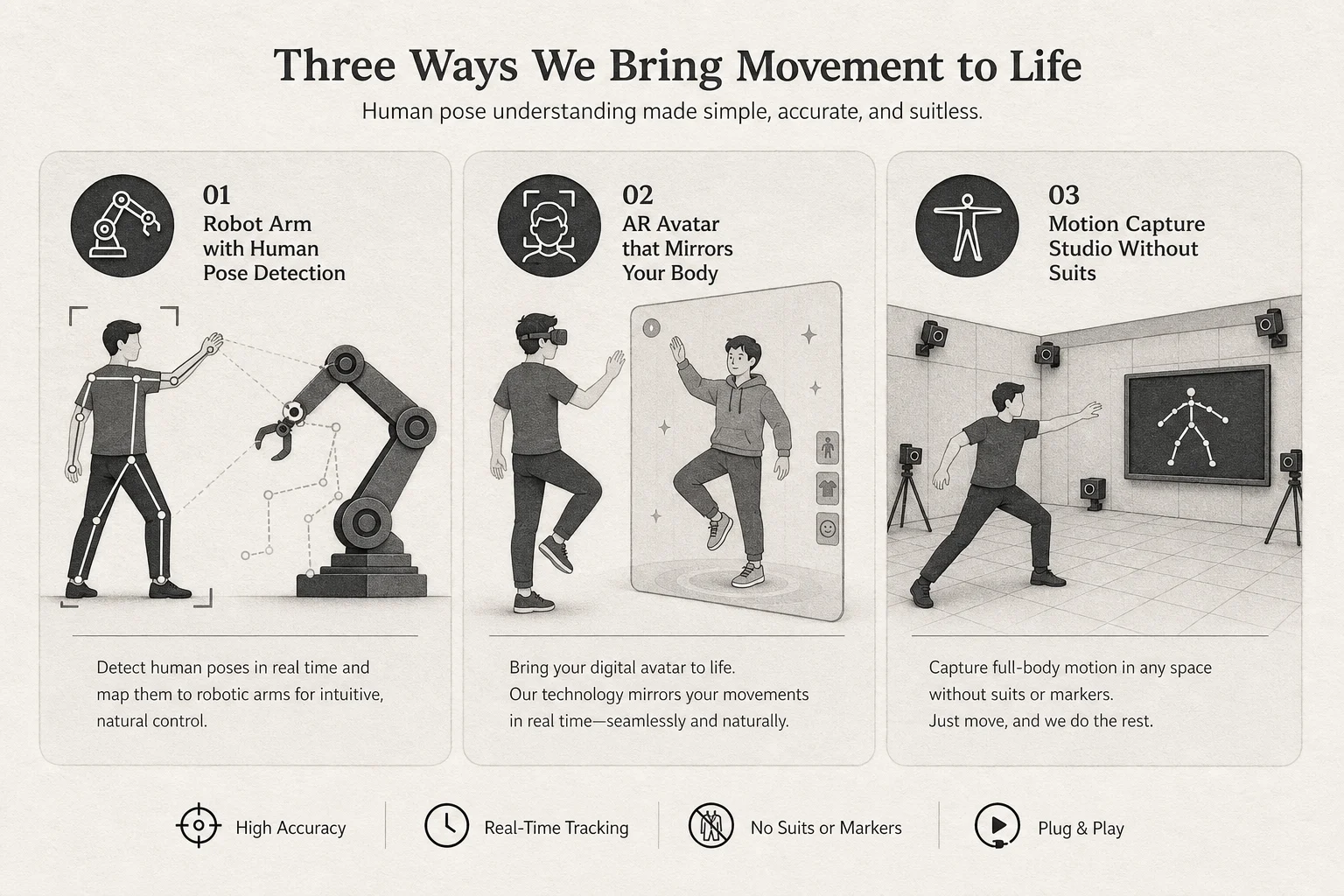
Robot perception: human-aware navigation and collaborative workcells need low-latency pose, not a Jupyter notebook on the factory floor.
Motion capture on a budget: indie studios and fitness apps can skip dedicated mocap hardware when single-camera mesh quality is good enough for their use case.
AR / games: full-body + hand tracking for avatars, gesture UI, or sports coaching overlays.
CSV / BVH pipelines: the repo includes utilities to dump per-frame joint CSV compatible with other mocap tooling, which helps if your animation team lives in Blender or MotionBuilder.
Trade-offs to plan for
Be honest about constraints before you commit:
| Factor | Reality check |
|---|---|
| Model size | ~5 GB encoder plus supporting files; not phone-trivial |
| GPU | CUDA execution provider expected for the heavy backbone |
| Accuracy vs multi-view | Single-camera HMR inherits occlusion errors |
| Maintenance | Community wrapper; verify against Meta releases |
If you only need 2D COCO keypoints, a smaller pose model may be cheaper. If you need 3D mesh + hands in native C++, this is one of the few open paths that skips Python at runtime.
How it compares to the Python path
| Official PyTorch repo | SAM3DBody-cpp | |
|---|---|---|
| Runtime | Python + PyTorch | C++ + ONNX Runtime |
| Integration | Research notebooks, HF demos | Games, robots, embedded vision |
| Model source | facebook/sam-3d-body-dinov3 | Converted ONNX bundle on HF |
| Hands + feet | Yes (MHR) | Yes (70 keypoints) |
Links worth bookmarking:
Takeaway
The interesting trend in vision tooling is not just better models. It is better deployment shapes: C++ inference, ONNX bundles, and APIs that product teams can actually ship.
SAM3DBody-cpp turns a strong research model into something you can call from a real-time loop. If you are building custom vision for ops, robotics, or immersive apps and need help choosing between edge ONNX, cloud APIs, and hybrid pipelines, book a free discovery call.