
A 3B parameter model should not beat a 17B stack on image quality benchmarks. Princeton's i1 does, and they shipped everything needed to reproduce it.
Released in June 2026, i1-3B is a text-to-image diffusion model that hits competitive scores at 1024 resolution across GenEval, DPG-Bench, PRISM, CVTG-2K, and LongText-Bench. The training data is public. The code is public. The checkpoints are public.
For teams tired of "open weights, closed recipe" releases, this is the real deal.
What makes i1 different from the open-weight crowd
Most "open" image models give you weights and a inference script. Princeton gave you the full stack:
| Released asset | Location |
|---|---|
| 3B checkpoint (1024px) | Hugging Face |
| 1B checkpoint | Hugging Face |
| Training captions dataset | i1-captions |
| JAX + PyTorch training code | GitHub |
| Benchmark eval pipeline | In repo |
| Intermediate 256/512 checkpoints | Hugging Face |
The paper investigates the design space of T2I models: how modeling and data choices affect capabilities. i1-3B is the culmination, not a one-off checkpoint drop.
Public data only matters
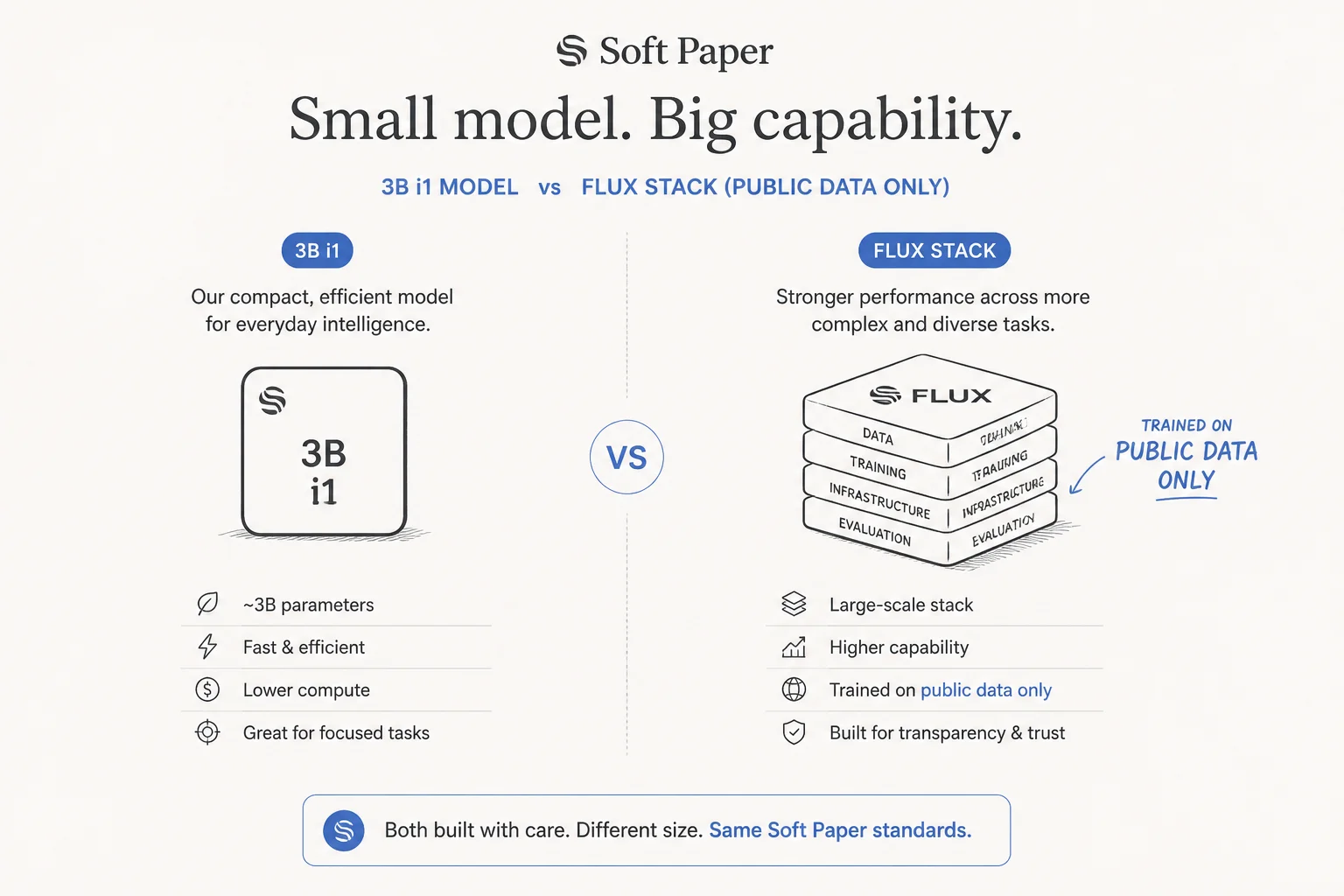
The AlphaSignal hook is "beats FLUX.1 Dev using only public data." That constraint matters for:
- Commercial products that cannot risk licensed training data contamination
- Research teams who need reproducible training runs
- Regulated industries (health, finance) auditing model provenance
- Fine-tuning from a known-clean base
FLUX.1 Dev remains a strong baseline (4.8B transformer + 12B text encoder) but ships under a non-commercial license. i1-3B gives you a smaller model with an open training recipe you can actually fork.
Benchmark context
Princeton reports competitive performance via average percentage score across five benchmarks. Exact head-to-head numbers vary by metric:
| Benchmark | What it measures |
|---|---|
| GenEval | Compositional accuracy (objects, count, color, position) |
| DPG-Bench | Dense prompt alignment |
| PRISM | Perceptual quality |
| CVTG-2K | Complex visual text rendering (2-5 regions) |
| LongText-Bench | Multilingual long-text in images |
FLUX.1 Dev scores 0.66 overall on GenEval in public tables. i1-3B's aggregate positions it in the same competitive band at a fraction of the parameter count.
For text-in-image specifically, long-text rendering has been a known weakness of latent-space diffusion models. Smaller pixel-native and efficient architectures (including HiDream-O1 at 8B) push further on that axis. i1-3B's value is reproducibility at 3B, not absolute SOTA on every metric.
Running i1 locally
Checkpoints ship in PyTorch and JAX formats. The repo includes:
jax/for TPU and GPU trainingtorch_train/andtorch_inference/for GPU workflowsdata_processing/for caption pipelinesbenchmark_eval/for reproducing paper numbers
Hardware expectations for 1024px inference: a single modern GPU with 16GB+ VRAM for the 3B model. The 1B variant is lighter for experimentation.
git clone https://github.com/zlab-princeton/i1.git
cd i1
# See torch_inference/ for GPU inference scripts
# Weights: huggingface.co/zlab-princeton/i1-3B
Multi-aspect-ratio training code was listed as pending at launch. Check the repo for updates if your use case needs non-square outputs.
When I would pick i1 over alternatives
Choose i1-3B when:
- You need full training reproducibility (public data + open code)
- 1024px is enough for your product (thumbnails, social, UI assets)
- You want to fine-tune on proprietary data from a clean base
- Parameter budget matters (edge deployment, batch cost)
Choose FLUX.1 Dev / Schnell when:
- You need the BFL ecosystem and tooling maturity
- Non-commercial research license is acceptable
- You want maximum photorealism without training your own
Choose HiDream-O1 (8B) when:
- Long-text rendering and 2048px native resolution are requirements
- MIT license and pixel-native architecture matter more than 3B size
For lead-gen sites and marketing assets I build for clients, i1-3B is interesting as a self-hostable, auditable option. See my local image generation post for the broader pattern of moving gen-AI off per-image API bills.
The bigger pattern
June 2026 keeps delivering the same lesson: architecture and data beat brute-force parameters.
- 3B i1 on public data vs 17B FLUX stacks
- 3B Unlimited-OCR vs page-by-page pipelines
- 8B HiDream-O1 vs 56B FLUX.2 Dev
- Learned orchestrators (Fugu) vs bigger single models
If your image pipeline still assumes "only frontier APIs can do quality," the open-source floor moved again.
Evaluating local image generation for a product or marketing stack? Book a free call and we can test whether a 3B self-hosted model covers your quality bar.