
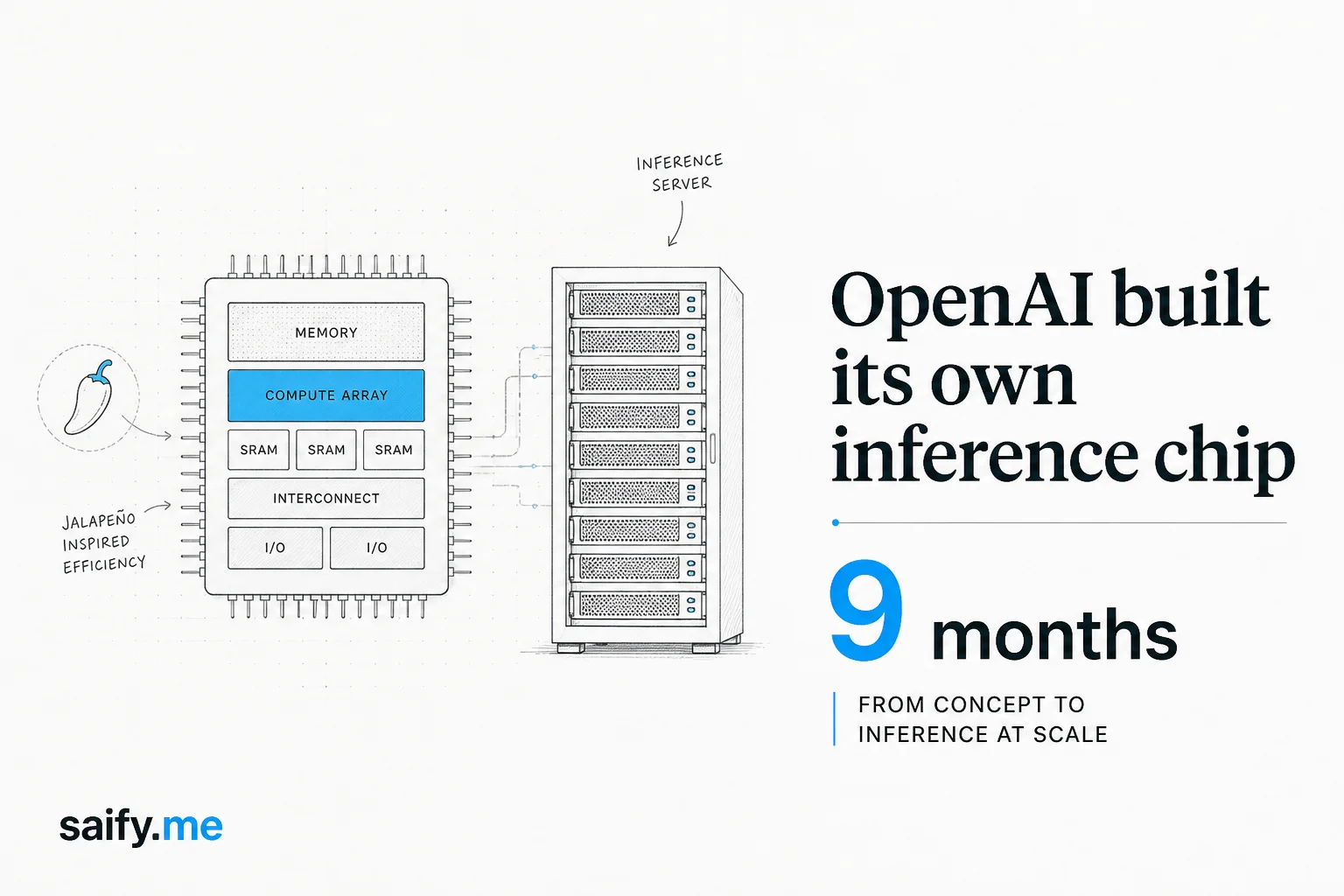
OpenAI shipped a custom chip and a model tune-up on the same day in June 2026. That pairing is the real story.
Jalapeño is OpenAI's first Intelligence Processor: an accelerator built from scratch for inference, the phase where a model reads your prompt and writes tokens back. Not training. Not benchmark screenshots. Serving ChatGPT, Codex, and API traffic at scale.
With a reported $20.9B operating loss hanging over the business, inference economics are not a side quest. They are the moat.
Inference is where the money burns
Training frontier models is a capital event. Inference is a daily meter.
Every ChatGPT reply, every Codex file edit, every API call runs inference on hardware that was mostly Nvidia GPUs until now. GPUs are flexible. They are also expensive, power-hungry, and oversubscribed when demand spikes.
Jalapeño is OpenAI's bet that purpose-built inference silicon beats general-purpose GPUs on the workloads they actually ship:
- Prefill (reading and encoding your prompt)
- Decode (generating each token)
- KV cache placement (keeping conversation state local instead of shuffling memory across a rack)
OpenAI says the architecture minimizes data movement and balances compute, memory, and networking so realized utilization sits closer to theoretical peak. That is the kind of sentence hardware teams write when they are tired of GPUs idling while waiting on memory buses.
Nine months from design to tape-out
The development timeline is the other headline. OpenAI and Broadcom claim Jalapeño moved from initial design to manufacturing tape-out in nine months, reportedly the fastest ASIC cycle anyone has published for a chip this complex.
Speed came from co-development:
- OpenAI brought model roadmaps, kernel knowledge, and serving stack requirements
- Broadcom handled silicon implementation and Tomahawk networking
- Celestica contributed board and rack integration
- OpenAI's own models reportedly helped accelerate parts of the design loop
Engineering samples are already running ML workloads at production target frequency and power, including GPT-5.3-Codex-Spark in the lab.
That is not a PowerPoint chip. It is silicon on a bench proving it can hold a real model.
What the early benchmarks claim
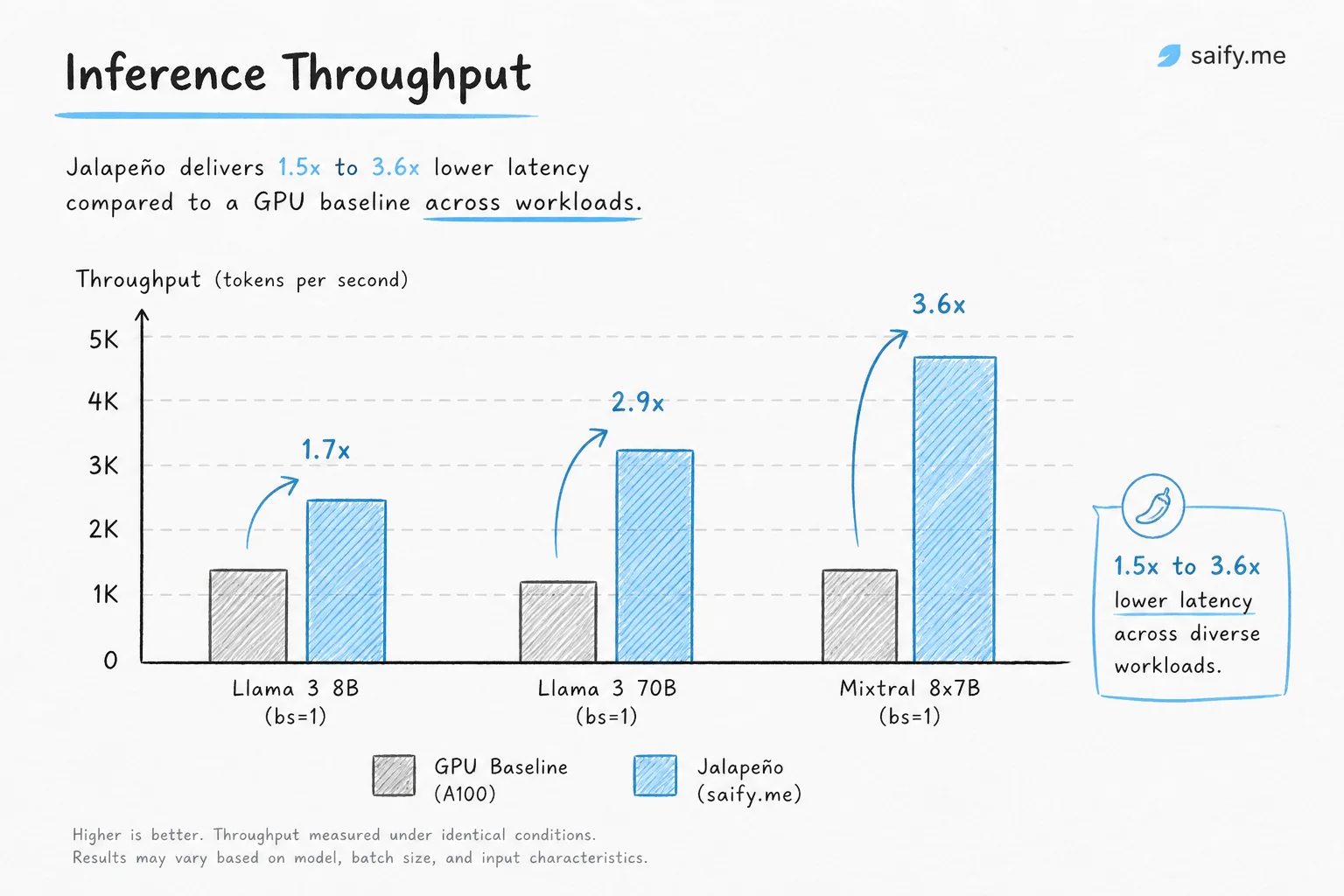
At Hot Chips in August 2026, OpenAI shared more detail on SemiAnalysis's InferenceX suite. Directional numbers from press briefings and third-party coverage:
| Workload | Throughput vs SOTA | Latency vs SOTA |
|---|---|---|
| GPT-OSS-120B | ~1.5x to 1.9x more AI work at peak | ~1.7x to 3.6x lower end-to-end |
| DeepSeek R1 | Similar band | Similar band |
| Kimi K2.5 | Similar band | Similar band |
System-level specs from the briefing deck are wild in a different way: 128 accelerators per rack, 1.7 exaFLOPS of 4-bit compute, 27.5 TB HBM4, and nearly 2 PB/s of memory bandwidth.
Each accelerator carries about 216 GB HBM4 and 13.4 petaFLOPS at MXFP4.
Treat vendor benchmarks as directional until independent labs rerun them on your harness. Still, the spread is the point. This is not "we matched Nvidia." It is "we think we beat the current inference stack on the workloads we care about."
What changes for API buyers and builders
Jalapeño does not land on your desk. It lands in OpenAI's datacenters. The downstream effects are still practical:
Cheaper inference per token. When serving cost drops, API list prices have room to fall, free tiers can widen, or quality can rise without margin pain. OpenAI has not tied a price cut to Jalapeño yet. The economics push in that direction.
Faster Codex under load. Coding agents are latency-sensitive. A chip tuned for decode and KV locality should show up as snappier tool loops when traffic spikes, not just higher throughput charts.
More reliable peak access. ChatGPT outages during demand surges are often capacity stories. Custom inference racks are capacity stories solved in silicon.
Full-stack integration. OpenAI is explicit that Jalapeño is the first step in a multi-generation platform where models, kernels, chips, and memory evolve together. That is the same vertical integration playbook Nvidia ran for a decade, now pointed at inference serving.
If you route production traffic through chat-latest or Codex today, you are already downstream of whatever inference fleet OpenAI runs. Jalapeño is about making that fleet cheaper and faster without you changing a line of code.
Deployment timeline (realistic expectations)
Broadcom CEO Hock Tan told CNBC to expect small prototype deployment in late 2026, ramp through 2027, and full tilt in the first half of 2028.
OpenAI's blog says initial deployment by end of 2026, expanding over the following years.
Translation for builders:
- Do not plan capacity around Jalapeño in Q3 2026
- Do expect competitive pressure on inference pricing through 2027 as custom silicon and Blackwell successors race each other
- Keep benchmarking cost per completed task, not list price per million tokens
How I read this as an applied engineer
I do not pick chips. I pick cost per merged PR and p95 latency on agent loops.
Jalapeño matters because the default stack for agentic coding (OpenAI API + Codex class models) is getting a hardware path that is not "buy more H100s and hope."
For client work, that means:
- Revisit OpenAI routing on high-volume automation once inference costs actually move
- Keep multi-provider fallbacks until deployment is real, not announced
- Watch SemiAnalysis and independent InferenceX reruns before rewriting architecture around OpenAI-only inference
The full-stack moat is no longer "we have the best model weights." It is "we own the path from silicon to your chat window."
If you are sizing inference budgets for agents, voice, or document pipelines and want a second opinion on provider mix, book a free discovery call.