
The debate about whether open models can compete with ChatGPT and Claude is over. The new question is who captures the money once the weights are good enough.
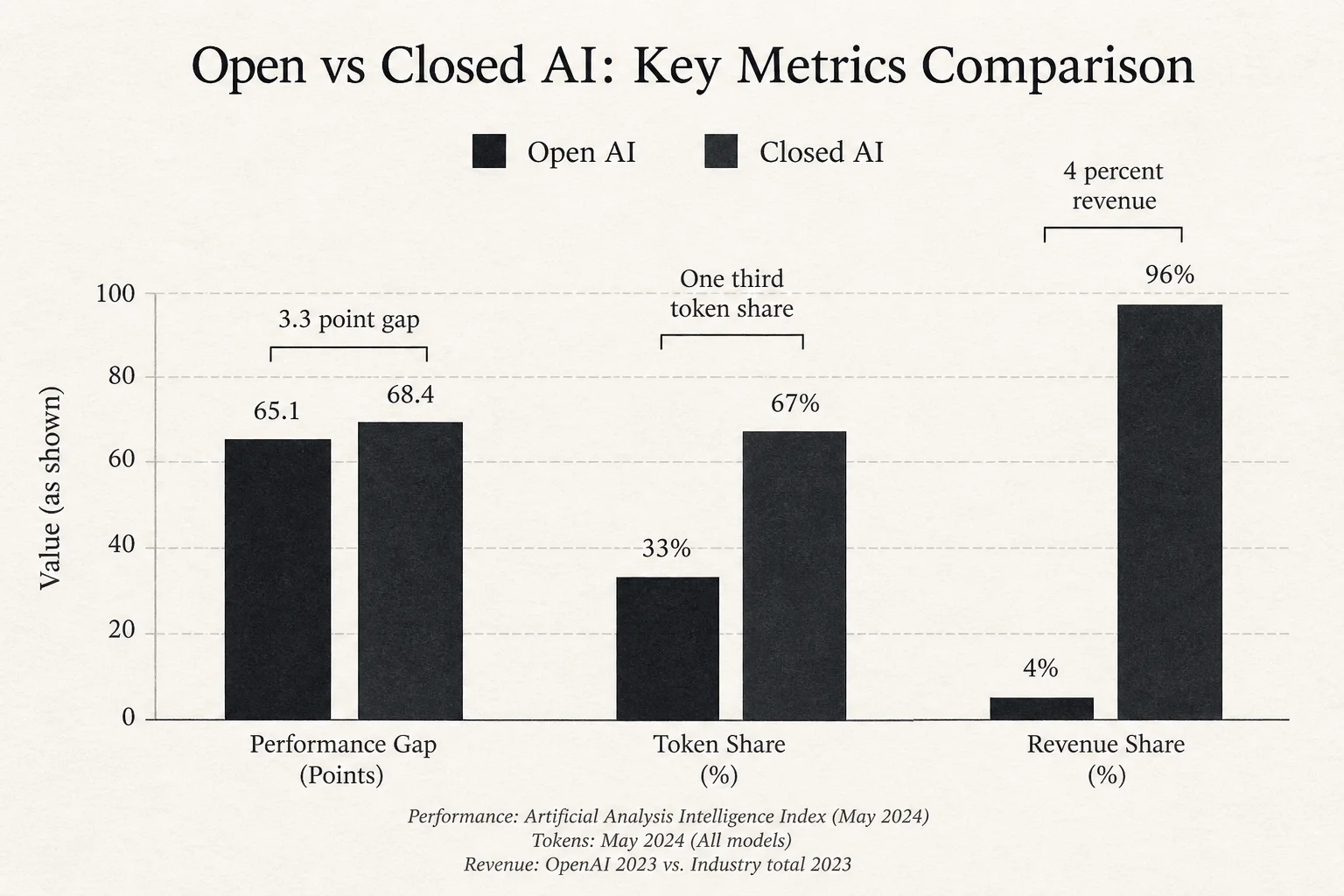
Mozilla's inaugural State of Open Source AI report, published in July 2026, argues open-weight AI crossed a threshold. Average capability trails the closed frontier by about 3.3 points. Inference costs fell from roughly $20 to $0.40 per million tokens in three years. Yet open models drive about one third of usage and only about 4% of revenue.
I route models for client builds every week. This report matches what I see in production: the model pick matters less than the harness, the eval loop, and who owns the compliance story.
The headline numbers (and what they hide)
Mozilla built the report on its own analysis plus a SlashData developer survey of more than 950 builders. Three stats anchor the narrative:
| Metric | Open-weight AI | Closed frontier |
|---|---|---|
| Avg. capability gap (composite) | ~3.3 pts behind | Reference tier |
| Share of production tokens (OpenRouter trend) | Majority by mid-2026 | Still leads on request count in some panels |
| Production deployment rate (survey) | ~51–53% reach prod | ~63% reach prod |
| Share of AI revenue | ~4% | ~96% |
Mozilla is careful to call the frontier jagged. Open models sit at or near parity on coding, instruction following, and general knowledge. Closed systems still lead on deep reasoning, 1M-token needle retrieval, and turnkey compliance (SOC 2, HIPAA, zero data retention by default).
On long-context fidelity, Mozilla cites multi-needle scores at 1M tokens: Gemini 3 at 89%, DeepSeek V4 Pro at 41%. That is not a rounding error. It is a workload-specific reason to pay for closed.
Kimi K3 and the fourth-place open model
The digest paired this report with Moonshot's Kimi K3 launch. Mozilla's benchmark slice puts Kimi K3 fourth overall on Artificial Analysis's Intelligence Index v4.1, about four points behind Claude Opus 5 at the top. On Terminal-Bench 2.1 inside Moonshot's harness, K3 scores 88.3 versus 88.8 for GPT-5.6 Sol.
That is the open-source story in one line: frontier-ish weights, uneven harness parity.
Closed labs pulled agent scaffolds in-house. Mozilla cites a 21.8-point harness advantage on Terminal-Bench that compressed to roughly 3 points in eight weeks once vendors shipped integrated CLI harnesses. The model is eating up the stack. Weights and scaffold ship as one product.
For applied AI engineers, the actionable read is not "download K3 and win." It is match model tier to job, then invest in the layer that actually executes tools.
Open ships easy. Open deploys hard.
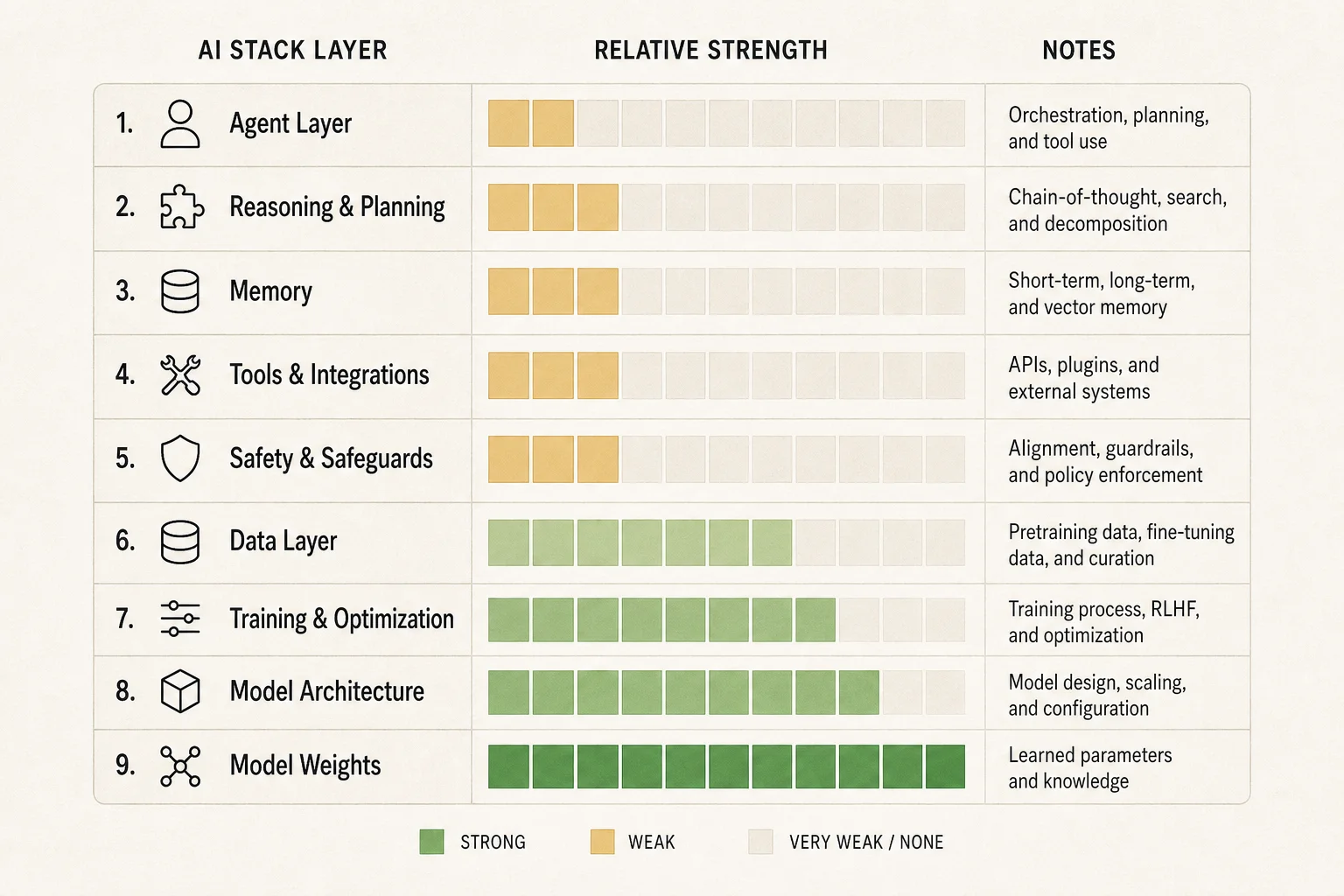
Mozilla's nine-layer stack map scores open components high on model code and weights, low on safeguards, agent layer, and documentation. Developers report open models across 5.1 use cases on average versus 4.6 for closed, but churned teams cite:
- Infrastructure and compute cost (27%)
- Security, privacy, compliance (26%)
- Integration complexity (+11 pp vs current open users)
- Insufficient documentation (+9 pp)
Closed deployment is often a problem money solves: buy vendor support, managed hosting, and implementation services. Open deployment is a problem the ecosystem still has to finish, regardless of budget.
Survey punchline: 79% of developers use open models. Only about half deploy them to production. The gap is operational, not IQ.
That matches my client work. Teams love open weights for cost and data control. They stall on observability, permissioning, upgrade paths, and who signs the compliance attestation.
Where value is moving: the agentic harness
Mozilla's CTO Raffi Krikorian frames the next battle as the harness: memory, permissions, pricing, and the runtime that turns weights into reliable agents. OpenRouter data shows token-heavy agentic workloads routing to open models first. Revenue still accrues to closed platforms that own the scaffold and the liability chain.
Mozilla calls for a "Rebel Alliance" of open infrastructure. Cute branding aside, the economic point is sharp: if harnesses stay proprietary, open weights become a commodity input while margin stacks upstream.
For founders building on open models, that implies:
- Budget for harness engineering, not just GPU bills.
- Treat benchmarks as harness-dependent. Terminal-Bench scores with Codex CLI do not transfer to your n8n webhook bot without re-measurement.
- Price on outcomes, not tokens. When inference is $0.40/M, your margin is workflow reliability and compliance, not markup on GPT-4 list prices from 2024.
Risks the report underplays (and why you should still care)
Critics note Mozilla's 3.3% average smooths a frontier where closed models still dominate reasoning and agentic depth. TIME's coverage also flagged that open weights are hard to un-publish if dangerous capabilities emerge, a live topic alongside OpenAI's Astra Critical rating the same week.
Mozilla's response is societal controls, not model containment alone. Whether you agree or not, open weights plus agent tools change your threat model. Security reviews should ask what happens when a downloaded checkpoint runs outside your vendor's sandbox.
What I would do this quarter
If you are picking a stack for a new agent product:
| Workload | Starting point |
|---|---|
| High-volume coding or ops automation with tight budget | Open-weight workhorse + your harness + eval suite |
| Long-context doc review, regulated data, strict liability | Closed frontier with vendor compliance package |
| Hybrid | Route 80% to open, escalate 20% to closed on failure or policy triggers |
Read the full report at stateofopensource.ai (PDF v1.0.1). Then audit your own deployment gap with Mozilla's stack layers, not another leaderboard screenshot.
Building agents on open or closed stacks and want help on routing, harness design, and production readiness? Book a free discovery call.