
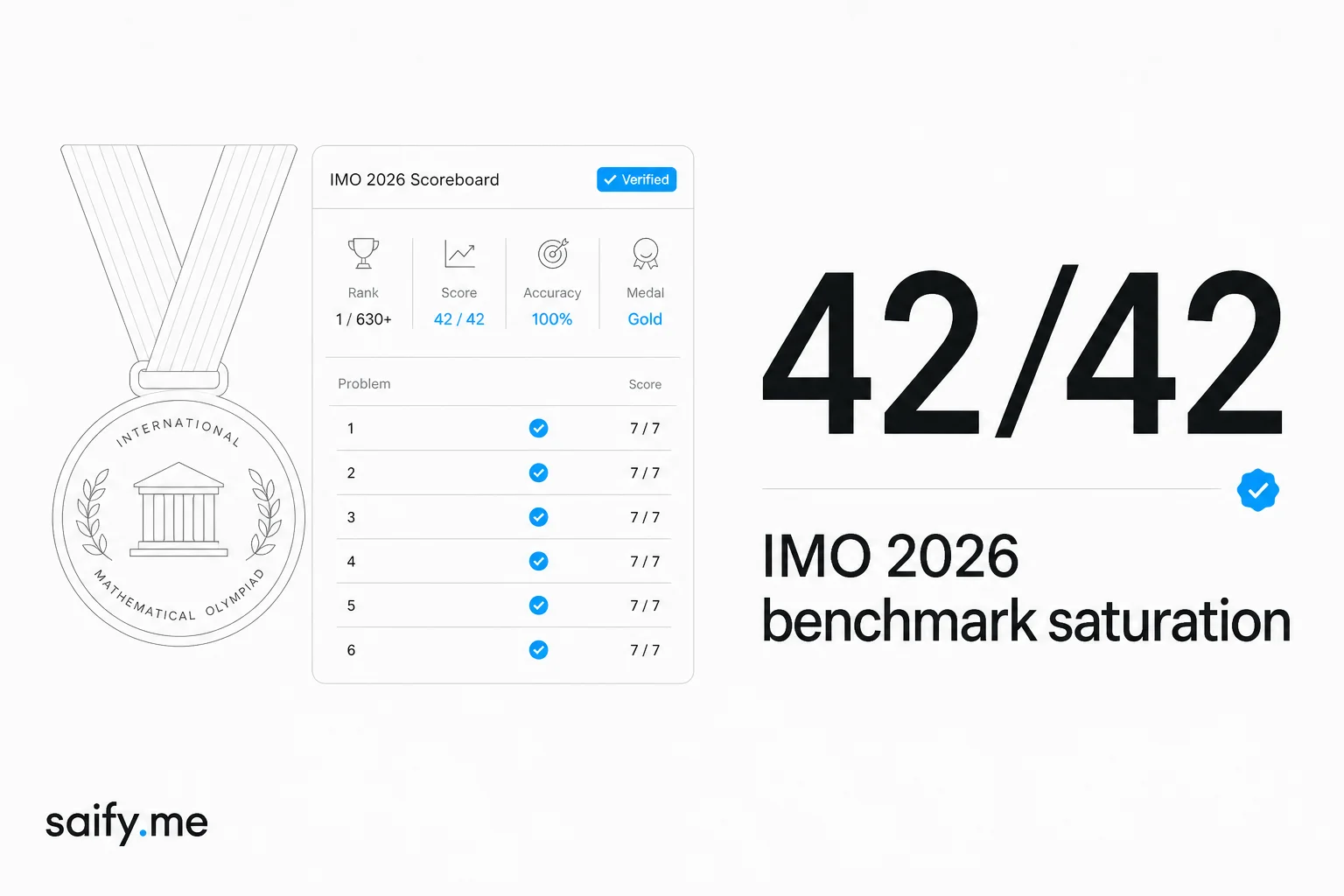
The 2026 International Mathematical Olympiad ended in Shanghai with seven human contestants at a perfect 42/42 out of 666 students. That is still rare.
Then four frontier models reported the same ceiling in independent test runs: Claude Fable 5, GPT-5.6 Sol, Kimi K3, and AxiomProver. Last year's best models topped out around 35/42. This year, three public frontier models hit the max for between $10 and $50 per run.
I care about this as an applied AI engineer because clients still ask "which model is smartest?" IMO headlines make that sound like a settled ranking. The July 2026 data says something different: accuracy is saturating; cost, latency, and proof rigor are the new separators.
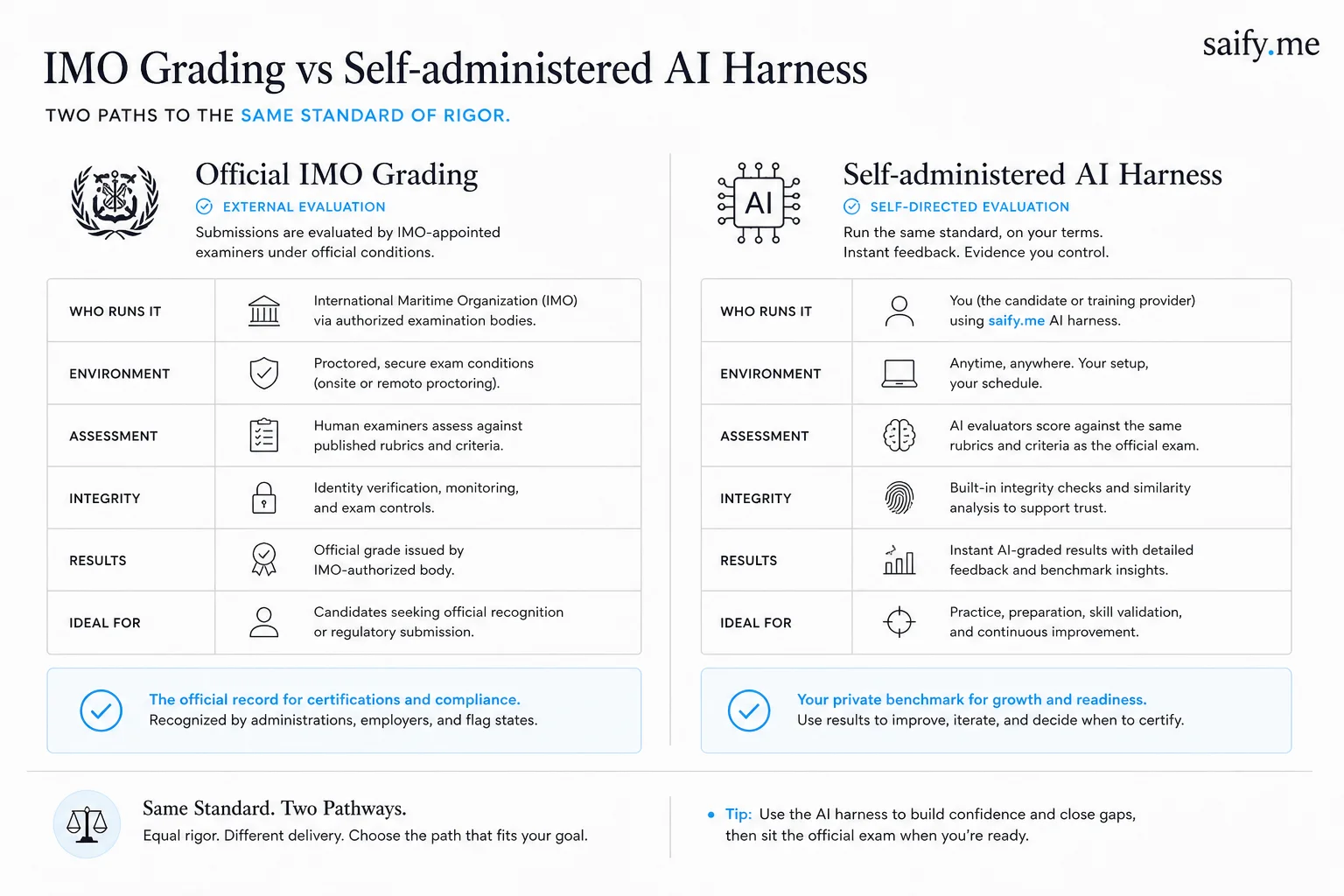
Two grading tiers (read this before you retweet)
There were actually two events, not one.
| Tier | Who graded | Models at 42/42 | What it proves |
|---|---|---|---|
| Official IMO process | IMO organizers, human-supervised conditions | Huawei Celia, Xiaohongshu dots-note-3.0 | First flawless scores under the competition's own rules |
| Self-administered harness | Claude-based agent graders (Deedy Das repo) | Claude Fable 5, GPT-5.6 Sol, Kimi K3, AxiomProver | Strong capability signal, not an IMO medal |
Deedy Das's imo-2026 repo is explicit: treat self-graded scores as strong but not authoritative. Digital Applied's breakdown makes the same distinction. Both results matter. They are not equivalent claims.
If you are picking a model for production math, do not stop at "42/42." Ask who graded, whether repair rounds were allowed, and whether the output is natural language or machine-verified.
What the public runs actually looked like
Das ran each model through a minimal agent harness with no web search, no leaked answers, and cutoffs before the competition dates. The problems were brand new IMO 2026 items.
| Model | Graded score | Time | Cost | Notes |
|---|---|---|---|---|
| Claude Fable 5 (high effort) | 42/42 | ~2.5 h | ~$51 | Fastest perfect run; synthetic P2 geometry proof |
| GPT-5.6 Sol (xhigh effort) | 42/42 | ~3.8 h | ~$21 | Cheapest perfect run after one repair round |
| Kimi K3 | 42/42 | ~17.4 h | ~$31 | Multiple repair rounds; original P6 compactness argument |
| AxiomProver | 42/42 (Lean verified) | ~25 h working time | Not stated | ~8,000 lines of Lean 4 across six problems |
P3 and P6 were the hardest by attempts and token volume. Students had nine hours total across six problems. Fable and Sol finished under four hours.
That gap is the story for builders: frontier models are no longer separated by whether they can solve IMO-style problems. They are separated by how much time and money you burn getting there.
Effort settings swing scores more than model swaps
The same repo shows how fragile headline numbers can be. GPT-5.6 Sol at default effort scored 28/42. At max effort it hit 30/42. At xhigh with repair it reached 42/42.
That is an 11-point swing from configuration alone on one model family. Benchmark saturation does not mean models are interchangeable. It means the benchmark stopped being a clean ruler.
When I advise teams on model routing, this is why I push task-specific evals over leaderboard chasing. Your CRM summarization task is not IMO geometry. Even your "hard reasoning" pipeline might care more about p95 latency than peak score.
AxiomProver and the Lean proof stack
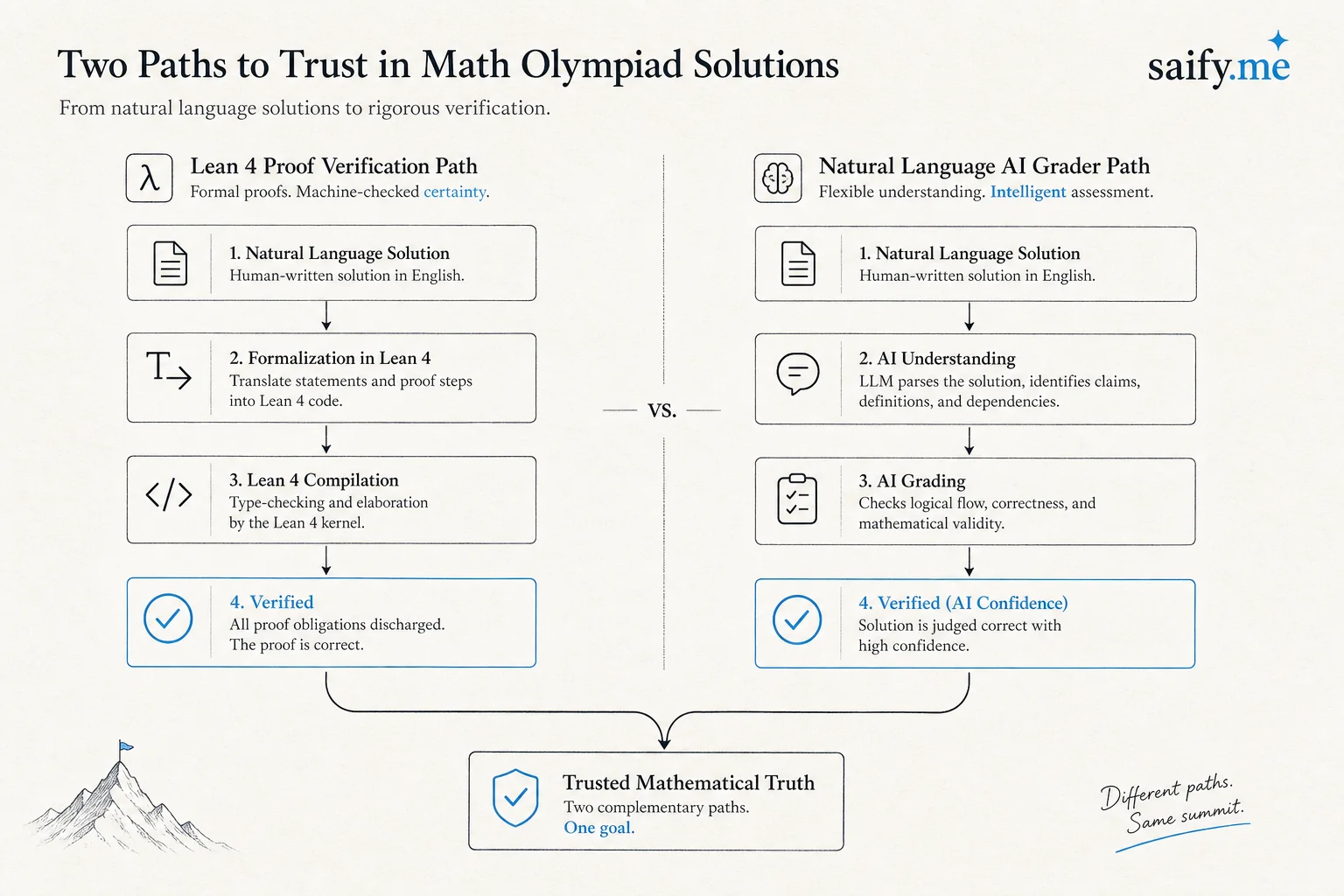
Axiom Math's IMO2026 repository publishes formal Lean 4 statements and verified proofs for all six problems. Q3 alone is 4,229 lines and took about 869 minutes of prover time.
That is a different product category from "model writes a plausible proof paragraph." Lean checks every step. If you need auditability (finance, safety-critical systems, regulated workflows), this matters more than a perfect score from an AI grader.
For most business automation? Natural-language reasoning at $21/run is plenty. For anything that needs a certificate? Lean verification is the only public run that gives you one.
What I would do with this as a builder
Stop using IMO as a buying guide. It is a capability ceiling test, not a workload match. Three models hit 42/42 with wildly different time and cost profiles.
Build a Real Benchmarks folder for your domain. Pick 20 tasks from your actual backlog. Measure pass rate, cost, and time. Re-run when providers change effort tiers.
Treat "perfect" scores skeptically until you read the grading appendix. Official IMO results and self-graded harness results should never be merged into one chart without a label.
Watch formal verification as a product lane. Axiom's approach will not replace chat agents tomorrow. It will eat share in workflows where "probably correct" is not enough.
The math ceiling for frontier LLMs at IMO difficulty is effectively gone for self-graded harnesses, and officially cracked for two models under human-supervised IMO conditions. The next question is not "can AI do math?" It is "how much proof, time, and money does your use case require?"
If you are routing models for agentic workflows and want a second pair of eyes on eval design, book a free discovery call.