
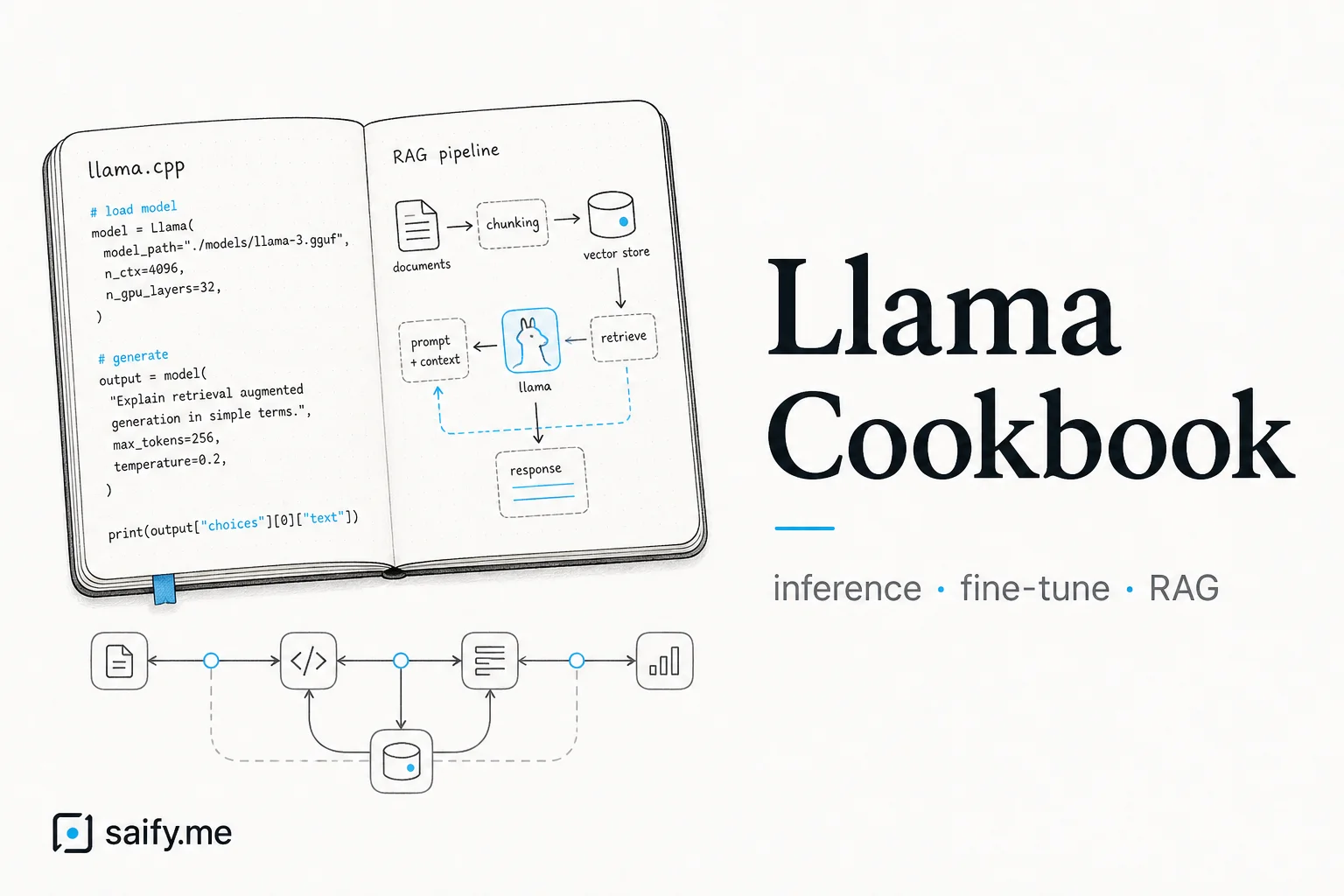
Meta did not launch a new model in this beat. They shipped something more useful for day-to-day builders: a reorganized Llama Cookbook, the official playbook for inference, fine-tuning, and RAG on open Llama weights.
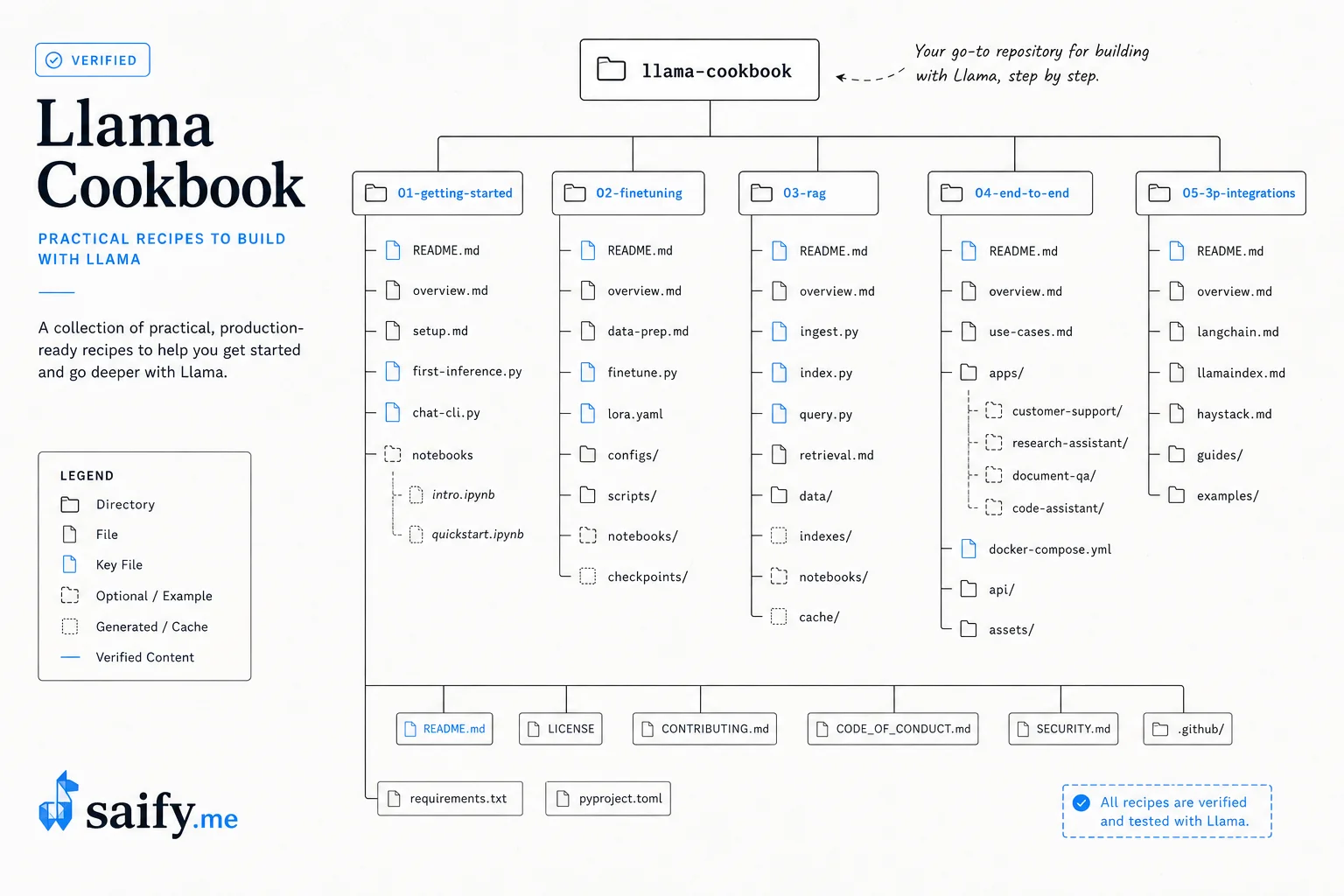
If you have ever cloned llama-recipes, updated your bookmarks. Meta renamed the repo to meta-llama/llama-cookbook and expanded the recipe set for Llama 4 Scout and Maverick workflows. For applied AI teams, this is the difference between "we could fine-tune" and "here is the notebook we actually ran."
What changed from llama-recipes
The FAQ in the repo is blunt: llama-recipes is now llama-cookbook. Same MIT license, same maintainer lane, cleaner structure.
| Folder | What you get |
|---|---|
getting-started/inference | Baseline generation patterns |
getting-started/finetuning | LoRA / PEFT and full fine-tune scripts |
getting-started/ (RAG notebooks) | Retrieval-augmented setups |
end-to-end-use-cases | Domain recipes (docs, SQL, multimodal) |
3p-integrations | Provider-specific deployment paths |
src/llama_cookbook | Python package backing the CLI fine-tune module |
Latest highlighted recipes include 5M-token long context with Llama 4 Scout, research-paper analysis with Maverick, and WhatsApp integration via Llama API.
The fine-tune path I would run first
For client MVPs, I almost always start with 8-bit LoRA, not full fine-tunes. Cookbook ships the canonical CLI:
python -m llama_cookbook.finetuning \
  --use_peft \
  --peft_method lora \
  --quantization 8bit \
  --model_name /path/to/model \
  --output_dir /path/to/save
That command lives in the repo README and maps to the src/llama_cookbook package. Pair it with a small, labeled dataset exported from your CRM tickets, support macros, or product docs. Train for one epoch, eval on a held-out set, ship behind a feature flag.
Common mistakes I see:
- Training on raw exports with PII. Redact before you tokenize.
- Skipping eval splits. Loss going down does not mean tone or format improved.
- Full fine-tune on day one. LoRA gets you 80% of the win at 20% of the ops pain.
The getting-started/finetuning notebooks are the fastest onboarding path if your team lives in Jupyter more than bash.
RAG and end-to-end recipes worth cloning
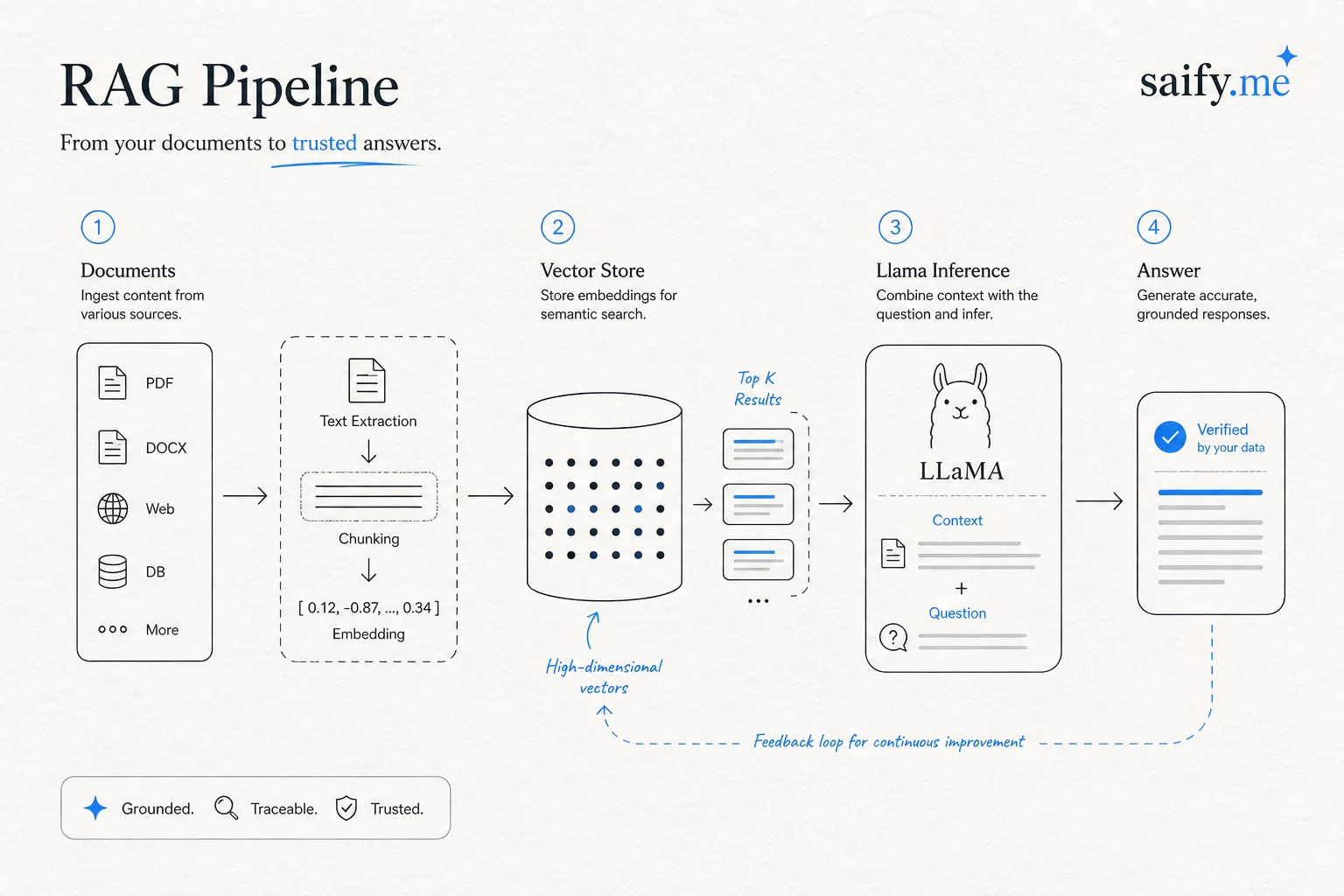
Cookbook's RAG section is not novel architecture. It is boring, reproducible wiring, which is what you want before you invent a custom retriever.
Start with one end-to-end notebook that mirrors your domain:
- Document Q&A if you are indexing PDFs or Notion exports
- SQL generation if operators live in spreadsheets today
- Multimodal if photos or scans matter (vision Llama recipes)
Meta also surfaces companion tools on developer.meta.com: Prompt Ops for migrating prompts to Llama models, Synthetic Data CLI for augmentation, and DocumentLens for multimodal extraction.
I treat Cookbook as scaffold code, not production architecture. You still need auth, observability, and a real vector store. The notebooks get you to a demo that survives a stakeholder meeting.
Cookbook versus Llama API (quick decision table)
| Question | Lean Cookbook | Lean Llama API / provider |
|---|---|---|
| Need custom weights on your VPC? | Yes | No |
| Demo due Friday? | Maybe slow | Yes |
| Fine-tune on proprietary tone? | Yes | Limited |
| Want Meta to host scaling? | No | Yes |
For lead-gen sites and voice ops work, I often start hosted, then move fine-tuned open weights once volume justifies GPU rent. Cookbook is the bridge for that second phase.
How I would onboard a team in one week
Day 1–2: Run inference notebook on your smallest Llama checkpoint. Confirm latency on your hardware or chosen provider.
Day 3–4: Fine-tune LoRA on 500–2,000 curated examples. Measure format compliance, not just perplexity.
Day 5: Wire RAG on the same corpus. Compare fine-tune-only vs RAG-only vs both.
Day 6–7: Pick one end-to-end use case notebook and replace sample data with your exports.
That rhythm beats reading release blogs. Meta gave you the scripts. The value is in your data and eval harness, not the star count (18k+ and climbing).
Llama Cookbook is the official shortcut from open weights to something you can show a client. If you want help scoping a fine-tune or RAG MVP on Llama without overbuilding day one, get in touch.