
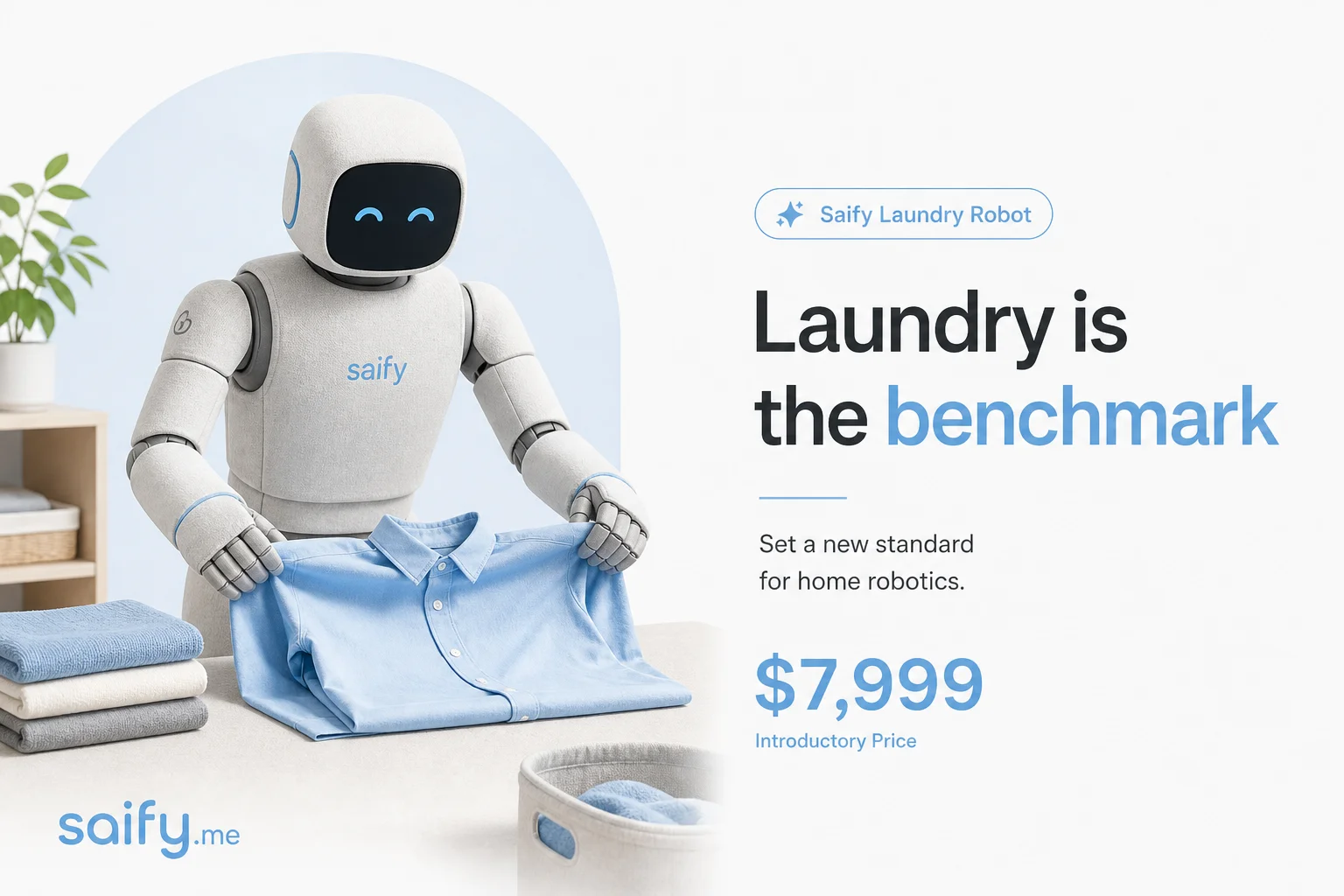
Every home robot roadmap eventually lands on the same chore: laundry.
In August 2026, Business Insider catalogued how Figure AI, Sunday Robotics, Weave Robotics, and even LG's CLOiD put clothes folding on stage. The pitch is intuitive. If a robot can handle a wrinkled hoodie on your couch, maybe it can handle the rest of the house.
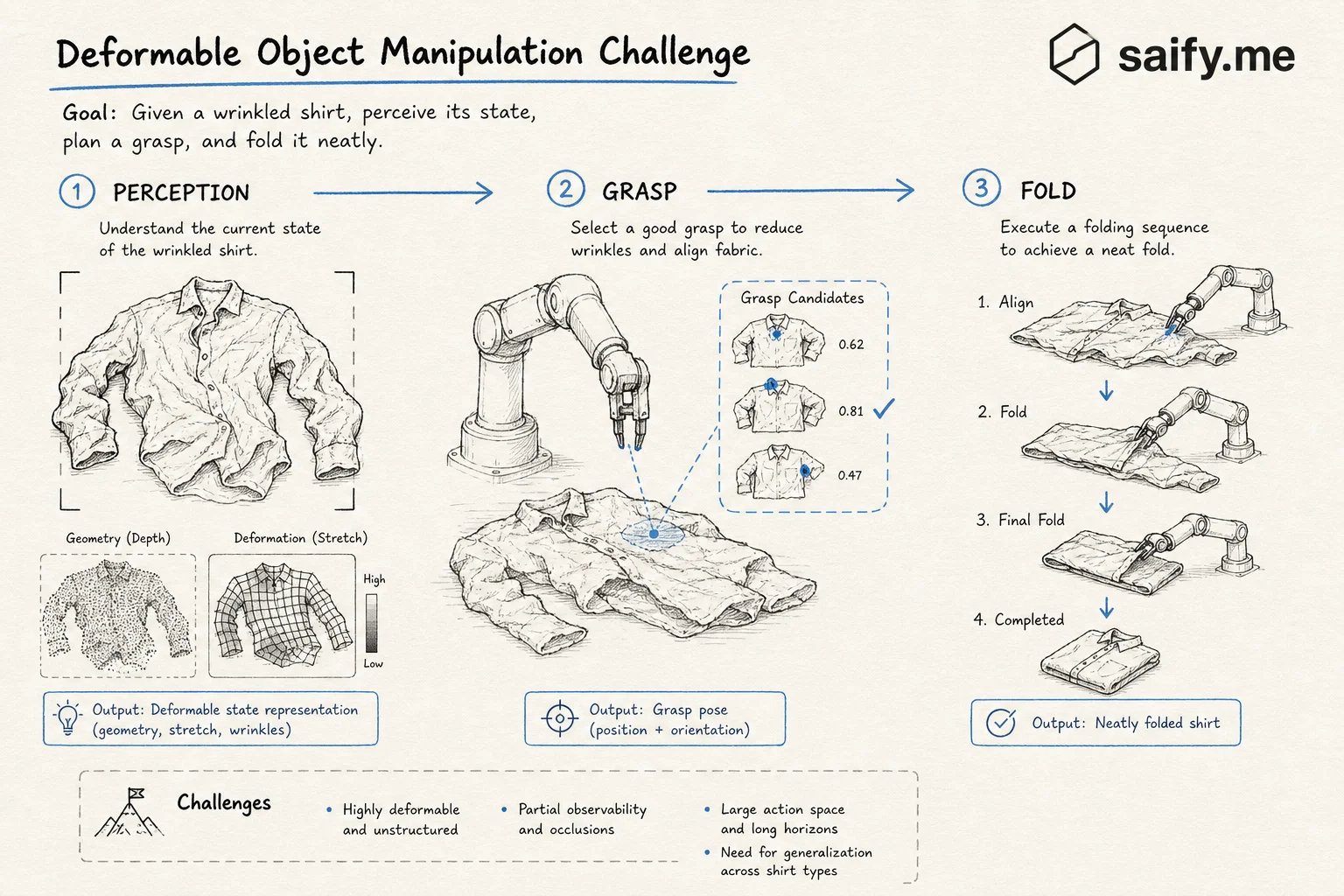
The harder truth is that laundry is a benchmark, not a product category. It stress-tests perception, grasping, and planning on objects that refuse to stay rigid.
Why deformable objects are the boss fight
Industrial arms excel at repeatable picks: same bolt, same tray, same weld path. Laundry violates every assumption:
| Challenge | Why it hurts |
|---|---|
| Variable geometry | No two folds share the same state |
| Texture and friction | Cotton, wool, and synthetics behave differently |
| Occlusion | Shirts hide sleeves; hampers hide everything |
| Context | Your bedroom lighting is not the lab |
Academic work on deformable manipulation has run for years. What changed in 2026 is shipping pressure. Investors want a consumer wedge, and laundry is relatable in a way warehouse pallet moves are not.
The players and what they actually promise
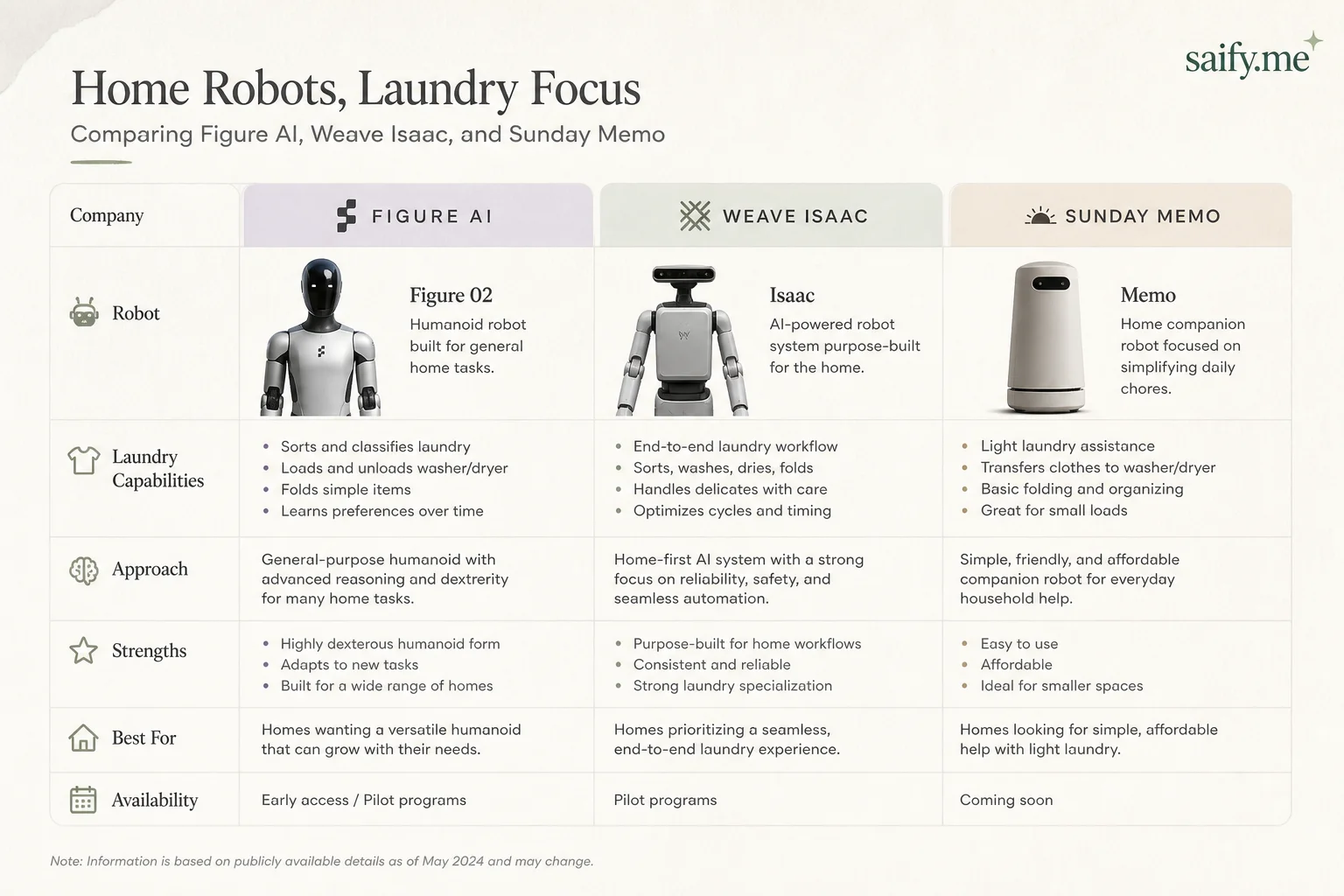
Weave Robotics Isaac 1
Weave's Isaac 1 is the most concrete offer right now. It is a mobile home robot with:
- Laundry Flow: find dirty clothes, handle hampers, fold, put away
- Daily Reset: beds, pillows, clutter back to place
- Pricing: $7,999 upfront or $449/month
- Ship window: California first, fall 2026
Weave is explicit that Isaac runs autonomously by default with teleoperation assistance when needed to guarantee task completion. That line matters. It means the demo you saw might include a human behind the cameras finishing the hard fold.
The company evolved quickly. Isaac 0 was a stationary folder. Isaac 1 adds mobility, a telescoping torso (roughly 3 ft to 5 ft 9 in), and room tidying. Same price band, more scope. That pace tells you how fast hardware iteration is moving, and how thin margins are.
Figure AI, Sunday Robotics, LG
Figure AI and Sunday Robotics have shown laundry and dish tasks in public demos. Sunday has talked about a home beta for its Memo humanoid in fall 2026. LG brought CLOiD to CES with similar folding theater.
None of these are commodity appliances yet. They are capability advertisements for investors and early adopters willing to tolerate imperfection.
Training pipelines still look like AI, not magic
Behind the soft fabric shells is a familiar 2026 stack:
- Human demonstration data, often first-person video of people doing chores
- Teleoperation for hard states the policy has not seen
- Simulation plus real-world fine-tuning on specific garment classes
- Over-the-air updates that expand capability after purchase
Weave's commercial fleet reportedly folded thousands of pounds of laundry monthly in partner locations before pushing into homes. That is the right order: commercial laundries are less forgiving than labs, more forgiving than teenagers' bedrooms.
If you have built RAG or agent systems, the pattern should feel familiar. Collect messy real-world traces, label the failures, patch with human review, ship a narrower v1 than the keynote implied.
What the demos do not show
Business Insider's Rundown coverage nailed the gap between stage and living room:
- Curated garment types and lighting
- Controlled hampers and table heights
- Remote operators for edge cases
- Marketing timelines that say "30 to 90 minutes per load" without showing every interruption
I am not saying the robots are fake. I am saying buyers should price in scaffolding. A $7,999 robot that needs occasional teleop is a different value proposition than a dishwasher.
Privacy is the other under-discussed line item. Home robots use cameras, Wi-Fi, and sometimes remote assistance. Bedrooms and bathrooms are not warehouse floors. Clear data retention and teleop policies should be part of the purchase checklist.
Why laundry still matters strategically
Even with caveats, laundry is a useful filter:
- Generalization signal: success on unseen shirts beats another pick-and-place reel
- Consumer storytelling: everyone understands the pain point
- Data flywheel: every home generates unique mess distributions
For applied AI engineers, the lesson is not "buy Isaac 1." It is that physical AI products need explicit failure budgets. Voice agents fail on accents. Laundry bots fail on fitted sheets. Plan for human takeover paths the way you plan for LLM fallbacks.
Xiaomi's open VLA work showed strong laundry-loading numbers in controlled benchmarks, but factory and home are different customers. The startups chasing U.S. living rooms have to survive unstructured clutter, pets, and kids. That is harder than a 80% success rate slide.
What I would ask before spending $8K
If a client asked me whether to preorder a laundry robot, I would run this checklist:
| Question | Why it matters |
|---|---|
| What fraction of tasks finish without teleop? | Defines real autonomy |
| Who can access the camera feed? | Privacy and trust |
| What garments are out of scope? | Sets expectations |
| How do updates change liability? | OTA moves behavior |
| What is the service model when it jams? | Hardware needs ops |
The bottom line
Laundry is the right benchmark and the wrong easy sell. Folding a shirt is physics, perception, and planning in one messy package. The companies putting it on stage are showing where home robotics is headed, not where it arrived.
If you are designing physical AI products or automation roadmaps and want help separating keynote demos from deployable systems, book a free call. I map what actually ships in ops, not just what trends on robotics Twitter.