
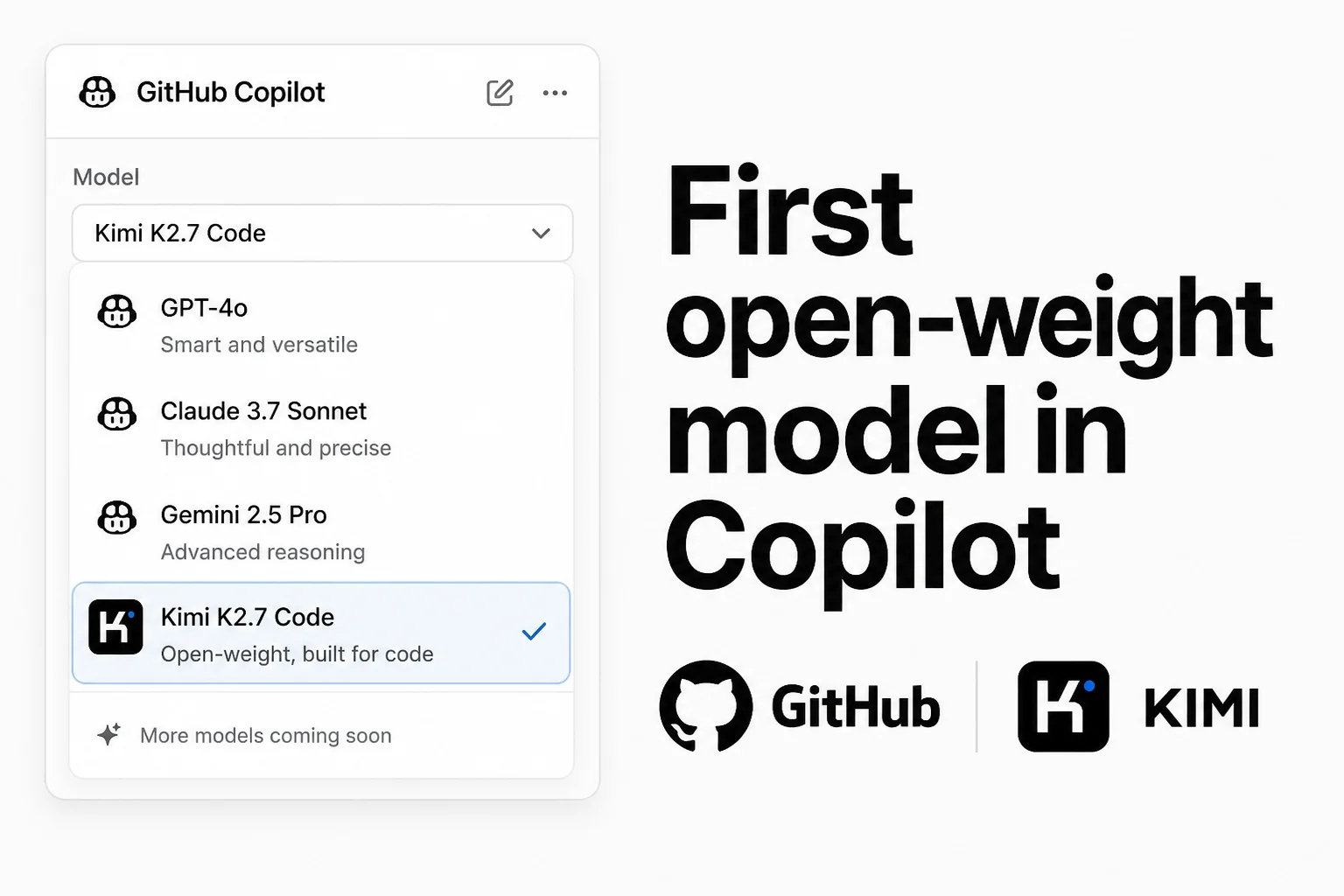
On July 1, 2026, GitHub Copilot did something it had never done before: it added an open-weight model to the picker.
Kimi K2.7 Code from Moonshot AI is now generally available for Pro, Pro+, and Max subscribers, with Business and Enterprise access following on July 7. The weights were already public on Hugging Face. What changed is that the world's default coding assistant now treats open weights as a first-class option, not a side quest you run on your own GPU.
I route agent loops for clients who care about margin. This is the kind of release I actually re-read the changelog for.
What Kimi K2.7 Code is
Kimi K2.7 Code is Moonshot's coding-focused agentic model. The architecture is a 1T-parameter MoE with 32B active parameters per token, 256K context, and a dedicated vision encoder (MoonViT) for multimodal workloads.
Moonshot's product page positions it for long-horizon software engineering: fewer thinking tokens than K2.6 (about 30% reduction in their internal numbers) and stronger end-to-end task completion on repo-scale work.
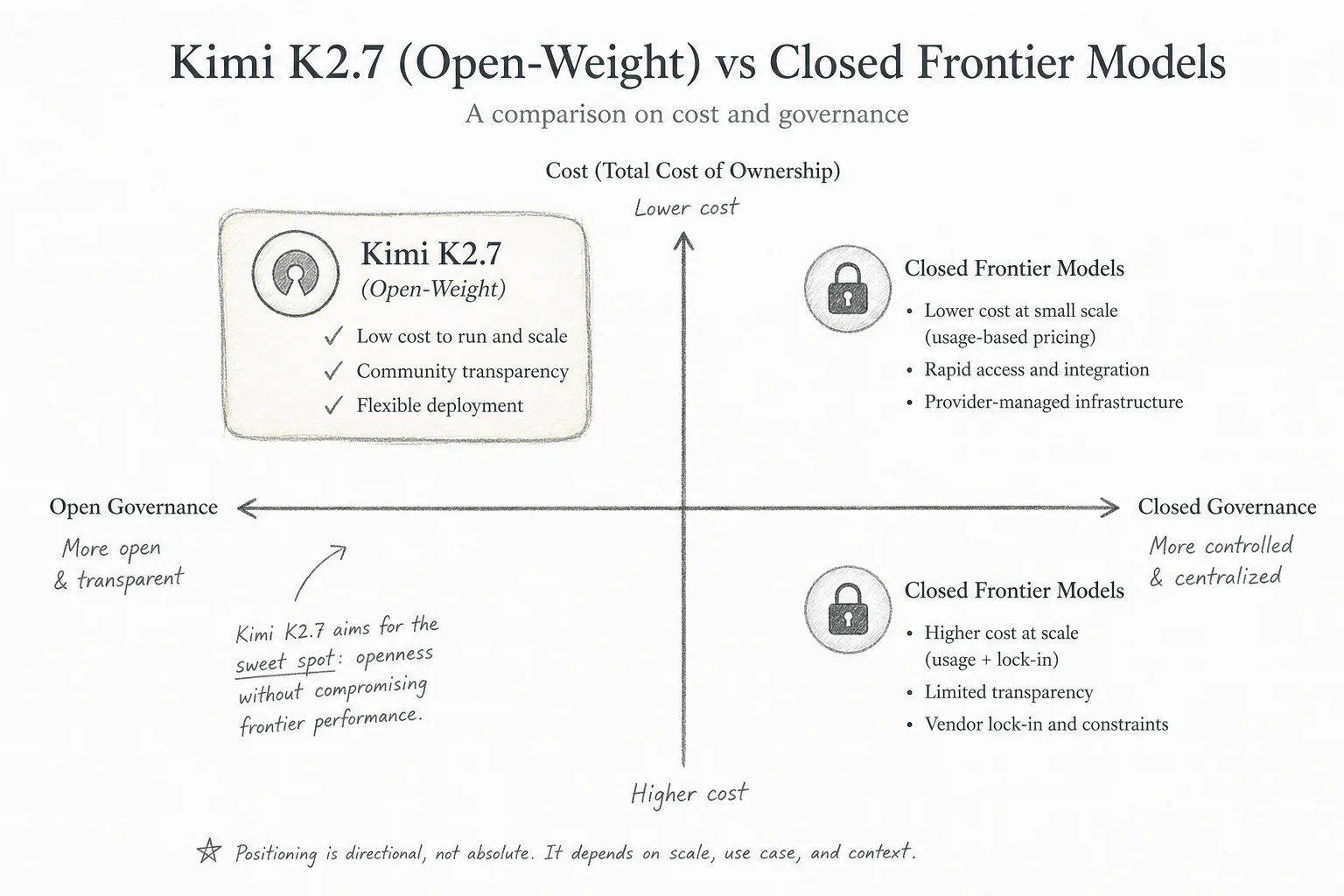
The open-weight part matters for governance conversations, not just hobbyists:
| Property | Kimi K2.7 in Copilot | Typical closed Copilot models |
|---|---|---|
| Weights | Public on Hugging Face (Modified MIT) | Not inspectable |
| Hosting in Copilot | GitHub on Microsoft Azure | Same |
| Enterprise default | Off until admin enables | Usually on by default |
| Self-host option | Yes, outside Copilot | No |
You can audit what the model is. You still choose whether your org lets developers select it inside Copilot.
Why GitHub adding an open model is a legitimacy signal
Until this week, every model in Copilot's picker came from a small set of proprietary providers. That made sense operationally: one billing relationship, one SLA, one support path.
Adding Kimi breaks the closed-model streak. It took 19 days from the Hugging Face release (June 12) to GA inside Copilot (July 1). That is faster than most frontier models spend in limited preview.
The pattern I keep seeing in client calls: open-weight models are landing inside mainstream dev tools, not just on Ollama blogs. Copilot is not a niche experiment. It is the default surface for millions of developers. When open weights show up there, procurement teams have to write policies for them, not hand-wave them away.
Cost and when I would use it
GitHub bills Kimi K2.7 under usage-based pricing at provider list rates. Independent write-ups cite roughly $0.95 per million input tokens and about $4.00 per million output tokens, with an input multiplier around 95 AI credits per million tokens in Copilot's credit system.
That sits well below frontier tiers that list closer to $5/$25 or higher. For agent loops where input context dominates (file reads, tool output, long histories), that gap compounds fast.
My routing mental model after releases like this:
| Task type | Model tier | Why |
|---|---|---|
| Multi-file refactors, test scaffolding, iterative fixes | Kimi K2.7 or other mid-tier | Cost per turn stays low across hundreds of tool calls |
| Novel architecture, security review on unfamiliar stacks | Frontier (Opus, GPT-5.x class) | Wrong code is more expensive than slow code |
| Compliance-sensitive orgs | Kimi only if admin enables + security review | Open weights need explicit policy, not accidental use |
I wrote about this economics layer in agentic coding model routing and specialized models in agent loops. Kimi in Copilot is another lever on the same dashboard: cost per finished task, not leaderboard vanity.
Enterprise admins: read the default-off policy
For Business and Enterprise, Kimi K2.7 Code is off by default. Administrators must enable the policy in Copilot settings before anyone in the org can select it.
GitHub's follow-up changelog explicitly recommends reviewing open-weight models against security, compliance, and data-governance requirements before enabling.
That is the right default. Open weights are not automatically safer or riskier than closed models. They are different:
- Auditable weights and reproducible behavior outside Copilot
- A new vendor lineage (Moonshot AI) in a picker that was mostly US-lab dominated
- A policy question your security team may not have written yet
If you are an admin, treat this like adding a new SaaS integration: update the AI acceptable-use doc, name who can enable models, and log who uses Kimi in production repos.
Surfaces where Kimi shows up
GitHub lists Kimi K2.7 in the model picker across a wide set of clients:
- VS Code 1.127.0+
- Visual Studio 17.14.6+
- Copilot CLI
- Copilot cloud agent
- github.com and GitHub Mobile
- JetBrains 1.9.1-251+
- Xcode and Eclipse
Rollout is gradual. If you do not see it yet, check plan tier and org policy before assuming your install is broken.
What I would test this week
If Kimi is enabled for your account, I would run the same harness on Kimi and your current default:
- Repo-scale refactor (5 to 10 files, tests included)
- Greenfield API endpoint with validation and error handling
- Debug session from a failing CI log pasted into chat
Measure: wall time, number of tool retries, and dollar cost from Copilot's usage view. One session is anecdote. Ten comparable tasks is a routing policy.
Open-weight in Copilot does not mean "run it yourself." It means you can choose managed hosting with inspectable weights, or self-host the same checkpoint when compliance requires air-gapped inference.
The bigger picture
Kimi K2.7 in Copilot is one data point in a trend: specialized and open models are entering the same surfaces where developers already work. The Superpowers plugin wrapping Kimi into structured agent workflows (mentioned in the same news cycle) is the other half of the story. Models are commodities. Harnesses and policies are where margin and safety live.
If you are wiring agent loops for a product team and want a second pair of eyes on model routing or governance defaults, book a free discovery call.