
In June 2026 someone archived roughly 1,500 lines of the system prompt behind Claude Fable 5 on GitHub. Not a hack. Models can be nudged to recite their instructions, and researchers have been collecting those leaks for years. The interesting part is not gossip. It is product architecture: a new Mythos-class tier above Opus, persistent artifact storage, and explicit wiring for Claude Code, Cowork, and browser agents.
I read the archived prompt alongside Anthropic's shorter published core prompt. The gap between them is where the real behavior lives.
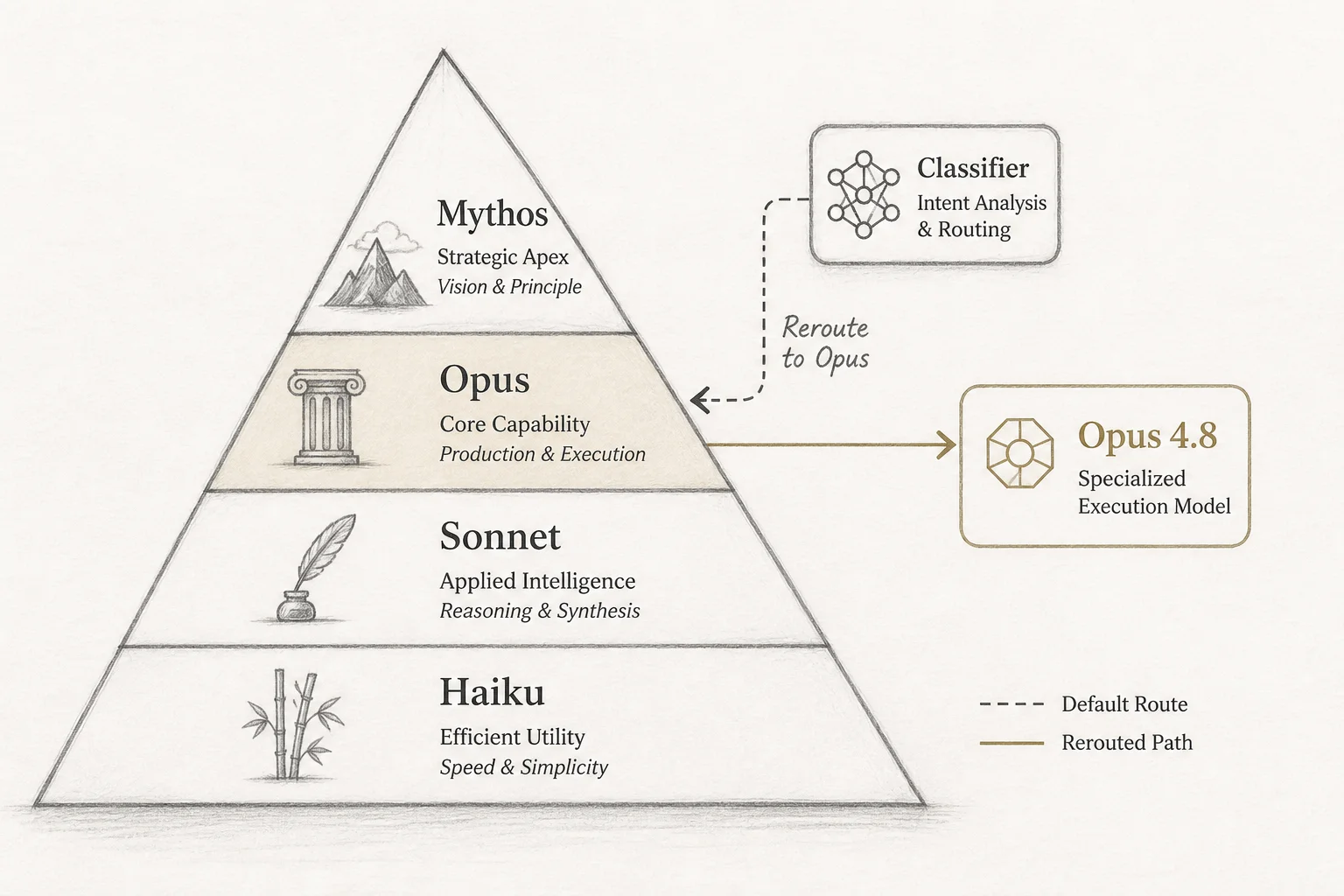
Mythos-class sits above Opus
The leaked text names Claude Fable 5 as the first public model in a Mythos-class tier that sits above Claude Opus in capability. Fable 5 launched June 9, 2026 with a 1M token context window and a knowledge cutoff at the end of January 2026.
The same weights power Claude Mythos 5, a variant Anthropic reserves for approved organizations with fewer safety guardrails. Same model, different policy envelope. That split matters if you are evaluating enterprise risk: capability and access control are not the same product.
| Model string (from leak) | Role |
|---|---|
claude-fable-5 | Default flagship in the Claude app |
claude-opus-4-8 | Still referenced for reroutes on high-risk topics |
claude-sonnet-4-6 | Workhorse inside artifacts and tools |
claude-haiku-4-5-20251001 | Fast paths where latency wins |
Anthropic also documents that classifiers can reroute sensitive sessions (cyber, bio, chem) to Opus 4.8. The leak claims under 5% of sessions hit that path. I cannot verify the percentage, but the design pattern is clear: one chat surface, multiple models behind the curtain.
Persistent artifact storage changes what you can ship
The leak describes a key-value storage API for artifacts that survives across chat sessions. Journals, leaderboards, lightweight trackers, and small dashboards can keep state without you spinning up a backend.
That is a bigger deal than it sounds on a portfolio site. Most "AI mini-apps" die when the tab closes. If the storage API is real and stable, you can prototype operational tools inside Claude: intake triage tallies, experiment logs, client onboarding checklists. Still not a production database, but a credible sandbox for workflows you might later harden in Next.js.
Artifacts can also call the Anthropic API internally (the leak references Sonnet 4 as the nested model). Recursive "Claude inside Claude" is not sci-fi anymore. It is a documented pattern in the product prompt.
Cowork, Claude Code, and the agent stack
The prompt lists Claude Cowork as a meta-agent that orchestrates Claude Code, Chrome, Excel, and PowerPoint agents. Whether you use every connector, the framing is consistent: chat is the shell, tools are the limbs.
For applied AI work, that matches what I see in client projects. The winning pattern is not "one giant prompt." It is a coordinator that picks the right specialist: repo edits via Claude Code, spreadsheet pulls via Excel agent, browser checks via Chrome. The leak confirms Anthropic is productizing that split instead of hoping one model does it all.
Claude Code documentationWhat the prompt says about tone and refusals
Leaked product prompts are part personality brief, part legal guardrail. Fable 5's file spends enormous space on:
- Refusal bright lines (weapons, illicit synthesis, malicious code, fake quotes from real people)
- Mental health and wellbeing routing
- Anti-bullet-point philosophy for certain conversational modes
- A rule to never emit
<voice_note>blocks
None of that is secret sauce. It is engineered restraint. If you build customer-facing agents, study how frontier labs phrase refusals. Users feel "robotic safety" when your policy stack fights the UX. Anthropic's leak is a free textbook chapter on balancing warmth with hard stops.
Model switching mid-conversation
Another practical detail: the model can switch versions mid-session, and prior messages from a different model version remain valid context. That explains why long Claude threads sometimes feel subtly different after an upgrade. Your history is not wiped, but the policy and capability envelope changed underneath.
For production agents you control, mirror that idea explicitly: version your system prompts, log which model served each turn, and test upgrades on copied conversations before you flip production traffic.
How to use the leak without worshiping it
Treat archived prompts as behavioral specs, not gospel.
- Read the asgeirtj system_prompts_leaks archive or community mirrors like saynchowdhury's breakdown repo
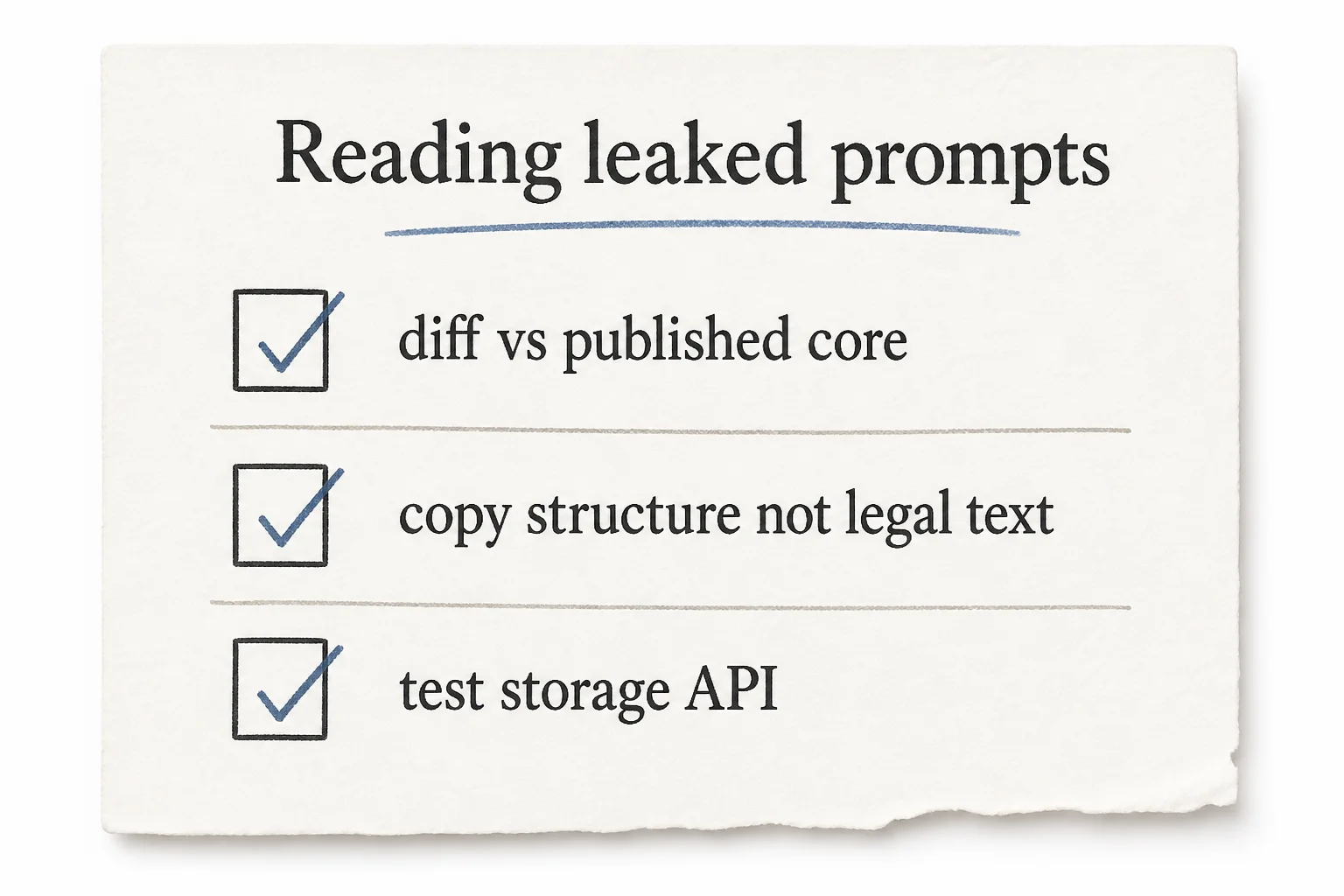
- Diff against Anthropic's published core prompt. The delta is your "app layer."
- Copy structural ideas (storage, reroutes, nested models) into your own agent designs. Do not copy Anthropic's safety text verbatim unless you have their liability budget.
What I would test this week
If you ship with Claude today, run three experiments:
- Build a two-session artifact that reads and writes KV storage. See what persists and what resets.
- Start a thread on a sensitive-but-legitimate research topic. Note whether answers shift tone or model mid-stream.
- Ask Cowork (if you have access) to split a task across Code + browser. Compare wall-clock time vs single-thread chat.
Write down failure modes. Those become your acceptance tests when Mythos-tier models show up in your API dashboard.
Bottom line
The Fable 5 leak is not about peeking at a magic spell. It is a product requirements document written in XML and lawyer English. Mythos above Opus, storage across sessions, orchestrated agents, classifier reroutes. That is the stack frontier chat products are converging on.
If you are an applied AI engineer, the actionable move is to design your client systems with the same separation: capability tiers, persistent state, specialist tools, and explicit upgrade paths.
Building multi-agent workflows for a business that cannot afford guesswork? Book a free discovery call and we can map what to prototype in Claude vs what needs your own infra.